Category Archives: Climate Change

Historical CAT Insured Losses – an update.

I was recently doing some research on the specialty insurance sector again, a topic I posted regularly on in the past. I googled historical insured catastrophe losses and a response from Google’s AI model Gemini included an old exhibit I had posted on this blog in 2013. I am in two minds about the result, chuffed that something I posted 12 years ago is still being used but perplexed why an exhibit that was so out of date would be relevant! A subject for another day…..

Anyway, the below exhibit updates the inflated insured catastrophe losses from 1990 to 2024 (with Swiss Re’s estimate for 2025). The trend is clearly upwards with the new 10-year average at $130 billion and the 5-year average at $140 billion. This is a significant change from the $60 billion 10 year average in the 2013 post!
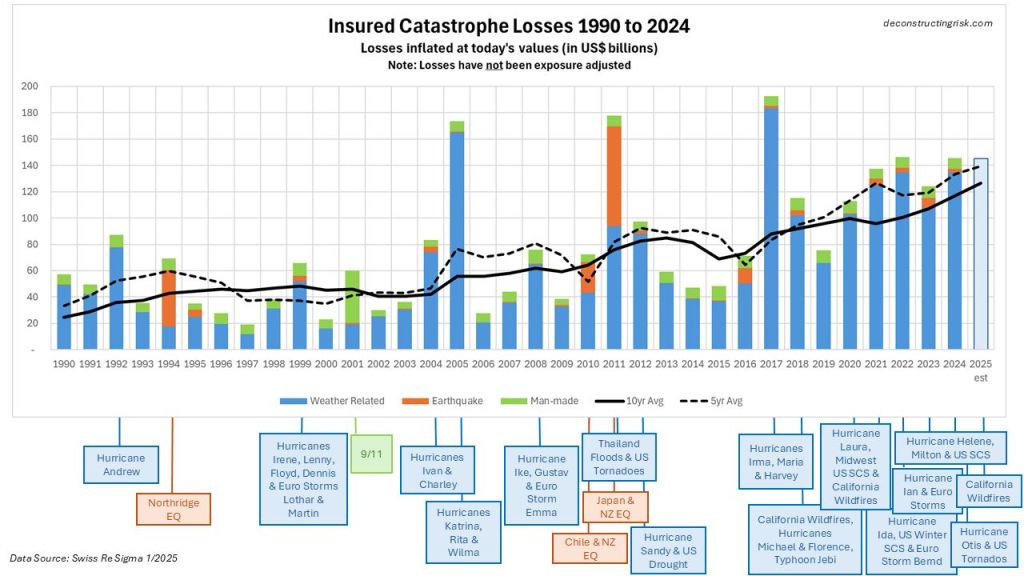
As I have highlighted many times previously here, inflated losses (i.e. bringing historical costs into today’s value) are not a true indicator of current risks as the historical losses need to be exposure adjusted (i.e. historical events run through models with today’s exposure date).

An excellent recent example of this is from a recent paper by Karen Clark & Co called “The $100 Billion Hurricane” which runs each historical US hurricane through 2025 exposures, as below.
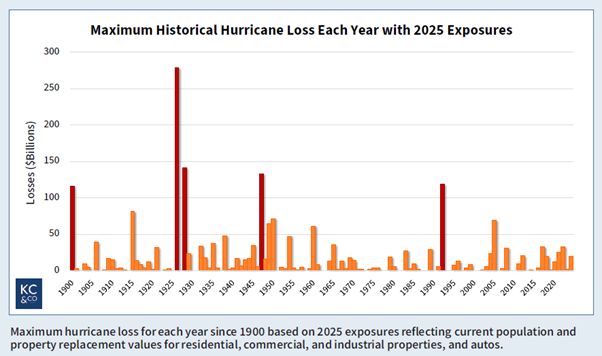
The paper concludes that “there is no significant upward trend in hurricane losses, and the US has been lucky over the past few decades”.

Two different angles of looking at historical data albeit that it’s undeniable that catastrophe losses, both by economic and insured value, in aggregate each year are only going in one direction.

Let’s hope the remainder of the 2025 US hurricane season doesn’t show us that the single $100 billion hurricane loss was overdue!
​​​​

Probable Futures

I can’t fathom that my last post was in January. Where does time go? Throughout this year, I have drafted several posts, worked on models and exhibits, but never finished anything to publish. Either I got distracted, the relevance of the point passed, I read something that made the point more elegantly than me, or I simply forgot. I seem to have got out of the habit of posting, focusing on other things, which is fine but something I’d like to get back to in 2022.

Anyway, the reason for this post is that as we approach the end of the year, I wanted to share a webinar and a website that I have found particularly insightful and useful this year. As the threat from COVID seemed to be abating, prior to the new Omicron strain emerging (which itself will hopefully pass), and the fall from grace of populist tendencies (the increasing nakedness of emperors like Boris and the Brexiteers’ fantasies becoming all too apparent), attention for a brief period this year was focused on the real issue of our time – climate change. Like me, I am sure you have also attended many webinars this year on a range of topics. It is such a pleasure to dip in and out of events that previously would have required time-out travelling to be only disappointed by some blatant marketing presentation posing as an expert session on a topic of the day! Well, my webinar of the year goes to a chap called Spencer Glendon who presented at a Milliman’s climate change conference. The session below is a follow-up to the main conference, but I found Spencer particularly insightful here. I would highly recommend that you spend the hour listening to this guy.

https://players.brightcove.net/5716634434001/YaL1J8g8di_default/index.html?videoId=6274631972001

I would also recommend the non-profit website that he founded; it’s called https://probablefutures.org/. The blurb on the site is that it “offers interactive maps of future climate scenarios using widely accepted climate models, along with stories and explanations designed to help you understand our changing world.” I have found it useful in my work but also thought provoking as we all grapple with what our new shared future will be.

Risks feel more real

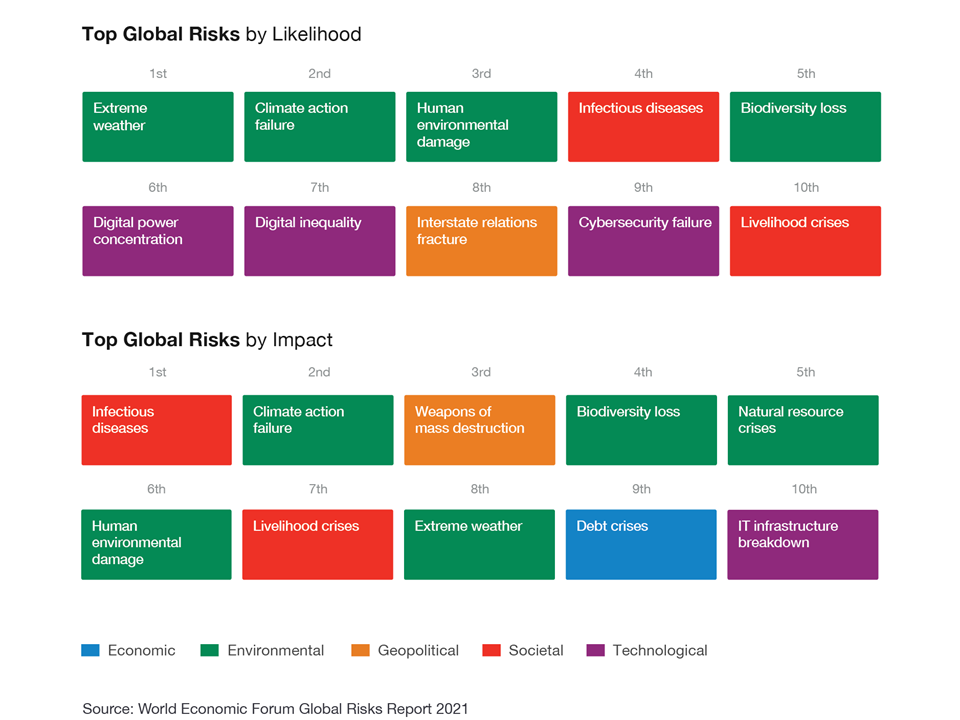
This week kicks off the World Economic Forum (WEF). The great and the good will not be flying in from all around the globe, as many did previously on their private jets, to pontificate on the world’s problems as this year the event is virtual. The situation seems apposite given the mess we are in and the prevalence of environmental risks highlighted in the Global Risks report that precedes each meeting, as shown in the list below.

Infectious diseases have made an obvious come-back onto the list after an absence of 10 odd years. To be fair, nobody foresaw the likelihood or impact of the Covid-19 pandemic and identifying global risk are inherently uncertain. One article that caught my attention on the WEF website was on the link between climate change and pandemics. I did see a TV report earlier this year that highlighted how land development in China was encroaching upon the natural habitat of wildlife resulting in more contact between humans and animals that could be an explanation for the initial Chinese outbreak, if indeed that is where Covid-19 first began (just to ensure I do not sound like the orange vainglorious one!). But that report didn’t stick in my mind. Until now.

As the WEF article highlights, the World Health Organization (WHO) has stated there is no evidence of a direct link between climate change and Covid-19. However, they acknowledge that changes in living environments of the animals on Earth caused by climate change may impact infectious diseases.  Dr. Anthony Fauci co-authored a paper in September that stated “the COVID-19 pandemic is yet another reminder, added to the rapidly growing archive of historical reminders, that in a human-dominated world, in which our human activities represent aggressive, damaging, and unbalanced interactions with nature, we will increasingly provoke new disease emergences.

Although not a journal noted for its medical or scientific expertise, this article in December from Rolling Stone on the topic frightened the hell out of me. Just another happy thought to add to expanding list these days! If I had read an article like this a year or older ago, I would likely not have given it as much thought as I do now. And that is a reflection on what the last year has done. Lists of risks such as those in the WEF Global Risks report seem a lot more real today.

Hot Trends

This is scary…

Net Zero Fantasy

As we enter a week where further market turmoil is likely against a background of further tensions between the US and China over the Huawei arrest, the climax of the Brexit debacle, and the yellow vest protests in France. All these issues can and will be resolved eventually but they pale in comparison to the political inaction over the latest climate change reports.

The US government, in the form of the United States Global Change Research Program (USGCRP), in a report in November concluded that “the evidence of human-caused climate change is overwhelming and continues to strengthen, that the impacts of climate change are intensifying across the country, and that climate-related threats to Americans’ physical, social, and economic well-being are rising” and warned that “these impacts are projected to intensify—but how much they intensify will depend on actions taken to reduce global greenhouse gas emis­sions and to adapt to the risks from climate change now and in the coming decades”. Of course, the Orange One again demonstrated his supreme myopic attitude with the dismissal “I don’t believe it”.

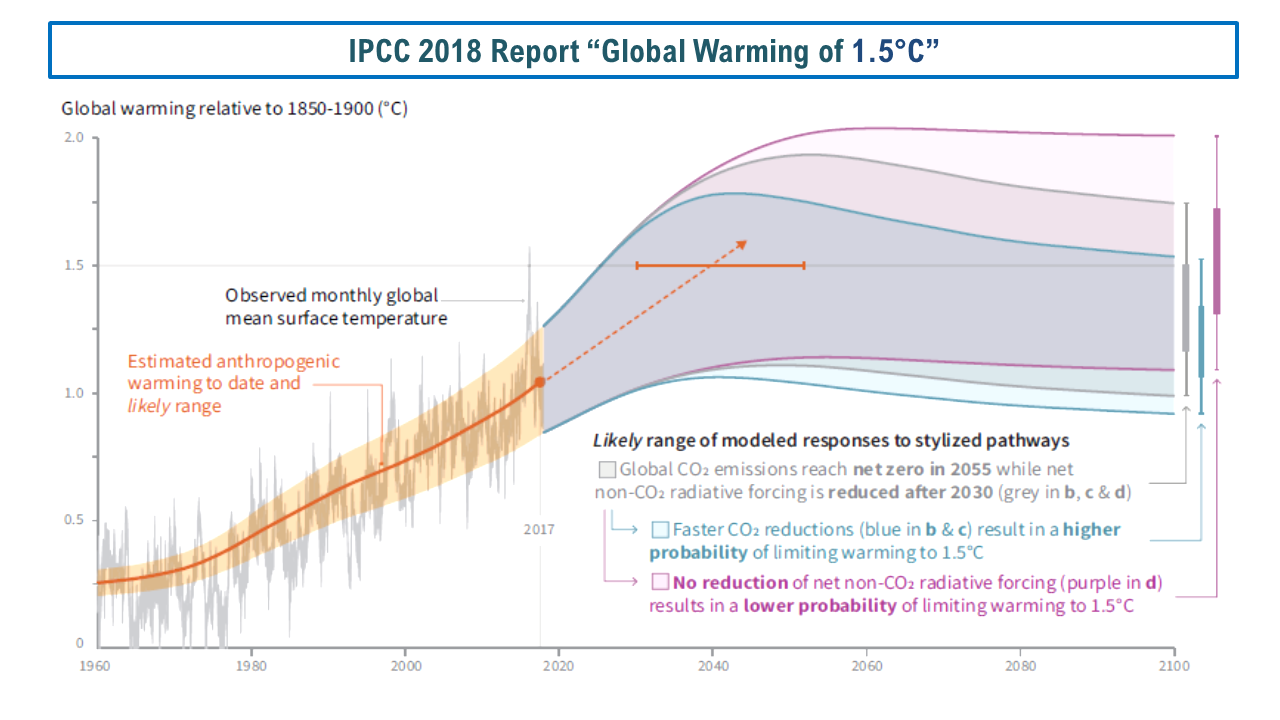
We now have the black comedy of oil producing states such as the US, Russia and Saudi Arabia arguing over whether to “welcome” or just “note” the latest IPCC report this week at the UN climate talks, known as COP24. The IPCC report on the impacts of a temperature rise of 1.5°C was launched last October and is a sobering read. The IPCC again states with a high level of confidence that “human activities are estimated to have caused approximately 1.0°C of global warming above pre-industrial levels, with a likely range of 0.8°C to 1.2°C” and that “global warming is likely to reach 1.5°C between 2030 and 2052 if it continues to increase at the current rate”.

click to enlarge

In order to avoid warming above 1.5°C, the world needs “global net anthropogenic CO2 emissions decline by about 45% from 2010 levels by 2030 (40–60% interquartile range), reaching net zero around 2050 (2045–2055 interquartile range)”. For limiting global warming to below 2°C, emissions need to “decline by about 25% by 2030 in most pathways (10–30% interquartile range) and reach net zero around 2070 (2065–2080 interquartile range)”.

Let’s face it, given the current political leadership across the globe, such declines are just fantasy. And I find that really depressing. The plea of David Attenborough at COP24 last week for leaders in the world to lead looks set to fall on deaf ears. Attenborough worryingly stated that “the continuation of our civilisations and the natural world upon which we depend, is in your hands (i.e. our leaders)”.

We’re pretty much toast then….