
Category Archives: General

Image

RIP David Bowie

Bowie quote quicksand

Precarity or fecundity?

The title of this post suggests some apposite thoughts on the world but, as will become obvious later, this post is far from that. 2015 has been a good year for me professionally, if very busy at times. Investment wise, it’s been a “so what” year with valuations roughly where they were 12 months ago, although the strong dollar and pound have helped a slightly down year in local currencies for some fund positions. Markets enter 2016 in a state of uncertainty. Still, I can’t complain even though an early retirement due to my investing genius is as implausible as ever!

I did not get as much time as I had hoped this year for blogging with an average of just below 3 posts per month compared to 5 in 2014. Besides work, I did manage to spend some time this year reading a few books (I posted on Wolf’s book here and Mason’s book here). In fact, I am currently enjoying reacquainting myself with many of the words of wisdom of Charlie Munger in Tren Griffin’s book “Charlie Munger: The Complete Investor”. Munger’s views on continuous learning and being worldly wise can never be said often enough. This time around, Munger’s words on needing to test one’s thought process against multiple models to avoid torturing truth into a perceived reality have helped me in a number of cases recently. It has a Monty Pyton feel to it, but the internet is full of examples of the multiple models Munger may be referring to, although he rightly declines to give us the handbook for wisdom (now there’s a best seller!). This article from Griffin is one example.

Another pearl from the Sage is on what a waste of energy envy is. Munger says that “envy is a really stupid sin because it’s the only one you could never possibly have any fun at”. Now, that’s a motto for 2016!

Another book that I am hoping to read over the holidays is “Superforecasting” by Philip Tetlock and Dan Gardner which has been getting rave reviews. Tetlock’s previous work, such as that on foxes (know a little about a lot) and hedgehogs (know a lot about very little), has always been engaging.

One of my reading habits is to note down words which I am unsure of and then try and use them in the future. That explains the title of this post! A list of some of these words is below (and I may just spend my free time over the next few weeks trying to come up with some clever sentences to use them in for posts next year!!!).

  • Apposite: apt in the circumstances or in relation to something.
  • Sundered: split apart.
  • Vainglorious: vain, excessively boastful, swelled pride.
  • Progeny: a descendant or the descendants of a person, animal, or plant.
  • Insuperable: impossible to overcome.
  • Insouciant: showing a casual lack of concern.
  • Fecund: producing or capable of producing an abundance of offspring or new growth.
  • Hysteresis: the phenomenon in which the value of a physical property lags behind changes in the effect causing it.
  • Dissonance: lack of agreement or harmony between people or things.
  • Propitious: giving or indicating a good chance of success.
  • Strictures: a restriction on a person or activity.
  • Parsimonious: very unwilling to spend money or use resources.
  • Higgling: to bargain in a petty way.
  • Sublation: assimilate a smaller entity into a larger one.
  • Impermanence: not permanent or enduring; transitory.
  • Precarity: a condition of existence without predictability or security, affecting material and/or psychological welfare.
  • Dialectial: relating to the logical discussion of ideas and opinions; concerned with or acting through opposing forces.
  • Confected: make (something elaborate or dainty) from various elements.

I did warn at the beginning of this post on its content…..

I really just wanted to wish all readers a great holiday and to thank you for your time and support this year.

Happy Christmas.

Inhibiting Derivatives

The array and complexity of new financial regulation in response to the financial crisis can have unforeseen impacts. A reduction in the liquidity of the bond markets today compared to before the crisis is commonly explained as a result of increased regulation of the banking sector.

A report by International Organization of Securities Commissions (IOSCO) in 2013 highlighted the impact of the regulatory push, following a G20 direction in 2009, for the OTC derivatives markets to be cleared through central counterparties (CCPs), thereby creating a potential for systemic counterparty risk (as per this post). The idea was to provide a centralised clearing point per asset class with the goal of increasing transparency and providing regulators with consistent data across borders to monitor.

The reality today is somewhat different that the theory. Many competing repositories have sprung up with the commercial intend of leveraging the valuable data. David Wright, the Secretary General of IOSCO, recently stated “we’ve got 25 of these beasts today and they don’t talk to each other, so a basic fundamental trawl of transparency is actually missing”. Regulators are stressing the need for further reform so that data can be aggregated to improve monitoring and, in February, issued requirements on CCPs to disclose information on topics such as the size of their credit risk, liquidity risk, collateral, margins, business risk, custody, and investment risks

Benoît Cœuré, a member of the Executive Board of the ECB, said in a speech this month that “the gross notional outstanding amount of centrally cleared positions was estimated at $169 trillion for OTC interest rate derivatives, and at $14 trillion for credit derivatives. The sheer magnitude of these figures (around ten times the GDP of the United States or European Union) gives us an idea of the severity of the potential consequences from a stress event at a major global CCP”.

Cœuré outlined a number of options for strengthening the financial resilience of CCPs including increased regulatory capital, initial margin haircutting, setting up cross-CCP resolution funds or a central resolution fund. Any such measures would have to be consistently applied across jurisdictions to ensure fairness and designed so as not to provide a disincentive to using CCPs.

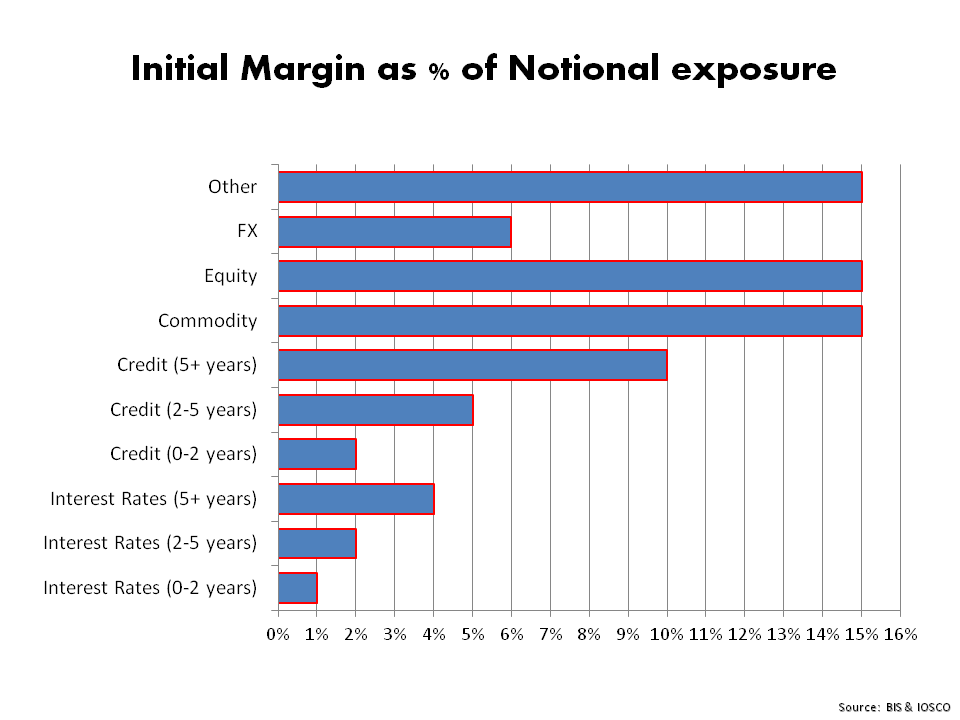
In March, the Bank of International Settlements (BIS) and IOSCO announced a delay until September 2016 for the introduction of margin requirements for non-centrally cleared derivatives (above certain thresholds and subject to exemptions). The proposed margin requirements are split between initial and variable, with the initial margin phased in from September 2016 to September 2020 and the variation margin phased in from September 2016 to March 2017.

The amount of initial margin reflects the size of the potential future exposure calculated “to reflect an extreme but plausible estimate of an increase in the value of the instrument that is consistent with a one-tailed 99 per cent confidence interval over a 10-day horizon, based on historical data that incorporates a period of significant financial stress”. The required amount of initial margin is calculated by reference to either a quantitative portfolio margin model or a standardised margin schedule (as per the schedule below). The requirements also prohibit the re-hypothecation of initial margin required to be collected and posted under the rules.

click to enlargeInitial Margin for Derivatives

The amount of variation margin reflects the size of this current exposure dependent on the mark-to-market value of the derivatives at any point in time. As such, the volatility of this requirement may be significant in stressed cases, particularly for illiquid derivatives.

The proposals, as set out by the BIS and IOSCO, are ambitious and it will be interesting to see how they are enforced across jurisdictions and the impact they will have on market behaviour, both within and outside CCPs. I suspect there will be a few twists in this tale yet, particularly in relation to unintended consequences of trying to tame the derivative monster.

Growing Alternate Lending Market

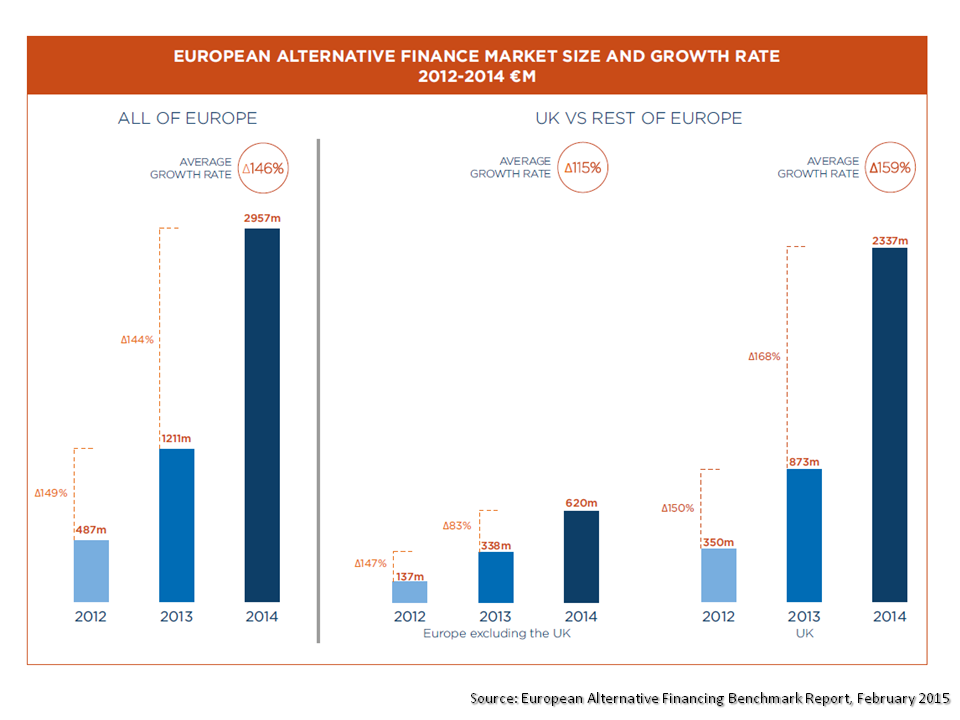
Over a year ago, I posted on an IOSCO report on the small but growing crowd-funding and P2P lending market. The University of Cambridge and EY issued a report last month which highlighted the growth in the sector putting its size at €3 billion in 2014 and predicting a growth to over €7 billion in 2015.

The UK is the largest market by far with about 75% of the deals originating from there, as the graph below from the report shows.

An interesting market, one worth keeping an eye on.

click to enlargeEuropean Alternative Financing Size

A thoroughly modern intellect

In only the way he could, one of Oscar Wilde’s quips highlights the futility in trying to look at future risks when he said “to expect the unexpected shows a thoroughly modern intellect“.

In a recent article from Lucy Marcus called “Preparing for the unknown unknowns”, the author stated the following:

“Moreover, for all the risks that we can and do plan for, it is those for which we cannot prepare that can do the most damage. That is why, alongside all of the identifying, quantifying, and mitigating, we must also embrace the idea that not all change can be clearly foreseen and planned for.”

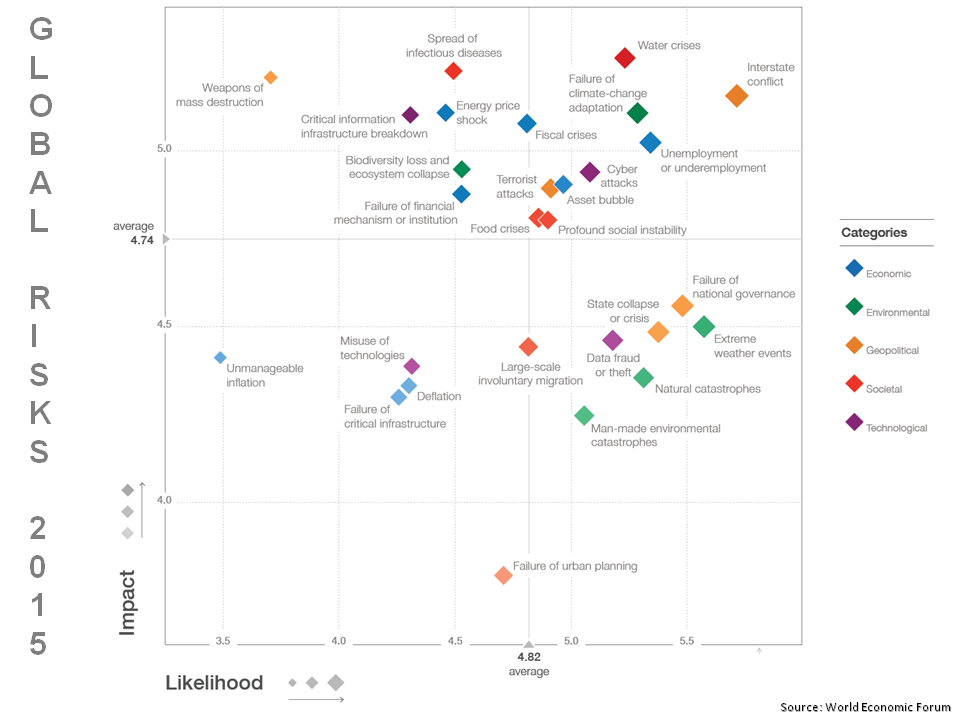
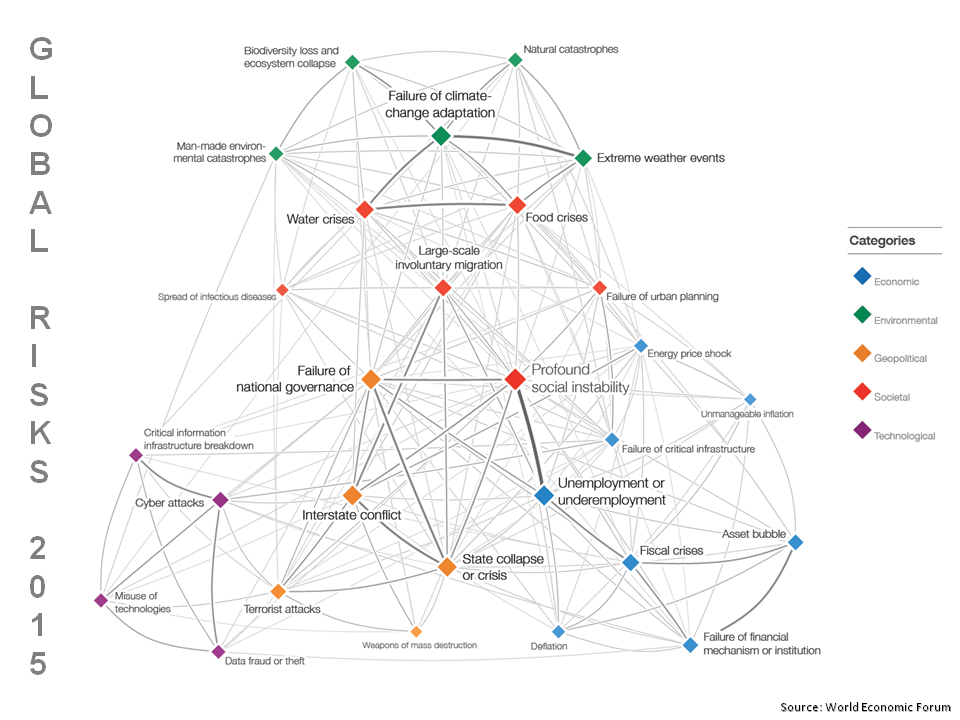
Notwithstanding the wisdom of these words, it is always interesting to see the results of the Global Risks report published each year by the World Economic Forum prior to the annual Davos meeting. The 2015 report is based upon the results of a survey from nearly 900 experts and the graphs below show the resulting likelihood and potential impact of 28 global risks and the interconnections between these risks.

click to enlargeGlobal Risks 2015

click to enlargeGlobal Risks 2015 Interconnections

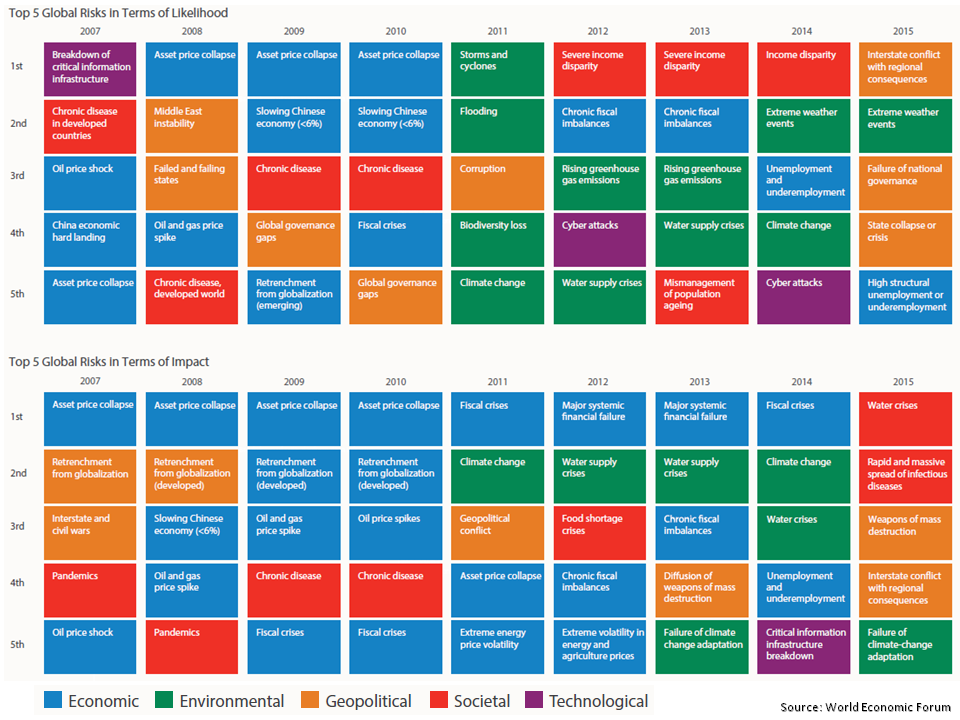
Perhaps the most interesting part of the report is the schematic, reproduced below, showing how the top 5 risks in terms of impact and in terms of likelihood have changed from 2007 through to this year’s report.

click to enlargeGlobal Risks 2007 to 2015

The changing colours across the years illustrate now fickle and influenced by recent experiences our concerns for the future can be and just how thoroughly modern our intellect is.

Given the name of this blog, I of course include myself in the previous sentence also.