Tag Archives: income inequality

Productivity Therapy

The IMF has sponsored another paper from staffers on the global productivity slowdown, with the catchy title “Gone with the Headwinds”. The paper reiterates many of the arguments concerning advanced economies referenced in this post, such as total factor productivity (TFP) hysteresis due to the boom-bust financial cycle and resulting capital misallocation, “an adverse feedback loop of weak aggregate demand, investment, and capital-embodied technological change”, elevated economic and policy uncertainty.

click to enlarge
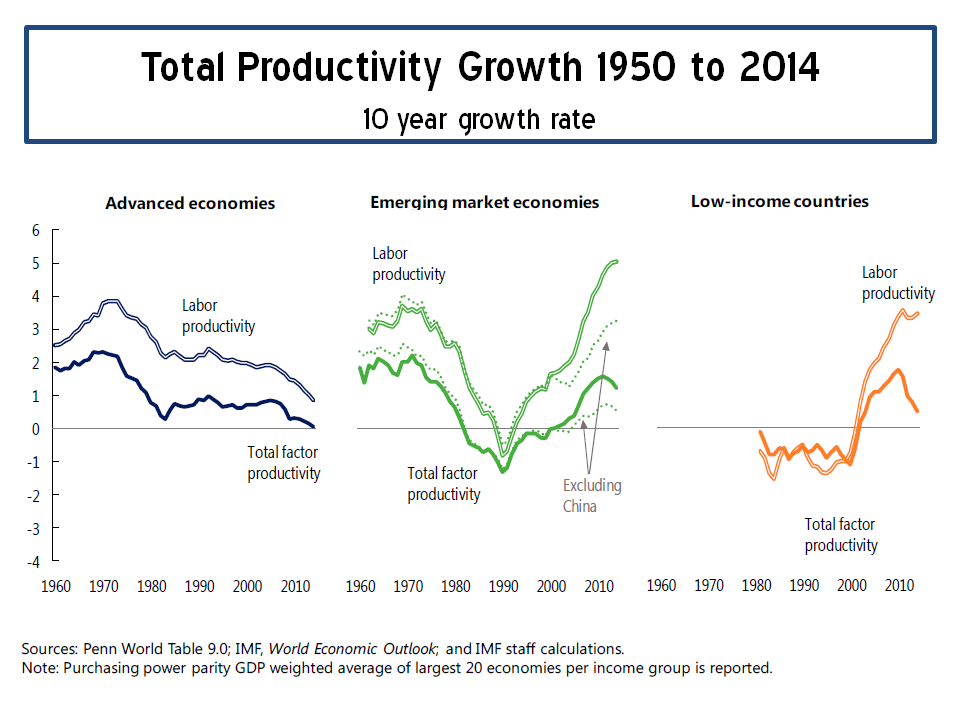
Also cited are structural headwinds including a waning information and communication technology (ICT) boom, an aging workforce, slower human capital accumulation, and slowing global trade integration (including the maturing of China’s integration into world trade). An exhibit on the ICT trends from the report is reproduced below.

click to enlarge
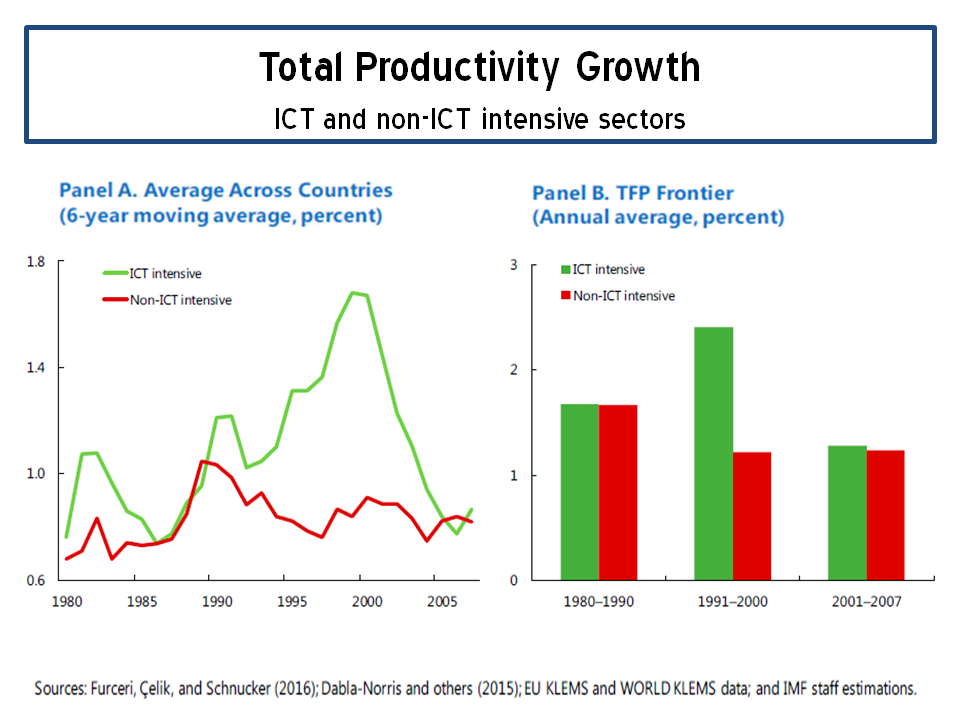
The report highlights short term remedies such as boosting private sector demand, efficient spending on infrastructure, strengthening balance sheets, and reducing economic policy uncertainty. Longer term remedies cited include policies to boost technological progress, policies to mitigate the effects of aging, policies to encourage migration, advancing an open global trade system, exploiting policy synergies, structural reforms, raising the quantity and quality of human capital.

Now, how many of these remedies are likely to be pursued in the current populist political environment? Although Trump has shown signs recently of doing the opposite to what he fought the election on, overall it does look like we are merrily going down a policy dead-end for the next few years in important advanced economies. Hopefully the policy dead-end will be principally confined to the US and they wouldn’t take too long in figuring out the silliness of the current journey and the need to get back to trying to deal with the big issues intelligently. Then again….
Risky World

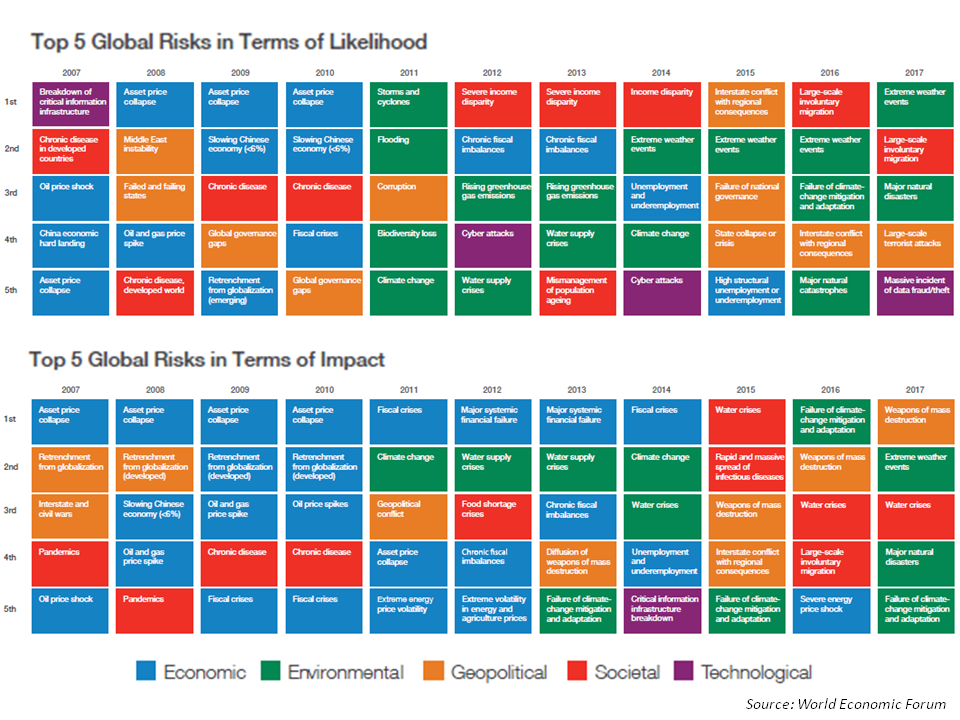
The latest World Economic Forum report on global risks is out today and, as usual, it reflects current concerns rather than offering any predictions for 2017. To be fair to WEF, the top risk for 2012 to 2014 inclusive in their survey was income disparity which is commonly viewed as one of the factors behind the rise in populism.

click to enlargewef-global-risks-2017

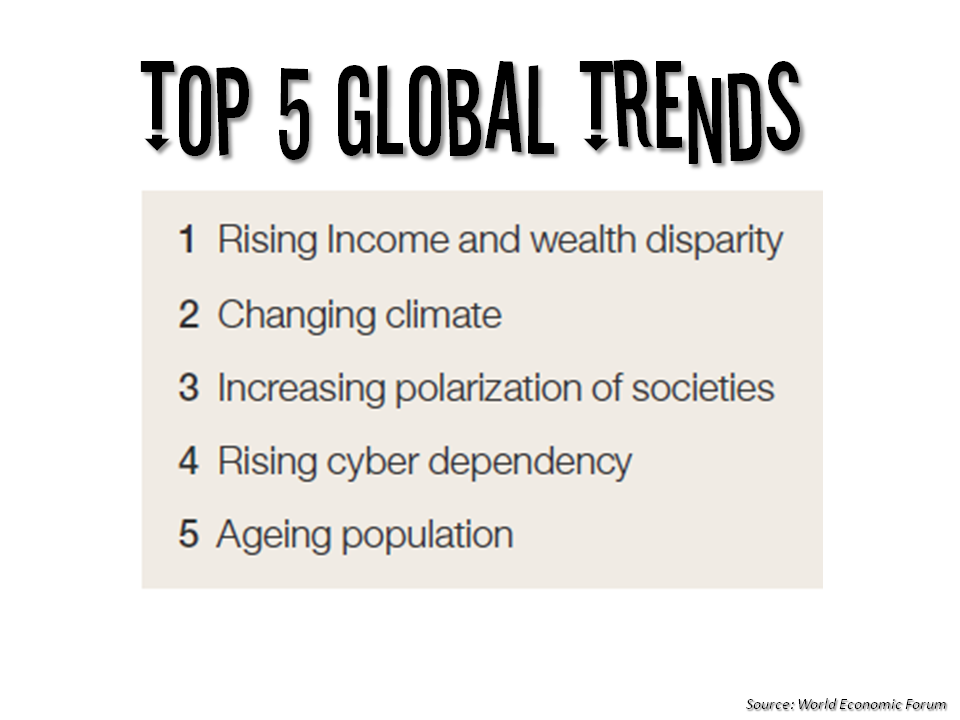
The report states the obvious about the impact on global risks following 2016, specifically that “societal polarization, income inequality and the inward orientation of countries are spilling over into real-world politics” and that “decision-making is increasingly influenced by emotions” due to the increase in nationalism. Where this year’s report is spot on, in my view, is in relation to the top 5 global trends that will determine global developments over the next 10 years, as below.

click to enlargewef-top-5-global-trends-2017

The report also states that “although anti-establishment politics tends to blame globalization for deteriorating domestic job prospects, evidence suggests that managing technological change is a more important challenge for labour markets” and that “we are in a highly disruptive phase of technological development, at a time of rising challenges to social cohesion and policy-makers’ legitimacy”.

Among the many risks highlighted in the report is a reduction in geopolitical co-operation which is likely to be detrimental to global growth, action on global indebtedness, and climate change.  It’s particularly depressing to think that even if the commitments under the Paris agreement were delivered, which now looks doomed after the election of Trump, the United Nations Environment Programme (UNEP) estimates the world will still warm by 3.0°C to 3.2°C, still far above the 2°C limit where scary and irreversible stuff happens.

Another worrying risk is the possibility of a new arms race in an era of rapid advancements in a technology which also has a retrograde feel, especially “while risks intersect and technologies develop quickly, too often our institutions for governing international security remain reactive and slow-moving”.

All pretty cheery stuff! And on it goes.

As I write this, I’m watching reports on Mr Trump’s press conference today, and although there is no doubt that our world is riskier as we enter 2017, it will be entertaining to see this guy as the leader of the free world. Hopefully good entertaining, not depressing entertaining!

Stuff just happened…

Many, like me, are scratching their heads this weekend about the Brexit vote. Besides the usual little Englanders and other crazies who crave an idealised yesteryear, a significant proportion of sensible people registered their protest in the vote, in a result that is clearly against their and their children’s economic interest. Places in the UK with significant employers dependent upon European access, places like Sunderland, Swindon and Flintshire (with bases for Nissan, Honda and Airbus), voted to leave.  They choose to ignore the consensus advice of the experts and their political leaders, the elite if you like. That’s what makes the outcome of this vote so significant.

In an article two years ago called “The Pitchforks are Coming”, the billionaire Nick Hanauer, who made his fortune on Amazon and aQuantive, wrote the following to his fellow billionaires:

“If we don’t do something to fix the glaring inequities in this economy, the pitchforks are going to come for us. No society can sustain this kind of rising inequality. In fact, there is no example in human history where wealth accumulated like this and the pitchforks didn’t eventually come out.”

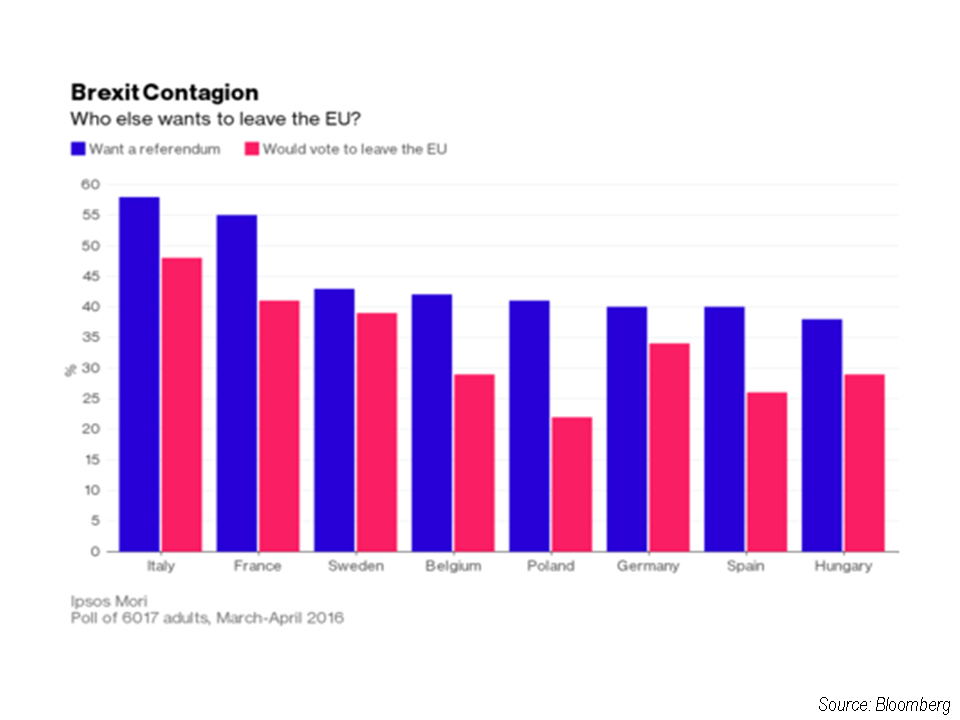
The thing is, would the populations of other major European countries also register such a protest, even where it was clearly against their interest? The graph below from Bloomberg suggests it could be a distinct possibility.

click to enlargeBrexit Contagion Bloomberg

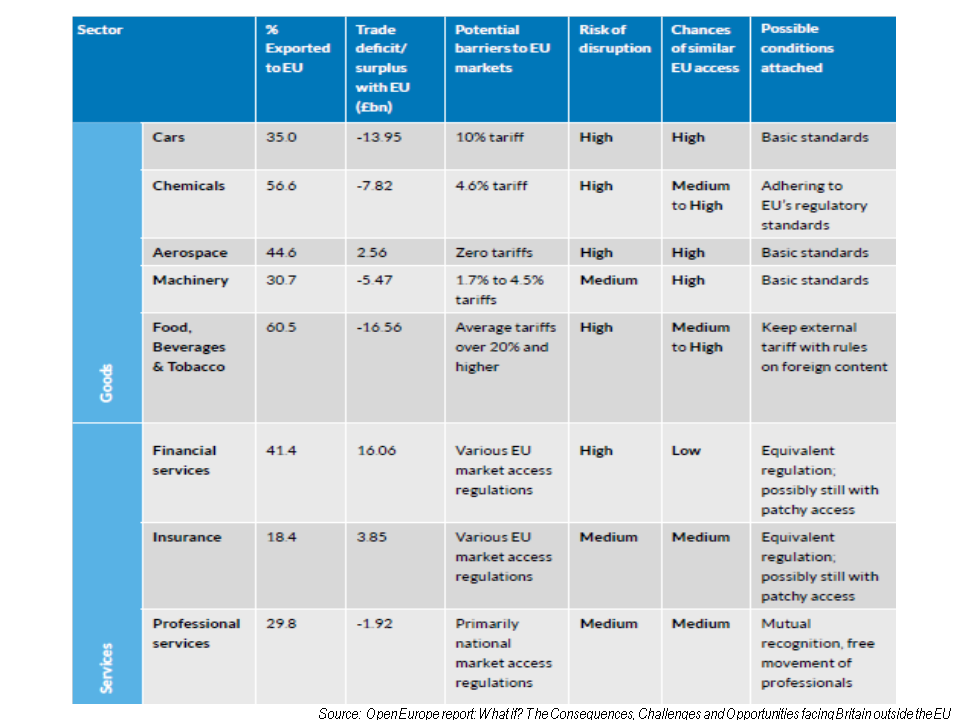
The problem now is that the EU cannot be seen to give the UK a deal which may encourage more discord. And, of course, the UK has no idea what deal it wants. The political turmoil in the UK government means they can’t even decide when to trigger Article 50 of the Lisbon Treaty, which will likely need a vote in parliament. The economic factors upon which any deal should be decided are illustrated in the exhibit below from a 2015 Open Europe report on Brexit. These economic factors may not play as important a part in the negotiations as they should given the emotive opposition to free labour movement, aka migration, which is a key issue for all Europeans.

click to enlargeOpen Europe Sectors Impacted by Brexit

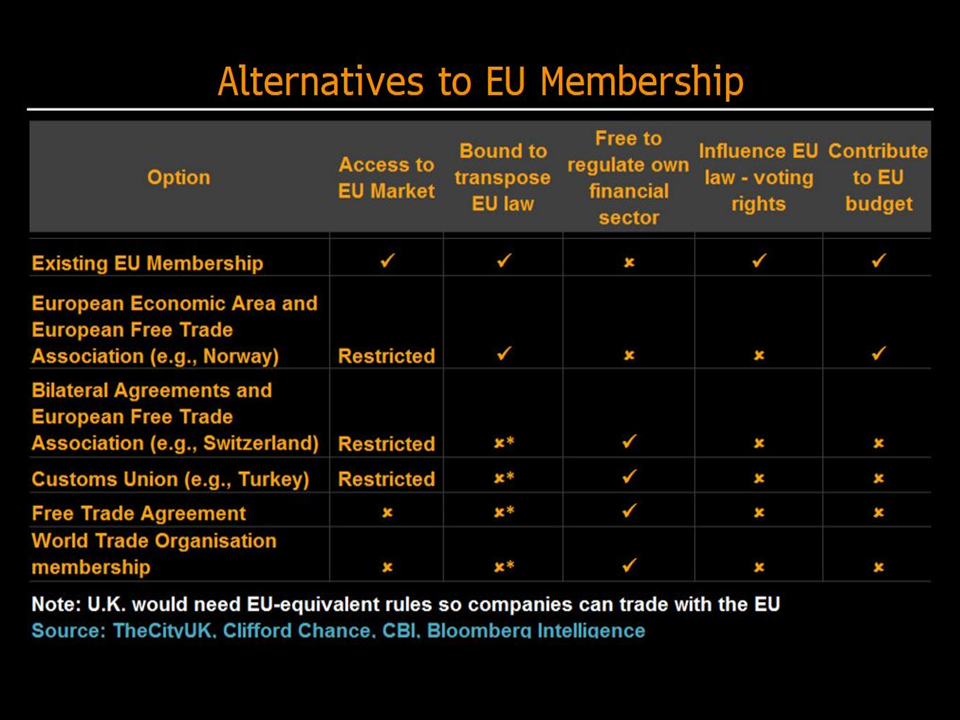
Matching these interests to the exit options available, as outlined in the exhibit below from Bloomberg, whilst satisfying the diverse opinions of the Brexiteers is the mess that we are now in. Any deal, whenever it arrives, will likely have to be voted upon again by the British public, maybe in the form of a general election.

click to enlargeAlternatives of EU for UK Bloomberg

Before that agreement can be made, we are in for an extended period of uncertainty. Radical uncertainties are a more apt term, with the emphasis on the radical.

Let’s hope that pitchforks are not part of our future.

Piddling Productivity

Walk around any office today and you will likely see staff on the internet or playing with their smartphones, the extent of which will depend upon the office etiquette. The rise of the networked society would intuitively imply increased productivity. Data analytics, the cloud, the ease with which items can be researched and purchased all imply a rise in efficiency and productivity. Or does it?

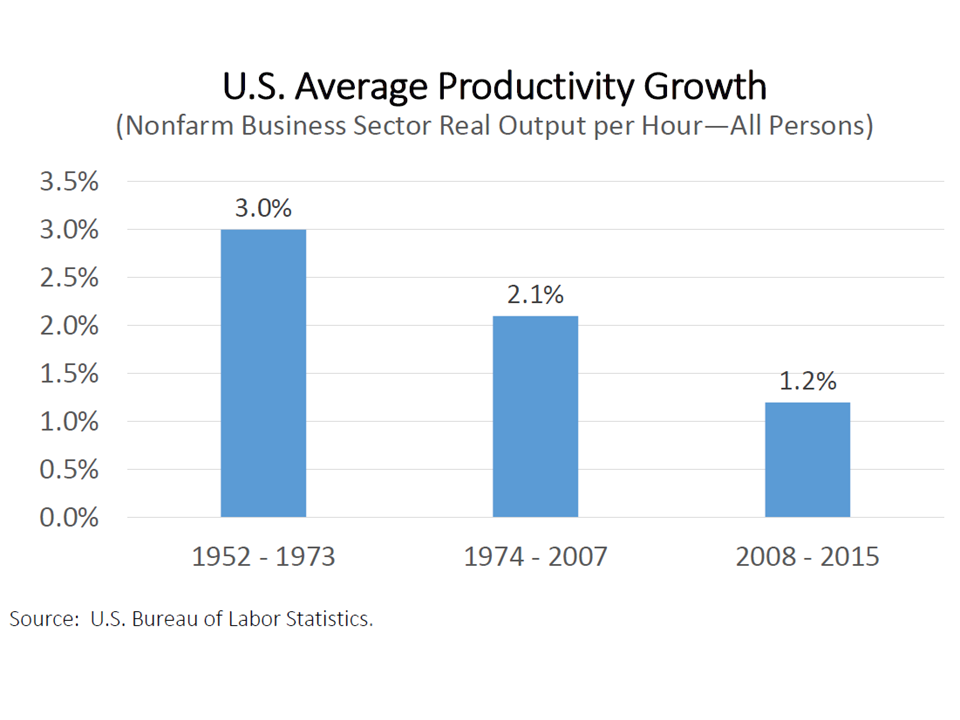
Productivity is about “working smarter” rather than “working harder” and it reflects our ability to produce more output by better combining inputs, owing to new ideas, technological innovations and business models. Productivity is critical to future growth. Has the rise of social media, knowing what your friends favourite type of guacamole is, made any difference to productivity? The statistics from recent years indicate the answer is no with the slowdown in productivity vexing economists with a multitude of recent opinion and papers on the topic. Stanley Fisher from the Fed stating in an interesting speech for earlier this month that “we simply do not know what will happen to productivity growth” and included the graph below in his presentation.

click to enlargeUS Average Productivity Growth 1952 to 2015

Martin Wolf in a piece in the FT on recent projections by the Office for Budget Responsibility (OBR) calls the prospects for productivity “the most important uncertainty affecting economic prospects of the British people”.

Some think the productivity statistics have misestimated growth and the impact of technology (e.g. the amount of free online services). A recent paper from earlier this month by Fed and IMF employees Byrne, Fernald and Reinsdorf concluded that “we find little evidence that the slowdown arises from growing mismeasurement of the gains from innovation in IT-related goods and services”.

The good news seems to be that productivity slumps are far from unprecedented according to a paper in September last year from Eichengreen, Park and Shin. The bad news is that the authors conclude the current slump is widespread and evident in advanced countries like the U.S. and UK as well as in emerging markets in Latin America, Southeast Europe and Central Asia including China.

A fascinating paper from December 2015 by staff at the Bank of England called “Secular drivers of the global real interest rate” covers a wide range of issues which are impacting growth, including productivity growth. I am still trying to digest much of the paper but it does highlight many of the economists’ arguments on productivity.

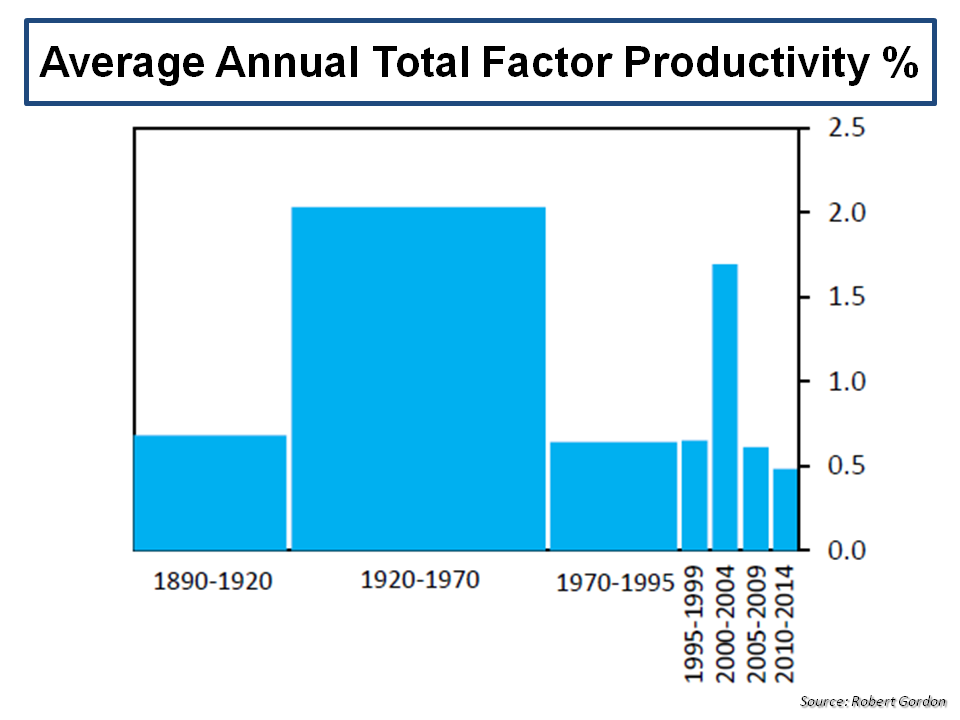
One of those is Robert Gordon, who has a new bestseller out called “The Rise and Fall of American Growth”. Gordon has long championed the view of a stagnation in technology advances due to structural headwinds such as an educational plateau, income inequality and public indebtedness.

click to enlargeAverage Annual Total Facor Productivity

Others argue that productivity comes in waves and new technology often takes time to be fully integrated into the production process (e.g. electricity took 20 years before the benefits showed in labour productivity).

Clearly this is an important issue and one which deserves the current level of debate. Time will tell whether we are in a slump and will remain there or whether we are at the dawn of a golden era of innovation led productivity growth…..

Summer Blues

After the holidays, it’s time to pack the bucket and spades away and get back into the routine. It has been a volatile August.  A bear call in a post in early May is looking pertinent (as is the post on a suggested tie-up between Paddy Power and Betfair!) given the 7% drop in the S&P500 since then, although it is more likely dumb luck.

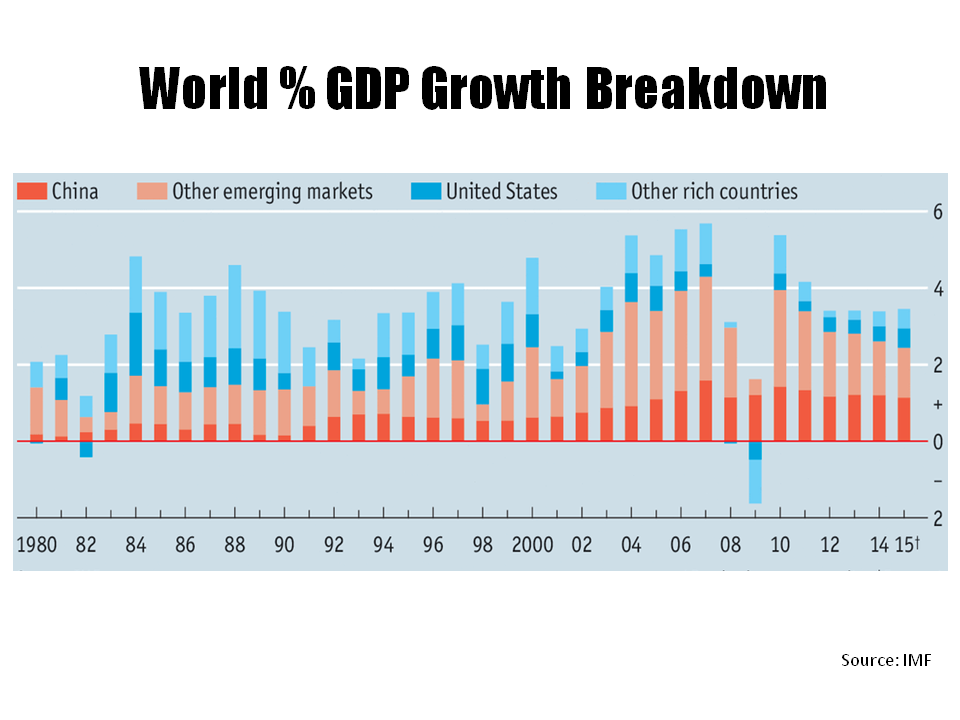
The market concern is centred on the prospects for China’s economy. Growth is widely believed to be a lot lower than the official 7% with exports down, concerns about zombie loans and the political ramifications of managing a lower growth economy. The Economist, in an article this week, highlighted the potential impact of a slow-down in China and other emerging markets on global growth, as per the graph below.

click to enlargeGlobal GDP Growth Breakdown 1980 to 2015

Amongst the usual holiday reading, I brought two books on economics for the beach. The first was the FT’s Martin Wolf’s “The shifts and the shocks” from late in 2014 and the second is the recently published “Postcapitalism” by Paul Mason. Although often a laboured read, I did manage to finish the former whilst I only got to start the latter (which is a much easier read).

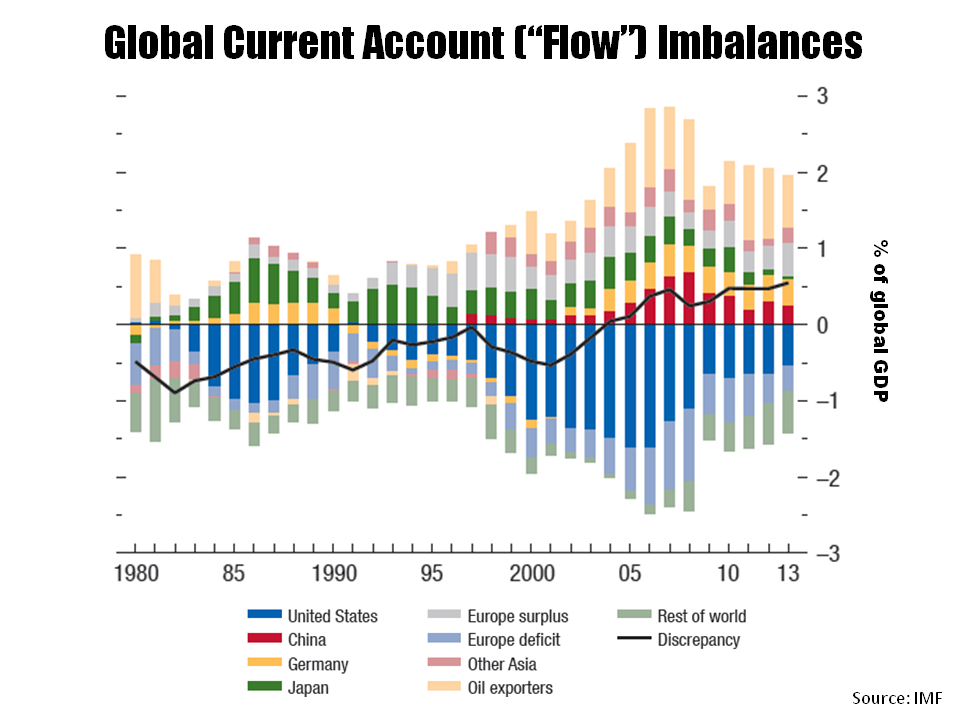
Reading Wolf’s book as the China led volatility was unfolding only led to an enhanced feeling of negativity from the themes of the book, namely the lessons as yet unlearned from the crisis. Wolf competently covers much of the causes of the crisis and its aftermath – a global savings glut and associated global imbalances, an expansionary monetary policy that ignored asset prices and credit, an unstable liberalized financial system supervised by naïve regulation. The following graph from the IMF reminds of the global imbalances that proved so toxic when combined with a rampant financial sector.

click to enlargeGlobal Current Account Imbalances 1980 to 2013

Wolf questions the “belief that government borrowing is the illness for which private borrowing is the cure has survived all that has happened”. Some of the solutions that Wolf proposes include much higher capital requirements for banks than is currently being implemented under Basel III, deleveraging initiatives such as tax incentives towards equity and away from debt, corporate tax changes to encourage corporate investment, changes in debt contracts to convert to equity on macro-economic metrics, policies to address income inequality and to promote research and education.

A more radical reform of the financial system, along the lines of the Chicago Plan for 100% reserve banking whereby the ability to create money is taken away from profit seeking banks and given solely to central banks, is a step that Wolf favours but believes is unrealistic given the realpolitik of the developed world system. On the globalised financial system, Wolf believes that the “obvious truth that unless regulation and the supply of fiscal backstops is to be much more global, finance should be far less so” and suggests a greater segmentation of the world’s financial system.

There are many themes in Wolf’s book that got me thinking and I am hoping that Mason’s book will do the same, albeit from a totally different perspective. I think the market volatility has more time to play out and hopefully my summer reading, although yet to be completed, will assist in understanding what may come next.