Tag Archives: low risk premia

Converts on a comeback

My initial reaction, from a shareholder view-point, when a firm issues a convertible bond is negative and I suspect that many other investors feel the same. My experience as a shareholder of firms that relied on such hybrid instruments has been varied in the past. Whether it’s a sign that a growing firm has limited options and may have put the shareholder at the mercy of some manipulative financier, or the prospect that arbitrage quants will randomly buy or sell the stock at the whim of some dynamic hedging model chasing the “greeks”, my initial reaction is one of discomfort at the uncertainty of how, by whom, and when my shareholding may be diluted.

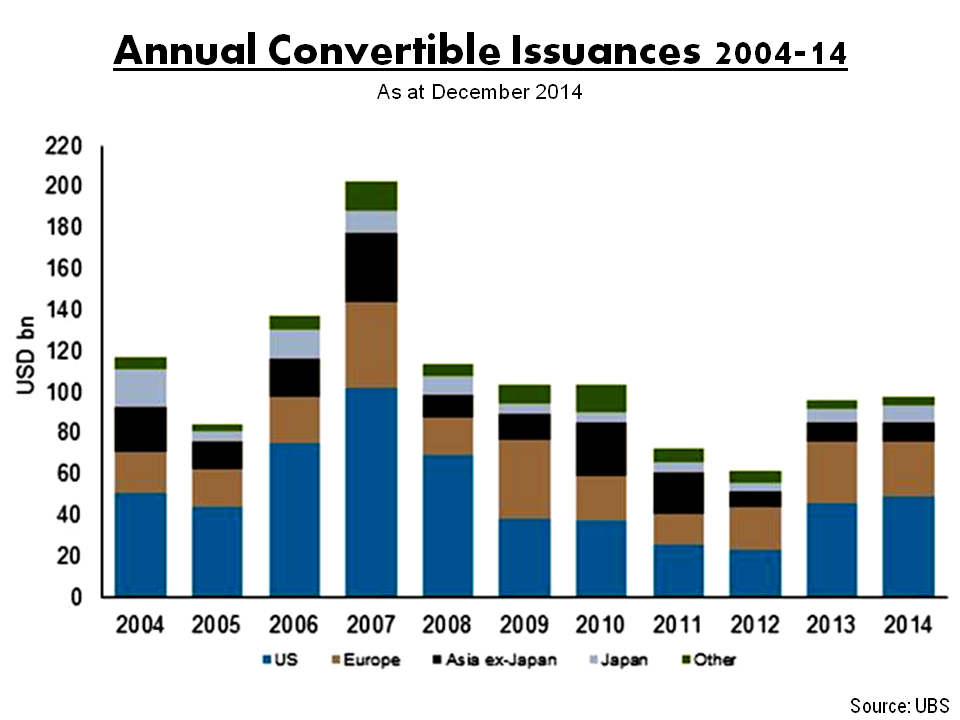
In today’s low risk premia environment, it’s interesting to see a pick-up in convertible issuances and, in the on-going search for yield environment, investors are again keen on foregoing some coupon for the upside which the embedded call option that convertibles may offer. Names like Tesla, AOL, RedHat, Priceline and Twitter have all been active in recent times with conversion premiums averaging over 30%. The following graph shows the pick-up in issuances according to UBS.

click to enlargeConvertible Bond Market Issuances 2004 to 2014
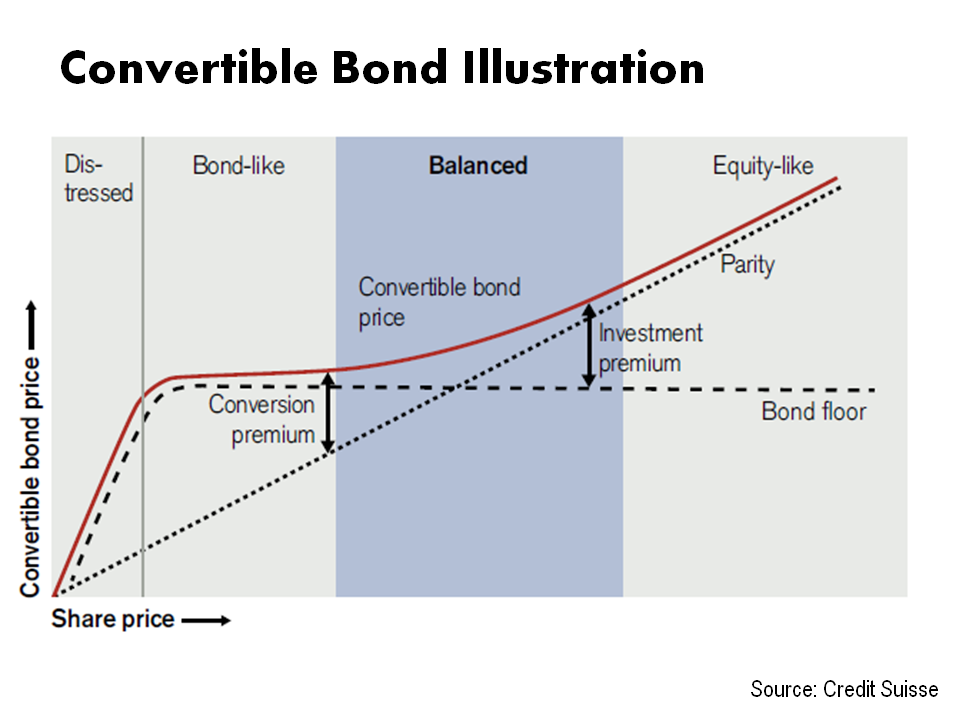
Convertible bonds have been around since the days of the railroad boom in the US and, in theory, combining the certainty of a regular corporate bond with an equity call option which offers the issuer a source of low debt cost at a acceptable dilution rate to shareholders whilst offering an investor the relative safety of a bond with a potential for equity upside. The following graphic illustrates the return characteristics.

click to enlargeConvertible Bond Illustration
The problem for the asset class in the recent past came when the masters of the universe embraced convertible arbitrage strategies of long/short the debt/equity combined with heavy doses of leverage and no risk capital. The holy grail of an asymmetric trade without any risk was assumed to be at hand [and why not, given their preordained godness…or whatever…]! Despite the warning shot to the strategy that debt and equity pricing can diverge when Kirk Kerborian’s increased his stake in General Motors in 2005 just after the debt was downgraded, many convertible arb hedge funds continued to operate at leverage multiples of well in excess of 4.

The 2008 financial crisis and the unwinding of dubious lending practises to facilitate hedge fund leverage, such as the beautifully named rehypothecation lending by banks and brokers (unfortunately the actual explanation sounds more like a ponzi scheme), caused the arbitrage crash not only across convertibles but across many other asset classes mixed up in so called relative value strategies. This 2010 paper, entitled “Arbitrage Crashes and the Speed of Capital”, by Mark Mitchell and Todd Pulvino is widely cited and goes into the gory detail. There were other factors that exacerbated the impact of the 2008 financial crisis on the convertible debt market such as market segmentation whereby investors in other asset classes were slow to move into the convertible debt market to correct mis-pricing following the forced withdrawal of the hedge funds (more detail on this impact in this paper from 2013).

Prior to the crisis, convertible arb hedge funds dominated the convertible bond market responsible for up-to 80% of activity. Today, the market is dominated by long only investors with hedge funds only reported to be responsible for 25% of activity with those hedge funds operating at much lower leverage levels (prime brokers are restricted to leverage of less than 1.5 times these days with recent talk of an outright rehypothecation ban for certain intermediaries on the cards). One of the funds that made it through the crash, Ferox Capital, stated in an article that convertible bonds have “become the play thing of long only investors” and that the “lack of technically-driven capital (hedge funds and proprietary trading desks) should leave plenty of alpha to be collected in a relatively low-risk manner” (well they would say that wouldn’t they!).

The reason for my interest in this topic is that one of the firms I follow just announced a convertible issue and I wanted to find out if my initial negative reaction is still justified. [I will be posting an update on my thoughts concerning the firm in question, Trinity Biotech, after their Q1 results due this week].

Indeed, the potential rehabilitation of convertible bonds to today’s investors is highlighted by the marketing push from people like EY and Credit Suisse on the benefits of convertible bonds as an asset class to insurers (as per their recent reports here and here). EY highlight the benefit of equity participation with downside protection, the ability to de-risk portfolios, and the use of convertible bonds to hedge equity risk. Credit Suisse, bless their little hearts, go into more technical detail about how convertibles can be used to lower the solvency requirement under Solvency II and/or for the Swiss Solvency Test.

With outstanding issuances estimated at $500 billion, the market has survived its turbulent past and it looks like there is life left in the old convertible bond magic dog yet.

Insurance & capital market convergence hype is getting boring

As the horde of middle aged (still mainly male) executives pack up their chinos and casual shirts, the overriding theme coming from this year’s Monte Carlo Renez-Vous seems to be impact of the new ILS capacity or “convergence capital” on the reinsurance and specialty insurance sector. The event, described in a Financial Times article as “the kind of public display of wealth most bankers try to eschew”, is where executives start the January 1 renewal discussions with clients in quick meetings crammed together in the luxury location.

The relentless chatter about the new capital will likely leave many bored senseless of the subject. Many may now hope that, just like previous hot discussion topics that were worn out (Solvency II anybody?), the topic fades into the background as the reality of the office huts them next week.

The more traditional industry hands warned of the perils of the new capacity on underwriting discipline. John Nelson of Lloyds highlighted that “some of the structures being used could undermine some of the qualities of the insurance model”. Tad Montross of GenRe cautioned that “bankers looking to replace lost fee income” are pushing ILS as the latest asset class but that the hype will die down when “the inability to model extreme weather events accurately is better understood”. Amer Ahmed of Allianz Re predicted the influx “bears the danger that certain risks get covered at inadequate rates”. Torsten Jeworrek of Munich Re said that “our research shows that ILS use the cheapest model in the market” (assumingly in a side swipe at AIR).

Other traditional reinsurers with an existing foothold in the ILS camp were more circumspect. Michel Lies of Swiss Re commented that “we take the inflow of alternative capital seriously but we are not alarmed by it”.

Brokers and other interested service providers were the loudest cheerleaders. Increasing the size of the pie for everybody, igniting coverage innovative in the traditional sector, and cheap retrocession capacity were some of the advantages cited. My favourite piece of new risk management speak came from Aon Benfield’s Bryon Ehrhart in the statement “reinsurers will innovate their capital structures to turn headwinds from alternative capital sources into tailwinds”. In other words, as Tokio Millennium Re’s CEO Tatsuhiko Hoshina said, the new capital offers an opportunity to leverage increasingly diverse sources of retrocessional capacity. An arbitrage market (as a previous post concluded)?

All of this talk reminds me of the last time that “convergence” was a buzz word in the sector in the 1990s. For my sins, I was an active participant in the market then. Would the paragraph below from an article on insurance and capital market convergence by Graciela Chichilnisky of Columbia University in June 1996 sound out of place today?

“The future of the industry lies with those firms which implement such innovation. The companies that adapt successfully will be the ones that survive. In 10 years, these organizations will draw the map of a completely restructured reinsurance industry”

The current market dynamics are driven by low risk premia in capital markets bringing investors into competition with the insurance sector through ILS and collaterised structures. In the 1990s, capital inflows after Hurricane Andrew into reinsurers, such as the “class of 1992”, led to overcapacity in the market which resulted in a brutal and undisciplined soft market in the late 1990s.

Some (re)insurers sought to diversify their business base by embracing innovation in transaction structures and/or by looking at expanding the risks they covered beyond traditional P&C exposures. Some entered head first into “finite” type multi-line multi-year programmes that assumed structuring could protect against poor underwriting. An over-reliance on the developing insurance models used to price such transactions, particularly in relation to assumed correlations between exposures, left some blind to basic underwriting disciplines (Sound familiar, CDOs?). Others tested (unsuccessfully) the limits of risk transfer and legality by providing limited or no risk coverage to distressed insurers (e.g. FAI & HIH in Australia) or by providing reserve protection that distorted regulatory requirements (e.g. AIG & Cologne Re) by way of back to back contracts and murky disclosures.

Others, such as the company I worked for, looked to cover financial risks on the basis that mixing insurance and financial risks would allow regulatory capital arbitrage benefits through increased diversification (and may even offer an inflation & asset price hedge). Some well known examples* of the financial risks assumed by different (re)insurers at that time include the Hollywood Funding pool guarantee, the BAe aircraft leasing income coverage, Rolls Royce residual asset guarantees, dual trigger contingent equity puts, Toyota motor residual value protection, and mezzanine corporate debt credit enhancement  coverage.

Many of these “innovations” ended badly for the industry. Innovation in itself should never be dismissed as it is a feature of the world we live in. In this sector however, innovation at the expense of good underwriting is a nasty combination that the experience in the 1990s must surely teach us.

Bringing this back to today, I recently discussed the ILS market with a well informed and active market participant. He confirmed that some of the ILS funds have experienced reinsurance professionals with the skills to question the information in the broker pack and who do their own modelling and underwriting of the underlying risks. He also confirmed however that there is many funds (some with well known sponsors and hungry mandates) that, in the words of Kevin O’Donnell of RenRe, rely “on a single point” from a single model provided by to them by an “expert” 3rd party.

This conversation got me to thinking again about the comment from Edward Noonan of Validus that “the ILS guys aren’t undisciplined; it’s just that they’ve got a lower cost of capital.” Why should an ILS fund have a lower cost of capital to a pure property catastrophe reinsurer? There is the operational risk of a reinsurer to consider. However there is also operational risk involved with an ILS fund given items such as multiple collateral arrangements and other contracted 3rd party service provided functions to consider. Expenses shouldn’t be a major differing factor between the two models. The only item that may justify a difference is liquidity, particularly as capital market investors are so focussed on a fast exit. However, should this be material given the exit option of simply selling the equity in many of the quoted property catastrophe reinsurers?

I am not convinced that the ILS funds should have a material cost of capital advantage. Maybe the quoted reinsurers should simply revise their shareholder return strategies to be more competitive with the yields offered by the ILS funds. Indeed, traditional reinsurers in this space may argue that they are able to offer more attractive yields to a fully collaterised provider, all other things being equal, given their more leveraged business model.

*As a complete aside, an article this week in the Financial Times on the anniversary of the Lehman Brothers collapse and the financial crisis highlighted the role of poor lending practices as a primary cause of significant number of the bank failures. This article reminded me of a “convergence” product I helped design back in the late 1990s. Following changes in accounting rules, many banks were not allowed to continue to hold general loan loss provisions against their portfolio. These provisions (akin to an IBNR type bulk reserve) had been held in addition to specific loan provision (akin to case reserves). I designed an insurance structure for banks to pay premiums previously set aside as general provisions for coverage on massive deterioration in their loan provisions. After an initial risk period in which the insurer could lose money (which was required to demonstrate an effective risk transfer), the policy would act as a fully funded coverage similar to a collaterised reinsurance. In effect the banks could pay some of the profits in good years (assuming the initial risk period was set over the good years!) for protection in the bad years. The attachment of the coverage was designed in a way similar to the old continuous ratcheting retention reinsurance aggregate coverage popular at the time amongst some German reinsurers. After numerous discussions, no banks were interested in a cover that offered them an opportunity to use profits in the good times to buy protection for a rainy day. They didn’t think they needed it. Funny that.