This is scary…

This is scary…
Posted in Climate Change
Tagged 5th assessment, above 1.5°C, agricultural productivity, anthropogenic greenhouse gas, atmospheric concentrations, biological carbon stores, carbon dioxide, carbon emission, climate change, climate change resilience, climate models, climate resilient pathways, climate system, climate warming, COP24, decarbonized economy, emissions reductions, geological data sets, global warming, greenhouse gas emissions, IPCC, IPCC 2018 report, IPCC assessment, methane hydrates, ocean carbon sinks, Paris Agreement, permafrost thaw, population growth, pre-industrial temperatures, sea level, soil erosion, synthesis reports, temperature increase, tipping elements, Trump climate change, UN climate talks
As we enter a week where further market turmoil is likely against a background of further tensions between the US and China over the Huawei arrest, the climax of the Brexit debacle, and the yellow vest protests in France. All these issues can and will be resolved eventually but they pale in comparison to the political inaction over the latest climate change reports.
The US government, in the form of the United States Global Change Research Program (USGCRP), in a report in November concluded that “the evidence of human-caused climate change is overwhelming and continues to strengthen, that the impacts of climate change are intensifying across the country, and that climate-related threats to Americans’ physical, social, and economic well-being are rising” and warned that “these impacts are projected to intensify—but how much they intensify will depend on actions taken to reduce global greenhouse gas emissions and to adapt to the risks from climate change now and in the coming decades”. Of course, the Orange One again demonstrated his supreme myopic attitude with the dismissal “I don’t believe it”.
We now have the black comedy of oil producing states such as the US, Russia and Saudi Arabia arguing over whether to “welcome” or just “note” the latest IPCC report this week at the UN climate talks, known as COP24. The IPCC report on the impacts of a temperature rise of 1.5°C was launched last October and is a sobering read. The IPCC again states with a high level of confidence that “human activities are estimated to have caused approximately 1.0°C of global warming above pre-industrial levels, with a likely range of 0.8°C to 1.2°C” and that “global warming is likely to reach 1.5°C between 2030 and 2052 if it continues to increase at the current rate”.
click to enlarge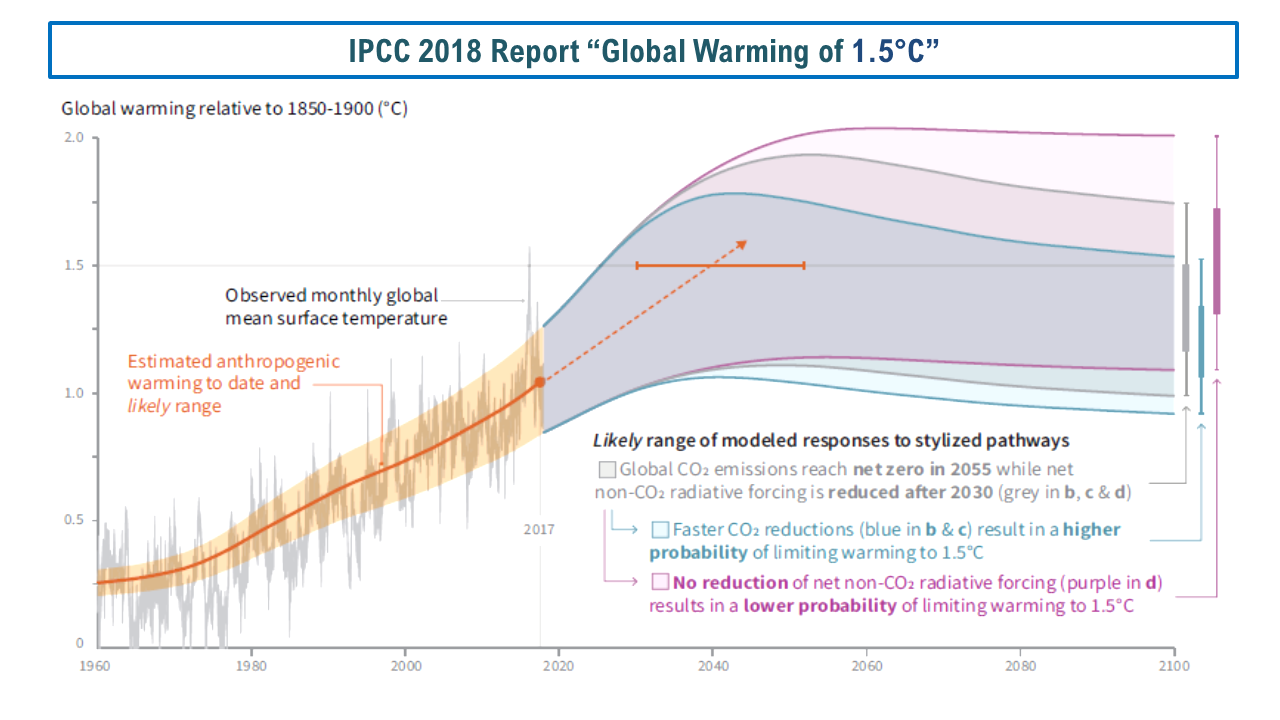
In order to avoid warming above 1.5°C, the world needs “global net anthropogenic CO2 emissions decline by about 45% from 2010 levels by 2030 (40–60% interquartile range), reaching net zero around 2050 (2045–2055 interquartile range)”. For limiting global warming to below 2°C, emissions need to “decline by about 25% by 2030 in most pathways (10–30% interquartile range) and reach net zero around 2070 (2065–2080 interquartile range)”.
Let’s face it, given the current political leadership across the globe, such declines are just fantasy. And I find that really depressing. The plea of David Attenborough at COP24 last week for leaders in the world to lead looks set to fall on deaf ears. Attenborough worryingly stated that “the continuation of our civilisations and the natural world upon which we depend, is in your hands (i.e. our leaders)”.
We’re pretty much toast then….
Posted in Climate Change
Tagged 5th assessment, above 1.5°C, agricultural productivity, anthropogenic drivers, anthropogenic greenhouse gas, atmospheric concentrations, biological carbon stores, carbon dioxide, carbon emission, climate change, climate change resilience, climate models, climate resilient pathways, climate system, climate warming, COP24, decarbonized economy, emissions reductions, geological data sets, global warming, greenhouse gas emissions, IPCC, IPCC 2018 report, methane, methane hydrates, National Academy of Sciences, nitrous oxide, ocean carbon sinks, Paris Agreement, permafrost thaw, PNAS, population growth, pre-industrial temperatures, sea level, soil erosion, synthesis reports, tipping elements, Trump climate change, UN climate talks, uninhabitable, USGCRP
 This blog represents my personal views and is not reflective of the views or opinions held by any company or employer I work for currently or have worked for in the past. The views expressed herein are based solely upon publicly available data. No views expressed herein should be taken as an endorsement to take any particular course of action in the markets. The basis of this blog is that different views should be expressed and readers make up their own minds on the what they believe and act accordingly.
 deconstructingrisk