Category Archives: Investing Ideas

Disappointing TRIB

Every investor knows the feeling of wondering what to do when a stock they have invested in falls unexpectedly in value. Although some may not be aware of the term “disposition effect” in behavioural economics, it reflects the widely observed tendency of investors to ride losses and lock in gains (a previous post touched on more behaviour economic concepts). I have been guilty in the past of just such a tendency, all too often I’m afraid! Bitter experience, maturity and the advice of many successful professional investors has caused me to now try to proactively act against such instincts. [On the latter point, the books of Jack Schwager and Steven Drobny with wide ranging professional investor interviews are must reads.]

Averaging down when a stock you hold falls, particularly when there is no obvious explanation, is another strategy that rarely ends well. Instead of looking at the situation as an opportunity to buy more of a stock at a reduced price, I now question why I would invest more in a situation that I have clearly misread. I only allow myself to consider averaging down where I clearly understand the reason behind any decrease and where the market itself has reduced (for the sector or as a whole). Experience has taught me that focusing on reducing the losers is critical to longer term success. Paul Tudor Jones put it well when he said: “I am always thinking about losing money as opposed to making money”.

This brings me to the case in point of my investment in Trinity Biotech (TRIB). I first posted about TRIB in September 2013 (here) where I looked at the history of the firm and concluded that “TRIB is a quality company with hard won experiences and an exciting product pipeline” but “it’s a pity about the frothy valuation” (the stock was trading around $19 at the time). The exciting pipeline included autoimmune products from the Immco acquisition, the launch of the new Premier diabetes instruments from the Primus acquisition, and the blockbuster potential of Troponin point-of-care cardiac tests going through FDA trials from the Fiomi deal.

Almost immediately after the September 2013 post, the stock climbed to a high of over $27 in Q1 2014, amidst some volatility. Fidelity built its position to over 12% during this time (I don’t know if that was on its own behalf or for an investor) before proceeding to dump its position over the remainder of 2014. This may simply have been a build up and a subsequent unwinding of an inverse tax play which was in, and then out, of vogue at the time. The rise of the stock after my over-valued call may have had a subconscious impact on my future actions.

By August 2014, the stock traded around the low $20s after results showed a slightly reduced EPS on lower Lyme sales and reduced gross margins on higher Premier instrument sales and lagging higher margin reagent sales. Thinking that the selling pressure had stopped after a drop by TRIB from the high $20 level to the low $20s, I revised my assessment (here) and established an initial position in TRIB around $21 on the basis of a pick-up in operating results from the acquisitions in future quarters plus the $8-$10 a share embedded option estimated by analysts on a successful outcome of the Troponin trials. As a follow-on post in October admitted, my timing in August was way off as the stock continued its downward path through September and October.

With the announcement of a suspension of the FDA Troponin trials in late October due to unreliable chemical agent supplied by a 3rd party, the stock headed towards $16 at the end of October. Despite my public admission of mistiming on TRIB in the October post and my proclamations of discipline in the introduction to this post, I made a classic investing mistake at this point: I did nothing. As the trading psychologist Dr Van Tharp put it: “a common decision that people make under stress is not to decide”. After a period of indecision, some positive news on a CLIA waiver of rapid syphilis test in December combined with the strength of the dollar cut my losses on paper so I eventually sold half my position at a small loss at the end of January. I would like to claim this was due to my disciplined approach but, in reality, it was primarily due to luck given the dollar move.

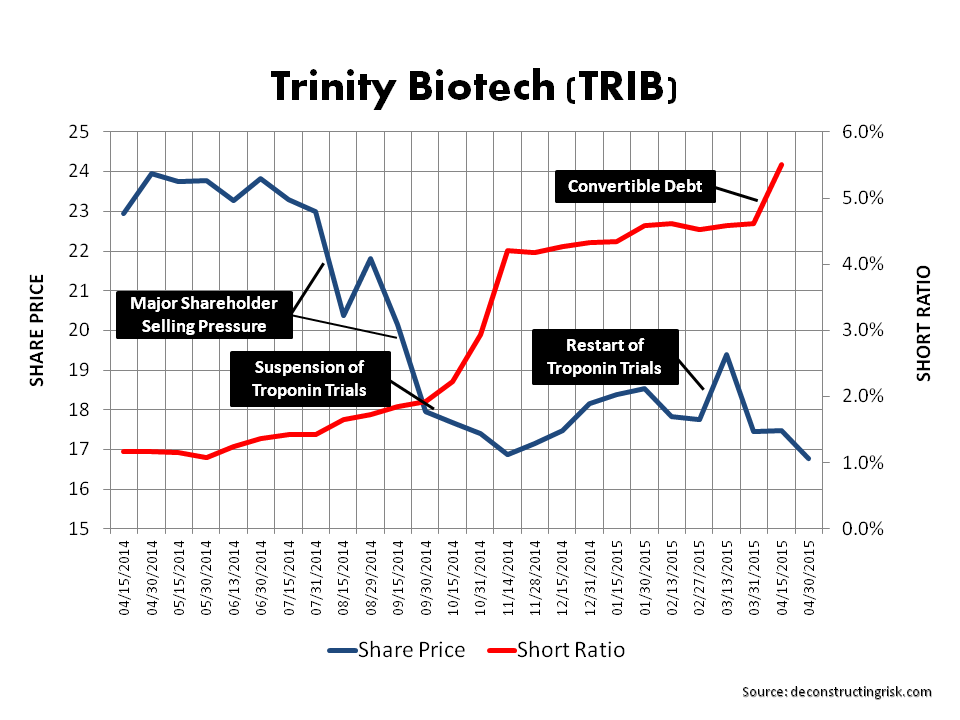
Further positive news on the resumption of the Troponin trials in February, despite pushing out the timing of any FDA approval, was damped by disappointing Q4 results with lacklustre operating results (GM reduction, revenue pressures on legacy products). The continued rise in the dollar again cushioned my paper loss.  It wasn’t until TRIB announced and closed a $115 million exchangeable debt offering in April that I started to get really concerned (my thoughts on convertible debt are in this post) about the impact such debt can have on shareholder value. I decided to wait until the Q1 call at the end of April to see what TRIB’s rationale was for the debt issuance (both the timing and the debt type). I was dissatisfied with the firm’s explanation on the use of funds (no M&A target has been yet identified) and when TRIB traded sharply down last week, I eventually acted and sold all of my remaining position around $16 per share, an approximate 15% loss in € terms after the benefits on the dollar strength. The graph below illustrates the events of the recent past.

click to enlargeTRIB Share Price + Short Interest
My experience with TRIB only re-enforces the need to be disciplined in cutting losses early. On the positive side, I did scale into the position (I only initially invested a third of my allocation) and avoided the pitfall of averaging down. Joe Vidich of Manalapan Oracle Capital Management puts it well by highlighting the need for strong risk management in relation to the importance of position sizing and scaling into and out of positions when he said “the idea is don’t try to be 100% right”. Although my inaction was tempered by the dollar strength, the reality is that I should have cut my losses at the time of the October post. Eventually, I forced myself into action by strict portfolio management when faced with a market currently stretched valuation wise, as my previous post hightlights.

As for TRIB, I can now look at its development from a detached perspective without the emotional baggage of trying to justify an investment mistake. The analysts have being progressively downgrading their EPS estimates over recent months with the average EPS estimates now at $0.16 and $0.69 for Q2 and FY2015 respectively. My estimates (excluding and including the P&L cost of the new debt of $6.3 million per year, as per the management estimate on the Q1 call) are in the graph below.

click to enlargeTRIB Quarterly Revenue+EPS 2011 to Q42015
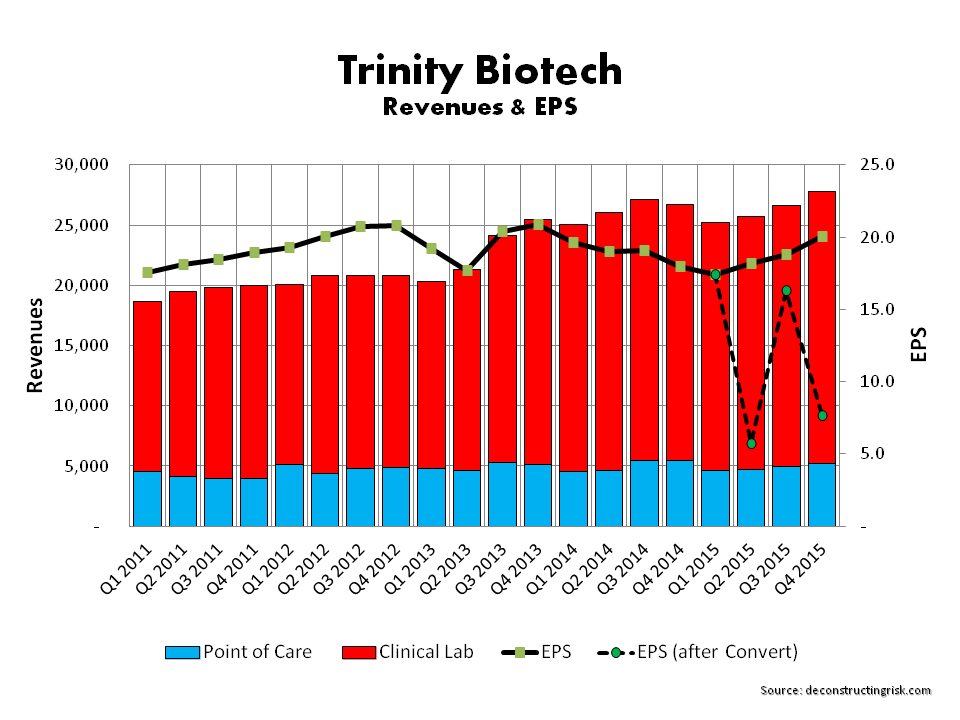
In terms of the prospects for TRIB in the short term, I am concerned about the lack of progress on the operational results from the acquisitions of recent years and the risks (timing and costs) associated with the Troponin approval. I also do not believe management should be looking at further M&A until they address the current issues (unless they have a compelling target). The cost of the debt will negatively impact EPS in 2015. One cynical explanation for the timing on the debt issuance is that management need to find new revenues to counter weakness in legacy products that can no longer be ignored. Longer term TRIB may have a positive future, it may even climb from last week’s low over the coming weeks. That’s not my concern anymore, I am much happier to take my loss and watch it from the side-lines for now.

Ray Dalio of Brightwater has consistently stressed the need to learn from investing mistakes: “whilst most others seem to believe that mistakes are bad things, I believe mistakes are good things because I believe that most learning comes via making mistakes and reflecting on them”. This post is my reflection on my timing on TRIB, my inaction in the face of a falling position, and my current perspective on TRIB as an investment (now hopefully free of any emotive bias!).
Converts on a comeback

My initial reaction, from a shareholder view-point, when a firm issues a convertible bond is negative and I suspect that many other investors feel the same. My experience as a shareholder of firms that relied on such hybrid instruments has been varied in the past. Whether it’s a sign that a growing firm has limited options and may have put the shareholder at the mercy of some manipulative financier, or the prospect that arbitrage quants will randomly buy or sell the stock at the whim of some dynamic hedging model chasing the “greeks”, my initial reaction is one of discomfort at the uncertainty of how, by whom, and when my shareholding may be diluted.

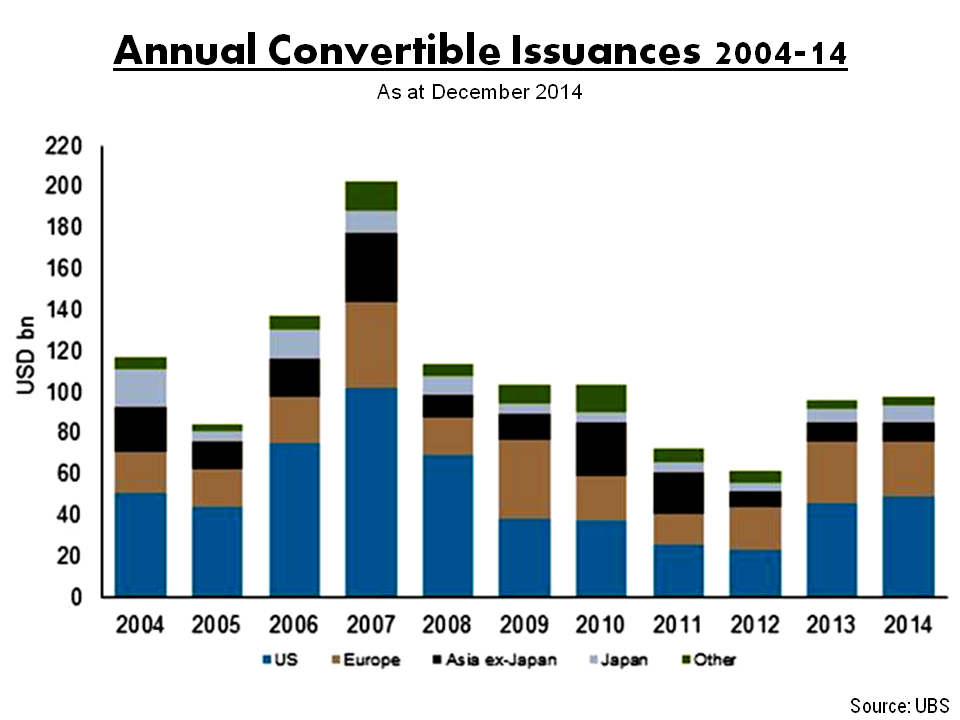
In today’s low risk premia environment, it’s interesting to see a pick-up in convertible issuances and, in the on-going search for yield environment, investors are again keen on foregoing some coupon for the upside which the embedded call option that convertibles may offer. Names like Tesla, AOL, RedHat, Priceline and Twitter have all been active in recent times with conversion premiums averaging over 30%. The following graph shows the pick-up in issuances according to UBS.

click to enlargeConvertible Bond Market Issuances 2004 to 2014

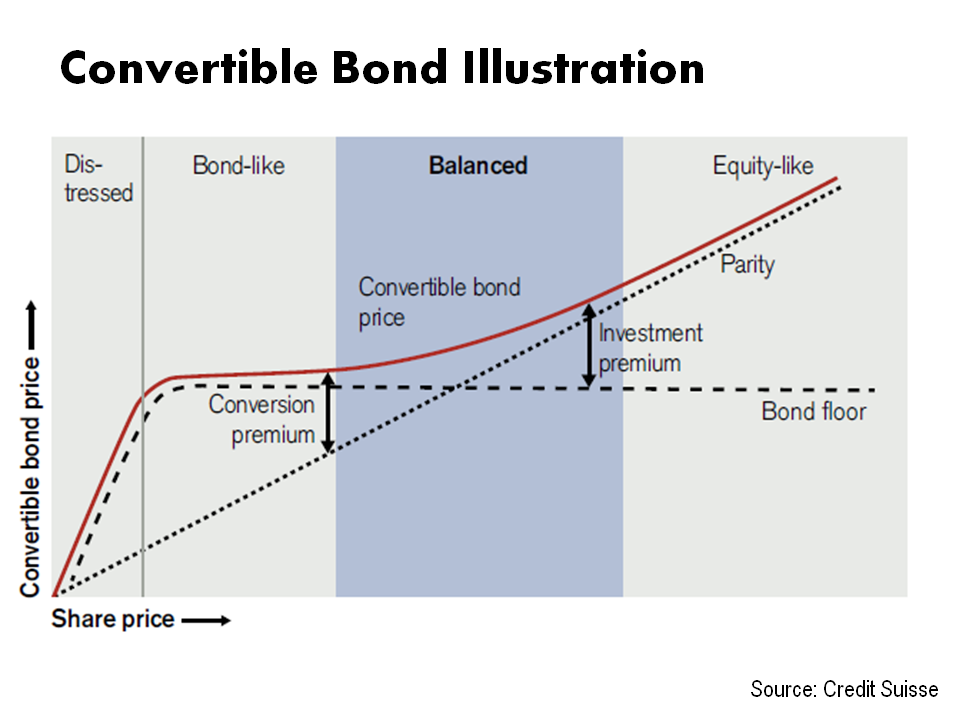
Convertible bonds have been around since the days of the railroad boom in the US and, in theory, combining the certainty of a regular corporate bond with an equity call option which offers the issuer a source of low debt cost at a acceptable dilution rate to shareholders whilst offering an investor the relative safety of a bond with a potential for equity upside. The following graphic illustrates the return characteristics.

click to enlargeConvertible Bond Illustration

The problem for the asset class in the recent past came when the masters of the universe embraced convertible arbitrage strategies of long/short the debt/equity combined with heavy doses of leverage and no risk capital. The holy grail of an asymmetric trade without any risk was assumed to be at hand [and why not, given their preordained godness…or whatever…]! Despite the warning shot to the strategy that debt and equity pricing can diverge when Kirk Kerborian’s increased his stake in General Motors in 2005 just after the debt was downgraded, many convertible arb hedge funds continued to operate at leverage multiples of well in excess of 4.

The 2008 financial crisis and the unwinding of dubious lending practises to facilitate hedge fund leverage, such as the beautifully named rehypothecation lending by banks and brokers (unfortunately the actual explanation sounds more like a ponzi scheme), caused the arbitrage crash not only across convertibles but across many other asset classes mixed up in so called relative value strategies. This 2010 paper, entitled “Arbitrage Crashes and the Speed of Capital”, by Mark Mitchell and Todd Pulvino is widely cited and goes into the gory detail. There were other factors that exacerbated the impact of the 2008 financial crisis on the convertible debt market such as market segmentation whereby investors in other asset classes were slow to move into the convertible debt market to correct mis-pricing following the forced withdrawal of the hedge funds (more detail on this impact in this paper from 2013).

Prior to the crisis, convertible arb hedge funds dominated the convertible bond market responsible for up-to 80% of activity. Today, the market is dominated by long only investors with hedge funds only reported to be responsible for 25% of activity with those hedge funds operating at much lower leverage levels (prime brokers are restricted to leverage of less than 1.5 times these days with recent talk of an outright rehypothecation ban for certain intermediaries on the cards). One of the funds that made it through the crash, Ferox Capital, stated in an article that convertible bonds have “become the play thing of long only investors” and that the “lack of technically-driven capital (hedge funds and proprietary trading desks) should leave plenty of alpha to be collected in a relatively low-risk manner” (well they would say that wouldn’t they!).

The reason for my interest in this topic is that one of the firms I follow just announced a convertible issue and I wanted to find out if my initial negative reaction is still justified. [I will be posting an update on my thoughts concerning the firm in question, Trinity Biotech, after their Q1 results due this week].

Indeed, the potential rehabilitation of convertible bonds to today’s investors is highlighted by the marketing push from people like EY and Credit Suisse on the benefits of convertible bonds as an asset class to insurers (as per their recent reports here and here). EY highlight the benefit of equity participation with downside protection, the ability to de-risk portfolios, and the use of convertible bonds to hedge equity risk. Credit Suisse, bless their little hearts, go into more technical detail about how convertibles can be used to lower the solvency requirement under Solvency II and/or for the Swiss Solvency Test.

With outstanding issuances estimated at $500 billion, the market has survived its turbulent past and it looks like there is life left in the old convertible bond magic dog yet.

Level3 flying high

It has been over 6 months since I have posted on the prospects for the telecommunications firm Level3 (LVLT) following its merger with TW Telecom (TWTC). I had previously posted on the strength of TW Telecom’s business model and its admirable operating history so I am extremely positive on the combination. At the time of the last post, LVLT was trading around $45 a share, a five year high. Since that time, the stock fell to a low of $38 in October 2014 before reaching a new high in recent weeks around $54.

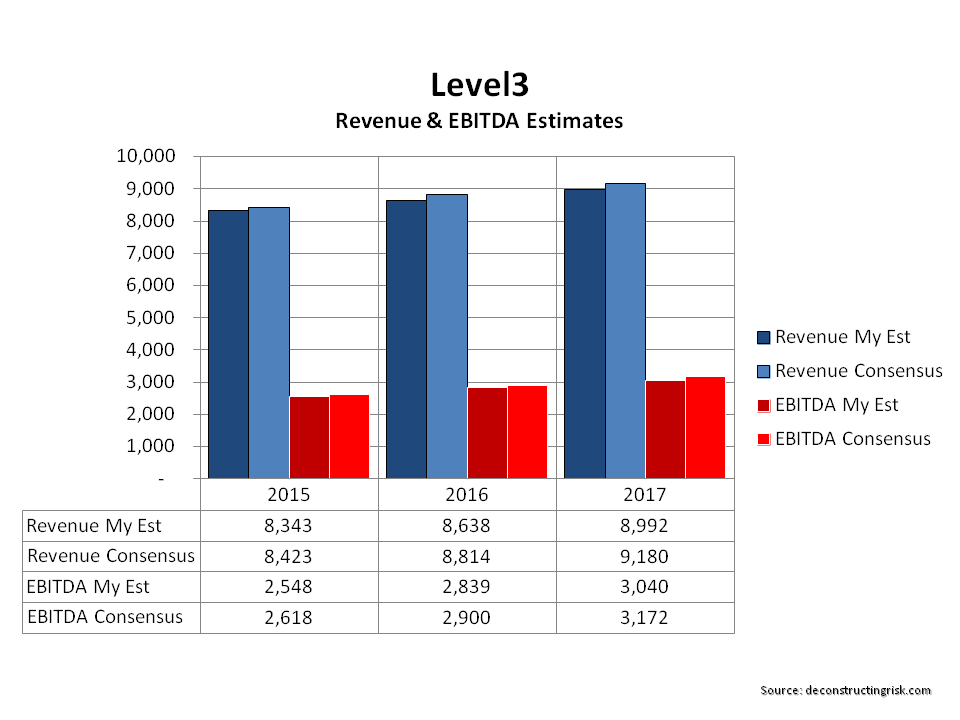
My previous post, using figures disclosed in a S-4 filing on the merger negotiations, made a projection that the combined entity could get to $9 billion of revenue and $3 billion of EBITDA by 2016. Based upon the Q4 figures, the firm’s guidance, and the recently filed 10K, I did some more detailed figures and now estimate that the $9B/$3B revenue/EBITDA threshold will more likely be in 2017 rather than 2016. My estimates for each against the consensus from analysts are below.

click to enlargeLevel3 Revenues and EBITDA estimates 2015 to 2017

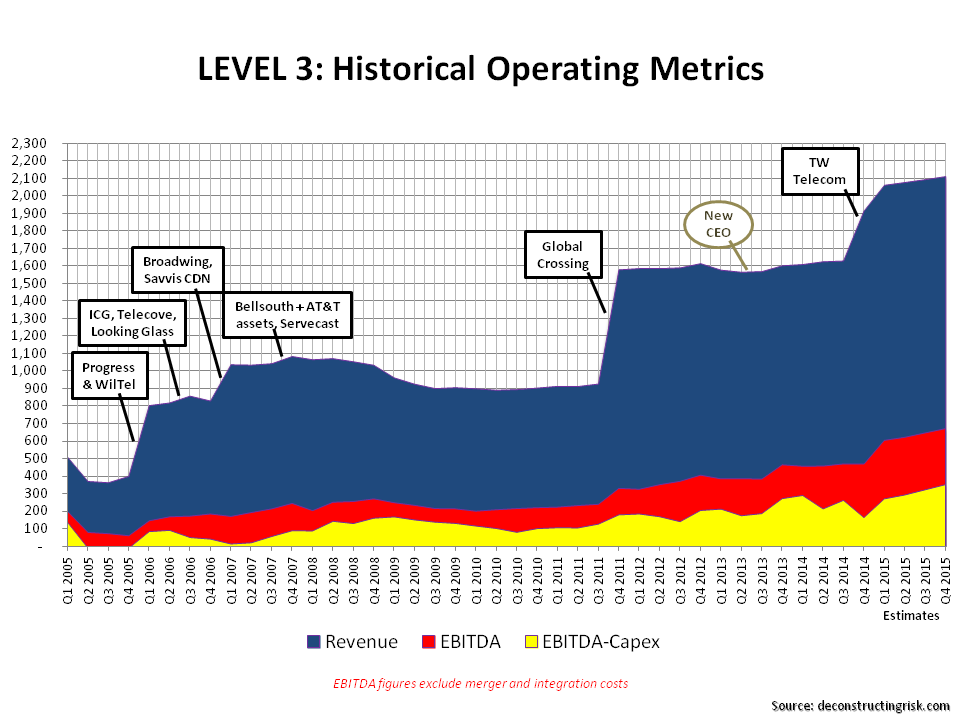
LVLT is an acquisitive firm and has learned through multiple deals the optimal way of integrating new firms through a shape focus on the customer experience whilst prudently integrating operations and reducing costs. Taking the Global Crossing integration as a template, the graphic below illustrates how my estimates fit in the past.

click to enlargeLevel3 Operating Metrics 2005 to 2015

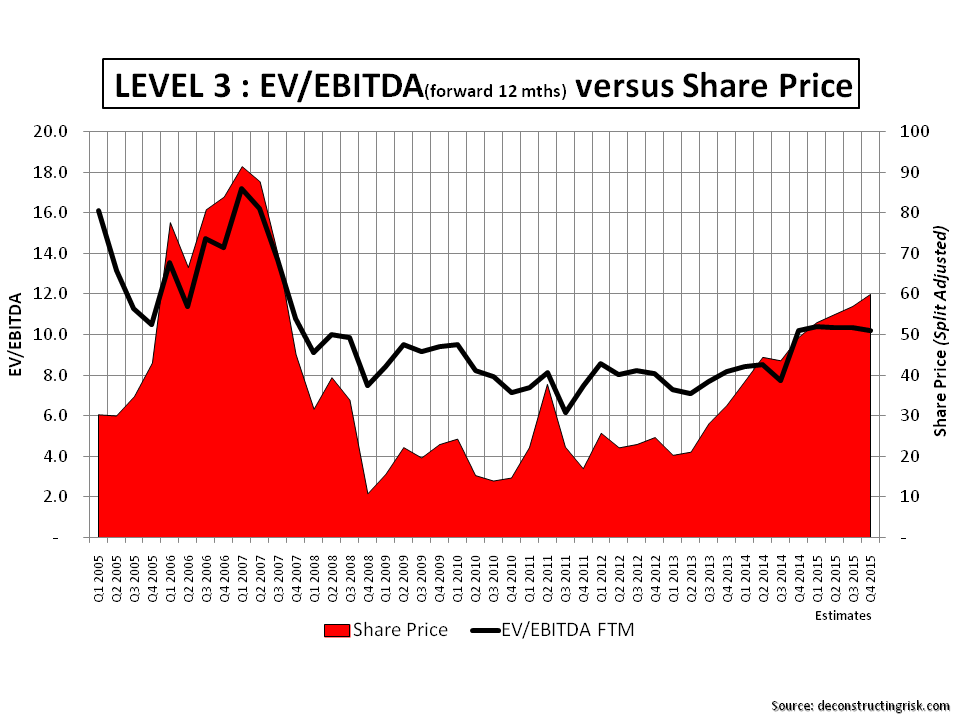
So, the question now is whether a share price in the mid to high 50s is justified (the average consensus is around $57 with the highest being Canaccord’s recent target of $63). Using an enterprise value to EBITDA multiple based upon a forward 12 month EBITDA figures (actual where relevant and my estimates from Q1-2015), I think a target between $50 and $60 is justified assuming a forward multiple of 10 to reflect growth prospects, as the graphic below illustrates. My DCF analysis also supports a target in the low 60s.

click to enlargeLevel3 10year EVtoEBITDA versus Share Price

Such a target range assumes operating results show positive momentum and that the overall market remains relatively stable with expectations on interest rate increases in the US within current estimates. Due to LVLT’s net debt load of just under $11 billion and a proforma leverage ratio of 4.4 to EBITDA, the stock is historically exposed to macro-economic volatility. A mitigant against such volatility is the increasing level of free cash that the business will generate (I estimate $600/$900/ $1,000 million over 2015 to 2017). Also, about $6.5 billion of its debt is fixed (current blended rate is 7.2%) and LVLT’s CFO has shown considerable skill in recent years at managing the interest rate down in this yield hungry environment. Its remaining floating debt (blended rate of 4.2%) has a minimum LIBOR rate of 1% and therefore offers headroom against movements in current LIBOR rates

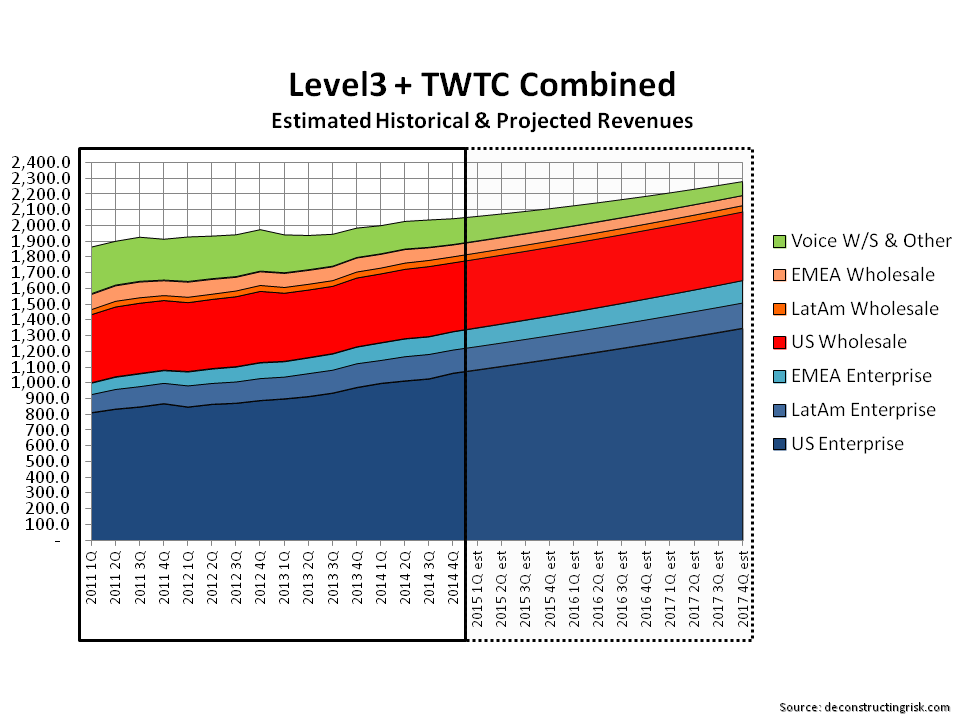
In my view, the key in terms of valuation is that the integration goes smoothly and that revenue growth in the enterprise market is maintained. One of the principal reasons for my optimism on LVLT is the operational leverage the business has as the mix of its business moves more towards the higher margin and stickier enterprise market, as the pro-forma revenue split shows.

click to enlargeLevel3 Proforma Revenue Split

As always with LVLT, I recommend using options to protect downside and waiting for a pull-back from current highs for any new investment. This stock has historically not been one for the faint hearted. I do believe however that they are on the path to a more stable future and it remains a core holding for me.

To China and back

Chinese internet stocks are way way way out of my comfort zone. Besides the hype and transient nature of many business models, the stratospheric valuations and the political risk are issues that I can’t get my head around. With the Chinese stock market up 25% in a month, it looks like classic bubble territory.

That said, the latest IDC predictions for 2015 recently caught my attention. One of the predictions asserted the following:

“China will experience skyrocketing influence on the global information and telecommunications technology market in 2015 with spending that will account for 43% of all industry growth, one third of all smartphone purchases, and about one third of all online shoppers. With a huge domestic market, China’s cloud and ecommerce leaders (Alibaba in ecommerce, Tencent in social, and Baidu in search) will rise to prominence in the global marketplace. Similarly, Chinese branded smartphone makers will capture more than a third of the worldwide smartphone market.”

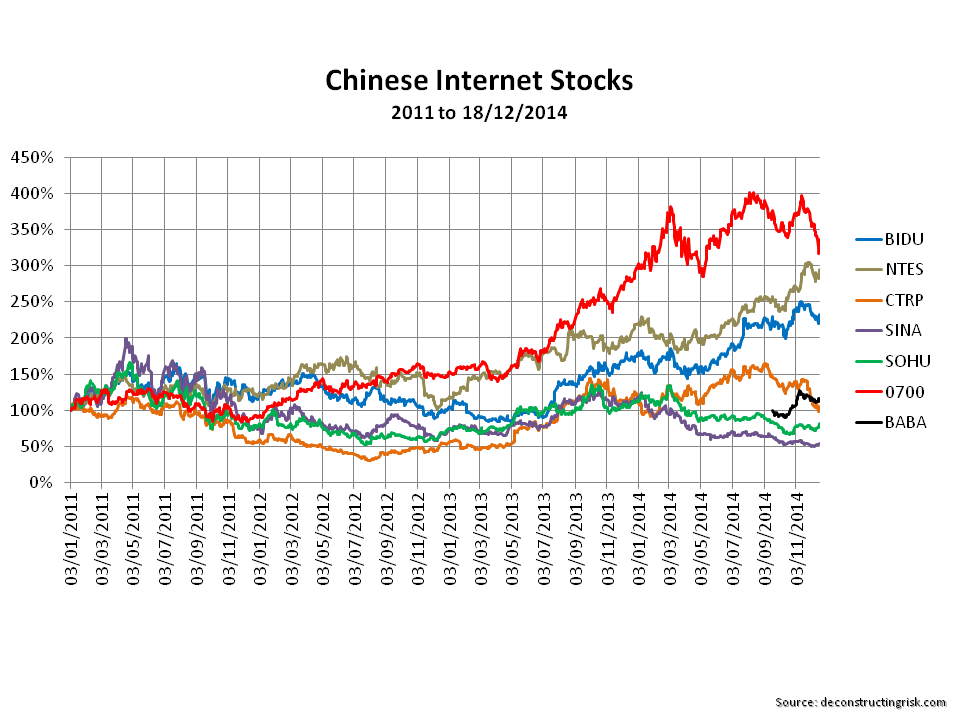
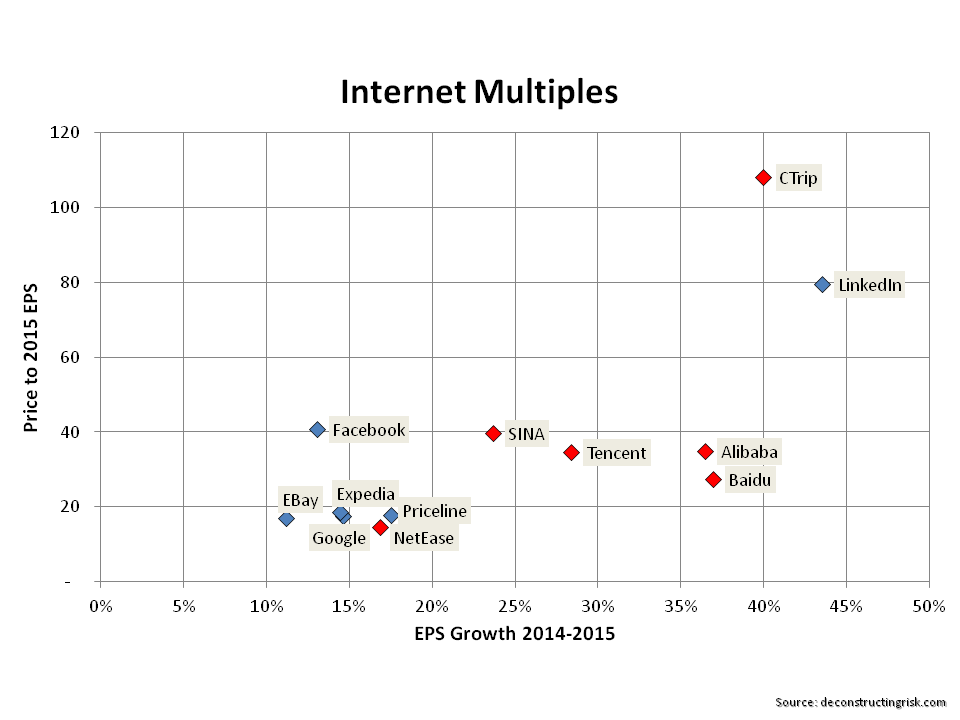
Every now and again (as I did in this post) I look at how a few of the Chinese internet stocks that trade in the US are progressing for the sake of curiosity. The graph below shows a selected few – Baidu (internet search), NetEase (online gaming), Ctrip (travel services), Sina (online media), Sohu (various online services), Tencent (social, traded in Hong Kong), and Alibaba (e-commerce). click to enlargeChinese Internet Stocks December 2014 Tencent is the biggest gainer at over 300% since 2011; NetEase is just below 300%; with Baidu over 200%. Alibaba is up 16% since its stock market debut in September. Since 2011, the underperformers are Ctrip about breakeven, Sohu down 20%, and Sina down 50%. An equally weighted portfolio of these stocks, excluding Alibaba, invested at the beginning of 2011 would have resulted in an 84% gain or an approx 16.5% annual return. The current price to 2015 projected EPS multiples against the 2014 to 2015 projected EPS growth for these stocks compared to the same metric for a number of the established US internet names gives an insight into current valuations, as per the graph below.

click to enlargeInternet multiples Looking at this graph, Baidu is the only Chinese stock of the names highlighted by IDC that looks to me like one that may warrant further investigation as an investment possibility (but only when there is a meaningful pull back in the market in 2015). However, I wouldn’t be rushing out to get involved anytime soon as it seems to me that an established internet name like Google is more interesting as an investment prospect at current relative valuations than any of the higher growth Chinese equivalents.