Category Archives: Telecom

COLT needs to show more progress

There has been an outburst of deal activity in European cable markets with Vodafone and Liberty Global squaring up on Spain’s Ono. Other European cable assets such as Com Hem, Get AS, and Galicia in Sweden, Norway and Spain respectively are reportingly also up for sale. Despite the economic woes in Europe and the regulatory uncertainty across the broader European telecom sector, valuations relative to the US have improved in 2013 returned to close to historical averages around 6 times EBITDA. The European incumbents are expected to see stabilisation, or at least a slowdown in decline, of revenue in 2014 and many are hoping that the environment is becoming more conducive to the long predicted European consolidation.

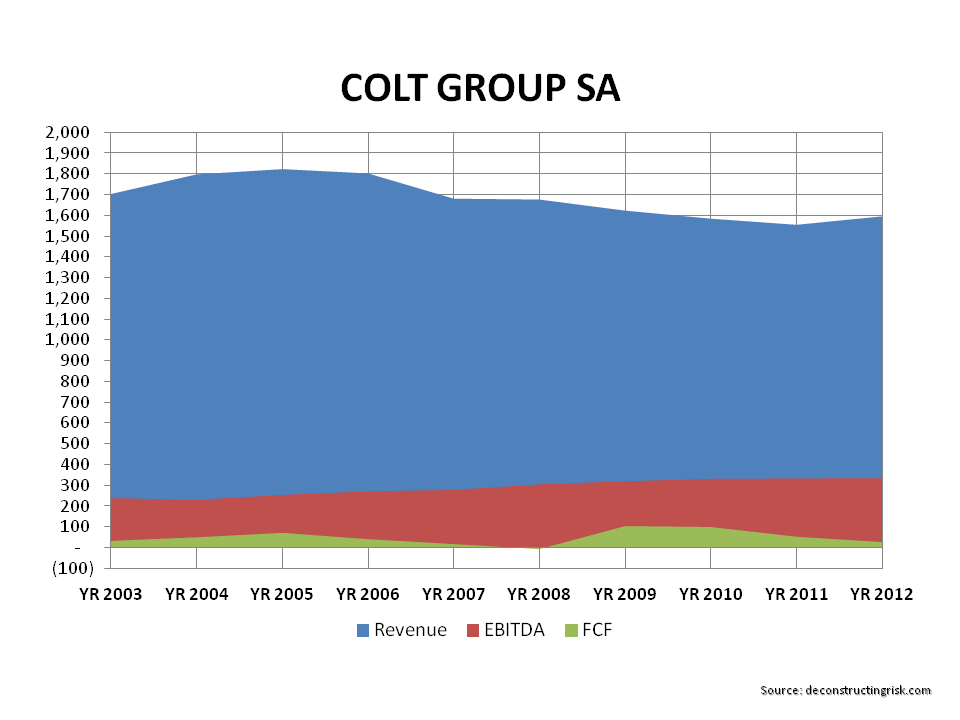
Against this background, I had a quick look over COLT Group SA, previously COLT Telecom, one of the start-up pan European telecoms from the heady days of the telecom bubble in the late 1990s/early 2000s. A previous post on the telecom sector touched on the past of COLT and the graph below shows the firm’s operating history to YE2012 and illustrates the pressure on cash-flow (e.g. EBITDA less capital expenditure) as a result of the changes COLT have undertaken since the mid-2000s to focus on being a pure pan-European data and managed services provider.

click to enlargeCOLT 2003 to 2012 Operating History

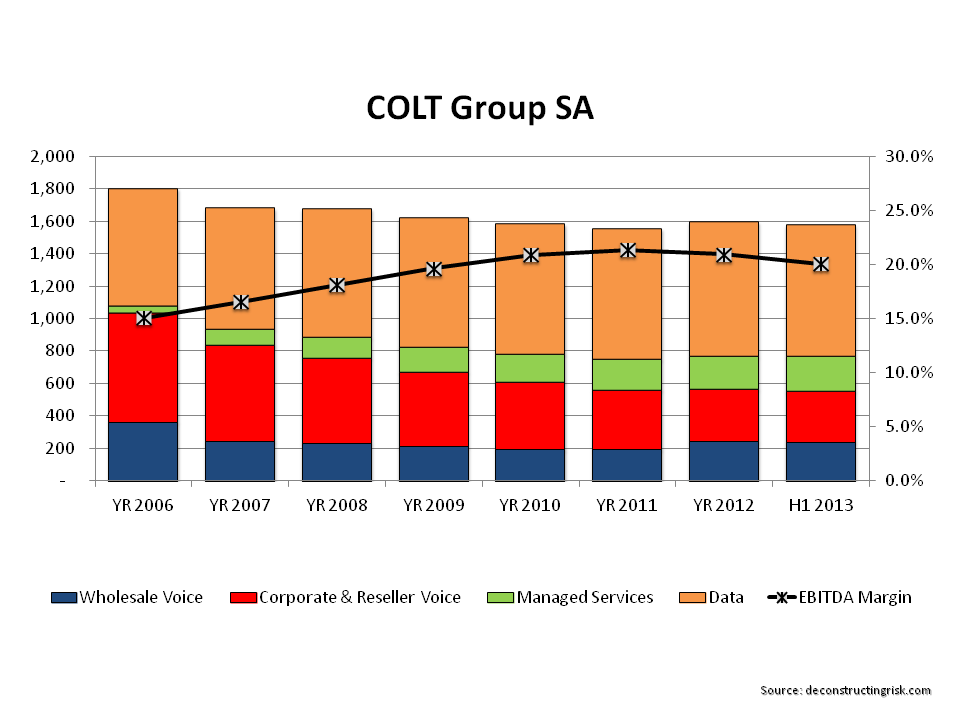
Digging a bit deeper, the breakdown of revenue by source shows that COLT has been making progress in reducing their exposure to lower margin voice revenues. However, annualising H1-2013 results shows that progress on EBITDA margins has slowed in the highly competitive sector and that returns on investment have yet to materialise operationally in a significant manner.

click to enlargeCOLT 2006 to H12013 Revenue Breakdown & EBITDA Margin

COLT is debt free but cash has reduced to €160 million as at Q3 (from €280m at YE 2012 & €340m at YE 2011) due to data centre infrastructure expense. COLT’s valuation, at below 5 times EBITDA, is less than many in the sector and also below recent acquisition multiples such as Deutsche Telecom’s purchase of GTS Central Europe for approx 6.3 times EBITDA. However, for me, recent sluggish revenue growth and EBITDA margins show that COLT still has much to prove in demonstrating the success of its investment in its strategy.

On the upside, a firm like COLT may get caught up in M&A speculation with someone like Vodafone looking to buy fixed line assets in Europe.

High Beta Delight: Level 3 at $30

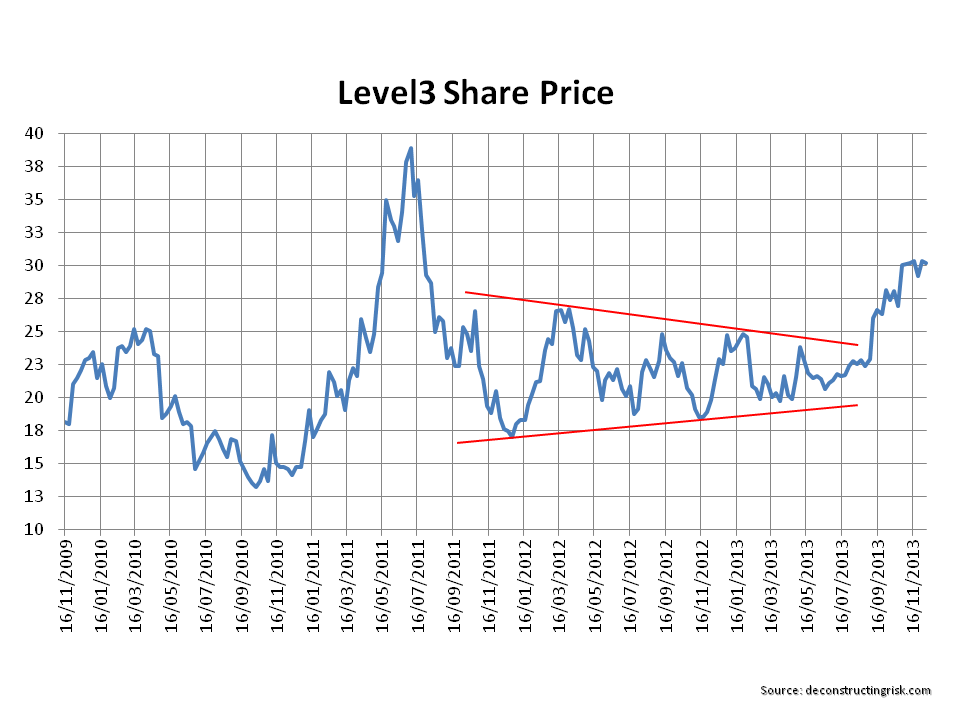
Following up on a previous post, Level 3 Communications (LVLT) has had a good run since June, breaking out of its trading range and holding around $30. Over the past 2 years, a successful trading strategy on LVLT would have been buying around $20 and selling in the high twenties, so I would expect traders of LVLT to take some profits (also there may be more shares on the market towards the end of the month after LVLT recently called some convertible debt). Given the historical volatility in LVLT and the market high valuations, a pull-back seems inevitable in the short term although over the medium term I have an increasing conviction that the future for LVLT’s long suffering equity holders is bright.

click to enlargeLevel3 Share Price

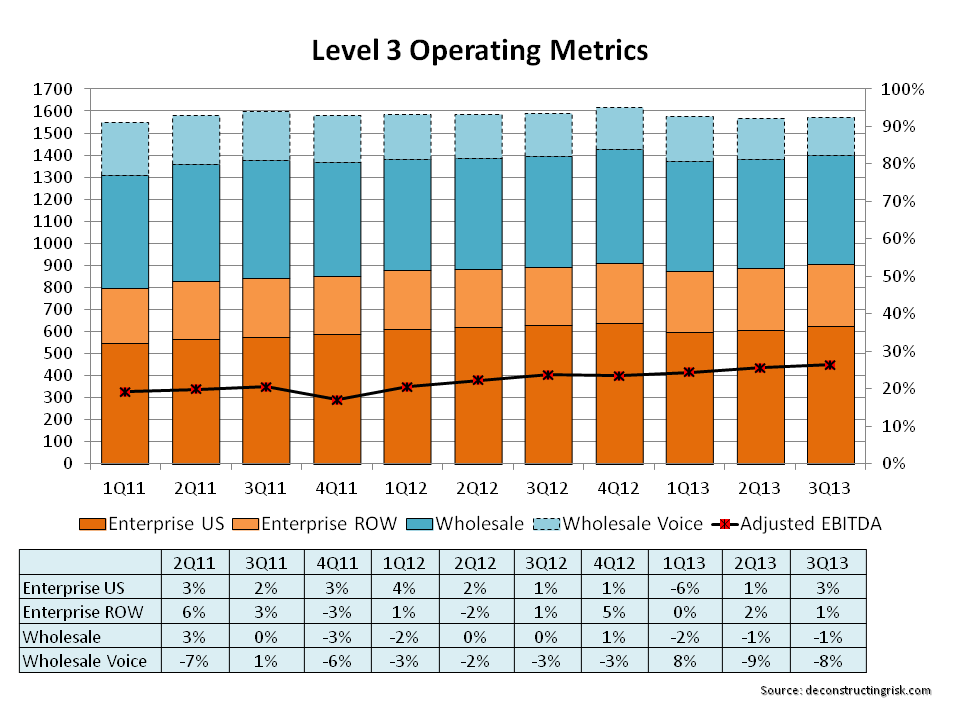
The recent increase has been driven by improving operating metrics, as per the graph on revenues and EBITDA margin below, and improved valuation multiples in the sector, as can be seen from a graphic on telecomrambings, plus the general increase in market valuations.

click to enlargeLevel3 Operating Metrics November 2013

LVLT has also been working hard on getting its oversized debt load (as at Q3 net debt was approx $8 billion) down to a more manageable size. To date in Q4, the firm managed to refinance approx $1 billion of debt and convert another $200 million. As LVLT achieves sustainable FCF in 2014, a virtuous circle of increased operating margins and reduced debt servicing may follow, vastly improving the credit profile of this once basket case (credit risk wise). The debt tinkering should reduce the average interest rate by 30 bps to 6.9% for year end and, assuming 2014 EBITDA of $1.8 billion, will reduce the net debt to EBITDA multiple from the current 5.2 to a more manageable 4.4.

The analysts have all increased their targets on the back of the recent results under the new leadership of Jeff Storey. UBS AG, Canaccord and DA Davidson are at $30, Goldman Sachs has $34, Cowen has $39, Deutsche Bank is at $40 (although this includes $8 of NOLs).

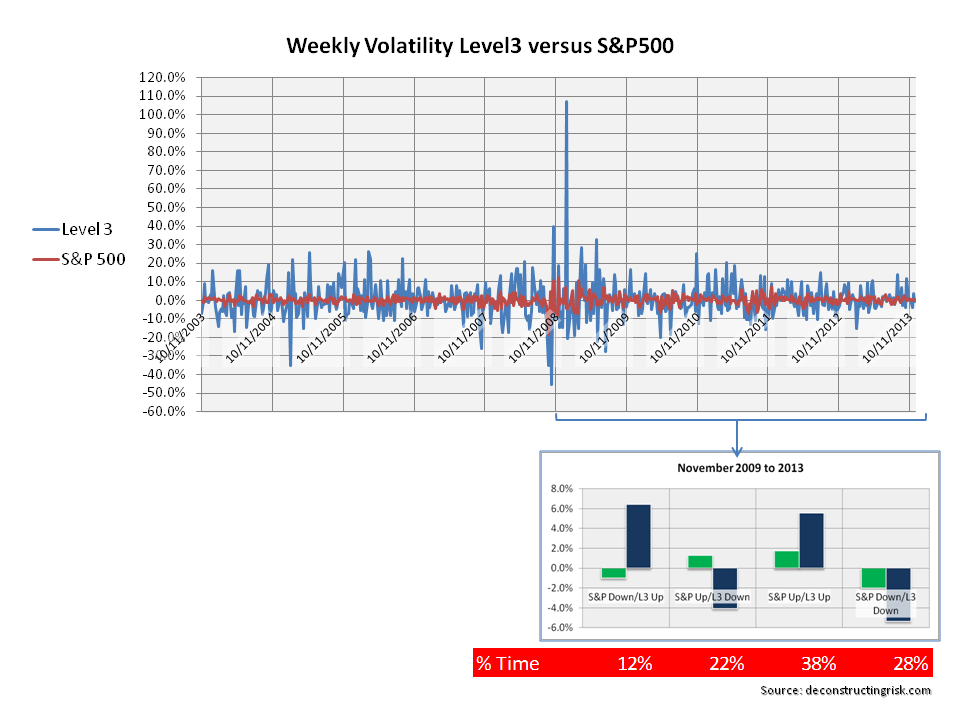
It’s important to again stress that LVLT has a very volatile history and is not for the weak hearted. YahooFinance calculates the current beta for LVLT at 1.8. The graph below illustrates historical weekly volatility versus the S&P500. There is also an analysis of the relationship between the S&P500 and LVLT since 2009 – LVLT moved with the market 66% of the time (3.2 times on average the market move on the way up and 2.7 times on the way down!), 22% of the time when the S&P was up LVLT was down (by a factor of 3!), and 12% of the time when the S&P was down LVLT was up (by a factor of 6.5!).

click to enlargeMonthly Volatility Level 3 S&P500 2003 to 2013

In an update of the highly influential paper by Andrea Frazzini and Lasse Pedersen called “Betting against Beta”, the authors test a number of investing strategies around beta and state that ”we find empirically that portfolios of high-beta assets have lower alphas and Sharpe ratios than portfolios of low-beta assets”. Although I would caution about short term volatility and an overexcited US equity market currently, I am hopeful that the days of LVLT being a pin-up for the high beta side are numbered.

Level 3 Options

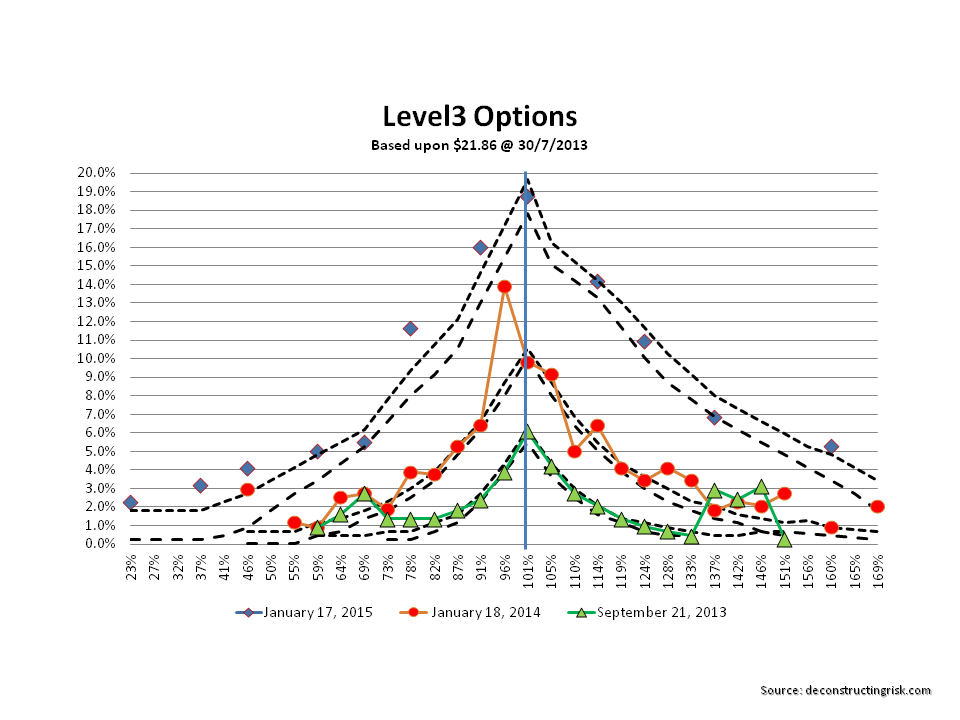
Following on from my post on Level3 and prior to their quarterly results tom0rrow, I thought it was opportune to have a look at the current option pricing for Level3. With data sourced from Yahoo (which generally needs to be treated with caution), the contrast with the liquid Apple options outlined in another post could not be greater. Liquidity is a major issue to consider when looking at options for a firm like Level3. Like the stock itself, illiquid options on a historically volatile stock is not for the faint hearted. That said, the recent stability of the underlying stock over the past 18 months does potentially offer value by way of option pricing formula if Level3 is finally about to deliver on its potential.

click to enlarge 

Level 3 options July 2013

I don’t expect anything major from Level3 tomorrow and would take the selections of Robert Powell at Telecom Ramblings as a reasonable expectation. The long term key for Level3 is sustainable revenue growth but I would be happy with continued marginal movement on costs and EBITDA margin for now.

New valuation realities

As the market pulls back again this week in a much-needed dose of worry about where QE is leading us and how it will end, there is another interesting article from Buttonwood in this week’s Economist. Based upon work of analysts in investment banks BNP Paribas, Société Générale, and Goldman Sachs (Andrew Lapthorne of SG does high quality analysis and his work generally makes for insightful reading), the article highlights how valuations based upon price to book ratios have broken with pre-crisis history and currently differentiate more acutely between “quality” stocks (depending upon varying criteria as applied by the said analysts).

The article highlights the limited pool of “quality” stocks no-matter what criteria is used and Buttonwood also makes a point (which I fully agree with), namely that “investors have been flocking to equities because interest rates are so low; some, perhaps, on the naive view that using a lower discount rate on future cashflows translates into higher share prices today“.

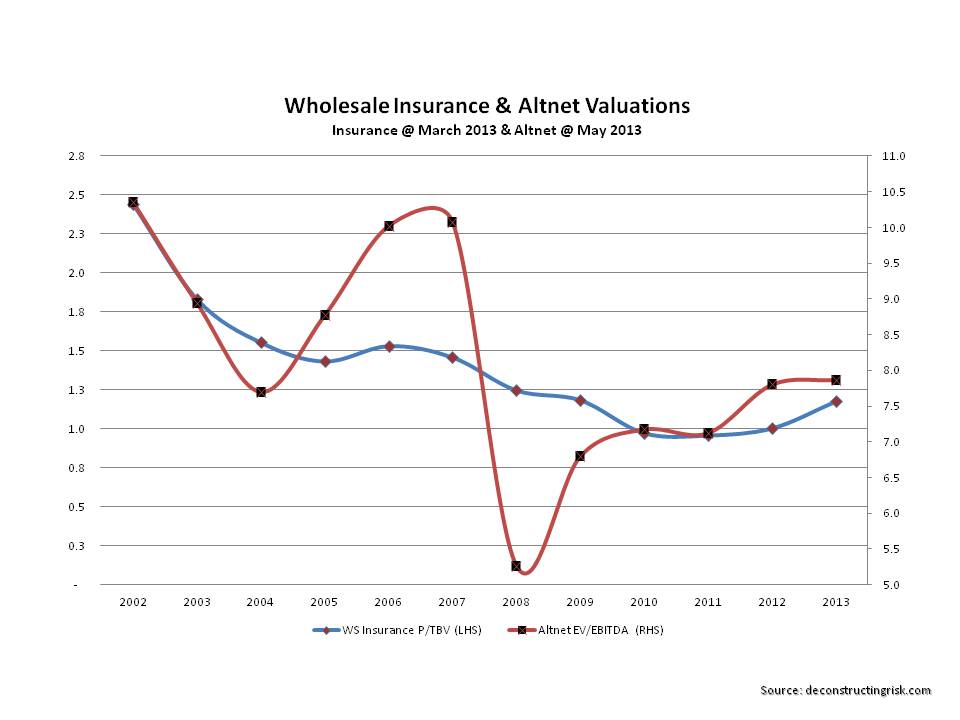
As readers of this blog will be aware, two sectors that I follow are the wholesale insurance and the alternative telecom sectors. In previous posts, I have presented my historical valuation metrics for both sectors (albeit from limited samples) and they are combined in the graph below (one based upon price to tangible book, the other an EV/ebitda metric). The alternative telecom sector is as far away from any “quality” stock criteria that one could imagine and would be in the lowest quintile (on volatility alone!) of any sensible criteria. Although results are volatile by definition in the wholesale insurance sector, some of the bigger names like Munich Re may get higher ratings, maybe a 2 or 3 on Buttonwood’s graph.

click to enlarge

wholesale insurer & altnet valuation metric comparison

The main point I am trying to make in this post is that relying on valuations returning to levels prior to the financial crisis for certain sectors is just not realistic or sensible. Unless the market goes into fantasy land on the upside (this may seem idle speculation given the market’s current mood but just think where sentiment was a few short weeks ago), the differentiation currently been made in the market between business models and their inherent volatility is rational. The worry, as the article points out, is that there is not enough “quality” stocks around currently to wet the appetite of hungry investors and historically that has been a negative indicator for future stock returns.

Will it be different for Level3 this time?

As per my previous post on telecom experiences, I reviewed my projections and valuation methodology for Level3. Level3 has a frustrating yet fascinating past. It miraculously survived the telecom implosion with an over sized debt load through growing into its debt by buying up smaller metro focused telecoms and its most recent merger with a post chapter 11 Global Crossing.

Level 3 struggled with the integration of its numerous merger partners from 2005 to 2007 and, with the downturn in 2008 to 2010, suffered reductions in the both of the top and bottom lines of the combined entities. There is however now some hope that the integration with Global Crossing will not suffer the same fate. For a start, Level3 approached the integration with a much sharper focus on the customer experience during the merger and ensuring minimal service disruptions. Also, Global Crossing itself had a number of years following its restructuring where it focused on its core products and de-emphasised the low margin commodity business. Finally, the recent replacement of long time CEO Jim Crowe with the COO Jeff Storey seems to have brought a new focus in the company on growing the larger business organically rather than through continuous M&A.

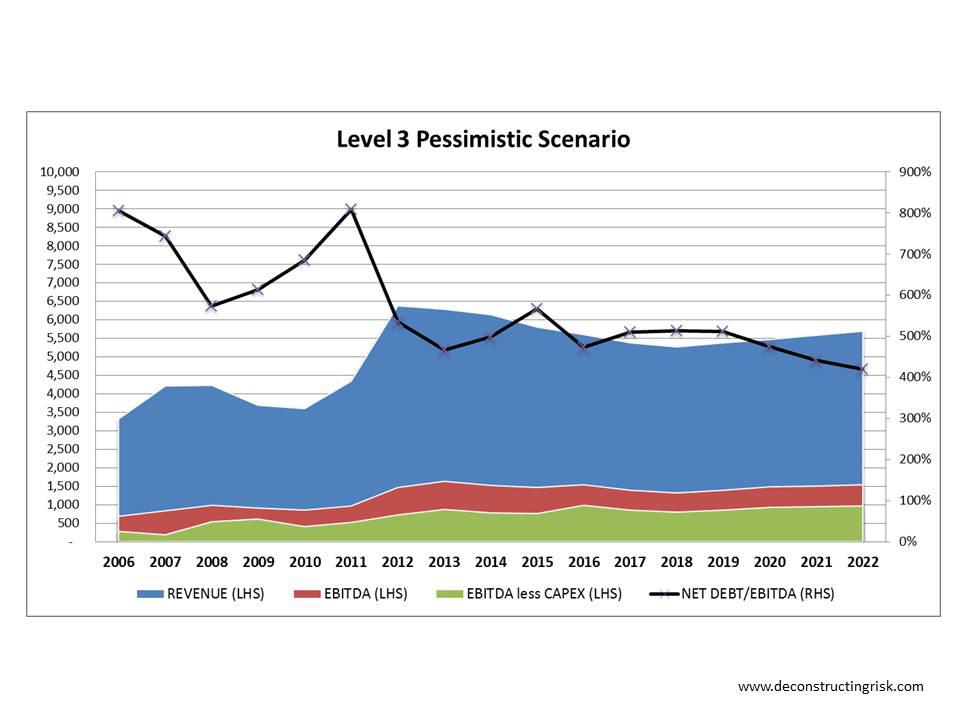
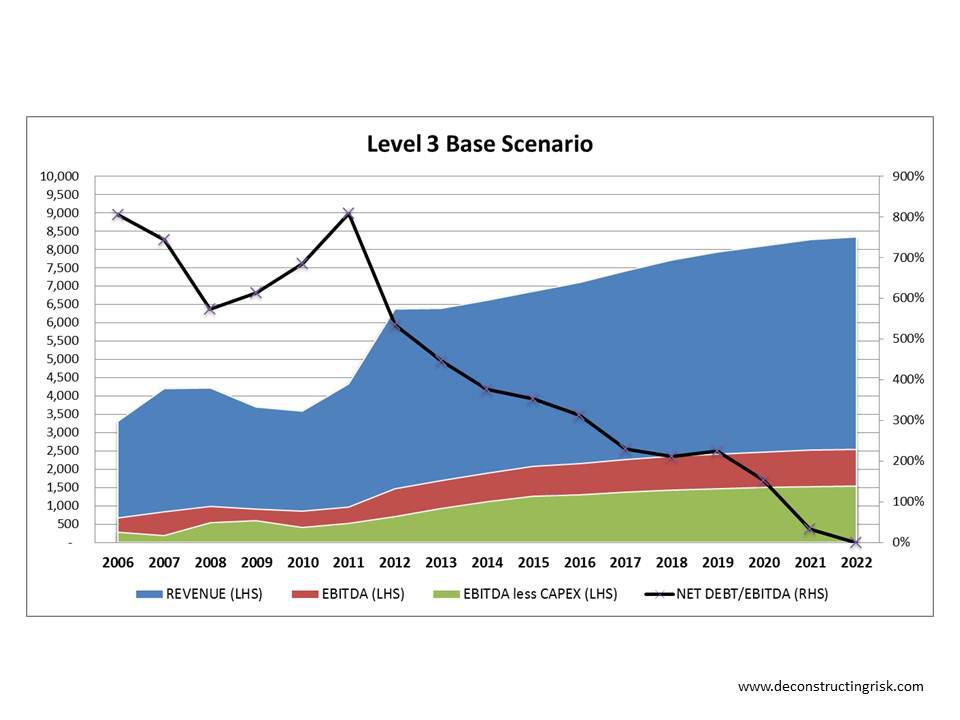
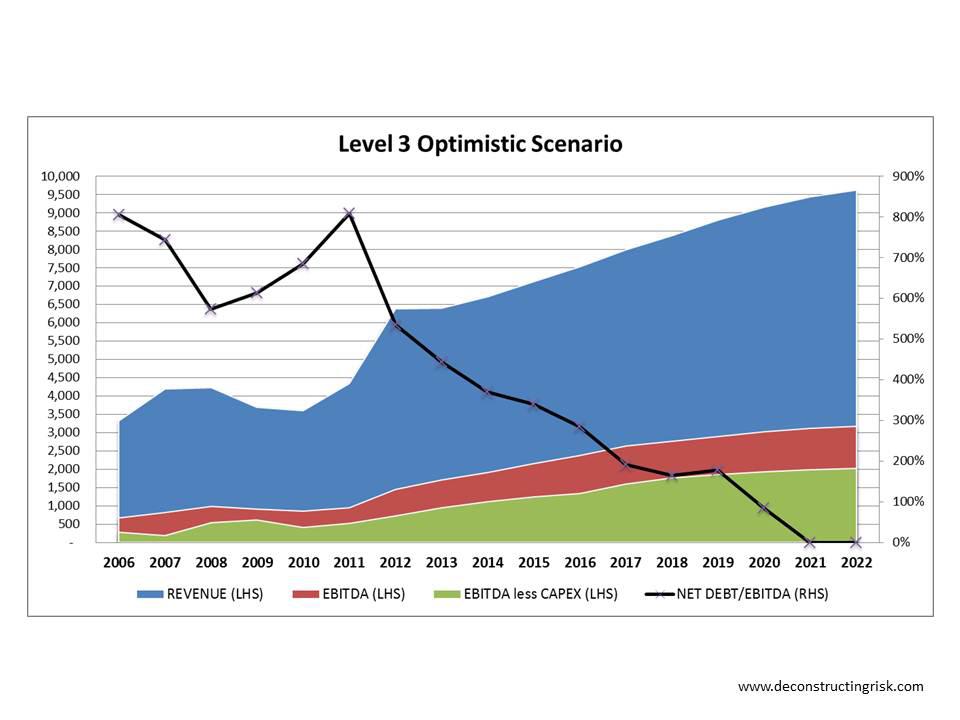
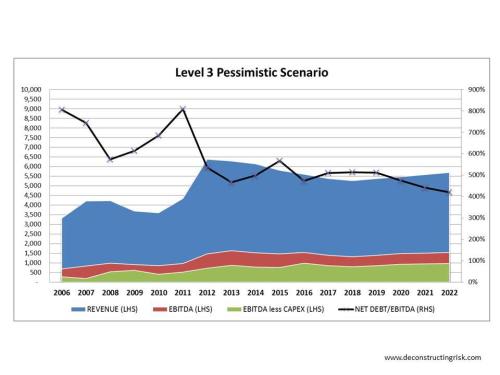
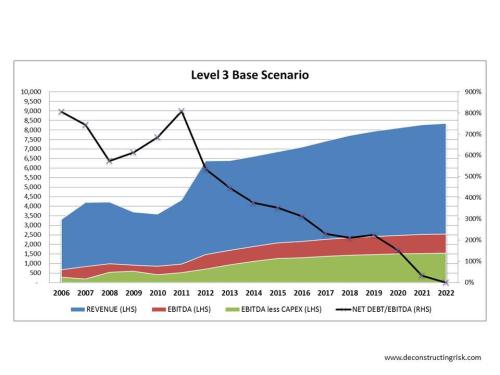
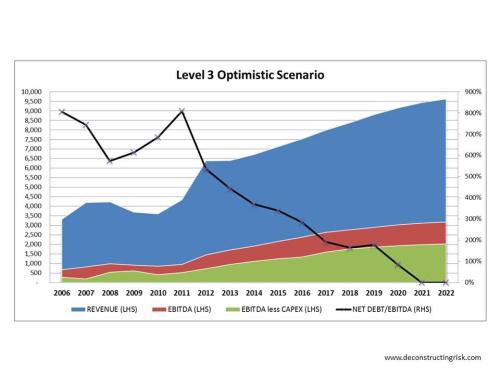
I developed 3 scenarios to illustrate the benefits and the dangers of the current Level3 leveraged business model. The pessimistic scenario assumes that Level3 does not succeed in growing the top line and stumbles on achieving material ebitda margin improvement, only managing margins in the middle 20’s range. The base scenario assumes that Level3 does grow its higher margin business modestly (against a stodgy economic background with interest rates gradually stepping up over the medium term) which offsets reductions in voice based business, achieving an ebitda margin around 30% in the medium term. The optimistic scenario assumes Level3 gets on-going synergies and material ebitda margin improvement achieving a 33% margin by 2017 and thereafter. Graphs representing the scenarios are below and also show the resulting leverage ratios the business achieves.

LVLT Projection Pessimistic Scenario (click to enlarge)Level3 Pessimistic
LVLT Projection Base Scenario (click to enlarge)Level3 Base
LVLT Projection Optimistic Scenario (click to enlarge)Level3 Optimistic
The pessimistic scenario assumes that Level3 can’t get its leverage materially below 500% and would ultimately need to be restructured. Assuming the equity would be wiped out here may be conservative given the equity’s history to date at higher leverage levels. Also, a takeover may give the equity some value in this scenario. Notwithstanding these possibilities, the pessimistic scenario does illustrate the dangers to investing in a highly leveraged firm and given the current macro-economic headwinds and the likely higher interest rate environment to come, I believe an equity wipe-out remains a risk for Level3 in a pessimistic scenario.

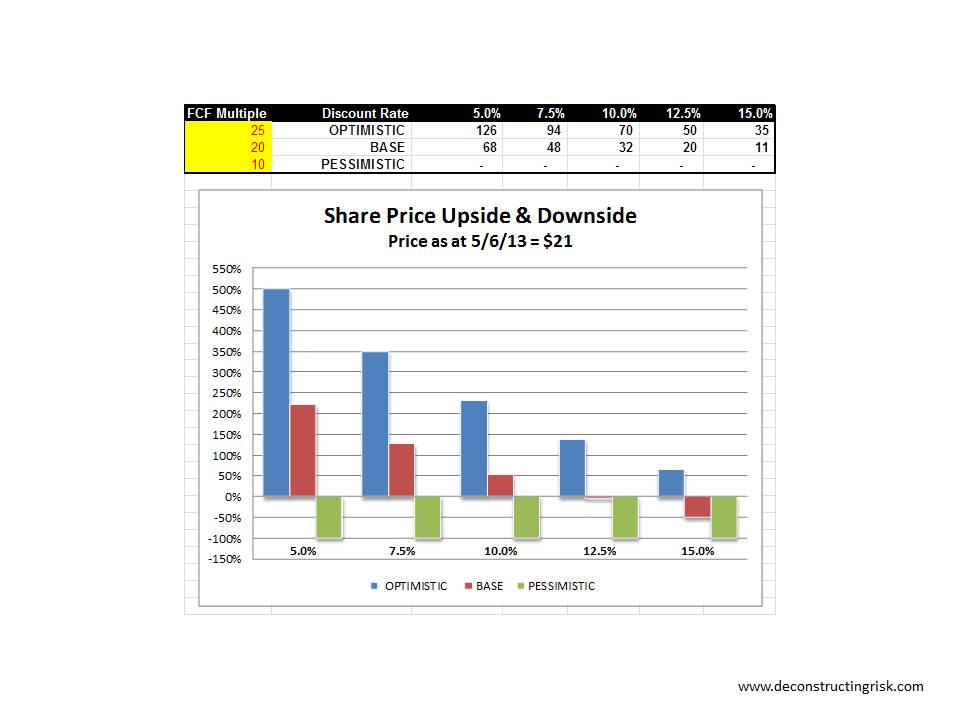
The thin line between madness and sanity for highly leveraged firms is illustrated by the upside that modest and healthy growth of both bottom and top lines could result in the base and optimistic scenarios respectively. The following table shows the DCF results at discount rates ranging from 5% to 15%. The discounted cash-flow analysis assumes a termination multiple of discounted free cash-flow after 10 years in 2022 (different multiples for each scenario). As I stated in the previous telecom post, I take the results of a DCF analysis for these firms with a healthy pinch of salt given the timeframe involved and the number of assumptions that have to be made (e.g. cost of debt). Focussing on a discount rate of between 7.5% and 12.5% (which is where I think LVLT should be) does show that the leveraged business model of Level3 provides a 2 to 3 times upside against a 100% downside risk profile (assuming a current $21 per share price).

Summary of DCF Analysis (click to enlarge)
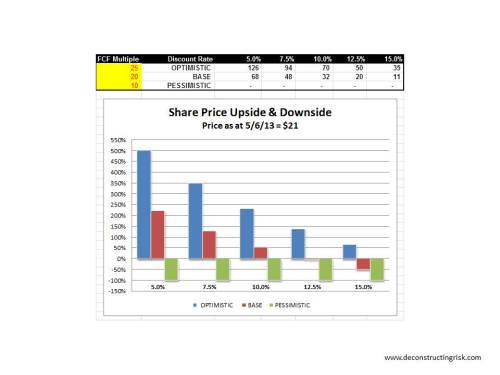
LVLT Share Price Upside & Downside

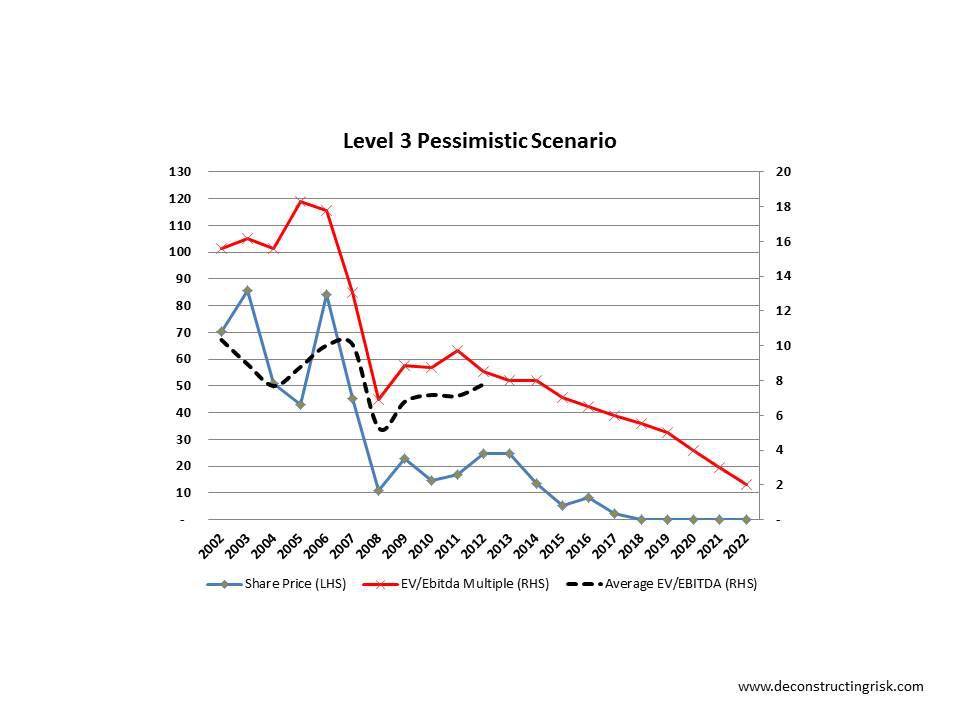
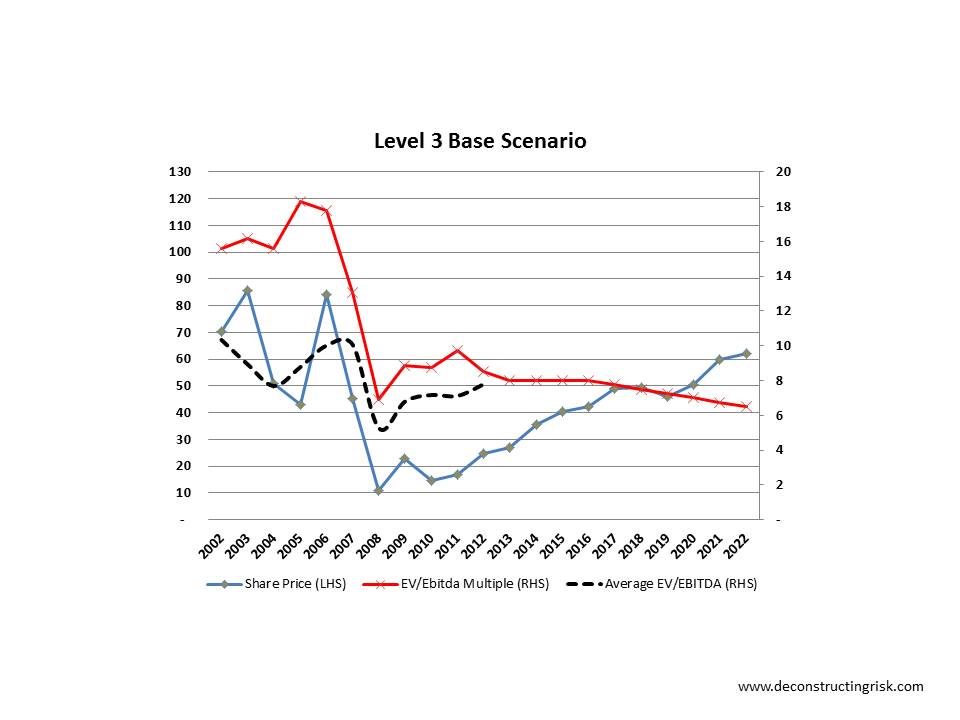
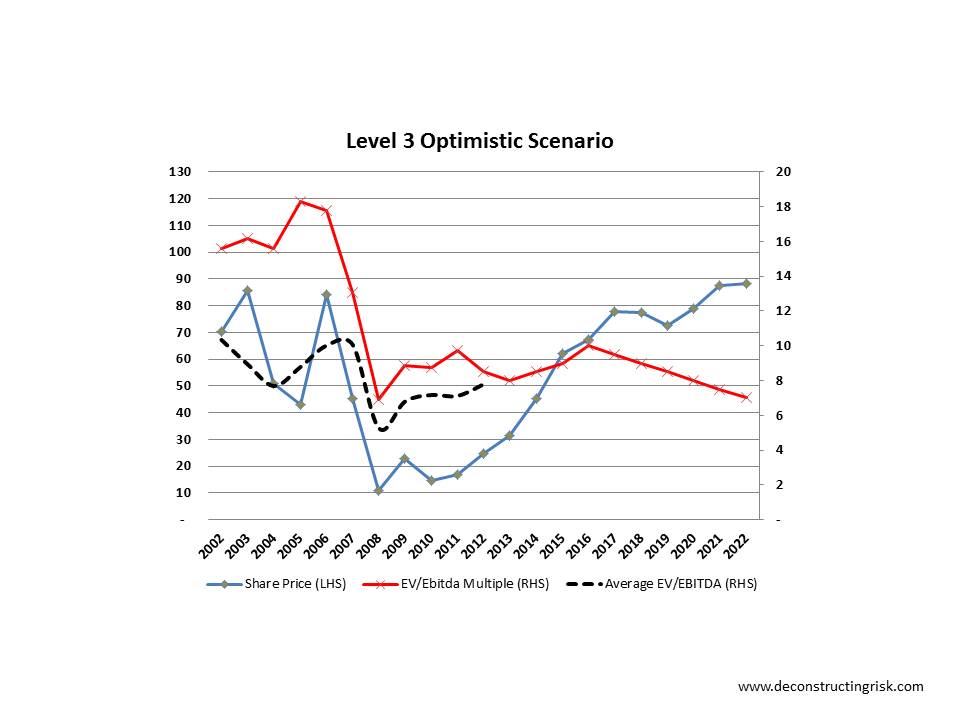
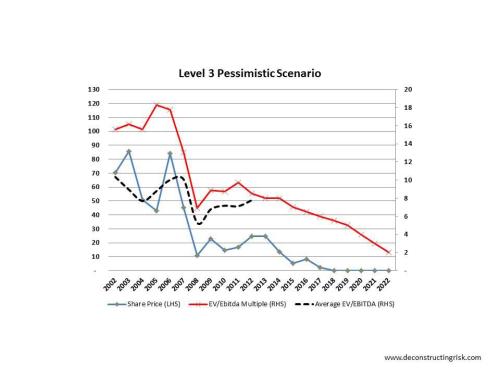
An alternative valuation method is to look at the EV/EBITDA multiple valuation that the scenarios above may imply. This analysis confirms a possible 200% to 300% upside for the base and optimistic scenarios respectively over a 5 year time horizon (and the 100% downside!).

EV/EBITDA Projection Pessimistic Scenario (click to enlarge)Level3 Pessimistic EV EBITDA multiple
EV/EBITDA Projection Base Scenario (click to enlarge)
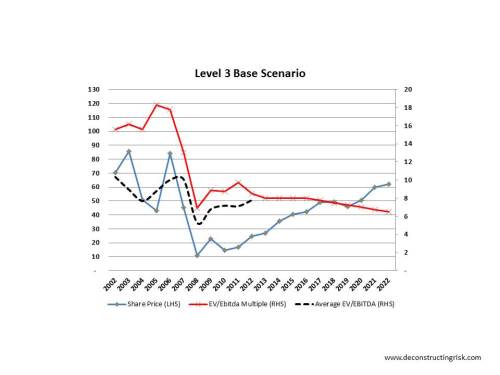
LVLT EVtoEBITDA Project BASE

EV/EBITDA Projection Optimistic Scenario (click to enlarge)
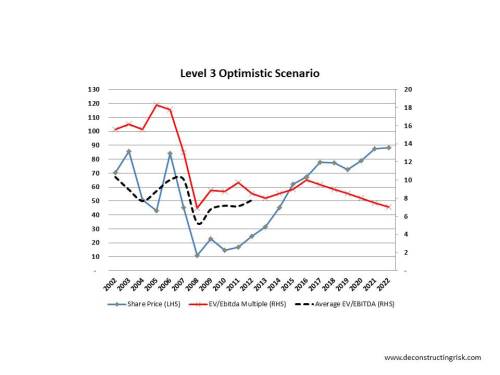
LVLT EVtoEBITDA Project OPT

Conclusion

Level3 has broken many hearts in the past. However, if the new CEO can execute on organic growth and margin improvement, the stock offers an attractive upside over the next few years due to its leveraged balance sheet and operating model. A lack of macro-economic turmoil will also be an important factor in any success. For even more aggressive investors, playing the stock through long dated out of the money options offers the prospect of leveraging returns even further (with the accompanying increase in risk profile). As I keep stating, Level3 has promised much in the past and failed to deliver on a spectacular basis. This time, maybe, just maybe, it could deliver something for patient investors. Anybody considering Level3 should always keep in mind that it remains a high risk/return play and is not for the faint hearted.