Tag Archives: climate change

Will the climate change debate now move forward?

The release of the synthesis reports by the IPCC – in summary, short and long form – earlier this month has helped to keep the climate change debate alive. I have posted (here, here, and here) on the IPCC’s 5th assessment previously. The IPCC should be applauded for trying to present their findings in different formats targeted at different audiences. Statements such as the following cannot be clearer:

“Anthropogenic greenhouse gas (GHG) emissions have increased since the pre-industrial era, driven largely by economic and population growth, and are now higher than ever. This has led to atmospheric concentrations of carbon dioxide, methane and nitrous oxide that are unprecedented in at least the last 800,000 years. Their effects, together with those of other anthropogenic drivers, have been detected throughout the climate system and are extremely likely to have been the dominant cause of the observed warming since the mid-20th century.”

The reports also try to outline a framework to manage the risk, as per the statement below.

“Adaptation and mitigation are complementary strategies for reducing and managing the risks of climate change. Substantial emissions reductions over the next few decades can reduce climate risks in the 21st century and beyond, increase prospects for effective adaptation, reduce the costs and challenges of mitigation in the longer term, and contribute to climate-resilient pathways for sustainable development.”

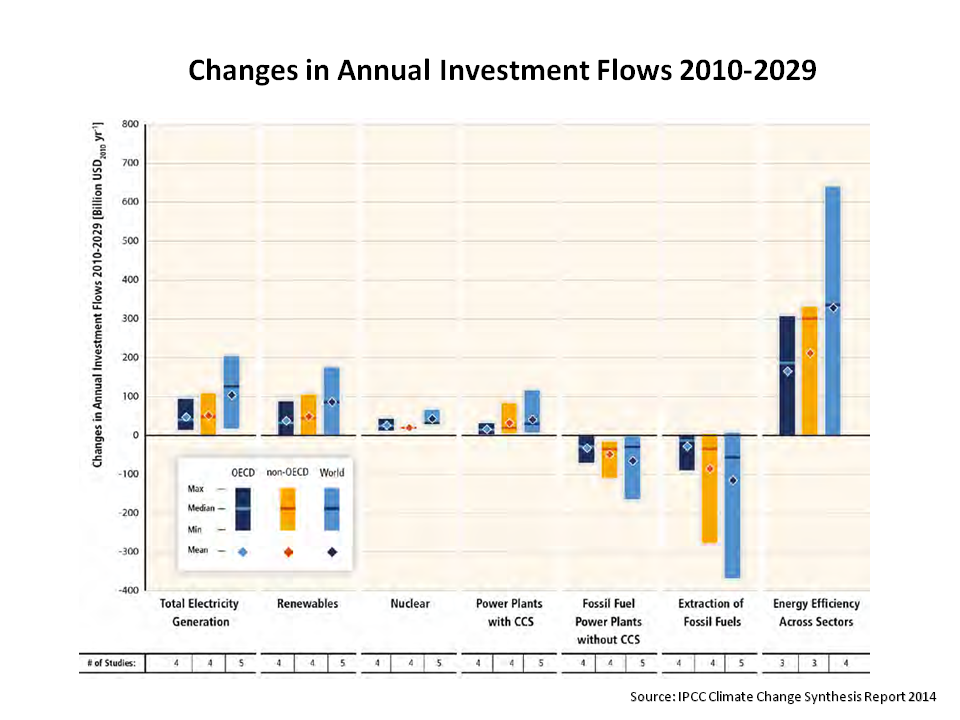
The IPCC estimate the costs of adaptation and mitigation of keeping climate warming below the critical 2oC inflection level at a loss of global consumption of 1%-4% in 2030 or 3%-11% in 2100. Whilst acknowledging the uncertainty in their estimates, the IPCC also provide some estimates of the investment changes needed for each of the main GHG emitting sectors involved, as the graph reproduced below shows.

click to enlargeIPCC Changes in Annual Investment Flows 2010 - 2029
The real question is whether this IPCC report will be any more successful that previous reports at instigating real action. For example, is the agreement reached today by China and the US for real or just a nice photo opportunity for Presidents Obama and Xi?

In today’s FT Martin Wolf has a rousing piece on the subject where he summaries the laissez-faire forces justifying inertia on climate change action as using the costs argument and the (freely acknowledged) uncertainties behind the science. Wolf argues that “the ethical response is that we are the beneficiaries of the efforts of our ancestors to leave a better world than the one they inherited” but concludes that such an obligation is unlikely to overcome the inertia prevalent today.

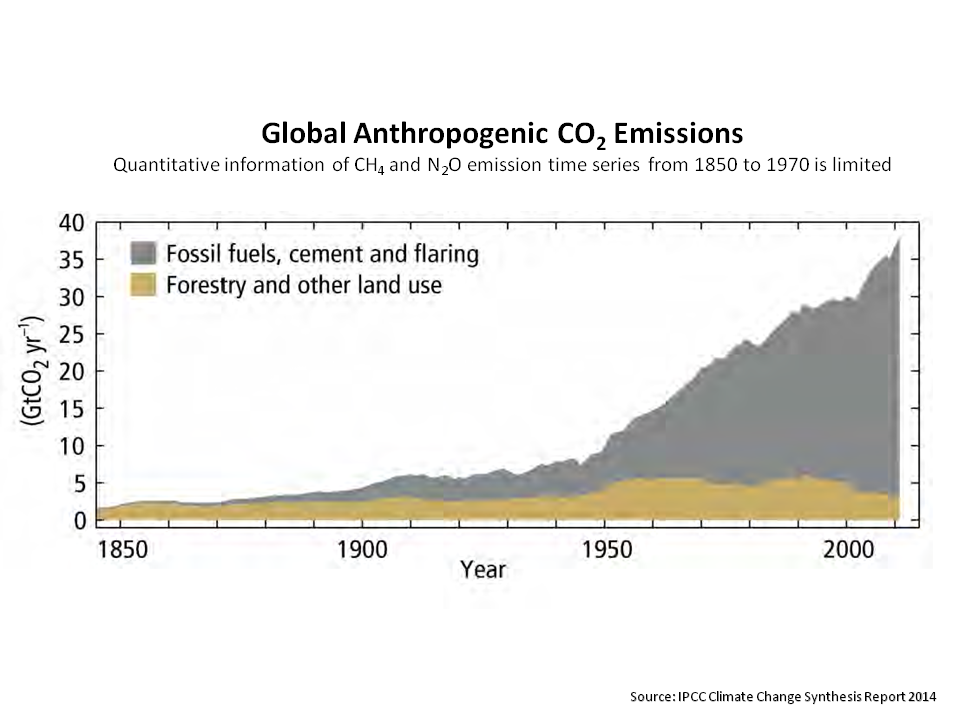
I, maybe naively, hope for better. As Wolf points out, the costs estimated in the reports, although daunting, are less than that experienced in the developed world from the financial crisis. The costs don’t take into account any economic benefits that a low carbon economy may result in. Notwithstanding this, the scale of the task in changing the trajectory of the global economy is illustrated by one of graphs from the report, as reproduced below.

click to enlargeIPCC global CO2 emissions
Although the insurance sector has a minimal impact on the debate, it is interesting to see that the UK’s Prudential Regulatory Authority (PRA) recently issued a survey to the sector asking for responses on what the regulatory approach should be to climate change.

Many industry players, such as Lloyds’ of London, have been pro-active in stimulating debate on climate change. In May, Lloyds issued a report entitled “Catastrophic Modelling and Climate Change” with contributions from industry. In the piece from Paul Wilson of RMS in the Lloyds report, they concluded that “the influence of trends in sea surface temperatures (from climate change) are shown to be a small contributor to frequency adjustments as represented in RMS medium-term forecast” but that “the impact of changes in sea-level are shown to be more significant, with changes in Superstorm Sandy’s modelled surge losses due to sea-level rise at the Battery over the past 50-years equating to approximately a 30% increase in the ground-up surge losses from Sandy’s in New York.“ In relation to US thunderstorms, another piece in the Lloyds report from Ionna Dima and Shane Latchman of AIR, concludes that “an increase in severe thunderstorm losses cannot readily be attributed to climate change. Certainly no individual season, such as was seen in 2011, can be blamed on climate change.

The uncertainties associated with the estimates in the IPCC reports are well documented (I have posted on this before here and here). The Lighthill Risk Network also has a nice report on climate model uncertainty which concludes that “understanding how climate models work, are developed, and projection uncertainty should also improve climate change resilience for society.” The report highlights the need for expanding geological data sets beyond short durations of decades and centuries which we currently base many of our climate models on.

However, as Wolf says in his FT article, we must not confuse the uncertainty of outcomes with the certainty of no outcomes. On the day that man has put a robot on a comet, let’s hope the IPCC latest assessment results in an evolution of the debate and real action on the complex issue of climate change.

Follow-on comment: Oh dear the outcome of the Philae lander may not be a good omen!!!
IPCC Risk & Uncertainty

I haven’t had time to go into the latest WGIII IPCC report in detail (indeed I haven’t had much time recently to spend on blogging) but I had a quick browse through the report and there is an excellent chapter on “Integrated Risk and Uncertainty Assessment of Climate Change Response Policies” which goes through many of the key elements of current risk management theory and practise and how they can be applied to climate change.

A previous post highlighted the difficulties of making predictions given the uncertainties involved. The report highlights the “large number of uncertainties in scientific understanding of the physical sensitivity of the climate to the build‐up of GHGs” and acknowledges that these “physical uncertainties are multiplied by the many socioeconomic uncertainties that affect how societies would respond to emission control policies”. The report calls these socioeconomic uncertainties “profound” and lists examples as the development and deployment of technologies, prices for major primary energy sources, average rates of economic growth and the distribution of benefits and costs within societies, emission patterns, and a wide array of institutional factors such as whether and how countries cooperate effectively at the international level.

The IPCC gives a medium rating (50% probability) to the statement that the “current trajectory of global annual and cumulative emissions of GHGs is inconsistent with widely discussed goals of limiting global warming at 1.5 to 2 degrees Celsius above the preindustrial level”.

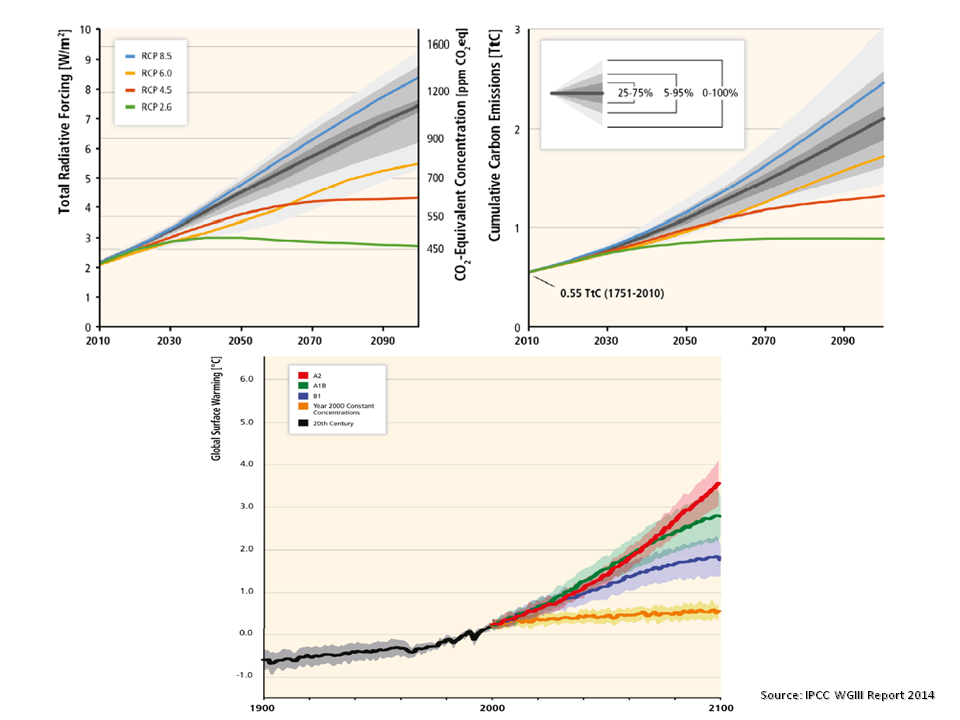
Included in Chapter 2 are the graphs below. According to the report “the representative concentration pathways (RCPs) are constructed by the IPCC on the bases of plausible storylines while insuring (1) they are based on a representative set of peer reviewed scientific publications by independent groups, (2) they provide climate and atmospheric models as inputs, (3) they are harmonized to agree on a common base year, and (4) they extend to the year 2100”. The 3 scenarios (A2, A1B and B1) are multi-model global averages of surface warming (relative to 1980–1999) shown as continuations of the 20th century simulations. Shading is the plus/minus one standard deviation range of individual model annual averages and the orange line is where concentrations were held constant at year 2000 values. Time permitting; it demonstrates that the conclusions and scenarios presented in the latest report are worth finding out more about.

click to enlargeIPCC global surface temperature scenarios from RCPs

Although each scenario is likely at the mercy of the uncertainties highlighted above, the open and thoughtful way the report is presented, including highlighting the underlying weaknesses, doesn’t mean that they (or the report) can be ignored. Indeed, the recent output from the IPCC will hopefully provide the basis for informed thinking on the subject in the coming years.

The report includes a reference to Kahneman-Tversky’s certainty effect where people overweight outcomes they consider certain, relative to outcomes that are merely probable. That implies that a 50% probability of the temperature blowing through 2 degrees celsius may not be enough to force real action. Unfortunately the underlying scientific and socioeconomic uncertainties inherent in making forecasts on temperature change over the next 30 to 50 years may mean that the required level of certainty cannot ever be achieved (until of course it’s too late).

The imperfect art of climate change modelling

The completed Group I report from the 5th Intergovernmental Panel on Climate Change (IPCC) assessment was published in January (see previous post on summary report in September). One of the few definite statements made in the report was that “global mean temperatures will continue to rise over the 21st century if greenhouse gas (GHG) emissions continue unabat­ed”. How we measure the impact of such changes is therefore incredibly important. A recent article in the FT by Robin Harding on the topic which highlighted the shortcomings of models used to assess the impact of climate change therefore caught my attention.

The article referred to two academic papers, one by Robert Pindyck and another by Nicholas Stern, which contained damning criticism of models that integrate climate and economic models, so called integrated assessment models (IAM).

Pindyck states that “IAM based analyses of climate policy create a perception of knowledge and precision, but that perception is illusory and misleading”. Stern also criticizes IAMs stating that “assumptions built into the economic modelling on growth, damages and risks, come close to assuming directly that the impacts and costs will be modest and close to excluding the possibility of catastrophic outcomes”.

These comments remind me of Paul Wilmott, the influential English quant, who included in his Modeller’s Hippocratic Oath the following: “I will remember that I didn’t make the world, and it doesn’t satisfy my equations” (see Quotes section of this website for more quotes on models).

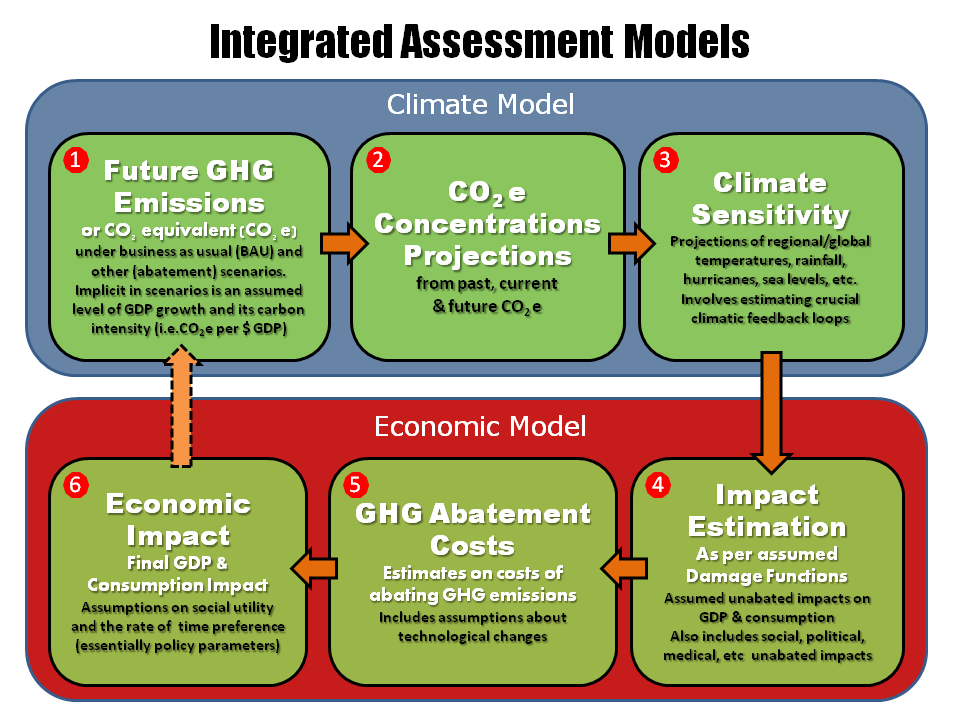
In his paper, Pindyck characterised the IAMs currently used into 6 core components as the graphic below illustrates.

click to enlargeIntegrated Assessment Models

Pindyck highlights a number of the main elements of IAMs which involve a considerable amount of arbitrary choice, including climate sensitivity, the damage and social welfare (utility) functions. He cites important feedback loops in climates as difficult, if not impossible, to determine. Although there has been some good work in specific areas like agriculture, Pindyck is particularly critical on the damage functions, saying many are essentially made up. The final piece on social utility and the rate of time preference are essentially policy parameter which are open to political forces and therefore subject to considerable variability (& that’s a polite way of putting it).

The point about damage functions is an interesting one as these are also key determinants in the catastrophe vendor models widely used in the insurance sector. As a previous post on Florida highlighted, even these specific and commercially developed models result in varying outputs.

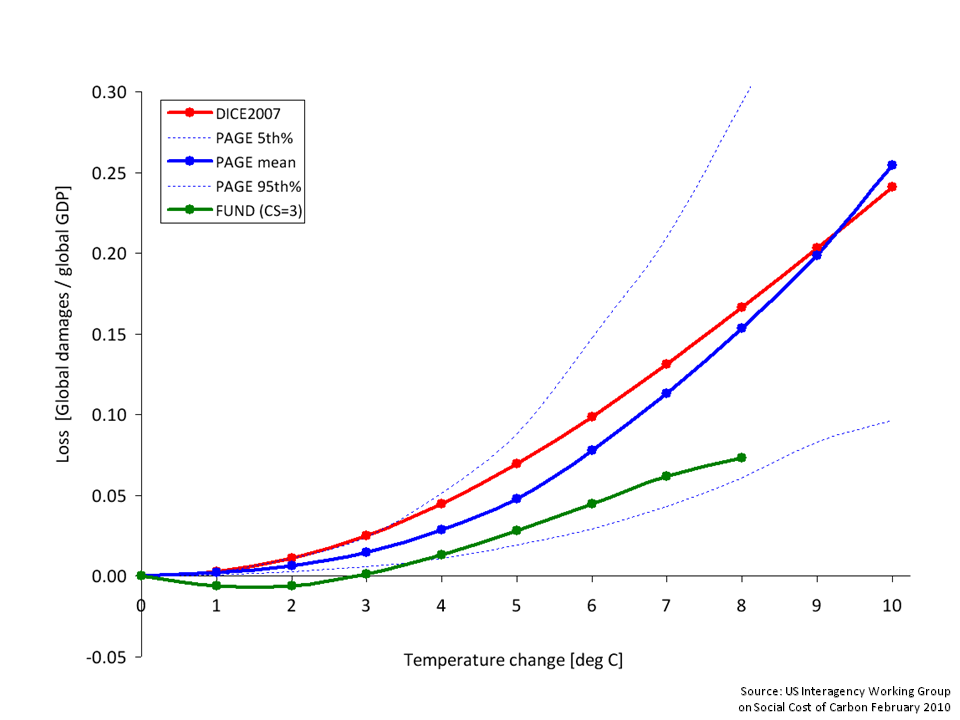
One example of IAMs directly influencing current policymakers is those used by the Interagency Working Group (IWG) which under the Obama administration is the entity that determines the social cost of carbon (SCC), defined as the net present damage done by emitting a marginal ton of CO2 equivalent (CO2e), used in regulating industries such as the petrochemical sector. Many IAMs are available (the sector even has its own journal – The Integrated Assessment Journal!) and the IWG relies on three of the oldest and most well know; the Dynamic Integrated Climate and Economy (DICE) model, the Policy Analysis of the Greenhouse Effect (PAGE) model, and the fun sounding Climate Framework for Uncertainty, Negotiation, and Distribution (FUND) model.

The first IWG paper in 2010 included an exhibit, reproduced below, summarizing the economic impact of raising temperatures based upon the 3 models.

click to enlargeClimate Change & Impact on GDP IWG SCC 2010

To be fair to the IWG, they do highlight that “underlying the three IAMs selected for this exercise are a number of simplifying assumptions and judgments reflecting the various modelers’ best attempts to synthesize the available scientific and economic research characterizing these relationships”.

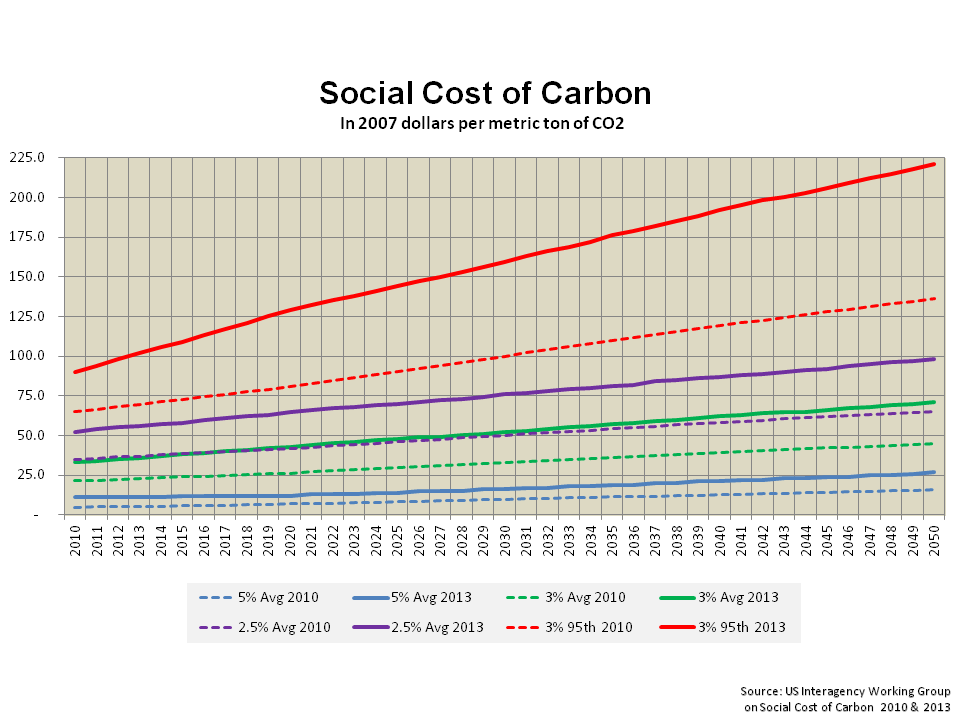
The IWG released an updated paper in 2013 whereby revised SCC estimates were presented based upon a number of amendments to the underlying models. Included in these changes are revisions to damage functions and to climate sensitivity assumptions. The results of the changes on average and 95th percentile SCC estimates, at varying discount rates (which are obviously key determinants to the SCC given the long term nature of the impacts), can be clearly seen in the graph below.

click to enlargeSocial Cost of Carbon IWG 2010 vrs 2013

Given the magnitude of the SCC changes, it is not surprising that critics of the charges, including vested interests such as petrochemical lobbyists, are highlighting the uncertainty in IAMs as a counter against the charges. The climate change deniers love any opportunity to discredit the science as they demonstrated so ably with the 4th IPCC assessment. The goal has to be to improve modelling as a risk management tool that results in sensible preventative measures. Pindyck emphasises that his criticisms should not be an excuse for inaction. He believes we should follow a risk management approach focused on the risk of catastrophe with models updated as more information emerges and uses the threat of nuclear oblivion during the Cold War as a parallel. He argues that “one can think of a GHG abatement policy as a form of insurance: society would be paying for a guarantee that a low-probability catastrophe will not occur (or is less likely)”. Stern too advises that our focus should be on potential extreme damage and that the economic community need to refocus and combine current insights where “an examination and modelling of ways in which disruption and decline can occur”.

Whilst I was looking into this subject, I took the time to look over the completed 5th assessment report from the IPCC. First, it is important to stress that the IPCC acknowledge the array of uncertainties in predicting climate change. They state the obvious in that “the nonlinear and chaotic nature of the climate system imposes natu­ral limits on the extent to which skilful predictions of climate statistics may be made”. They assert that the use of multiple scenarios and models is the best way we have for determining “a wide range of possible future evolutions of the Earth’s climate”. They also accept that “predicting socioeconomic development is arguably even more difficult than predicting the evolution of a physical system”.

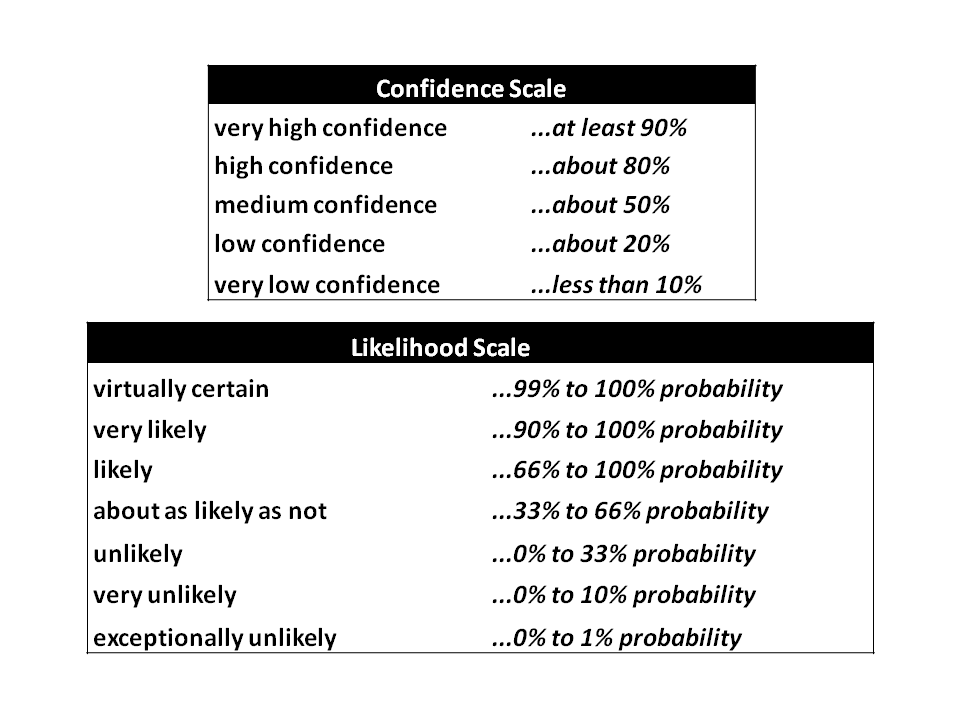
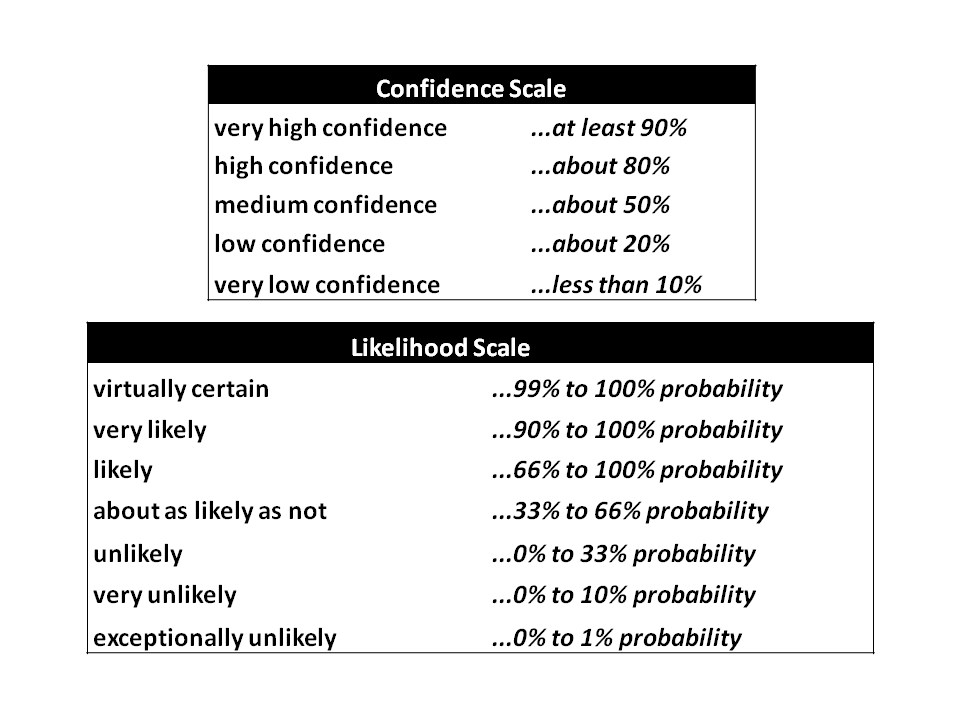
The report uses a variety of terms in its findings which I summarised in a previous post and reproduce below.

click to enlargeIPCC uncertainty

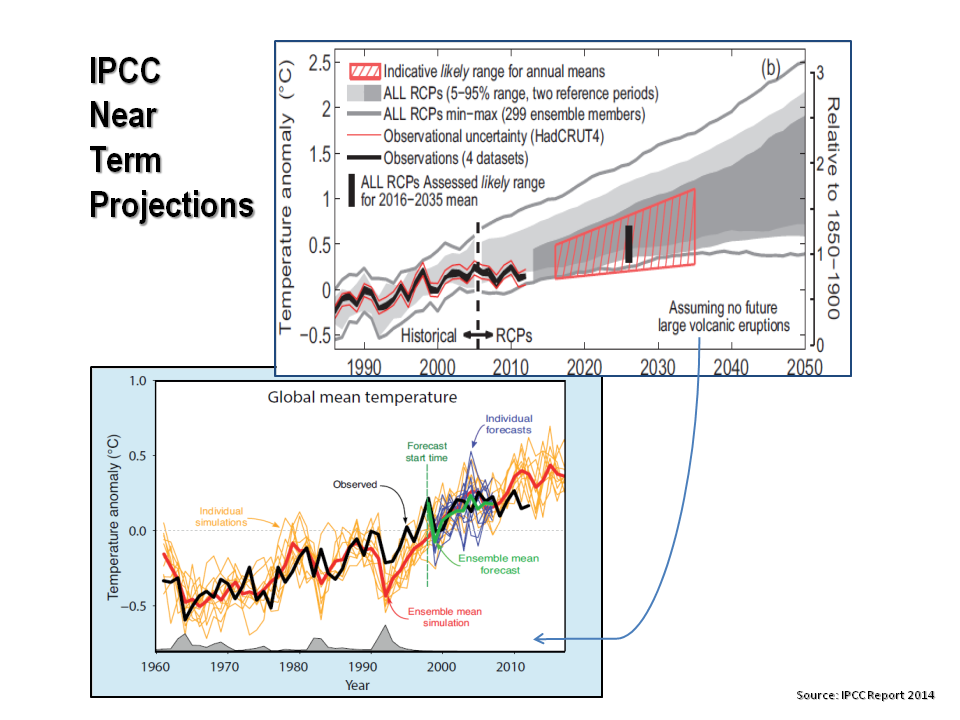
Under the medium term prediction section (Chapter 11) which covers the period 2016 to 2035 relative to the reference period 1986 to 2005, a number of the notable predictions include:

  • The projected change in global mean surface air temperature will likely be in the range 0.3 to 0.7°C (medium confidence).
  • It is more likely than not that the mean global mean surface air temperature for the period 2016–2035 will be more than 1°C above the mean for 1850–1900, and very unlikely that it will be more than 1.5°C above the 1850–1900 mean (medium confidence).
  • Zonal mean precipitation will very likely increase in high and some of the mid-latitudes, and will more likely than not decrease in the subtropics. The frequency and intensity of heavy precipitation events over land will likely increase on average in the near term (this trend will not be apparent in all regions).
  • It is very likely that globally averaged surface and vertically averaged ocean temperatures will increase in the near term. It is likely that there will be increases in salinity in the tropical and (especially) subtropical Atlantic, and decreases in the western tropical Pacific over the next few decades.
  • In most land regions the frequency of warm days and warm nights will likely increase in the next decades, while that of cold days and cold nights will decrease.
  • There is low confidence in basin-scale projections of changes in the intensity and frequency of tropical cyclones (TCs) in all basins to the mid-21st century and there is low confidence in near-term projections for increased TC intensity in the North Atlantic.

The last bullet point is especially interesting for the insurance sector involved in providing property catastrophe protection. Graphically I have reproduced two interesting projections below (Note: no volcano activity is assumed).

click to enlargeIPCC temperature near term projections

Under the longer term projections in Chapter 12, the IPCC makes the definite statement that opened this post. It also states that it is virtually certain that, in most places, there will be more hot and fewer cold temperature extremes as global mean temper­atures increase and that, in the long term, global precipitation will increase with increased global mean surface temperature.

I don’t know about you but it seems to me a sensible course of action that we should be taking scenarios that the IPCC is predicting with virtual certainty and applying a risk management approach to how we can prepare for or counteract extremes as recommended by experts such as Pindyck and Stern.

The quote “it’s better to do something imperfectly than to do nothing perfectly” comes to mind. In this regard, for the sake of our children at the very least, we should embrace the imperfect art of climate change modelling and figure out how best to use them in getting things done.

A quick look over the latest IPCC climate change assessment

After the debacle of the last report, the spotlight is back on climate change with the release of the new (fifth) assessment by the Intergovernmental Panel on Climate Change (IPCC). The financial crisis, combined with credibility issues over the last report as a result of errors found after publication, has meant that the issue has taken a back seat in recent years. This assessment is drawn from the work of 209 authors with 50 review editors from 39 countries and more than another 600 contributors from across the global scientific community. It will hopefully dispel the nut job climate change deniers and allow for a renewed focus on concrete actions that can be taken to address climate change issues.

The latest publication from IPCC yesterday is actually a summary of headline statements and a “summary for policymakers” from the IPCC Working Group I which makes an assessment of the physical scientific aspects of the climate change. A full draft report will be published in a few days and is expected to be finalised by late 2013 or early 2014. The two other working groups, creatively named IPCC Working Group II and III, are due to publish their reports in 2014 and are charged with assessments of vulnerability to climate change and options for mitigating the effects respectively.

The language used by IPCC is important. For some reason they use a number terms for uncertainty, as follows:IPCC uncertainty

The strongest (and most obvious) statement is:

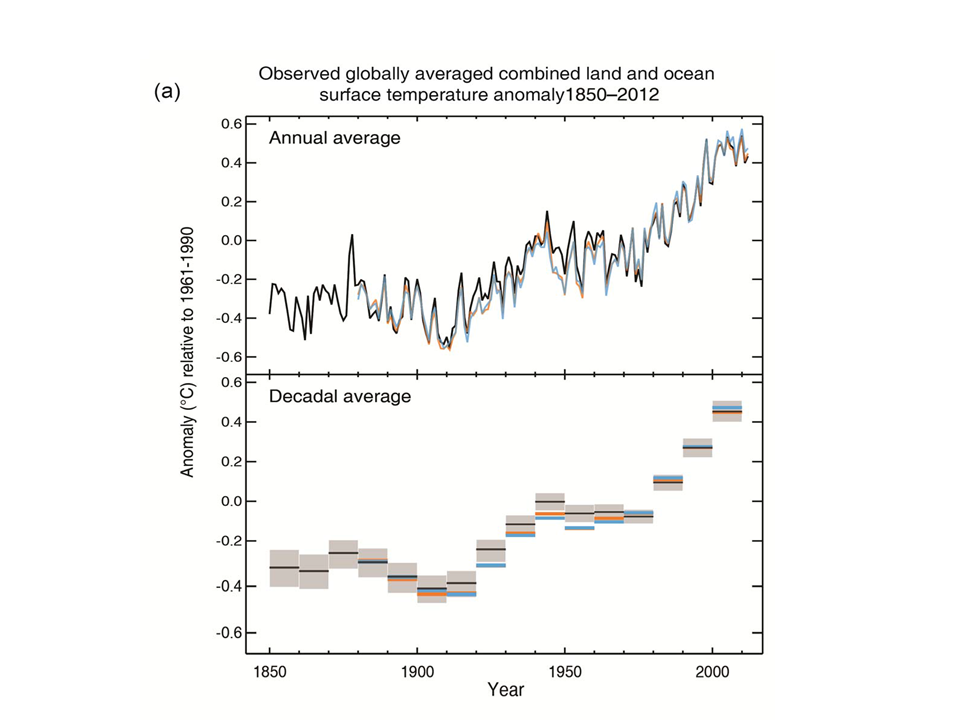
“Warming of the climate system is unequivocal, and since the 1950s, many of the observed changes are unprecedented over decades to millennia. The atmosphere and ocean have warmed, the amounts of snow and ice have diminished, sea level has risen, and the concentrations of greenhouse gases have increased.”

It does sound silly that it has taken us this many years for a statement like that to be made unequivocally but that’s the world we live in. A graph from the summary from WG I is below.

IPCC findings

A number of the headline statements that are being reported in the press are included below.

Very high confidence is assigned to the ability of climate models “to reproduce observed continental-scale surface temperature patterns and trends over many decades, including the more rapid warming since the mid-20th century and the cooling immediately following volcanic eruptions“.

High confidence is assigned to each of the following:

  • Ocean warming dominates the increase in energy stored in the climate system, accounting for more than 90% of the energy accumulated between 1971 and 2010.
  • Over the last two decades, the Greenland and Antarctic ice sheets have been losing mass, glaciers have continued to shrink almost worldwide, and Arctic sea ice and Northern Hemisphere spring snow cover have continued to decrease in extent.
  • The rate of sea level rise since the mid-19th century has been larger than the mean rate during the previous two millennia.

Medium confidence is assigned to the assertion that in “the Northern Hemisphere, 1983–2012 was likely the warmest 30-year period of the last 1400 years.

Other strong statements include the following section (by the way, I think extremely likely is yet another new term meaning over 95% probability!):

“It is extremely likely that human influence has been the dominant cause of the observed warming since the mid-20th century. Continued emissions of greenhouse gases will cause further warming and changes in all components of the climate system. Limiting climate change will require substantial and sustained reductions of greenhouse gas emissions.”

The summary documents also refer to the scenarios used, including four new scenarios, to assess impacts on items including CO2, temperature, sea levels and temperatures. The full draft assessment and next year’s WG II and III reports will likely give more detail.

There is a few intriguing assertions in the report although they are subject to final copyedit.

Medium confidence is used to describe the assessment of whether human actions have resulted in an increase in the frequency, intensity, and/or amount of heavy precipitation. For the early 21st century and the late 21st century it is assessed that increased precipitation is likely over many land areas and very likely over most of the mid-latitude land masses and over wet tropical regions respectively.

Low confidence is used to describe the assessment of whether human actions have resulted in an increase in intense tropical cyclone activity and is also used to describe the likelihood of a change in intense tropical cyclone activity in the early 21st century.

The more detailed draft report from WG I will be interesting reading.