Tag Archives: LVLT

Fidelity’s clever move on COLT

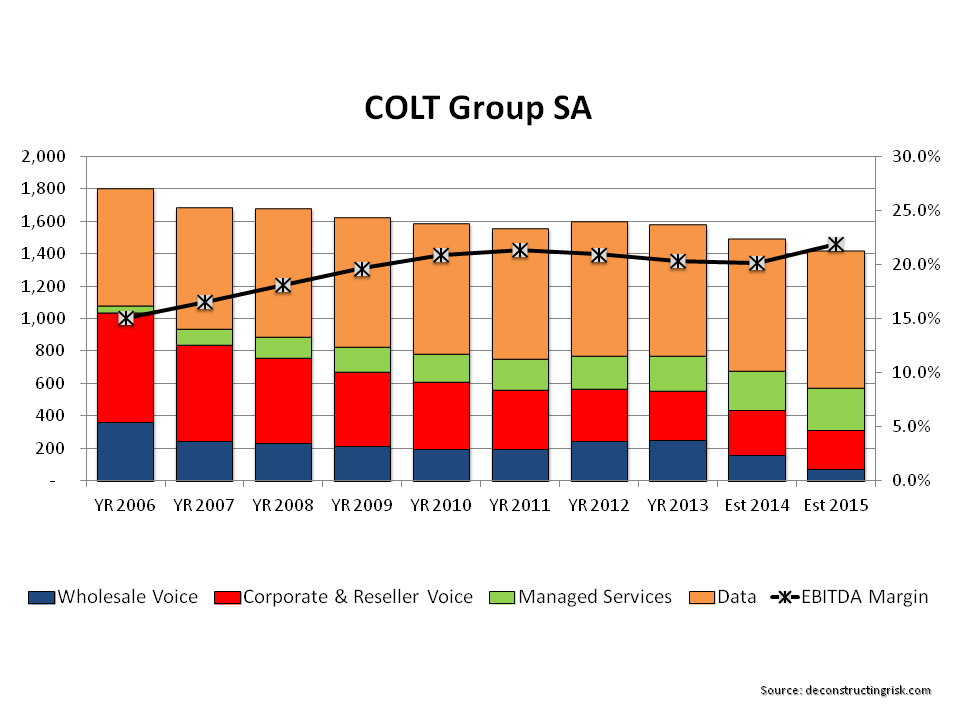
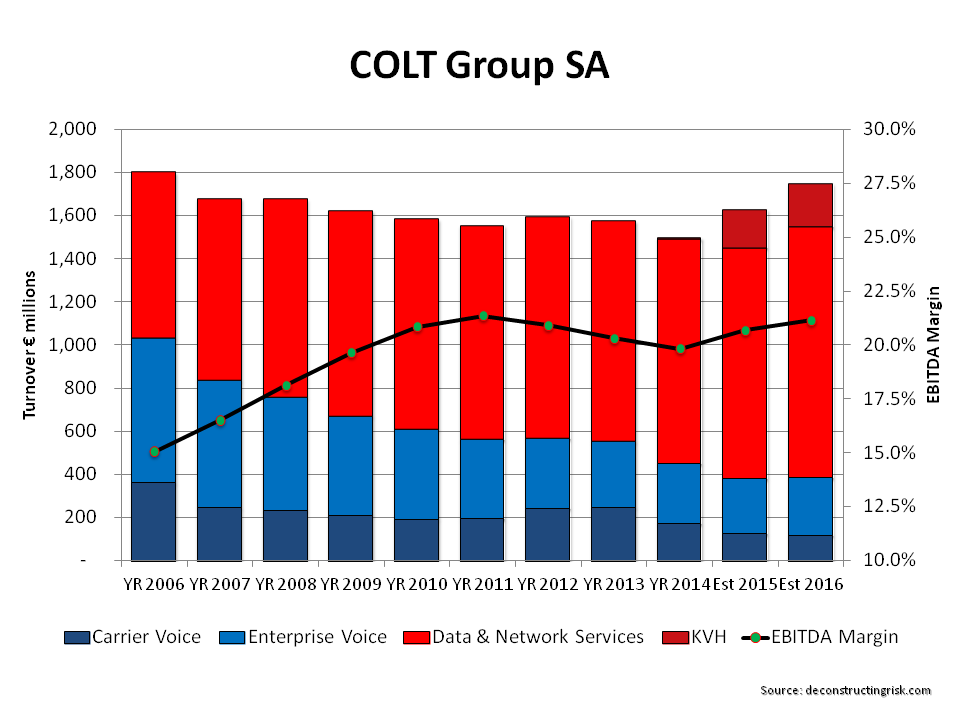
On Friday, Fidelity made a 190 pence offer, which is a 21% premium to the previous day’s close, for the approximately third of COLT that it doesn’t own. After years of underperformance and a series of restruturings, COLT has been long looking for a positive future. It bought the smaller Fidelity owned Asian carrier KVH last year (see previous posts here and here). COLT’s core European business has been slowly moving to higher growth and margin data and network business, as the graph below shows.

click to enlargeCOLT Telecom Revenue & EBITDA Margin 2006 to est2016

Fidelity’s offer values the debt-free business at £1.7 billion (or €2.4 billion or $2.7 billion at current FX rates) which I estimate to be 7 times 2015 EBITDA or 6.44 times 2016 EBITDA estimates (assuming 2015 EBITDA of €335 million and a 2016 10% EBITDA YoY growth). The independent directors have called the offer too low but haven’t made a recommendation due to the lack of options for minority shareholders.

From Fidelity’s viewpoint, this looks like a clever move to force any likely bidders out into the open or, failing any bidders emerging, to take the firm fully private at an attractive price. Robert Powell over at telecomramblings speculates that other European carriers such as Interroute or the US based Level 3 may be possible bidders. It will be fascinating to see how this one plays out.

Level3 Merger Follow-up

It’s now been 6 weeks since Level3 and TW Telecom announced their intention to merge, as per a previous post. Without any other bidder emerging and with the announcement of the merged entity’s intended management team, basically the existing L3 team with TW senior managers running the US business and the IT side, the deal looks like going ahead absent any unforeseen hic-cup. Level 3 released a S-4 filing which outlined the negotiations and the figures used by each sides’ advisors during the negotiations. I always find the detail behind such deals interesting reading and this is no different, albeit in this case relatively straight forward.

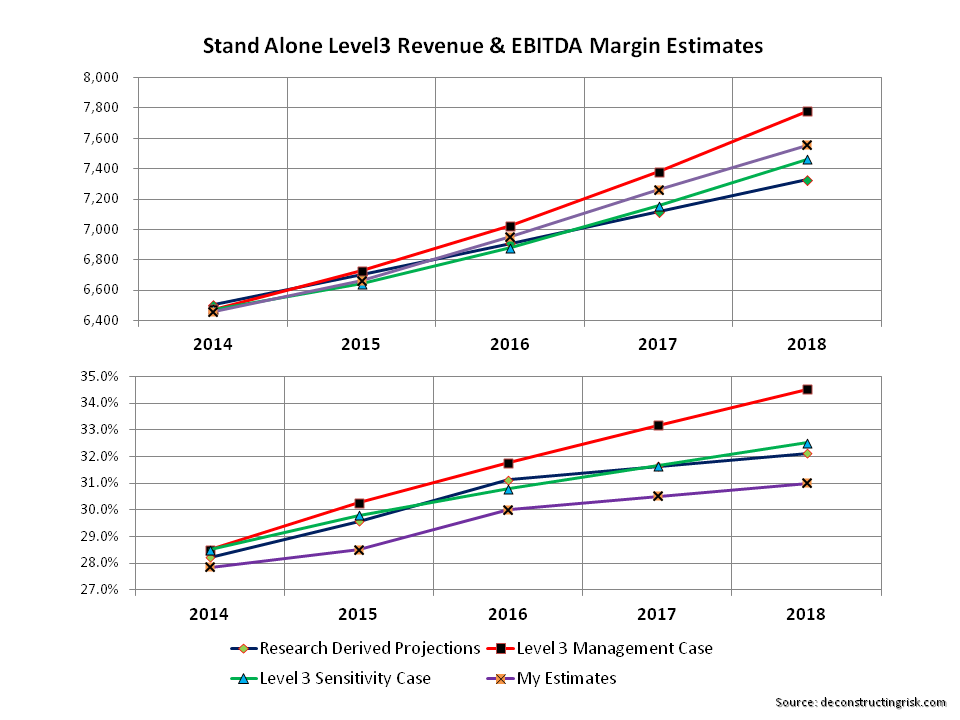
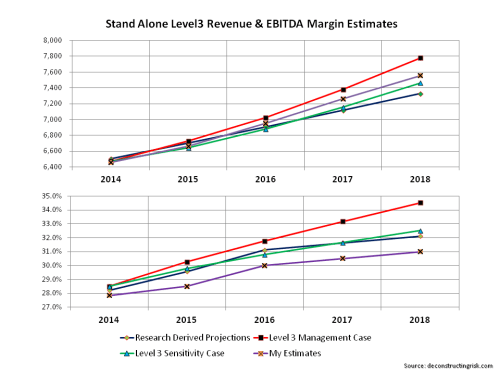
The valuations provided by each of the advisors yielded some interesting data. The management of each side, Level3 and TW Telecom, provide their estimates of future results which the other side then adjusted (the sensitivity case) to use as the basis for the deal. Given that each management team would have tried to maximise the value of their own firm during the negotiations, these estimates are likely optimistic projections. The graph below shows the revenue and EBITDA margin projections of each for a stand alone LVLT compared to the public analysts’ estimates (called Research Derived Projections) and my own estimates.

click to enlargeStand alone Level3 projections
As my revenues estimates were roughly in the middle of the management estimates and the sensitivity case, I have used the average of both for my new estimates of the combined L3/TW entity as my new base case for valuation purposes. I have also used the EBITDA margin from the sensitivity case as my base with the assumed operating savings of $200 million plus the combined capex of each firm with the full savings assumed of approx $40 million, whereby both cost savings don’t fully kick-in until the 2016 year. The results for the 2016 year are not far off my initial estimates in the previous post with revenues of $8.9 billion, an EBITDA and capex margin of 34% and 15% respectively.

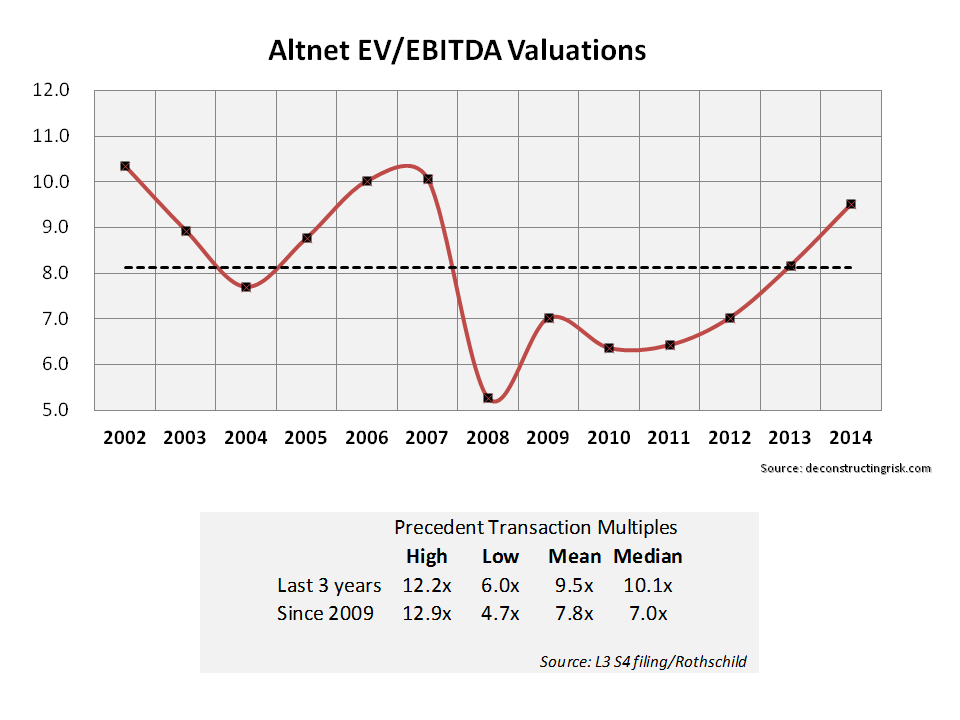
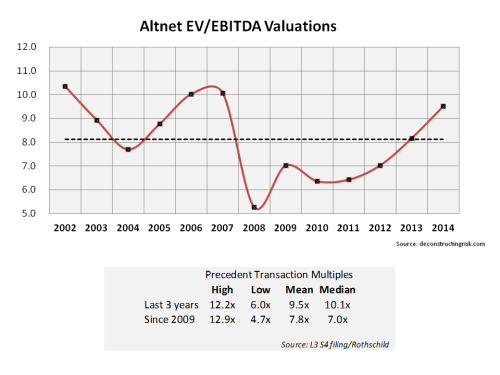
The S-4 outlined the different valuation methods used by the advisors, including DCF and EV/EBITDA multiples. Evercore, one of the advisors, applied a 10x to 13x 2014 EBITDA multiple to determine an implied equity value range and calculated illustrative future stock prices by applying a forward multiple range of 8.5x to 10.7x. Rothschild, another advisor, selected a range of implied EBITDA multiples of 9.5x to 10.5x. The graph below shows the historical multiples for a group of peer firms (although LVLT and TWTC tend historically be above the average peer) that I have kept track of. The graphic also includes the ranges offered by Rothschild.

click to enlargeTelecom EV Ebitda Multiple
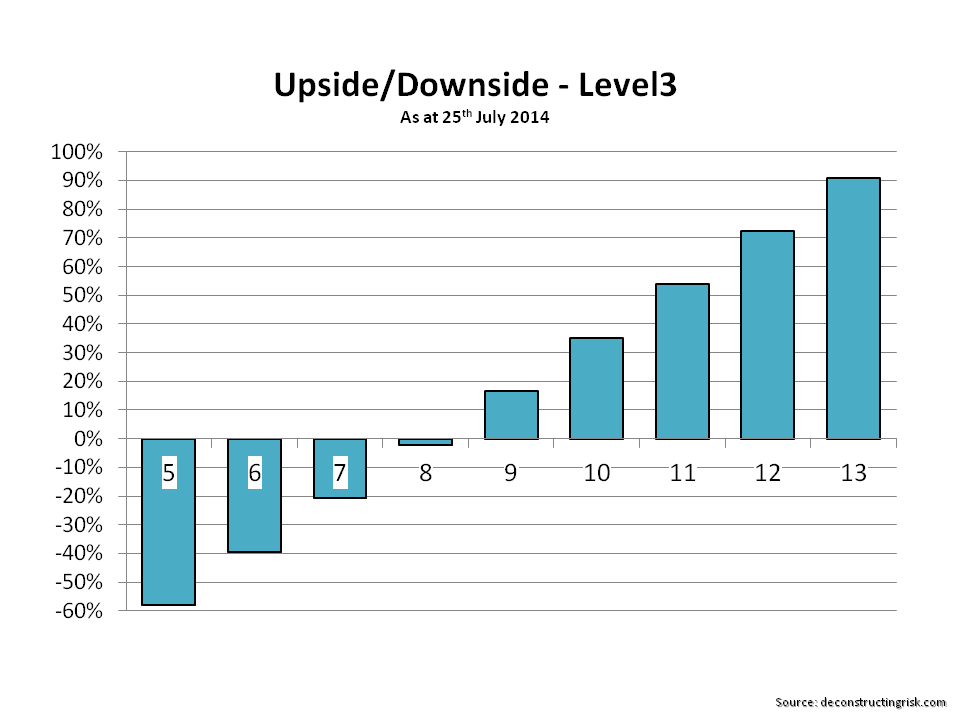
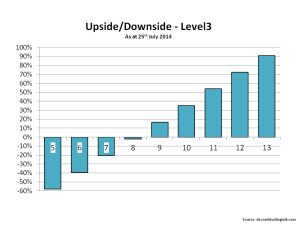
Based upon all of the assumptions above and the balance sheet details offered in the transaction presentation, I calculated the upside & downside to LVLT’s current share price based upon different multiples to the projected 2016 figures. The graph below shows the results (for multiples from 5 to 13).

click to enlargeLevel3 Upside Downside
There are a lot of assumptions in the analysis above although I have tended to be conservative. That said I am conscious that LVLT has had a great run-up (equity up 110% over the past 12 months with big gains on the calls) and looks fully valued today based upon execution risks in the TWTC deal, as well as the general frothiness in the US equity market. For those who already own LVLT, buying insurance by way of the January 2015 puts around $35 looks like a sensible course of action here to me. For new comers, I would wait for a better entry point (we may get some wobbles in September although my 2013 September post on the subject last year was way off!!).

From tera to zetta and beyond to yotta

One of the great lessons of the internet crash was that the exponential growth in internet activity did not mean a similar level of growth in revenues for many of the new business models which were hyped. I can remember an insightful report before the crash which added up all the expected top-line growth projections and concluded that household expenditure on internet services would have to amount to 30% to 40% of household expenditures if projections were to be met!! Although on a personal basis household expenditure on internet access does seem to be growing all the time, it’s not at anything like the growth in our usage. Not yet anyway!

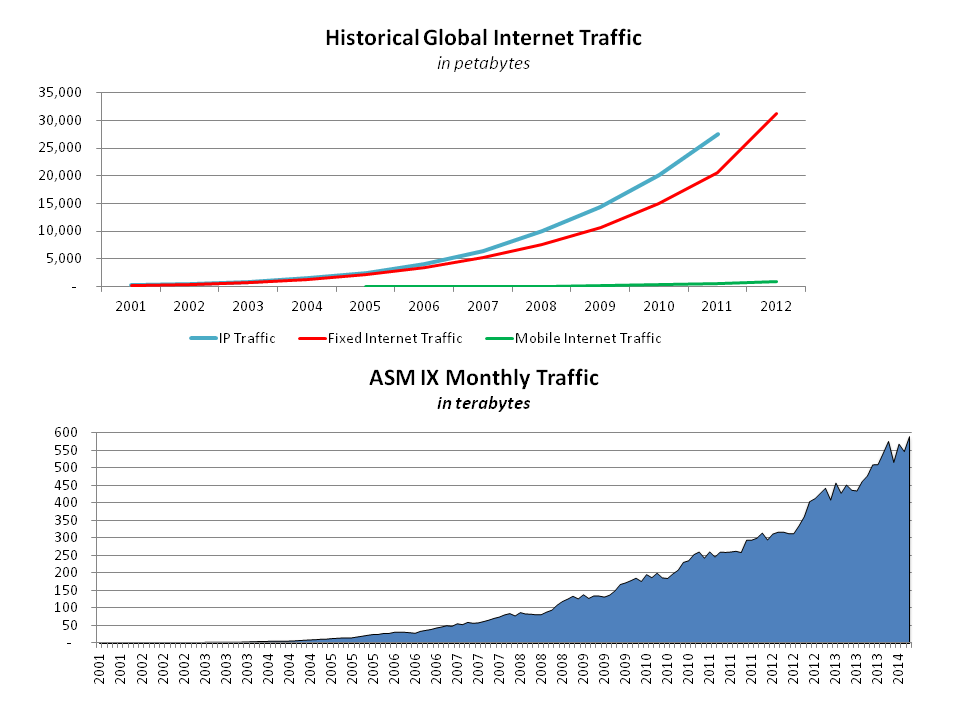
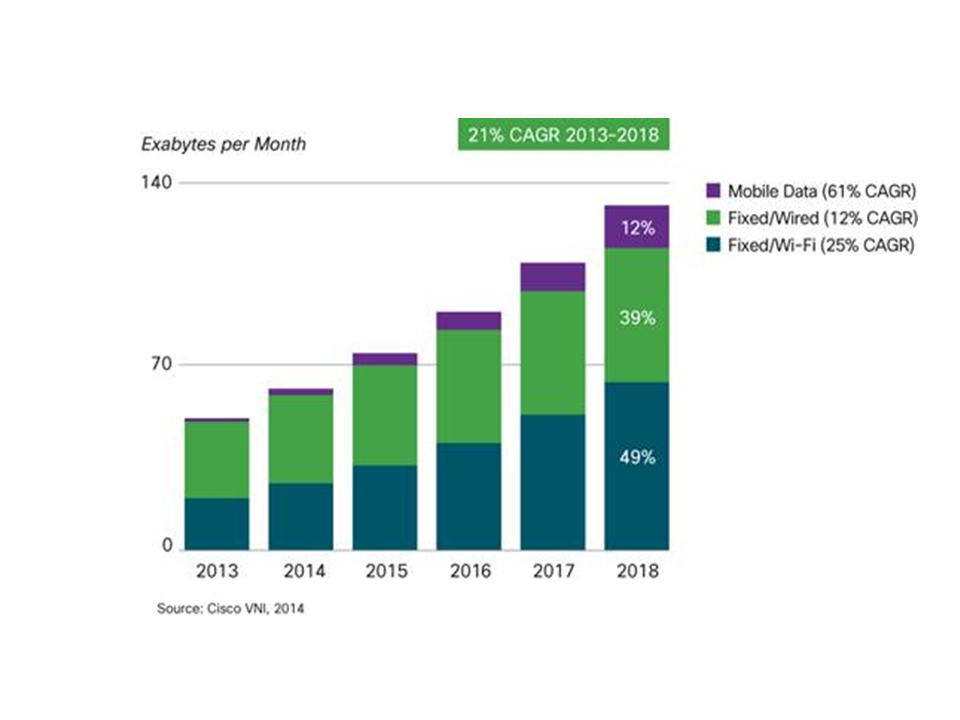
The graphs below shows the growth in global internet traffic from 2001 to 2012 according to Cisco, split by IP, fixed and mobile internet traffic. Although not on the same scale but in a similar vein, the lower graph shows the monthly peering traffic recorded over the Amsterdam Internet Exchange from July 2001 to May 2014

click to enlarge
Historical Internet Growth

For reference, gigabyte/terabyte/petabyte/exabyte/zettabyte/yottabyte is a kilobyte to the power of 3, 4, 5, 6, 7 and 8 respectively.

According to the latest projections from Cisco in their report this month “ The Zettabyte Era – Trends and Analysis”, global IP traffic will surpass the zettabyte threshold by the end of 2016 growing by approximately 20% per annum. Global IP traffic has increased fivefold over the past 5 years, and Cisco predicts an increase of threefold over the next 5 years.

click to enlarge
IP Growth Cisco June 2014 projections

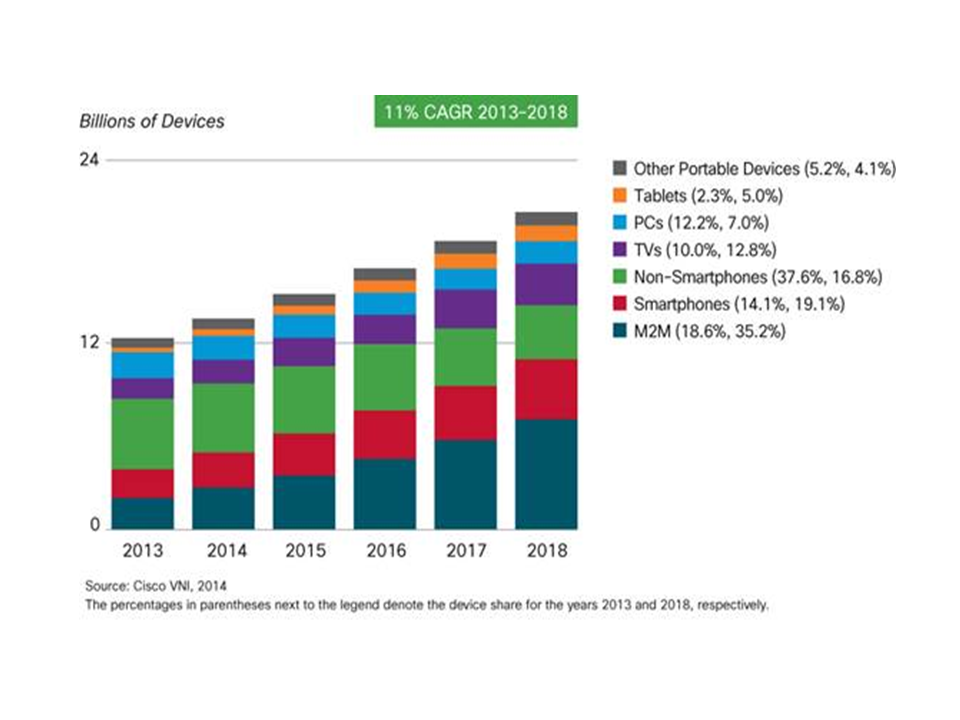
The graph below illustrates the changes in devices used to access the internet behind Cisco’s projections.

click to enlarge
Connected Devices Cisco predictions June 2014

The report highlights a number of core trends including the following:
1) Transition to newer devices will alter network demand and usage.
2) M2M growth will drive the internet of everything.
3) Fixed broadband speeds will nearly triple by 2018.
4) Wi-Fi will dominate access technology.
5) Metro traffic will grow nearly twice as fast as long-haul traffic.
6) IP video will accelerate IP traffic growth through 2018.
7) Bottlenecks may result between peak and average demand times.

Bring on the yotta era!

A classy telecom marriage

Two of my favourites names in the telecom space – Level 3 (LVLT) and TW Telecom (TWTC) – have announced an agreement to merge. I have posted previously on both – here and here respectively. Overall, my initial reaction is positive on the deal as I believe that LVLT have bought a quality asset, albeit at a high multiple of 12.8 times TW’s 2014 estimated EBITDA (TW’s deep metro fiber business model has a high EBITDA margin of approx 35% with a high capex spend in the low to mid 20% range).

There is always execution risk in these deals particularly when taking over a tightly managed and focussed player like TW. LVLT’s successful integration of recent M&A and the new CEO’s focus on operational results mitigates the risks somewhat. My guess is that cultural issues may be the hardest issue to manage as it looks like TWTC’s management will exit after the deal. However, the businesses are very complementary and the sector is one where scale and depth is becoming increasingly important to compete for the demands of the growing bandwidth hungry enterprise sector.

On the financials, based upon my quick and dirty analysis, I estimate that the combined entity could generate approx. $9 billion of revenue and $3 billion of EBITDA by 2016. Despite taking on extra debt for the deal, I estimate that LVLT can meet its leverage target by getting net debt to EBITDA below 3.5 by the end of 2016. Maintaining the leverage target was emphasised by LVLT during the deal presentation. At an EV/EBITDA multiple of 8.5 (assuming 350 million shares after the deal and LVLT 2015 debt conversion), a target price for LVLT of $45 looks sensible to me. Been more positive, a 9.5 multiple gives a target price of $55. Those targets may disappoint LVLT shareholders given the stock was at $44 before the deal was announced and there was further upside potential from a standalone LVLT due to the virtuous cycle of operational efficiencies, reducing interest expense, and growing core revenues .

My view is that now is the opportune for LVLT to use their highly valued stock as currency to purchase a quality asset like TWTC. A classy bride does not come cheap but over the longer term the rewards should come. Either that or you end up broke!

COLT calls time

COLT announced plans this week to cut €175 million of low margin voice wholesale business and take a €30 million restructuring charge in an attempt to address declining margins and halt operating cash burn, issues which I highlighted in a previous post. The stock took a hit and is down about 10% on the month. Press reports, like this FT article and this Guardian article, speculate that majority shareholder Fidelity is losing patience and the business is effectively for sale. Robert Powell at Telecom Ramblings is also speculating on potential buyers.

The graph below shows my rough estimates of the revenue and EBITDA margin (excluding restructuring charges) for 2014 and 2015 based upon COLT’s guidance (2015 is purely based upon my guestimates). The execution risk in the restructuring based upon the firm’s recent history doesn’t match up against any potential M&A upside in my opinion. This one is best to watch from the side-line. It should be interesting.

click to enlargeCOLT Telecom 2006 to 2013 Revenue & EBITDA Margin 2014 & 2015 forecast