Tag Archives: reinsurance pricing

An Unhappy New Year for Reinsurers?

The broker reports on the January renewals paint a picture of building pricing pressures for reinsurers and specialty insurers. The on-going disintermediation in the property catastrophe market by new capital market capacity is causing pricing pressures to spill over into other classes, specifically on other non-proportional risks and on ceding commissions on proportional business.

The Guy Carpenter report  highlight that traditional players are fighting back on terms and conditions through “an extension of hours clauses, improved reinstatement provisions and expanded coverage for terror exposures” and “many reinsurers offered more tailored coverage utilizing options such as aggregate and quota share cover, multi-year arrangements and early signing opportunities at reduced pricing”. Guy Carpenter also point to large buyers looking at focusing “their programs on a smaller group of key counter-party relationships that were meaningful in relation to the overall size of the program”.

The Aon Benfield report and the Willis Re report also highlight the softening of terms and conditions to counteract cheap ILS capacity emphasising items such as changes in reinstatement terms.  Willis states that “the impact of overcapacity has been most clearly evidenced by the up to 25% risk adjusted rate reductions seen on U.S. Property Catastrophe renewals at 1 January and the more modest but still significant rate reductions of up to 15% on International Property Catastrophe renewals”.

Following an increase in valuation multiples from all time lows for the sector over the past 24 months, the current headwinds for the sector as a result of over-supply and reduced demand mean, in my opinion, that now is a good time for investors to reduce all exposure to the sector and move to the side-lines. I particularly agree with a comment in the Willis report that “experienced reinsurers will remember that the relaxation of terms and conditions more so than price reduction caused the real damage in the last soft market cycle”. Meaningful upside from here just doesn’t look on the cards to me particularly when compared to the downside risks (even M&A activity is likely to be with limited premium and/or on an all stock basis).

The graph below shows the premium split by main product line for the firms that I monitor. The firms have been sorted left to right (low to high exposure) by a subjective factor based upon exposure to the current pricing pressures. The factor was calculated using a combination of a market pricing reduction factor for each of the main business classes based upon the pricing indicated in the broker reports and upon individual business class discounts for each firm depending upon their geographical diversification and the stickiness of the business written. The analysis is fairly subjective and as many of the firms classify business classes differently the graph should be considered cautiously with a pinch of salt.

click to enlargePremium Split Specialty Insurers & Reinsurers
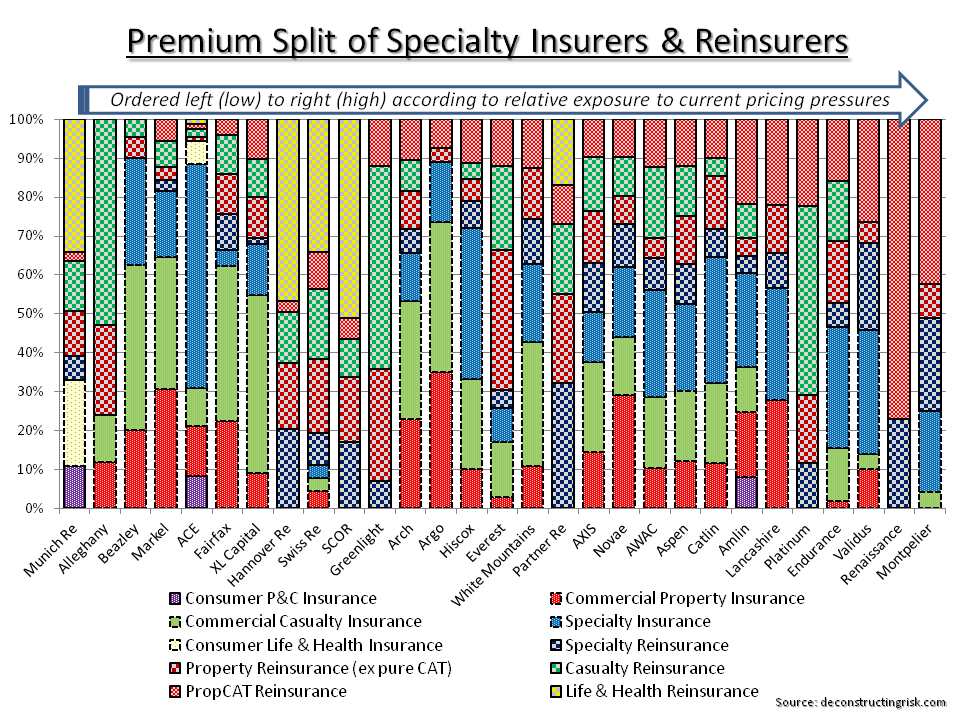
Unsurprisingly, reinsurers with a property catastrophe focus and with limited business class diversification look the most exposed. The impact of the reduced pricing on accident year ratios need to be combined with potential movement in reserves to get the impact on calendar year operating results. Unfortunately, I don’t have the time at the moment to do such an analysis on a firm by firm basis so the graph below simply compares the subjective pricing factor that I calculated against average operation ROEs from 2009 to Q3 2013.

click to enlargeSpecialty Insurers & Reinsurers Exposure to Pricing Pressures
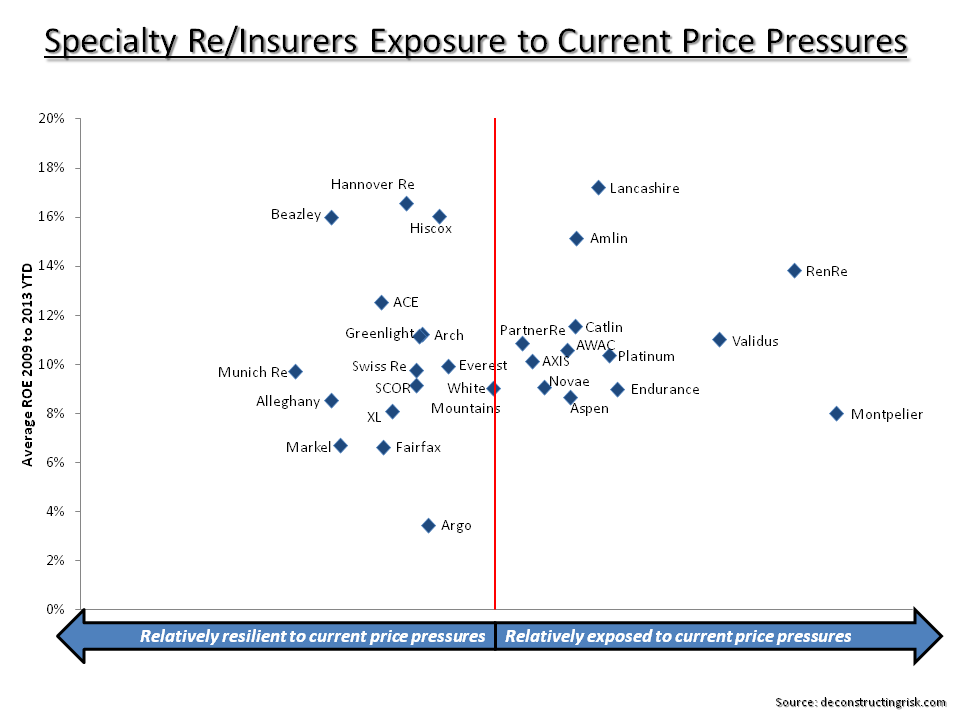
As stated previously, the whole sector is one I would avoid completely at the moment but the graph above suggests that those firms on the right, specifically those in the lower right hand quadrant, are particularly exposed to the on-going pricing pressures.
Shifting risk profiles in an arbitrage reinsurance market

There was some interesting commentary from senior executives in the reinsurance and specialty insurance sector during the Q2 conference calls.

Evan Greenberg of ACE gave the media a nice sound-bite when he characterised the oversupply in the property catastrophe sector as “that pond with more drinking out of it”. He also highlighted, that following a number of good years, traditional reinsurers “are hungry” and that primary insurers are demanding better deals as their balance sheets have gotten stronger and more able to retain risk. Greenberg warns that, despite claims of discipline by many market participants, for some reinsurers “it’s all they do for a living and so they feel compelled” to compete against the new capacity.

Kevin O’Donnell of Renaissance Re put some interesting perspective on the new ILS capacity by highlighting that in the early days of the property catastrophe focused reinsurer business model, they “thought about taking risk on a single model”. These reinsurers developed into multi-model and some into proprietary model users. O’Donnell highlighted that the new capacity from capital markets “is somewhat similar to” earlier property catastrophe reinsurance business models and “that, but beyond relying in some instances, on just a single model, they are relying on a single point.” O’Donnell stressed that “it’s very important to understand the shape of the distribution, not just the mean.” Edward Noonan of Validus commented that “the ILS guys aren’t undisciplined; it’s just that they’ve got a lower cost of capital.

Historically lax pricing in reinsurance has quickly trickled down into softer conditions in primary insurance markets. In the US, although commercial insurance rates have moderated from an average increase of 5% to 4% in recent months, the overall trend remains upwards and above loss trend. Greenberg believes that the reason why it could be different this time is “the size of balance sheet on the primary side on the large players” and that more intelligent data analytics means that primary insurers are “making different kinds of decisions about how to hold retentions” and “how to think about exposure”. Although Greenberg makes valid points, in my opinion if pricing pressures continue in the reinsurance sector, the knock-on impacts onto the primary sector will eventually start to emerge.

As always, the market in property catastrophe is dependent upon events, particularly from the current windstorm season. Noonan of Validus commented that the market can’t “sustain a couple more years of 15% off”, referring to the recent Florida rate reductions. Diversified reinsurers point to their ability to rebalance their portfolios in response to the current market. However the resulting impact on risk adjusted returns will be an issue the industry needs to address. The always insightful and ever direct John Charman, now at the helm of Endurance Specialty, highlights the need to contain expenses in the industry. Charman commented “when I look at the industry, it’s very mature.” He characterised some carriers as being “very cumbersome” and “over-expensed”.

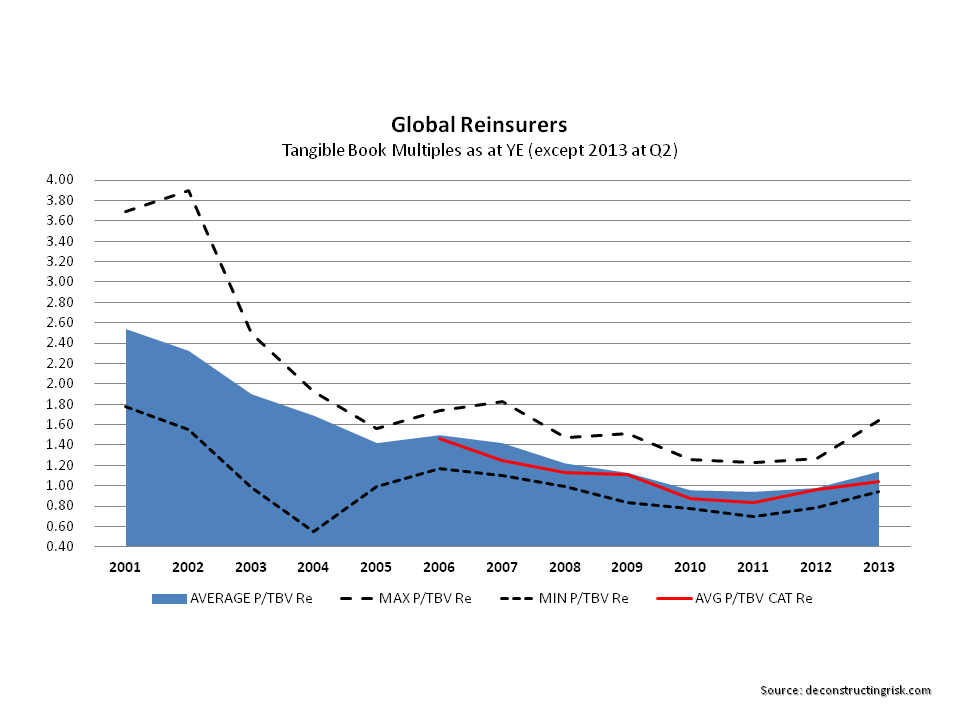
For the property catastrophe reinsurers, the shorter term impact on their business models will likely be that they will have to follow a capital management and shareholder strategy more compatible with the return profile of the ILS funds. In terms of valuations, the market is currently making little distinction between diversified reinsurers and catastrophe focussed reinsurers as the graph below of price to tangible book for pure reinsurers and catastrophe reinsurers show. Absent catastrophe events, that lack of distinction by the market could change in the near term.

click to enlargeReinsurers price to tangible book multiples August 2013

In the shorter term, the more seasoned and experienced players know how to react to an influx of new capacity. The conferences calls demonstrate those taking advantage of the arbitrage opportunities. Benchimol of AXIS commented that “we have actually started to hedge our reinsurance portfolio using ILWs and other transactions of that type.” O’Donnell commented that “we continue to look for attractive ways of ceding reinsurance risk as a means to optimizing our reinsurance portfolio.” Charman commented that “we also took advantage of the abundant capital by purchasing Florida retro protection”. Noonan commented that “we also found good value in the retrocession market and took the opportunity to purchase a significant amount of protection for our portfolio during the quarter.” Iordanou of Arch commented that “we did buy more this quarter” and that “we felt we were getting good deals.

Right now, we are clearly in an arbitrage market and the reinsurers that will thrive in this market are those who are clever enough to use the current market dislocation to their advantage.

ILS Pricing Party Heats Up

As we approach the July renewals, new capacity continues to pour into the insurance linked securities space pushing prices ever downward. Morgan Stanley estimate that so called alternative capital will make up 30% of the forthcoming July renewal. Market participants continue to cheer on the arrival of this capacity. To counter some of the concerns expressed about this market, some of which were outlined in my last post on this subject, I noticed an interesting article this week from Guy Carpenter’s website.

The article starts with an overview of the market stating “the impact has been dramatic; pricing has decreased more than 50 percent year over year, particularly for peak U.S. risks such as Florida”. And continues “the institutional money that is offering capacity to Florida wind at 40 percent less than last year’s pricing isn’t pricing Florida risk incorrectly, it just does not have the same capital costs and therefore can, on a sound basis, charge less for peak U.S. wind risk than the traditional reinsurance market on a sustained basis.

In other words, the return hurdles for institutional money is less! That doesn’t make sense if you consider the reduced diversification offered by investments in property catastrophe focused funds to institutional money compared to traditional reinsurers which have diversified portfolios spread over property, casualty, specialty and, in some cases, life business.

Guy Carpenter continue in their attempt to convince themselves that everything will be okay by stating that “increasing the breadth of an informed sophisticated investor base can only be a good thing for the markets’ long term prospects as it increases available capacity without leaving the market susceptible to reckless capital that will support transactions with ill-considered terms, which eventually cause problems themselves or set problematic precedents for others to follow.

I don’t really understand what they are saying here. Is it something as hollow as it’s okay to slash prices as they are “sophisticated investors”? I have even heard another broker try to justify the overall market benefit of the influx of capacity by concluding that excess capacity will result in more policyholders in the high risk zones being able to get property cover. I didn’t know that the institutional investors are getting into this asset class with the intent that the risk profiles expand! Where have we heard that before?

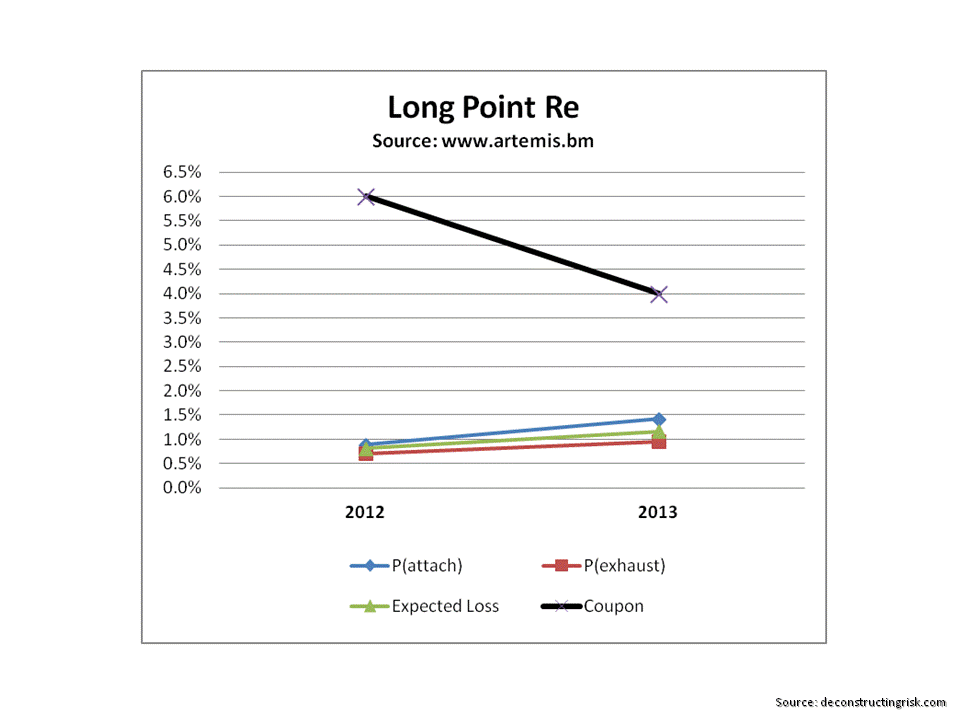
The article again states that “capacity is expanding because sophistication and attention to transaction mechanics is increasing, not decreasing.” Let’s look at a recent deal to see how that statement stacks up. One recent deal this month by Travelers, under the Long Point Re series, covering northeast US wind was priced as per the graphic below compared to last year.

Long Point Graph

Looking at a crude measure of risk and reward, as the coupon divided by expected loss, shows a ratio reduction from 741% to 345% for 2012 to 2013. Other recent deals also show reductions in the risk/reward dynamics such as the Turkish quake deal, under the Bosphorus Re banner, which got away for 250 basis points compared to an expected loss cost of 1% (that’s a 250% ratio). Industry veteran, Luca Albertini of ILS fund Leadenhall Capital Partners, remarked that the Turkish deal was significant as previously this market did not like to play in the sub-300 basis points deal area. Albertini put a positive spin on this development for his sector by saying that the new appetite for sub-300bps issuances means that a wider range of exposures and therefore deals can be marketed, thereby providing diversification. That sounds great but, to paraphrase a quote from Jim Leitner, is there any real benefit to diversification if such diversification comes from a portfolio of underpriced assets? Underpriced risk is, after all, mispriced risk.

I recently asked a banker, who has marketed this new asset class to clients, at what level of return would the institutional investors walk away. To my surprise he said none; based upon his previous experience of investors following sheep like into quant driven new “non-correlating” asset classes, only a loss would awaken investors to the risks. It’s depressing to think that institutional money still likes to partake in the practice of picking up pennies in front of a stream roller!

As readers will realise, I am becoming ever more cautious on the wholesale insurance & reinsurance sector. With overall demand decreasing and supply increasing, the sector looks like it’s reaching an inflection point. In the short term, returns will likely remain acceptable (high single/low double digit ROE) if claim inflation stays mute resulting in continuing underwriting profits/reserve releases and in the absence of large catastrophes. In the medium term, ILS pricing pressures and new capacity entering the traditional market (latest examples include new money from Qatar in the form of Q Re and the AON/Berkshire deal providing a 7.5% blind follow line across the Lloyds market) leads me to conclude that a more defensive investment strategy in this space is warranted.