Tag Archives: TW Telecom

Level3 Merger Follow-up

It’s now been 6 weeks since Level3 and TW Telecom announced their intention to merge, as per a previous post. Without any other bidder emerging and with the announcement of the merged entity’s intended management team, basically the existing L3 team with TW senior managers running the US business and the IT side, the deal looks like going ahead absent any unforeseen hic-cup. Level 3 released a S-4 filing which outlined the negotiations and the figures used by each sides’ advisors during the negotiations. I always find the detail behind such deals interesting reading and this is no different, albeit in this case relatively straight forward.

The valuations provided by each of the advisors yielded some interesting data. The management of each side, Level3 and TW Telecom, provide their estimates of future results which the other side then adjusted (the sensitivity case) to use as the basis for the deal. Given that each management team would have tried to maximise the value of their own firm during the negotiations, these estimates are likely optimistic projections. The graph below shows the revenue and EBITDA margin projections of each for a stand alone LVLT compared to the public analysts’ estimates (called Research Derived Projections) and my own estimates.

click to enlargeStand alone Level3 projections
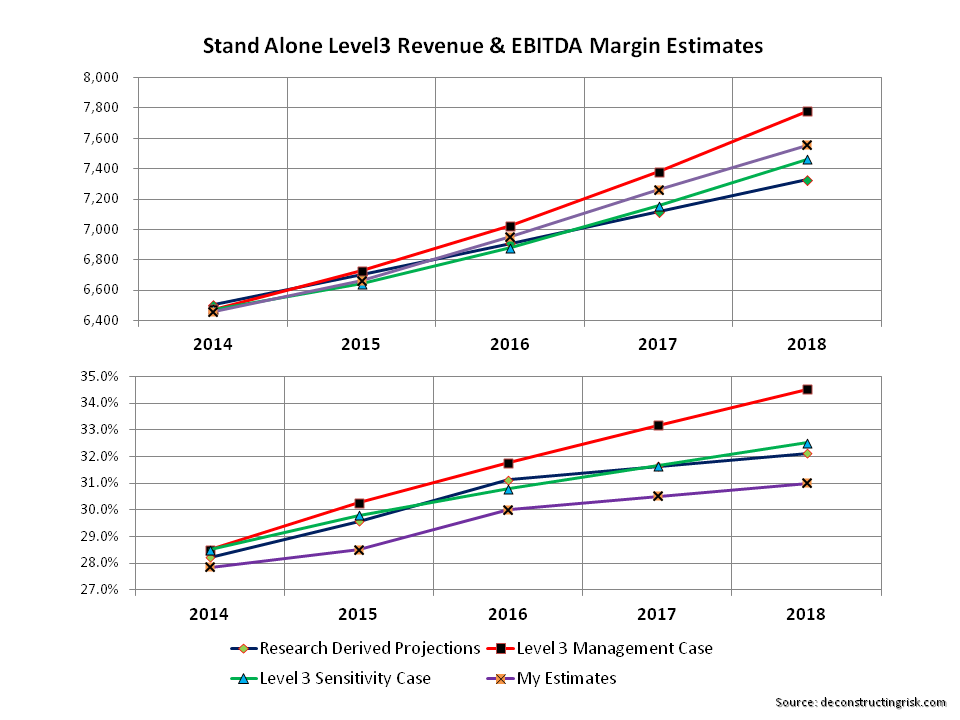
As my revenues estimates were roughly in the middle of the management estimates and the sensitivity case, I have used the average of both for my new estimates of the combined L3/TW entity as my new base case for valuation purposes. I have also used the EBITDA margin from the sensitivity case as my base with the assumed operating savings of $200 million plus the combined capex of each firm with the full savings assumed of approx $40 million, whereby both cost savings don’t fully kick-in until the 2016 year. The results for the 2016 year are not far off my initial estimates in the previous post with revenues of $8.9 billion, an EBITDA and capex margin of 34% and 15% respectively.

The S-4 outlined the different valuation methods used by the advisors, including DCF and EV/EBITDA multiples. Evercore, one of the advisors, applied a 10x to 13x 2014 EBITDA multiple to determine an implied equity value range and calculated illustrative future stock prices by applying a forward multiple range of 8.5x to 10.7x. Rothschild, another advisor, selected a range of implied EBITDA multiples of 9.5x to 10.5x. The graph below shows the historical multiples for a group of peer firms (although LVLT and TWTC tend historically be above the average peer) that I have kept track of. The graphic also includes the ranges offered by Rothschild.

click to enlargeTelecom EV Ebitda Multiple
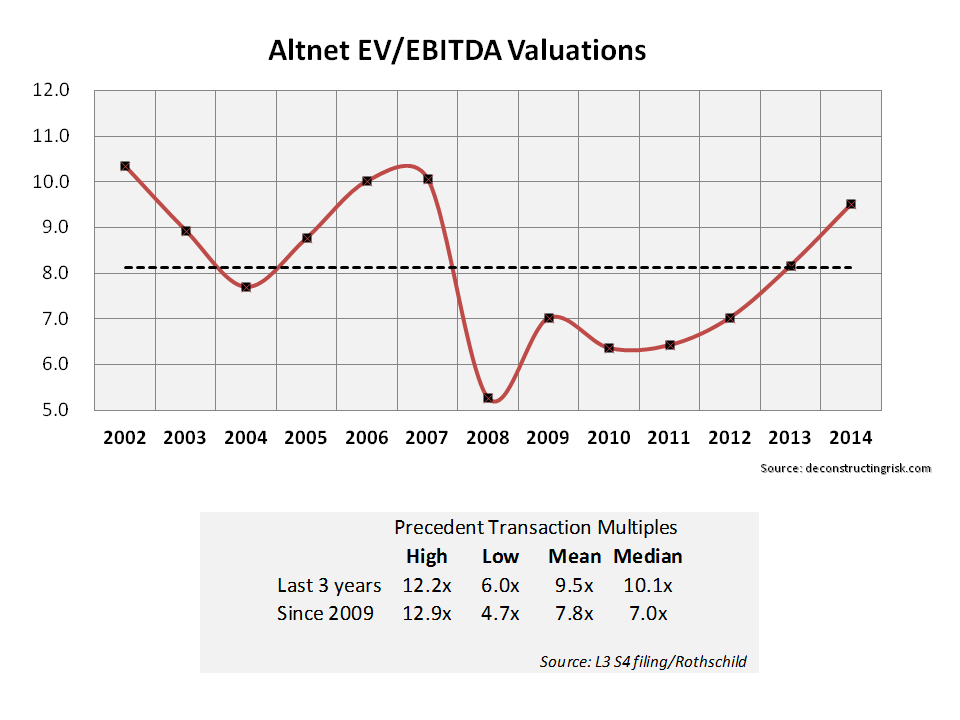
Based upon all of the assumptions above and the balance sheet details offered in the transaction presentation, I calculated the upside & downside to LVLT’s current share price based upon different multiples to the projected 2016 figures. The graph below shows the results (for multiples from 5 to 13).

click to enlargeLevel3 Upside Downside
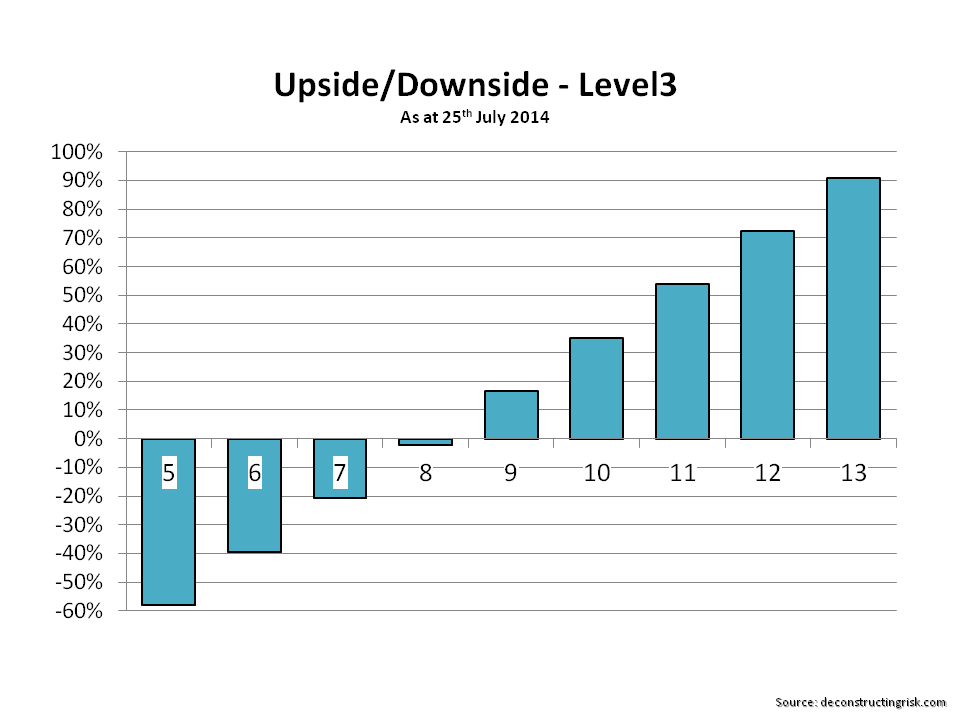
There are a lot of assumptions in the analysis above although I have tended to be conservative. That said I am conscious that LVLT has had a great run-up (equity up 110% over the past 12 months with big gains on the calls) and looks fully valued today based upon execution risks in the TWTC deal, as well as the general frothiness in the US equity market. For those who already own LVLT, buying insurance by way of the January 2015 puts around $35 looks like a sensible course of action here to me. For new comers, I would wait for a better entry point (we may get some wobbles in September although my 2013 September post on the subject last year was way off!!).
A classy telecom marriage

Two of my favourites names in the telecom space – Level 3 (LVLT) and TW Telecom (TWTC) – have announced an agreement to merge. I have posted previously on both – here and here respectively. Overall, my initial reaction is positive on the deal as I believe that LVLT have bought a quality asset, albeit at a high multiple of 12.8 times TW’s 2014 estimated EBITDA (TW’s deep metro fiber business model has a high EBITDA margin of approx 35% with a high capex spend in the low to mid 20% range).

There is always execution risk in these deals particularly when taking over a tightly managed and focussed player like TW. LVLT’s successful integration of recent M&A and the new CEO’s focus on operational results mitigates the risks somewhat. My guess is that cultural issues may be the hardest issue to manage as it looks like TWTC’s management will exit after the deal. However, the businesses are very complementary and the sector is one where scale and depth is becoming increasingly important to compete for the demands of the growing bandwidth hungry enterprise sector.

On the financials, based upon my quick and dirty analysis, I estimate that the combined entity could generate approx. $9 billion of revenue and $3 billion of EBITDA by 2016. Despite taking on extra debt for the deal, I estimate that LVLT can meet its leverage target by getting net debt to EBITDA below 3.5 by the end of 2016. Maintaining the leverage target was emphasised by LVLT during the deal presentation. At an EV/EBITDA multiple of 8.5 (assuming 350 million shares after the deal and LVLT 2015 debt conversion), a target price for LVLT of $45 looks sensible to me. Been more positive, a 9.5 multiple gives a target price of $55. Those targets may disappoint LVLT shareholders given the stock was at $44 before the deal was announced and there was further upside potential from a standalone LVLT due to the virtuous cycle of operational efficiencies, reducing interest expense, and growing core revenues .

My view is that now is the opportune for LVLT to use their highly valued stock as currency to purchase a quality asset like TWTC. A classy bride does not come cheap but over the longer term the rewards should come. Either that or you end up broke!

Consistency with ambition, the case for TWTC

Valuations remain high (S&P PE at 19.5 and CAPE over 25) despite recent volatility and I have posted on my views previously. A recent post on Level3 (LVLT) in December referred to increases in telecom valuation multiples. Since then LVLT reported a very good end to the year and has rocketed to around $38, or an approx 9.4 EV to 2014 guided EBITDA multiple (and 8.7 to my 2015 estimated EBITDA). An analyst report, whilst upgrading the stock, commented “with a focus that has shifted from a slow deleveraging exercise via acquisitions to now focusing on integration and execution of assets the company possesses, we believe we are on the cusp of a sustained outperformance”. Although I generally ignore anything analysts say, I too am bullish on LVLT over the longer term based upon the virtuous circle of improving operating results and decreasing debt. However I think valuation may have gotten ahead of itself with LVLT up 70% in 6 months. I have taken some profits to buy some downside protection. There is likely to be some bumps on the road in 2014 both for companies like LVLT and from an overall market viewpoint. Structural changes in the rapidly changing telecom market like net neutrality or the proposed Comcast/Time Warner Cable (TWC) merger may also have an impact.

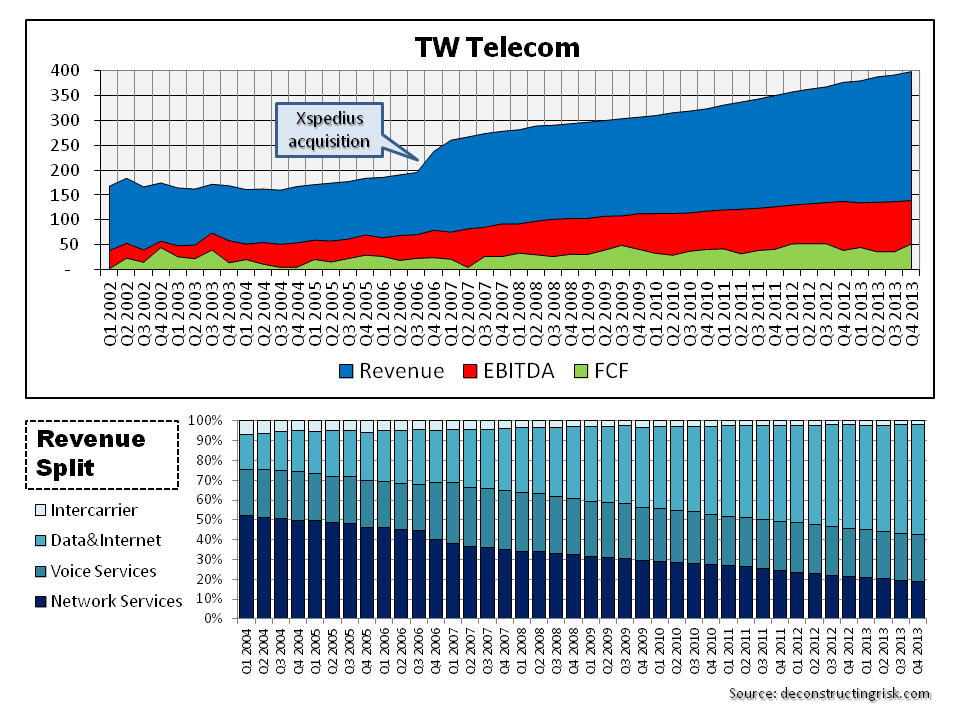
Speaking of Time Warner, there is a telecom that was spun off from Time Warner in the late 1990s called TW Telecom (TWTC) that has a history over the past 10 years of outstanding execution. Over that time, TWTC has diversified itself away from its roots (top 10 customers make up 18% of revenues in 2013 compared to 23% 5 years ago and 40% 10 years ago) with a current focus on business Ethernet, data networking, IP VPN, Internet access, and network security services for enterprises. The graphic below illustrates how successful and consistent TWTC’s operating results has been. I would particularly highlight their results through the troubled 2007 to 2009 period. TWTC have had solid 35% EBITDA margins for the past 10 years with average capital expenditures of 25% as they build their last mile metro fiber network to their business customers on a success basis. Their execution is in no small measure down to one of the best (and most consistent) management teams in the business, led by long term CEO Larissa Herda.

click to enlargeTW Telecom a history of consistent operating results

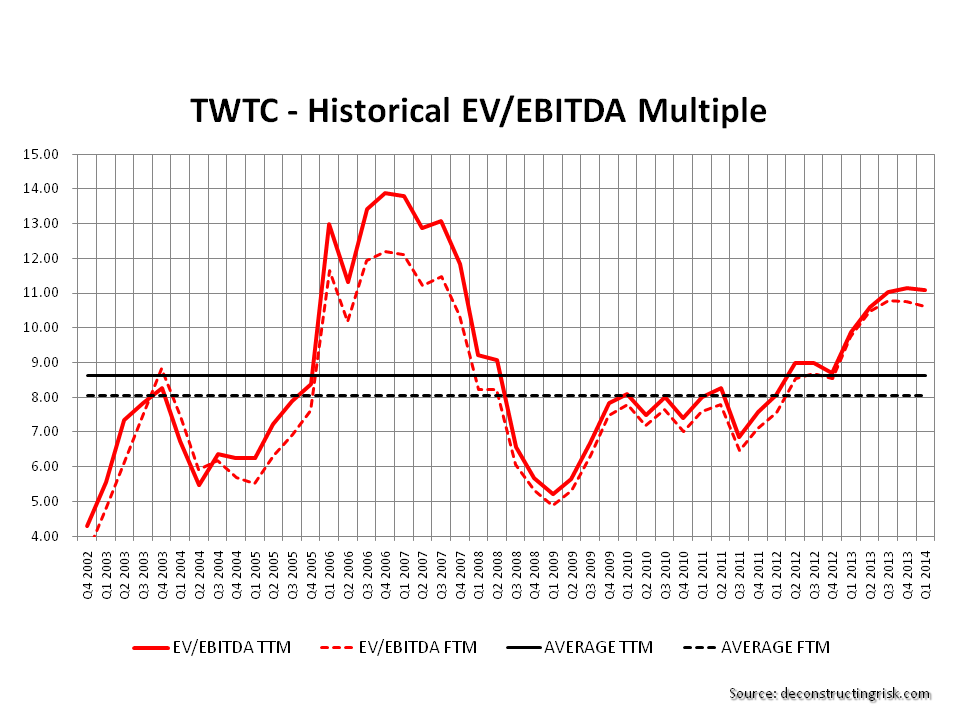
In addition to solid operating results, TWTC have always shown disciplined balance sheet management with net debt well below 2 times EBITDA in the past 5 years (except for 2013 at 2.3 times as per the changes below). As a result of the factors highlighted above, TWTC has always enjoyed a premium valuation multiple in the market as the graph (of enterprise value to twelve month trailing (TTM) and future twelve months (FTM) EBITDA) below shows.

click to enlargeTW Telecom EV to EBITDA Multiples

TWTC has long been talked of as an acquirer or a target for others but nothing of substance has materialised since their Xspedius acquisition back in 2006. The firm has increasingly undertaken shareholder friendly actions such as the $400 million spend on its own shares in 2013. TWTC has also bought back convertible debt and pushed out the maturities on its debt which has increased from YE2012 of $1.76 billion to just below $2 billion as at YE2013.

The reason for the increase in debt plus an additional one-off capital expenditure of $120 million in 2013 on capital leases (not included in graph above), with another one off $50 million due in 2014, is a strategic market expansion announced by TWTC in late 2013. The strategic market expansion is to extend its metro fiber footprint into 5 new high demand markets and accelerate the density of its metro-fiber footprint in 27 existing markets by 17%. Given TWTC’s history of execution, their plans for expansion and the (almost giddish) optimism of management during their Q4 conference call caught my attention. These are people who have not make such promises lightly in the past.

One of the factors behind their expansion is the success of new product innovation introduced in 2012, namely products called Enhanced Management and Dynamic Capacity. Such products allow enterprises to automate, manage and purchase network capacity on a flexible real time framework based upon their needs and offer flexibility in accessing connections to private, hybrid and public clouds. TWTC refer to their state of the art network as the Intelligent Network and are marketing their range of products on the basis of what they call their Constellation Platform which “will connect our customers nearly instantaneously through data centers directly to numerous applications in the cloud with increasing network automation”. All of these fancy products names and high minded assertions shouldn’t in themselves be taken as anything earth shattering in the rapidly changing IT and telecom market. What may be special is that TWTC has indicated increased interest in their offerings and that, through partnerships with cloud providers such as Amazon, they are getting interest from new enterprises with big data needs . TWTC state that their expansion is “a very targeted opportunity to rapidly increase our market density to drive additional revenue growth and greater cash flow” and that it “is all part of our broader vision of bringing better, faster and easier solutions to customers as we continue to innovate and create market differentiation”.

Given the history of execution by TWTC’s management, I would be positive on their ability to deliver on their promises. They have indicated that EBITDA margins will be under pressure in 2014 as they staff up for the new expansion. For 2015 & 2016, EBITDA expansion of 10% to 15% does not seem unreasonable to me based upon my calculations. Given a current EV/EBITDA on a TTM basis of over 11, TWTC is not cheap and, as stated in the beginning of this post, there are likely to be bumps in the road over 2014. Such bumps may provide an opportunity to back TWTC and its expansion at an attractive valuation.

I, for one, will be looking out for it.

My Erratic Telecom Habit

One of the sectors that I have followed for nearly 15 years now is the emerging telecom sector, specifically the so called altnet or CLEC sector. My affiliation with this sector has been the cause of many highs and lows, some very painful lows, through the telecom/internet bubble & bust, the 2000’s and to this day. Initially the attraction was the boom in internet and data traffic and the leveraged nature of many of the firms. After spectacular gains in the go-go days of the bubble (I bought hook line and sinker into the “picks and shovel” rationale), the subsequent reality of the telecom bust and the “nuclear winter” left me with big losses. For those unfamiliar with the stories of the bubble era, Om Malik’s excellent book “Broadbandits: Inside the $750 bilion Telecom Heist” goes deep into the madness that prevailed.

Over the past 10 years odd, I have had a much more cautious and opportunistic approach on the sector and have had some success at dipping in and out of stocks/debt/options of restructured companies as they moved in and out of favour (particularly prior to the financial crisis). Successes in recent years include the post-bankruptcy Virgin Media and Global Crossing. One notable failure was a firm called XO Communications backed by the vulture investor Carl Icahn. A self publicised champion of the minor investor, when it suits him, investing alongside Icahn in XO proved to be a grave error. This article illustrates some of the drama. I Iearned much from the experience including the dangers of illiquid stocks, the nonsense of following a self hyped dominant “star” investor, and the obvious perils of over-leveraged stocks with poor balance sheets in commoditising businesses. Despite these up and downs, the core thesis of a rapidly increasing data consuming society with the potential for high return/high risk (and often leveraged) investments remains for those with an aggressive risk appetite, particularly now that most of the overcapacity from the telecom boom years is becoming less of a factor. For any investor in this space, Robert Powell’s website Telecom Ramblings is the go-to place to get sensible and experienced insights.

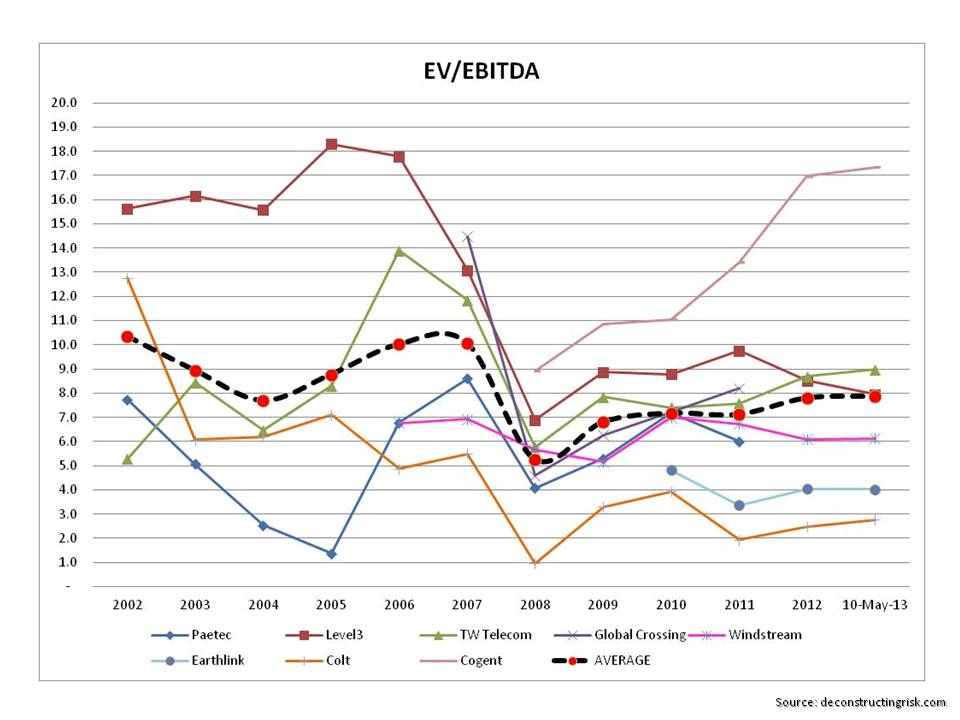
One commonly used valuation metric for telecoms is the EV/EBITDA multiple (although it needs to be supplemented with other metrics such as debt and cash-flow measures to get a holistic picture in the altnet space). The graph below shows the variation that has been prevalent in the sector (for selected firms that survived & there is many names that didn’t).

Historical EV/EBITDA Valuations (point selections as at Year End) click to enlarge

Historical EVtoEBITDA Multiples CLEC sector May 2013

As I was preparing to crystallise my thoughts & analysis on this sector (the discipline of having to write down my analysis for this blog is a big reason I am continuing with this blog experiment), the comments from Keith Meister of Corvex at the Ira Sohn conference this week on Level 3 and TW Telecom have been extremely timely. By the way, Meister is an old colleague of Carl Icahn and served as his envoy on the XO board. Given this pedigree, I would therefore totally discount anything he says as 100% self serving. This post will outline some of the historical experience and a follow-on post will outline my valuation analysis for the future of Level 3 and TW Telecom.

Anybody familiar with this space is well aware of the ups and downs of the soap opera that is Level 3. One of the key players in the telecom boom, it built a wholesale network with the help of vast amounts of equity and debt in the bubble years (raised $14 billion in 1998!) and through the 2000’s became a serial consolidator purchasing firms such as Genuity, Wiltel, Progress Telecom, ICG, Telcove, Looking Glass networks and Broadwing to rebalance its business away from the wholesale business into the enterprise space. It is quite incredible that this company avoided the Chapter 11 route that so many companies in this space had to go through to right-size their balance sheets in the face of the new reality of the sector in the 2000’s. With its merger with the restructured Global Crossing announced in 2011, Level 3 seems to have finally reached a level where its balance sheet fits its business. The company also now has diversity across products and regions which indicate that it may be the right time to focus on organic growth. The arrival of the new CEO, Jeff Storey who previously served as Level 3’s COO and previously was the CEO of Wiltel, and his comments on the latest conference call seem to have signalled that Level 3’s consolidation days are behind it and the focus will now be on driving the company forward given its extensive global assets and improved balance sheet. The company is also a potential attractive takeover target for larger established telecoms looking to expand or from regional telecoms or bandwidth hungry technology companies looking for diversification (the more fanciful speculation highlights Level 3’s chairman Walter Scott & his friendship with Warren Buffet and his place on Berkshire’s Board). Again, Robert Powell posts, such as the one this week on TW Telecom, are the place to go to get sensible and knowledgably views on items such as M&A speculation.

TW Telecom, on the other hand, is at the opposite end of the spectrum to Level 3. It always had a focus on the enterprise space and has such a determined management that its business execution normally results in an ability to predict its quarterly result to the nearest million. Its leverage has always being far more rational than that of Level 3 and it has grown into its balance sheet gracefully over the past years. TW telecom is the sensible stable child to Level 3’s wild rebel in this space. Indeed, TW Telecom’s lack of adventure has been recently cited as a reason why it may be ready for a takeover.

In order to get some context on these two US based firms and a view of what has happened to a European focussed altnet, I also include a historical review of a European company called COLT Telecom (recently cited by Telecom Ramblings as a potential acquisition target for Level 3).

Graph of Historical Share Price for LVLT, TWTC, COLT click to enlarge

Historical Share Prices LVLT TWTC COLT

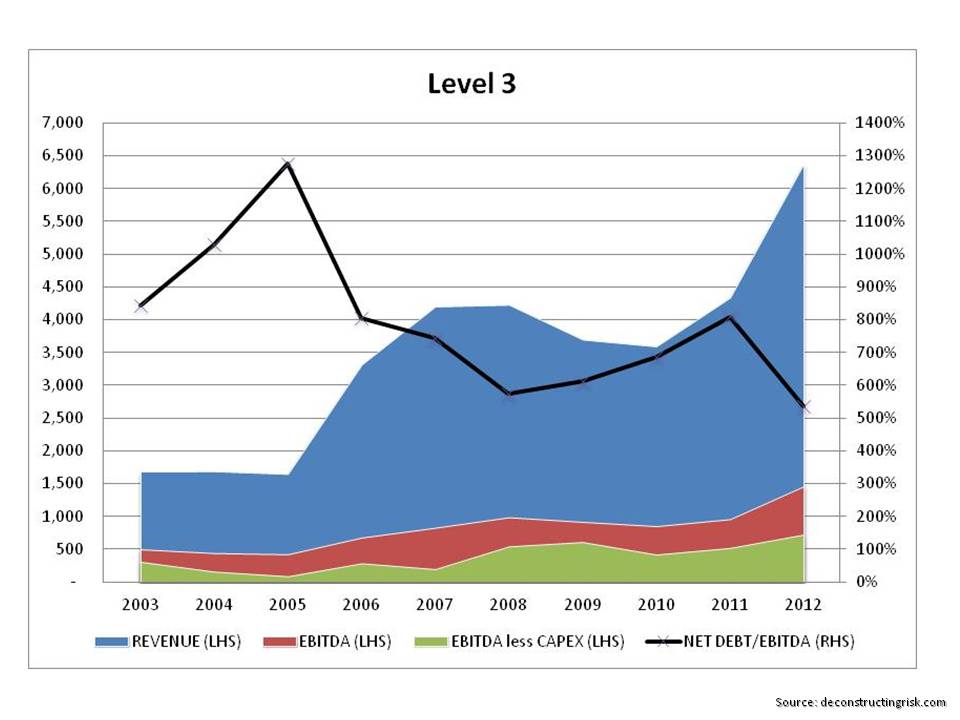
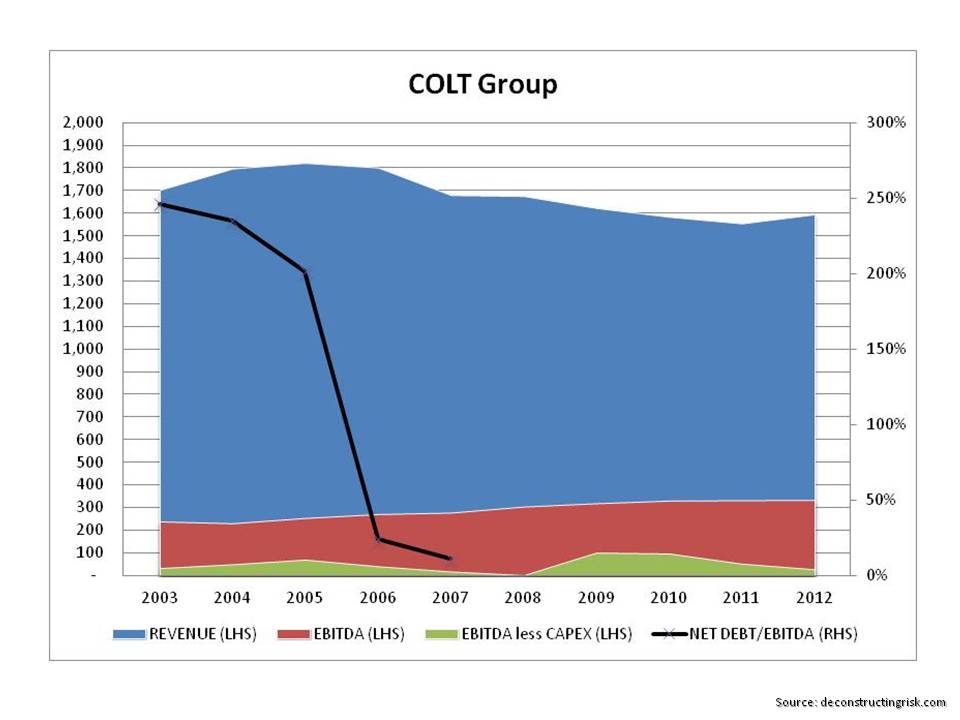
The historical operating figures for these three companies are highlighted below.

Historical Level 3 Operating Metrics (US$s) click to enlarge

Historical Operating Metrics LVLT

Historical TW Telecom Operating Metrics (US$s) click to enlarge

Historical Operating Metrics TWTC

Historical COLT Group Operating Metrics (€s) click to enlarge

Historical Operating Metrics COLT

In the interests of open disclosure, I currently own stock & options in Level 3 and have owned some of the other companies named in this post in the past. I am currently re-examining my valuation methodologies for the sector, specifically for estimating Level 3’s future path using TW Telecom as an example of firm’s experience in a relatively steady state and COLT as an example of firm’s experience on a cross border basis. I have used traditional discounted cash-flow and EV/EBITDA multiple analysis in the past but have recently become more sceptical about the underlying theory for such methods. I am trying to adapt them to get a more realistic view of the sector based upon previous experiences. I will post a follow-up of my thoughts and conclusions.