Category Archives: Economics

The bowels of the system and helicopters

The market volatility in 2016 did seem odd in certain respects. Valuations were too high and a correction was needed. No doubt. It’s more the way the selling seemed to be indiscriminate at certain points with oil and equity prices locked in step. Some argue that China selling reserves to support their currency or oil producing countries selling assets to make up for short falls in oil revenue may be behind some of the erratic behaviour. Buttonwood had an interesting piece over the past weeks on how consequences from new bank regulations are impacting market liquidity with unusual activity in derivative pricing such as negative swap rates and relative CDS rates.

Gilian Tett, in a FT article in January, pointed to the example of capital outflows from China. Whether repaying US debt (or as Tett succinctly calls it, a quasi carry trade in reverse) in face of likely further yuan weakness or withdrawals from overzealous M&A (about a quarter of China outbound deals are said to be in trouble) or other reasons behind the veil of the Chinese economy, the outflows are having impacts. Tett said:

“Capital flows, fuelled by politics and policy change, are where the important action is taking place. Deep in the bowels of the system all manner of financial flows are switching course, creating unexpected knock-on effects for many asset prices. Capital flight from China is one example. The energy sector is another.”

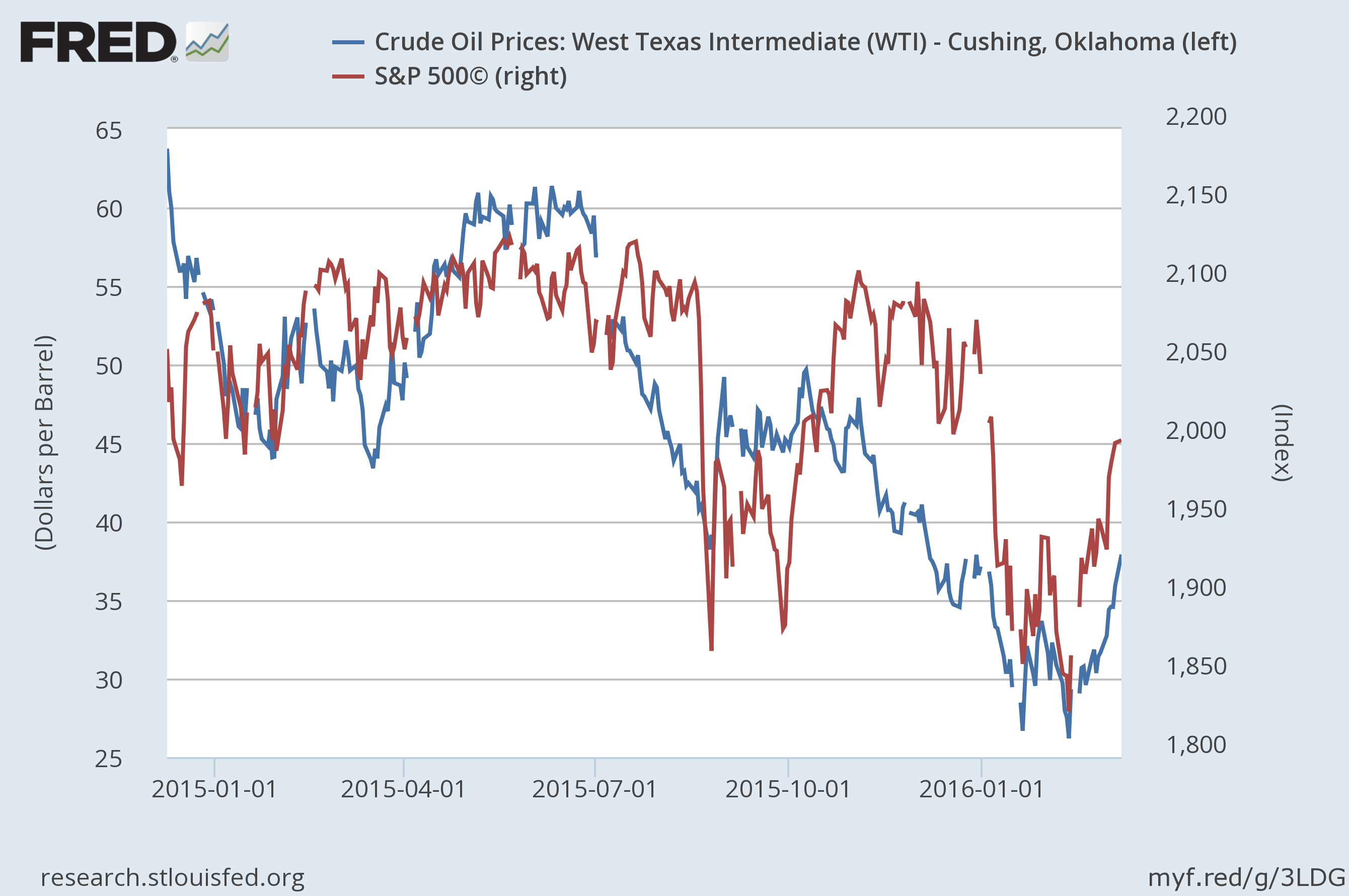
The strangle lockstep between oil and the S&P500 can be seen below.

click to enlargeoil and sp500
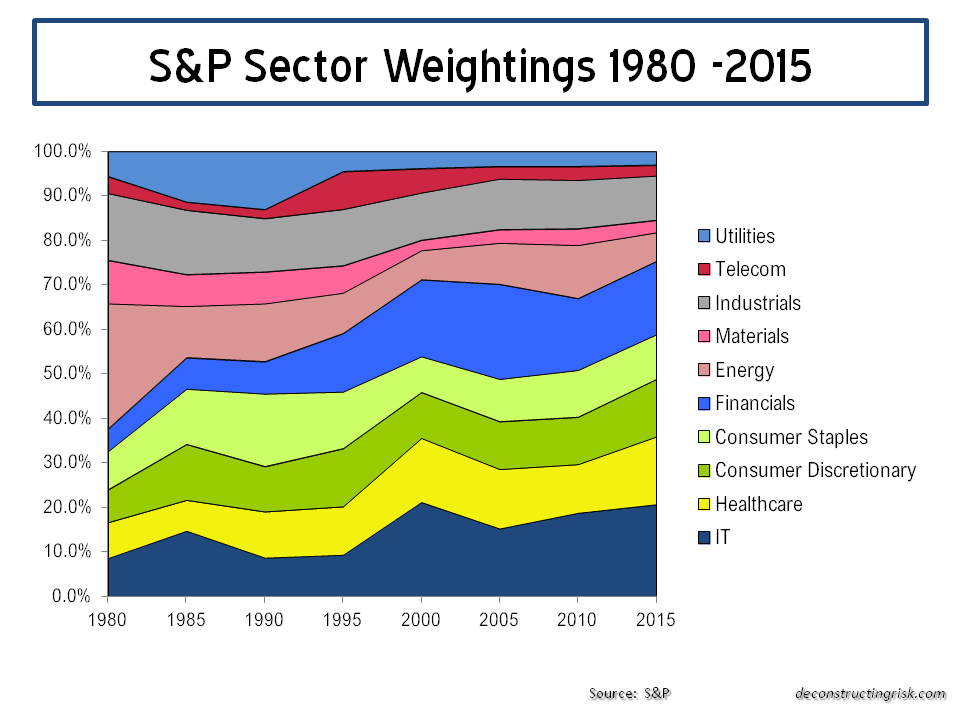
Energy has only a small impact on the S&P500 makeup, as can be seen below, and on the operating profit profile.

click to enlargeS&P Sector Weightings 1980 to 2015
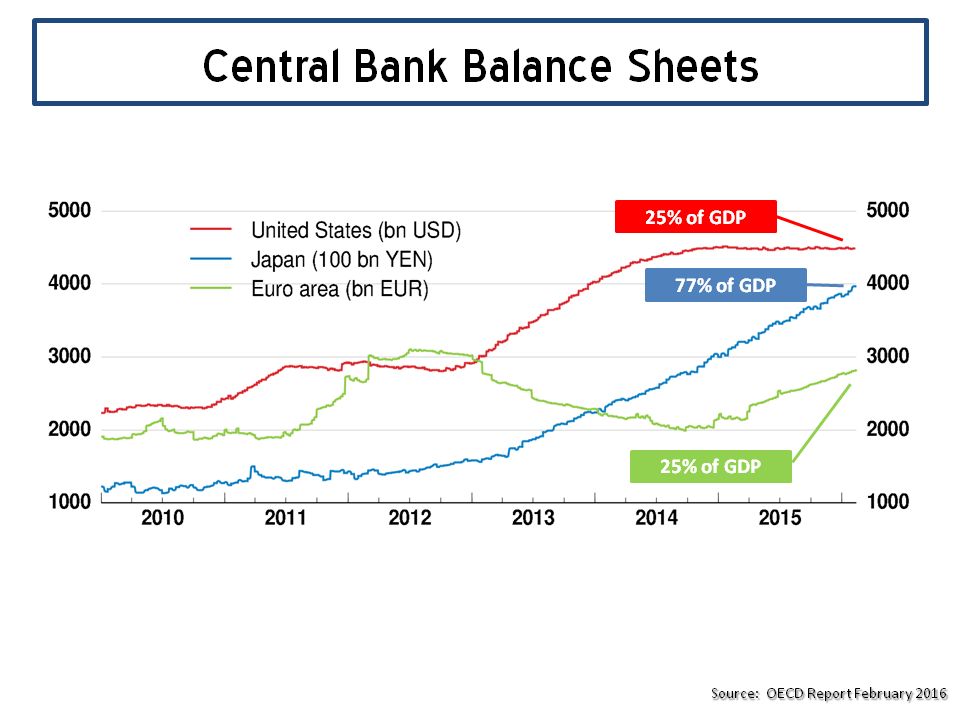
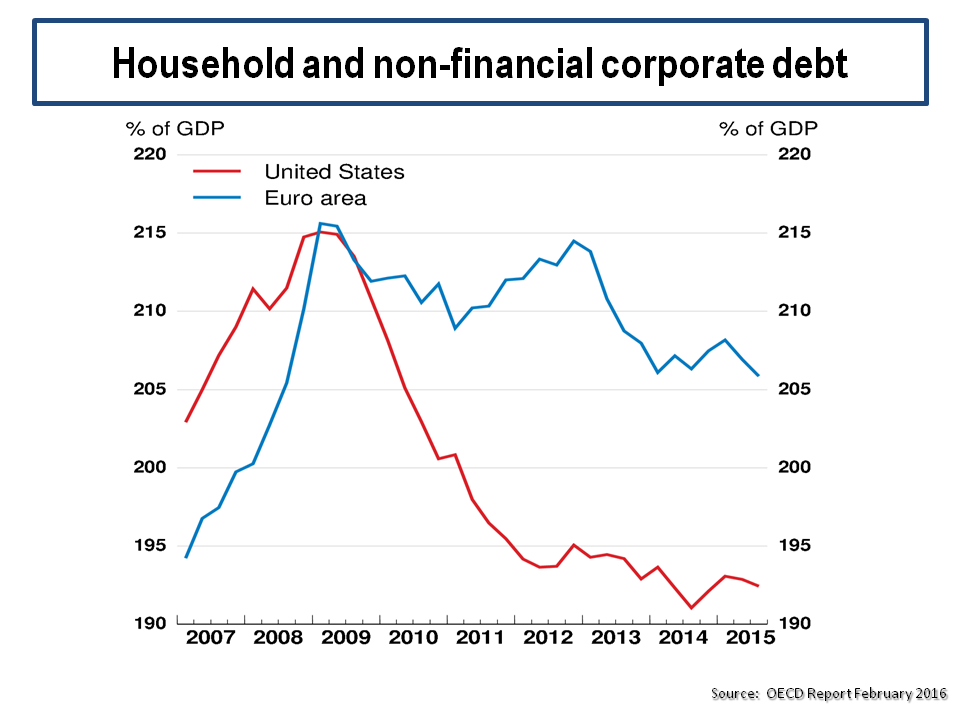
The OECD interim economic outlook by Catherine Mann on 18th February recommended “maintaining accommodative monetary policy, supportive fiscal policies on investment led spending and more ambition on structural policies which raise global growth and reduce financial risks”. Ah, yes the old structural reform answer to all of our ills. The OECD gave some graphic reminders of where we are, as below.

click to enlargeUS & Euro Household & Nonfinancial Corporate Debt 2015
click to enlargeCentral Bank Balance Sheets 2015

Central Bank policies remain stuck to QE and increasingly exotic forms of monetary policy despite the obvious failure so far for QE to kick-start either inflation or growth. The latest experiment is on negative interest rate which has had funny impacts on banks and the lending rates they need to charge. Japan in particular has shown how their brand of negative rates was countered by a currency whiplash. Mark Carney, the Governor of the Bank of England, offered the view that “for monetary easing to work at a global level if cannot rely on simply moving scarce demand from one country to another.

A recent BIS article on negative interest rates in Switzerland, Europe and Japan stated that “there is great uncertainty about the behaviour of individuals and institutions if rates were to decline further into negative territory or remain negative for a prolonged period. It is unknown whether the transmission mechanisms will continue to operate as in the past and not be subject to tipping points“.

This week Mario Draghi came up with a new twist on negative interest rates, relying on targeted long-term refinancing operations (TLTROs) to give banks effectively free money. The currency impact will be interesting, particularly to see if the Japanese whiplash will repeat. One of the results of all this QE is that central banks are a much larger player in the system and have basically taken over the government bond markets in Europe, Japan, and America. The ECB even buys low-rated bonds, not just the AA and AAA positions taken by the Fed, and makes billions of euros in low-interest-rate loans to banks.

No less that Adair Turner, Martin Wolf and Ray Dalio have all made favourable comments about another evolution in QE, so called helicopter money (named after Milton Friedman).  Wolf argues that central banks should enter the arena of public investment in the face of inaction by fiscal authorities (by which I assume he means elected politicians). He passionately says “policymakers must prepare for a new “new normal” in which policy becomes more uncomfortable, more unconventional, or both.” Turner believes that targeted stimulus of nominal demand poses “less risk to future financial stability than the unconventional monetary policies currently being deployed“.

The recent anxiety by electorates across the developed world in expressing a desire for the certainty of the past, whether it be the popularity of Donald Trump, anti-immigrant rhetoric in Europe or the arguments in the UK to leave the EC, show that ordinary people are worried about the future and no end of short term monetary stimulus is likely to change that. Helicopter money sounds like a medicated solution to the symptoms of low growth rather than any real answer to the problem of slowing growth, Chinese and Japanese unsustainable debt loads and global productivity challenges due to aging populations.

Maybe it’s just me, and I do respect the views of Wolf, Turner and Dalio, but it looks to me a measure that is open to so much moral hazard as bordering on the surreal. It gives Central Banks more power in the markets and that could be dangerous without more thought on the unintended consequences. If we are moving piecemeal towards a Chicago Plan or some other alternate economic model, then somebody should get the public on board. I think they are desperately looking for new answers to the way we run our economies.

Sagacious Soros

The thoughts of George Soros never sounded so sensible to me than in this Bloomberg interview on the global issues in our world today. Its worth a view if you have 30 odd minutes spare.

http://www.bloomberg.com/api/embed/iframe?id=yIRcJcfFSdylv6JJqKI1TQ

The Next Wave

As part of my summer reading, I finished Paul Mason’s book “PostCapitalism: A Guide To Our Future” and although it’s an engaging read with many thoughtful insights, the concluding chapters on the future and policy implications were disappointing.

Mason points to many of the same issues as Martin Wolf did in his book (see post) as reasons for our current situation, namely the inherent instability in allowing private profit seeking banks to create fiat money, ineffective regulation (and the impossibility of effective regulation), increased financialization, global flow imbalances, aging populations, climate change and the disruptive impact of new information technologies. This 2005 paper from Gretta Krippner on the financialization of the US economy and reports from S&P (here and here) on the policy implementations of aging demographics are interesting sources cited in the book.

It is on the impact of the information technology and networks that Mason has the most interesting things to say. Mason uses Nikolai Kondratieff’s long wave theory on structural cycles of 50-60 years to frame the information technological age as the 5th wave. The graphic below tries to summarise one view of Kondratieff waves (and there are so many variations!) as per the book.

click to enlargeHistory Rhyming in Kondratieff Waves

The existence of such historical cycles are dismissed by many economists and historians, although this 2010 paper concludes there is a statistical justification in GDP data for the existence of such waves.

Mason shows his left wing disposition in arguing that a little known theory from Karl Marx’s 1858 notebook called the Fragment on Machines gives an insight into the future. The driving force of production is knowledge, Marx theorises, which is social and therefore the future system will have to develop the intellectual power of the worker, enhancing what Marx referred to as the general intellect. Mason contends that the intelligent network we are seeing unfold today fits into Marx’s theory as a proxy for the general intellect.

Mason also promotes the labour theory of value, as espoused by Marx and others, where automation is predicted to reduce the necessary labour in production and make work optional for many in a post-capitalist world. To highlight the relevance of this possibility, a 2013 study asserted that 47% of existing jobs in the US would be replaced by automation. References to Alexander Bogdanov’s sci-fi novel Red Star in 1909 may push the socialist utopia concept driven by the information age too far although Mason does give realistically harsh assessments of Soviet communism and other such misguided socialist experiments.

The network effect was first discussed by Theodore Vail of Bell Telephone 100 years ago with Robert Metcalfe, the inventor of the Ethernet switch, claiming in 1980 that a network’s value is the number of users squared. Mason argues that the intelligent network, whereby every person and thing (through the internet of things) is wired to the network, could even reduce the marginal cost of energy and physical goods in the same way the internet has for digital products. Many of these ideas are also present in Jeremy Rifken’s 2014 book “Zero Marginal Cost Society”. Mason further argues that the network makes it possible to organise production in a decentralized and collaborative way, utilizing neither the market nor management hierarchy, and that info-capitalism has created a new agent of change in history: the educated and connected person.

The weakest part of the book are the final chapters on possible policy responses which Mason calls Project Zero with the following aims: a zero carbon energy system, the production of products and services with near zero marginal costs, and the goal of pushing the necessary labour time close to zero for workers. Mason proposes a trial and error process using agent based modelling to be adopted by policy makers to test post-capitalism concepts. He refers to a Wiki-State, a state that acts like the business model of Wikipedia nurturing new economic forms without burdensome bureaucracies. Such a state should promote collaborative business models, suppress or socialize info-monopolies, end fractional banking (as per the Chicago Plan), and follow policies such as a minimum basic wage for all to accommodate the move to new ways of working. All very laudable but a bit too Red Star-ish for me!

Nonetheless, Mason’s book has some interesting arguments that make his book worth the read.


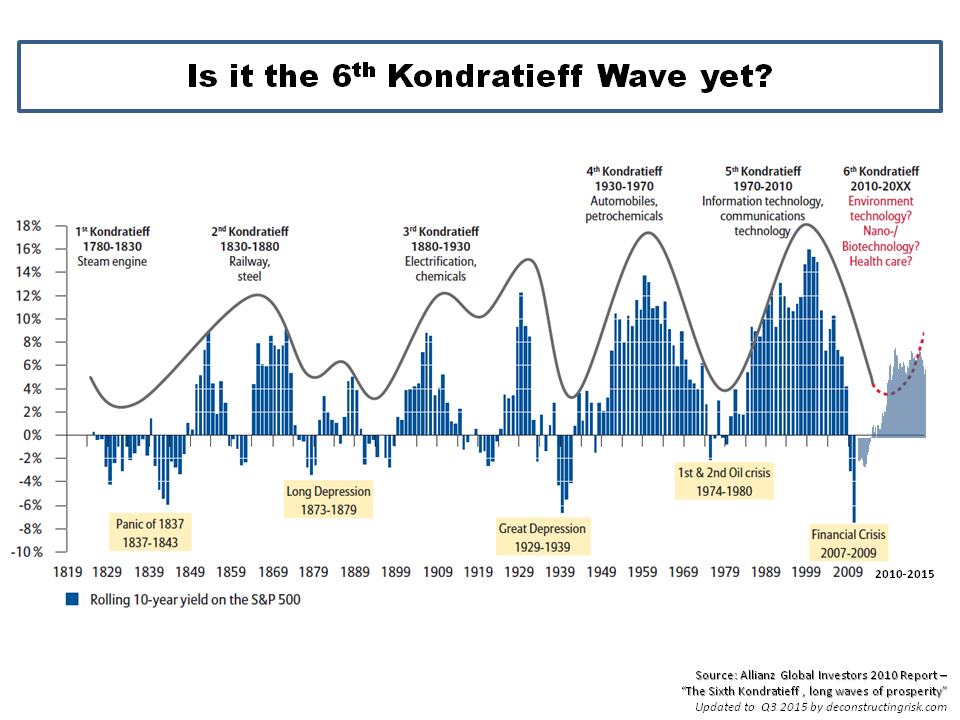
An aside – As highlighted above, there are many variations on the Kondratieff long wave out there. An interesting one is that included in a 2010 Allianz report which, using the 10 year average yield on the S&P500 as the determinant, asserts that we are actually entering the 6th Kondratieff wave (I have updated it to Q3 2015)!

click to enlarge6th Kondratieff Wave

Looking through some of the mountain of theories on long waves reminds me of a 2004 quote from Benoit Mandelbrot that “Human nature yearns to see order and hierarchy in the world. It will invent it if it cannot find it.

Why Liquidity Rules

Businesses with strong cash-flow are rightfully held in high esteem as investments. Google and Apple are good examples. Betting/gambling firms and insurers (in non-stressed loss periods) are other examples of businesses, if properly run, that can operate with high positive cash-flow.

The banking sector is at a completely different end of the spectrum as liquidity transformation is essentially the business. Everybody knows of Lehman Brothers bankruptcy, which was instigated in late 2008 by an immediate need to find $3 billion of cash to meet its obligations. The winding-up of the Lehman Brothers holding company in the US is estimated to return approximately 26 cents on the dollar according to this FT article.  It was therefore a surprise to read in the FT article and in another recent article on the expected surplus of £6 to £7 billion from the winding up of Lehman Brothers operation in London after all of the ordinary creditors have been repaid in full. This outcome is particularly surprising as I understood that the US operation of Lehman did a cash sweep across the group, including London, just prior to entering bankruptcy.

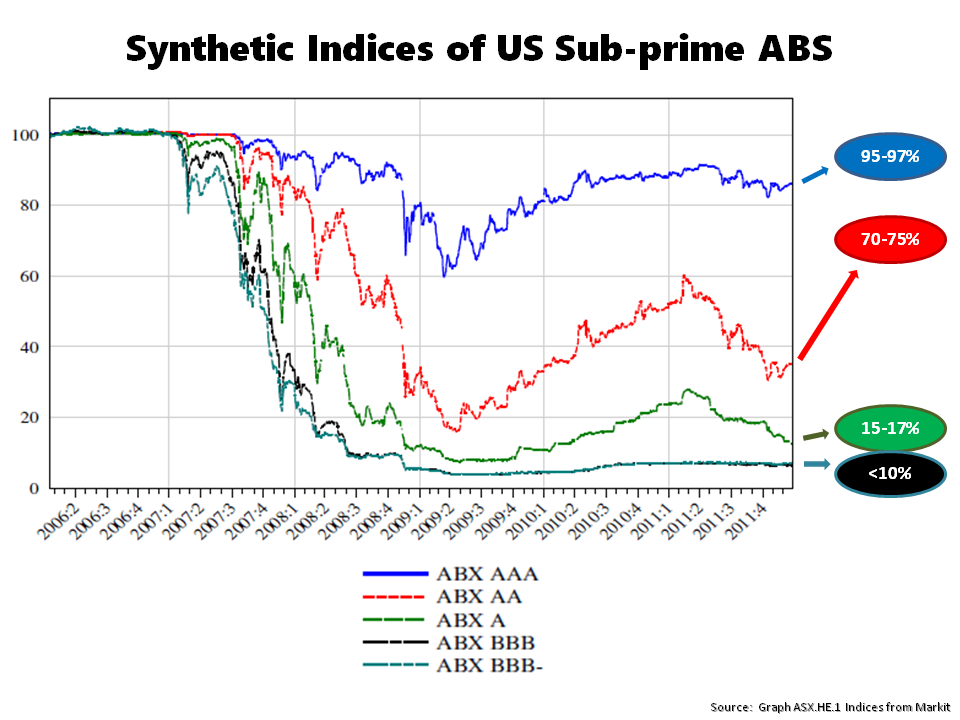
In his book (as referenced in this post), Martin Wolf highlights the changing perceptions of value since the crisis by using ABX indices from Markit which represent a standardized basket of home equity asset backed securities. The graph below shows the value for one such index, the ABX.HE.1, to the end of 2011. These indices are infamous as they were commonly used to value securities since the crisis when confidence collapsed and can be used to demonstrate the perils of mark to market/model accounting (or more accurately referred to as mark to myth values!).

click to enlargeMarket Value Asset Backed Subprime Index

I have included the more recent values of similar ABX indices in the bubbles as at last year from Wolf’s book. This graph accentuates the oft used quote from Keynes that “the market can remain irrational longer than you can remain solvent”.

Wolf argues that the 3% liquidity ratio proposed under Basel III or indeed the 5% proposed in the UK are totally inadequate and he suggests a liquidity ratio closer to 10%. On capital ratios, Wolf argues for capital ratios of 20% and above with a strong emphasis on tier 1 type equity or bail-inable debt that automatically converts. This contrasts against the 6% and 2.5% of tier 1 and 2 capital proposed respectively under Basel III (plus a countercyclical and G-SIFI buffer of up to 5%). Wolf also highlights the bankers ability to game the risk weighted asset rules and suggests that simple capital ratios based upon all assets are simpler and cleaner.

Wolf supports his arguments with research by Bank of England staffers like David Miles1 and Andrew Haldane2 and references a 2013 book3 from Admati and Hellwing on the banking sector. Critics of higher liquidity and capital ratios point to the damage that high ratios could do to business lending, despite the relatively low level of business lending that made up the inflated financing sector prior to the crisis. It also ignores, well, the enormous cost of the bailing out failed banks for many tax payers!

For me, it strengthens the important of liquidity profiles in investing. It also reinforces a growing suspicion that the response to the crisis is trying to fix a financial system that is fundamentally broken.


  1. Optimal Bank Capital by David Miles, Jing Yang and Gilberto Marcheggiano
  2. The Dog and the Frisbee by Andrew Haldane
  3. The Bankers New Cloths by Anat Admati and Martin Hellwing


Summer Blues

After the holidays, it’s time to pack the bucket and spades away and get back into the routine. It has been a volatile August.  A bear call in a post in early May is looking pertinent (as is the post on a suggested tie-up between Paddy Power and Betfair!) given the 7% drop in the S&P500 since then, although it is more likely dumb luck.

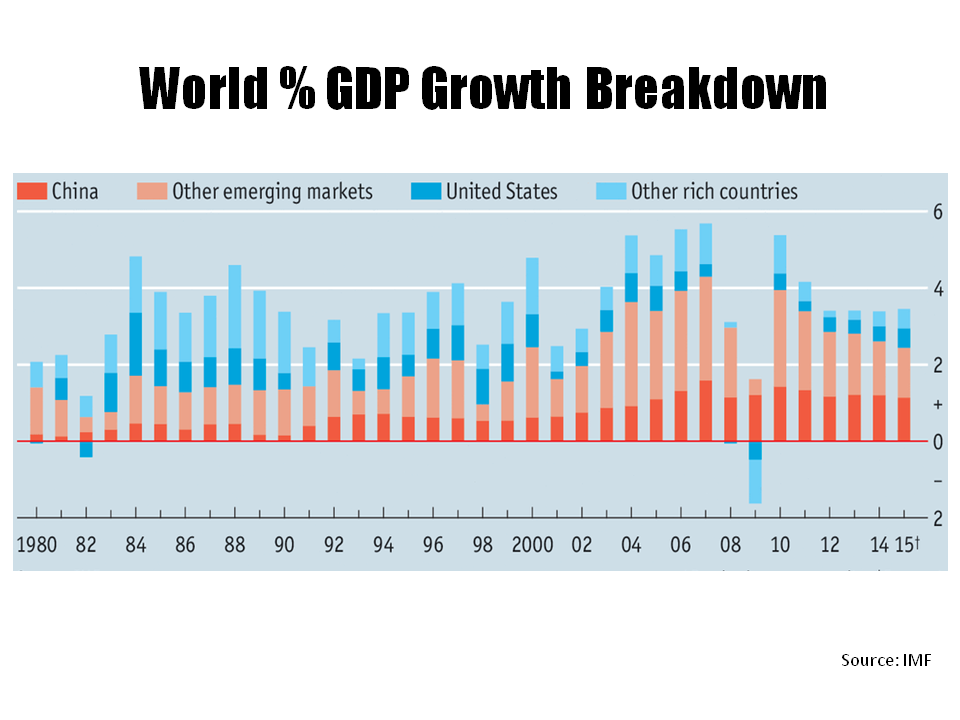
The market concern is centred on the prospects for China’s economy. Growth is widely believed to be a lot lower than the official 7% with exports down, concerns about zombie loans and the political ramifications of managing a lower growth economy. The Economist, in an article this week, highlighted the potential impact of a slow-down in China and other emerging markets on global growth, as per the graph below.

click to enlargeGlobal GDP Growth Breakdown 1980 to 2015

Amongst the usual holiday reading, I brought two books on economics for the beach. The first was the FT’s Martin Wolf’s “The shifts and the shocks” from late in 2014 and the second is the recently published “Postcapitalism” by Paul Mason. Although often a laboured read, I did manage to finish the former whilst I only got to start the latter (which is a much easier read).

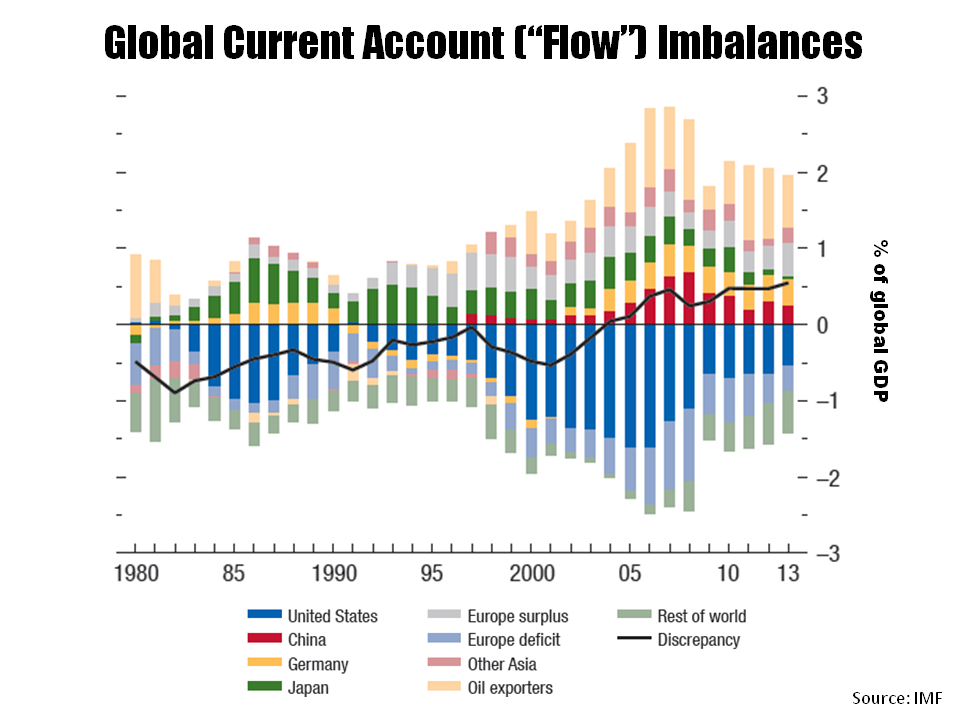
Reading Wolf’s book as the China led volatility was unfolding only led to an enhanced feeling of negativity from the themes of the book, namely the lessons as yet unlearned from the crisis. Wolf competently covers much of the causes of the crisis and its aftermath – a global savings glut and associated global imbalances, an expansionary monetary policy that ignored asset prices and credit, an unstable liberalized financial system supervised by naïve regulation. The following graph from the IMF reminds of the global imbalances that proved so toxic when combined with a rampant financial sector.

click to enlargeGlobal Current Account Imbalances 1980 to 2013

Wolf questions the “belief that government borrowing is the illness for which private borrowing is the cure has survived all that has happened”. Some of the solutions that Wolf proposes include much higher capital requirements for banks than is currently being implemented under Basel III, deleveraging initiatives such as tax incentives towards equity and away from debt, corporate tax changes to encourage corporate investment, changes in debt contracts to convert to equity on macro-economic metrics, policies to address income inequality and to promote research and education.

A more radical reform of the financial system, along the lines of the Chicago Plan for 100% reserve banking whereby the ability to create money is taken away from profit seeking banks and given solely to central banks, is a step that Wolf favours but believes is unrealistic given the realpolitik of the developed world system. On the globalised financial system, Wolf believes that the “obvious truth that unless regulation and the supply of fiscal backstops is to be much more global, finance should be far less so” and suggests a greater segmentation of the world’s financial system.

There are many themes in Wolf’s book that got me thinking and I am hoping that Mason’s book will do the same, albeit from a totally different perspective. I think the market volatility has more time to play out and hopefully my summer reading, although yet to be completed, will assist in understanding what may come next.