Category Archives: Economics

More on Non-existent Deleveraging

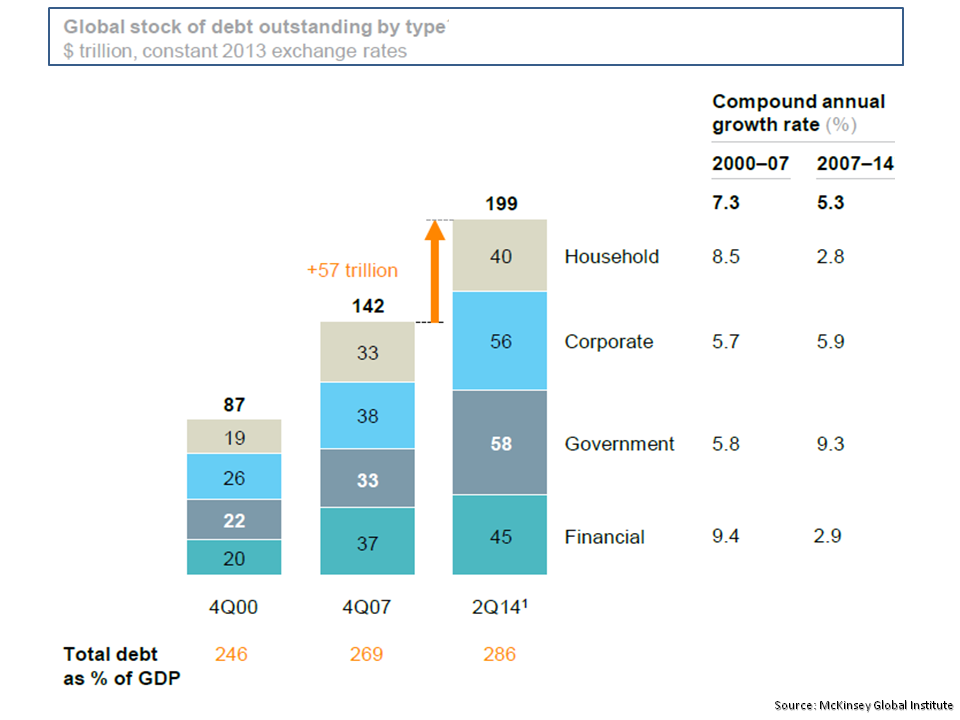
McKinsey released their third report on global debt levels recently, entitled “Debt and (not much) Deleveraging”. Covering much of the same ground as the Geneva report in September (see previous post), the highlights of the report include detail behind the rise in public sector and household debt, the growth rates needed to start real deleveraging, the higher capital levels in the banking sector, the detail behind China’s rising debt, and some suggestions to live with high debt levels in the future. I would recommend the report to anybody interested in the macroeconomics.

The report is the subject of the Buttonwood piece this week where he also talks about the challenges that higher global debt brings. A recent post on changes to global demographic profiles is also relevant when thinking about servicing future public and private debt.

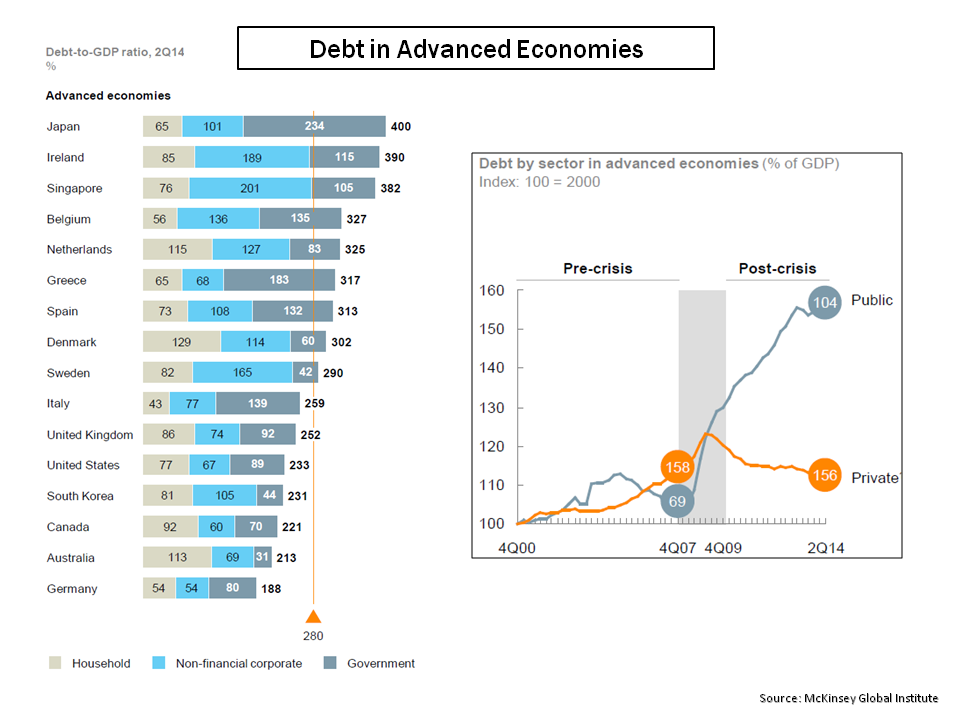
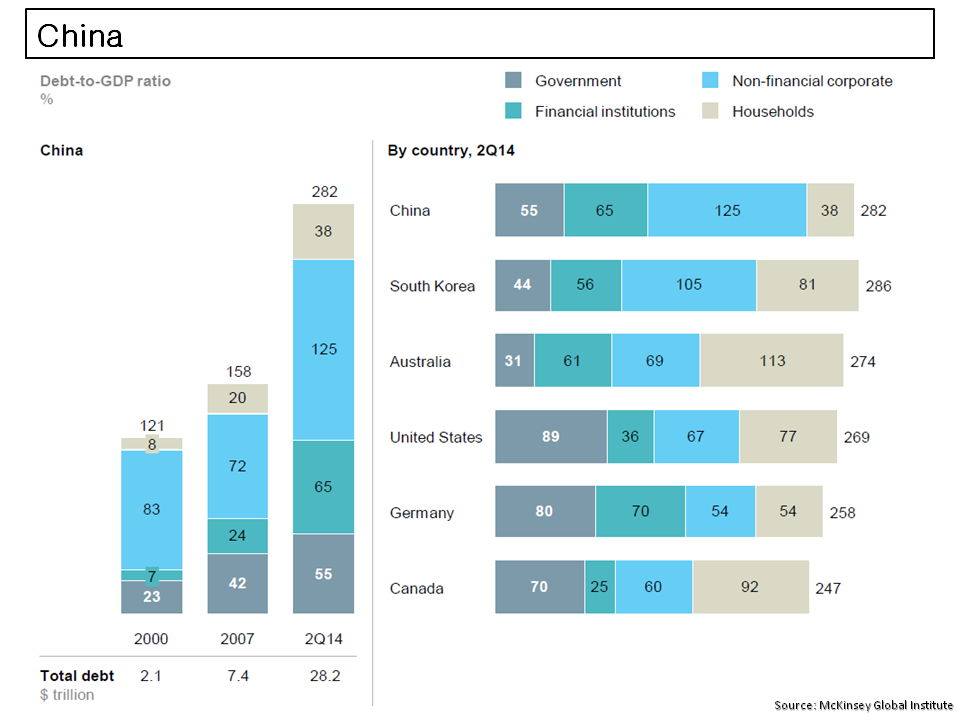
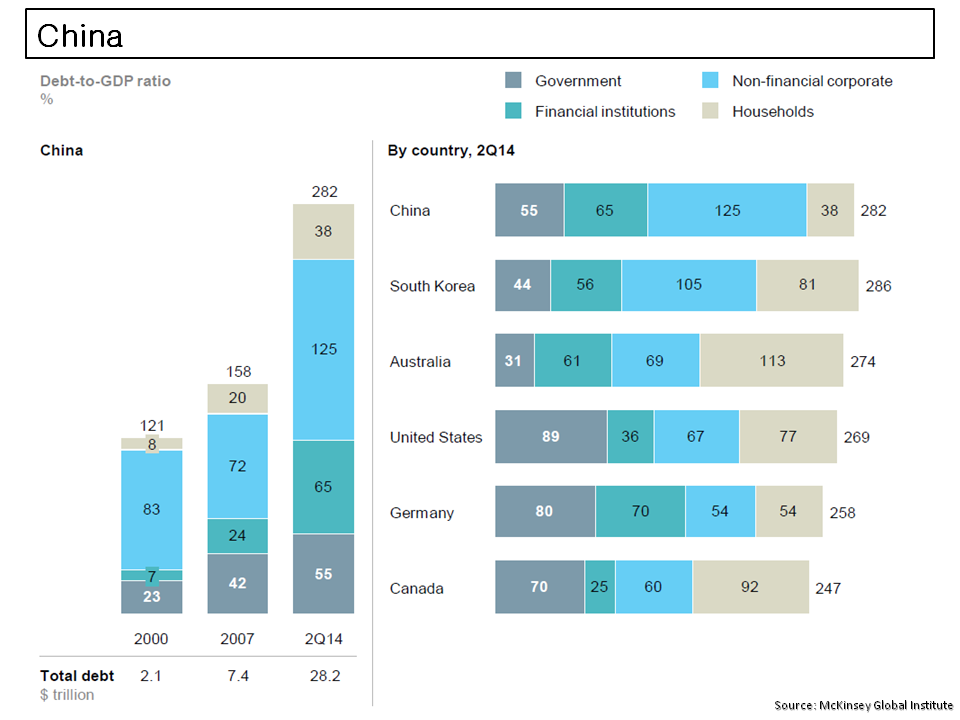
Below are a few of the graphics of interest from the report on the size and split of global debt, the mix between private and public debt in developed countries and the growth rate needed to start deleveraging, and the debt in China.

click to enlargeMGI Global Debt

click to enlargeMGI Advanced Economies Public vrs Private Debt

click to enlargeMGI GDP required to start deleveraging

click to enlargeMGI China Debt to GDP

Debt in a greying age

The book “Capital in the Twenty-First Century” by Thomas Piketty is unquestioningly one of the books of 2014. This blogger is currently reading Piketty’s book after finding it in his Santa sock this Christmas. There were not many other books from 2014 that caught my attention. One book that I am very much looking forward to in 2015 is the new Steven Drobny book “The New House of Money” with detailed interviews of money managers. On his website, Drobny has already released the first two chapters – one on Kyle Bass and the other with Jim Chanos.

The views of Kyle Bass, in particular, on Japan got me thinking again about demographics and the ability to withstand large debt loads. The views of Bass are also articulated in a piece on the investor perspectives website. For example, Bass states that currently in Japan debt repayments take up 25% of government tax revenues but that a 100bps rise in interest rates in Japan would mean that 100% of tax revenues would go to repayments. That leaves very little room for error!

This week, Buttonwood also has an article on the restrictions that large debt loads places on the effectiveness of monetary policy.

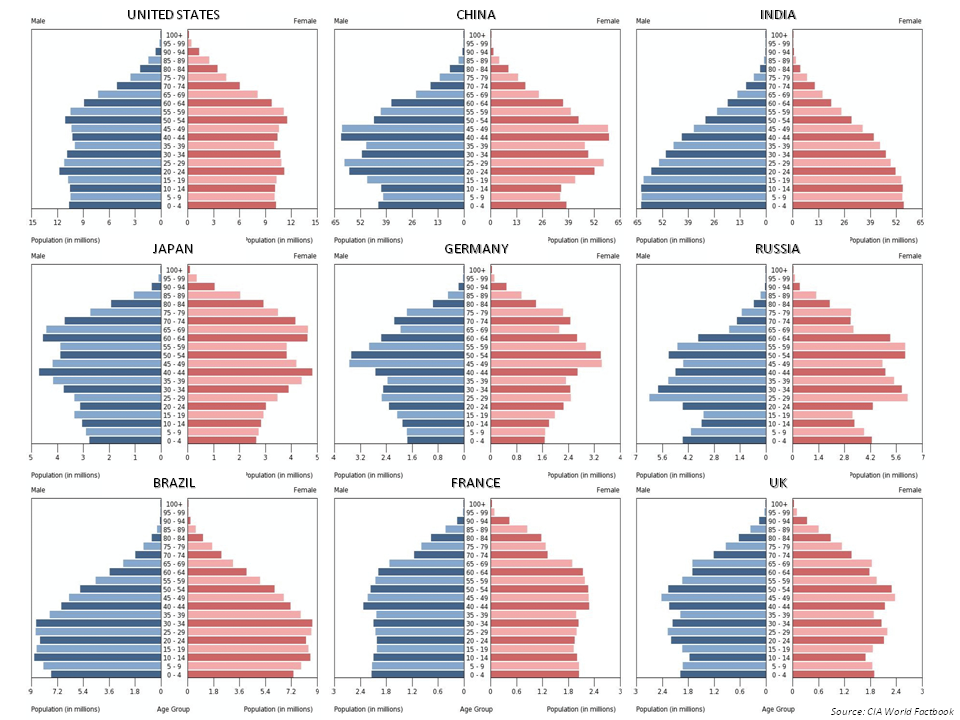
In terms of age profiles, the graphic below shows the profiles of the 9 largest economies (according to the World Bank).

click to enlargeTop 9 Demographics

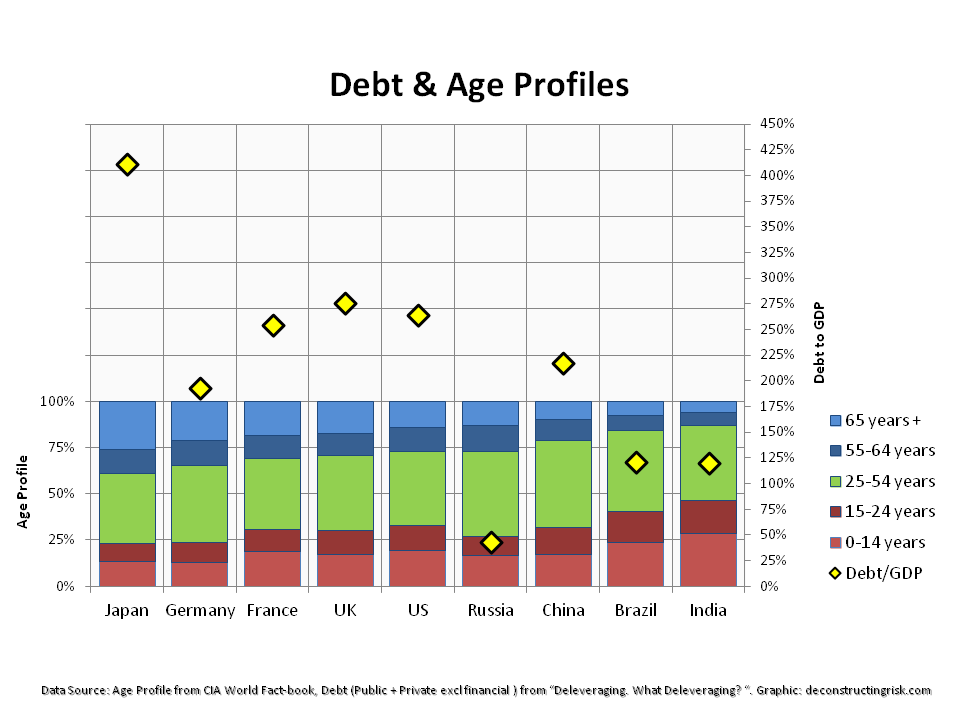
Japan and Germany clearly stand out as countries with an aging population, currently with 26% and 21% of their populations over 65 respectively. I also compared the age profiles against the public and private debt figures (excluding that from banking and other financial service firms) from the “Deleveraging. What Deleveraging?report (see previous post on that report), as per the graph below.

click to enlargeMajor Country Public & Private Debt ex financial versus Age Profile
The graph does show that there is a clear relationship between debt loads and age profiles, particularly the percentages for the over 55s. However, the outliers of Germany and Russia on the low debt side and indeed Japan on the high debt side show that there are many other factors at play, not least the historic cultural characteristics of each country. The burden that high debt loads places on future generations is clearly an important policy issue for the global economy, one that will become ever more important if interest rates are to return to anyway close to normality.

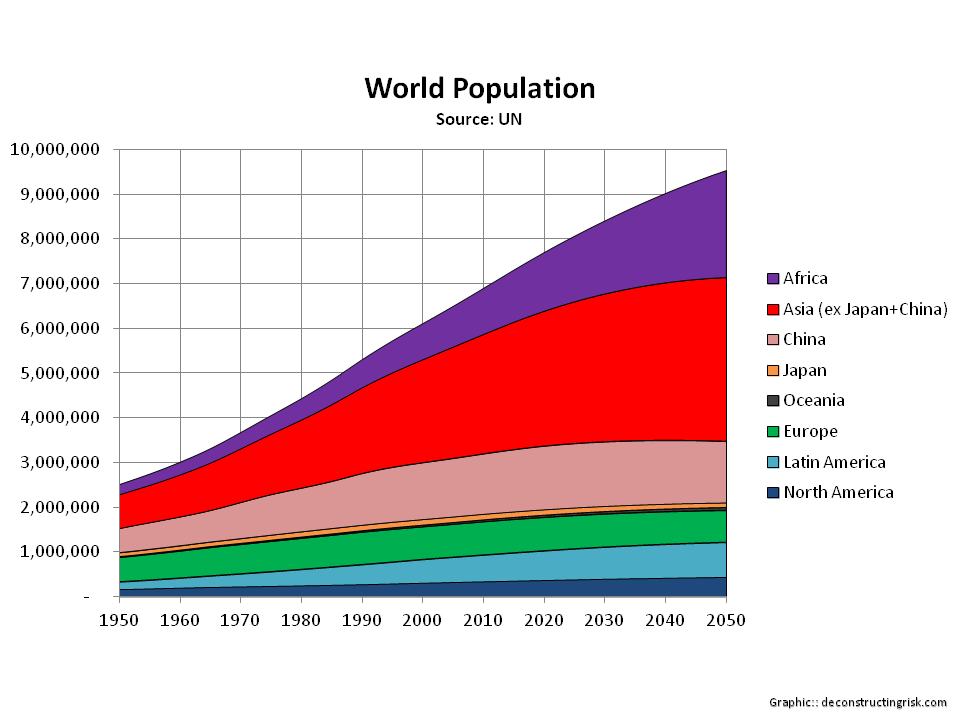
As a follow-on to this post, I have been looking through the UN population projections and the following graphs represent population profiles I found interesting. The first is the world population historical figures and projections by age profile.

click to enlargeWorld Population Projections & Age Profile

The next graph is the world population split by continent (with Japan and China split out of Asia).

click to enlargeWorld Population Projections by Continent

And finally, a graph of the world population aged over 60 and aged under 15 split by continent.

click to enlargeWorld Population Over 60s & Under 15s by Continent

Delirious Deleveraging

Michael Lewis, in his 2011 book “Boomerang” on the consequences of the financial crisis, said that “leverage buys you a glimpse of a prosperity you haven’t earned”. Well, if that is true, we are all in trouble based upon the findings from the fascinating Geneva report “Deleveraging? What Deleveraging?” from Luigi Buttiglione, Philip Lane, Lucrezia Reichlin and Vincent Reinhart, published yesterday.

The report paints a stark picture, as the following statements illustrate:

“Contrary to widely held beliefs, the world has not yet begun to delever and the global debt-to-GDP is still growing, breaking new highs. At the same time, in a poisonous combination, world growth and inflation are also lower than previously expected, also – though not only – as a legacy of the past crisis. Deleveraging and slower nominal growth are in many cases interacting in a vicious loop, with the latter making the deleveraging process harder and the former exacerbating the economic slowdown. Moreover, the global capacity to take on debt has been reduced through the combination of slower expansion in real output and lower inflation.”

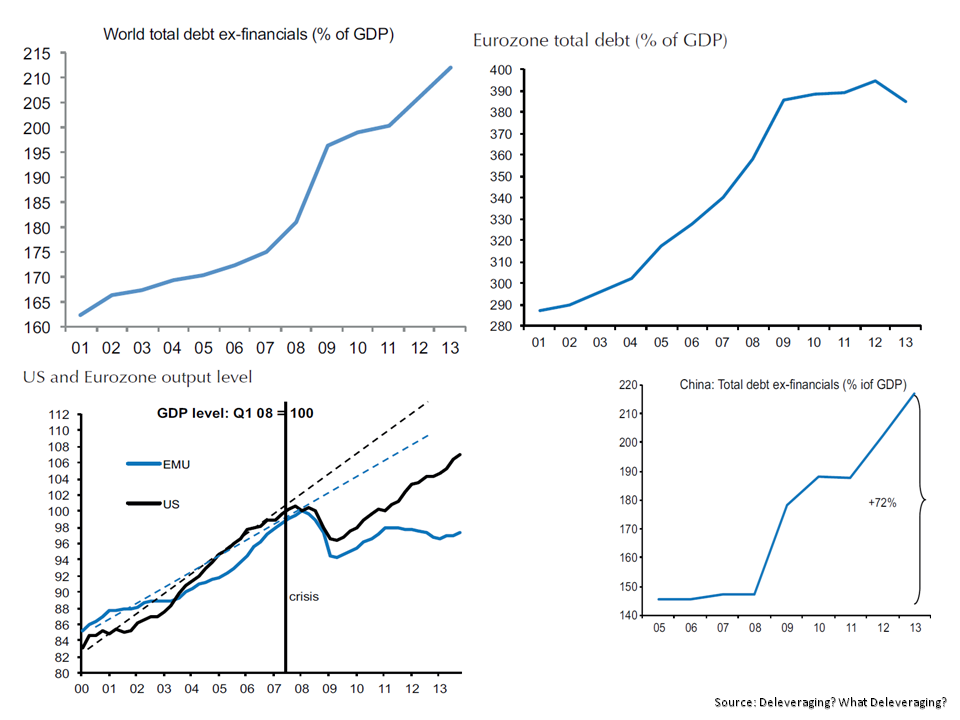
The report has a number of attention grabbing graphs on debt levels as a % of GDP like the one below on the US and others on Europe, China and global debt levels, as below.

click to enlargeUS Debt as % of GDP

click to enlargeDebt as % of GDP

The report is particularly pessimistic about China’s medium term prospects after its rapid 72% rise in debt levels since the crisis. On the US and the UK, for the countries who “managed the trade-off between deleveraging policies and output costs better so far, by avoiding a credit crunch while achieving a meaningful reduction of debt exposure of the private sector and the financial system” the legacy of “a substantial re-leveraging of the public sector, including the central banks” leaves a considerable challenge for the future.

Is the Euro now safe?

Whilst reading commentary on the implications of the Euro elections and the procedural tensions over the selection of the next European Commission president between the EU parliament and Europe’s finance ministers, I came across a thought provoking article – “Whither the Euro”- from a March IMF publication by Oxford Professor Kevin O’Rourke.

O’Rourke points out that the preventative policies necessary to avoid another Euro crisis – first a banking union, then a single resolution framework, followed by a euro area fiscal backstop, and (maybe) a common deposit insurance framework – require a deepening of European integration or “more Europe”. Although progress has been made on banking union, the “show me the money” commitment required for the next steps of integration has not been forthcoming so far. Nichola Veron, in another IMF article entitled “Tectonic Shift”, describes banking union as “a regime change for European finance” and says that whilst “prospects for the first step (of banking union) are reasonably encouraging, it will be a long time before the implications for Europe’s financial stability and economic prospects can be comprehensively assessed”.

O’Rourke highlights the reality today and the choice facing Europe:

“Europe is now defined by the constraints it imposes on governments, not by the possibilities it affords them to improve the lives of their people. This is politically unsustainable. There are two solutions: jump forward to a federal political Europe, on whose stage left and right can compete on equal terms, or return to a European Union without a single currency and let individual countries decide for themselves.”

O’Rourke asks at what stage the European wide political resolve to jump forward will emerge, having failed to materially progress 5 years after the crisis. The election results which just emerged across Europe suggest that the electorate has little appetite for “more Europe” and that there is a real disconnect with policy makers.

I must admit that since the Draghi put dispersed the prospect of a Euro breakup, I haven’t given much thought to revisiting the messy consequences. The fantasy spreads of many European sovereign bonds, as highlighted in a previous post, do suggest that markets are currently being over-optimistic on the future monetary stability of the region. With the prospect of future uncertainty due from increasing electorate discontent across Europe and due to events such as the unresolved structural faults in many economies and the likely exit of the UK from the EU in a referendum due by the end of 2017, a logical prediction may be that we will revisit the whole subject of the Euro again in the years to come.