Category Archives: Investing Ideas

Bad education

I have been neglecting this blog as the soap opera that is American politics has been playing out. Trump’s decision to go for it full throttle straight from the off looks like resulting in political war in the US which will no doubt result in a messy few weeks, if not months, ahead. The jury is still out on whether this new form of extreme politics can survive indefinitely, or whether one of Trump’s skeletons will come crashing out of the closet, or whether Trump gets catch out dealing with an unexpected event. For the Democrats, there is the depressing thought that if Trump messes up big time, the option of impeachment requiring their consent to a two third majority in congress, would only result in President Pence!

My instinct is telling me to reduce equity exposure currently, on valuation concerns rather than political ones, and my hard fought for risk management discipline means I am acting on that instinct. I also distrust the neatness of the market consensus that markets will rise on stimulus hopes to mid year before falling back to sustainable valuations by year end. Reality is never neat, especially I suspect in Mr Trumpland. Notwithstanding this environment, one of my new year’s resolutions was to try and get some new equity ideas to track and maybe pick up if valuations get more attractive.

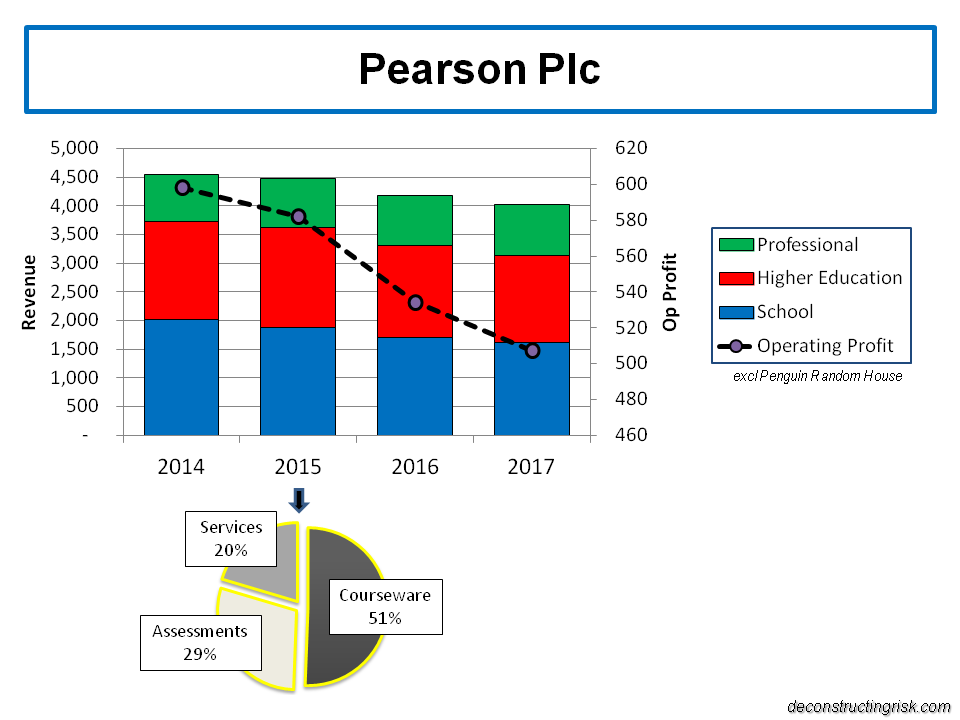
The disappointing results from Pearson Plc two weeks ago reminded me of my last post on the technological changes disrupting the education sector. I thought I would have a quick look over some of the firms mentioned in that post three years on. The trends at Pearson are not pretty, as the graph below shows. Particular poor results in the US higher education sector mean the firm is selling off Penguin Random House and “taking more radical action to accelerate our shift to digital models and to keep reshaping our business”. Pearson’s stock is down over 50% since my last post three years ago and another shakeup in management, if not strategy, looks inevitable.

click to enlargepearson-plc
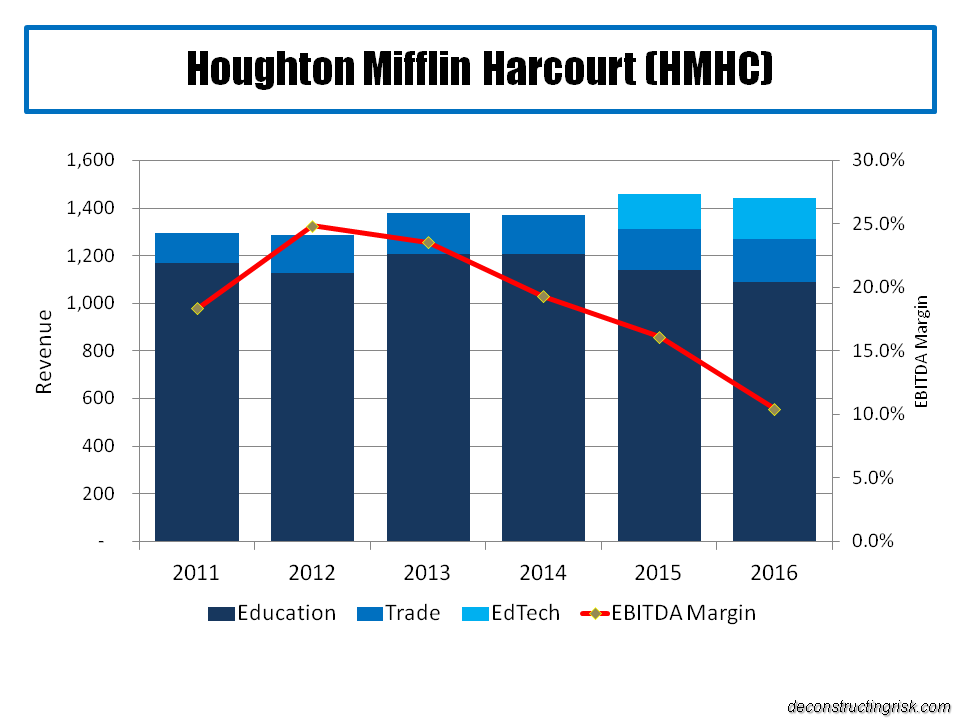
In fact the hope that the juicy margins of the old world text book business can be transferred to the new on-line world is looking fanciful. The shift to on-line education looks like another example of technology gutting the margins of yesteryear’s reliable business models. Houghton Mifflin Harcourt (HMHC) has a younger school focus and was the main education stock featured in my 2014 post. HMHC too is down considerably over the past three years, approx 42%. The graph below shows the downward trend in its core revenues and margins.

click to enlargehoughton-mifflin-harcourt-2011-to-2016-revenue-ebitda-margin
So it looks like hoping established education firms can transition with seamless profits into the digital world is not a place to look for new investment ideas. Of course, there have been big successes in the online sphere from newer firms and business models. TAL Education (ticker TAL), the Chinese K12 after school online tutor, is one and it’s up approx 250% over the past three years. It’s outside of my risk appetite as I prefer large diverse established firms with a clear market advantage, an understandable reason for upside and a management team I can believe in to entrust my optimism.

The search for new ideas goes on…

PS – Any ideas out there would be greatly welcome!
Trinity Meltdown

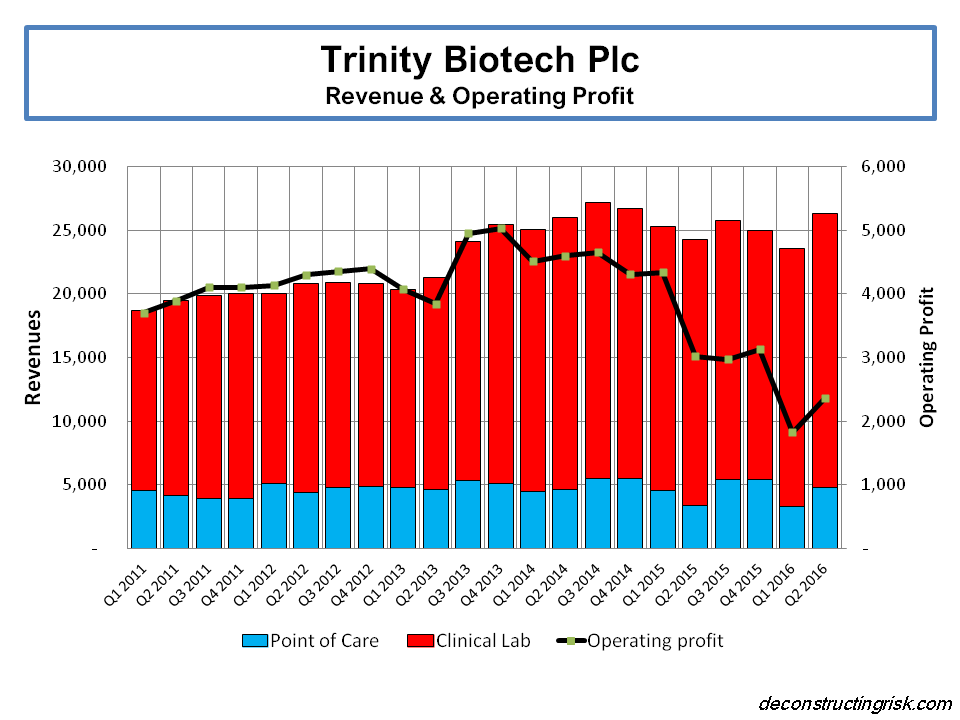
In May last year I posted on an undisciplined investment, Trinity Biotech (TRIB), which I bought at $21 per share and, after ignoring some basic investing rules, didn’t sell until it hit $16. I had thought that the underlying metrics of TRIB existing business would improve, with a big upside potential with the FDA approval of its Meritas Troponin Point-of-Care test (as outlined in this post). Since last year, I have kept an eye on the firm as their operating results continued to be uninspiring, as per the graph below.

click to enlargetrinity-biotech-2011-to-q22016-revenue-operating-profit

I continued to monitor the firm from afar to see how the FDA approval was progressing, for curiosity sake more than anything else (the investment case was similar a coin toss given the operating results and I have, thankfully, grown out of such gambles). The timing of any final approval was dependent upon FDA queries but Q4 was been talked of as a possible time for a final FDA decision.

It has therefore come as a considerable shock to all stakeholders, and a 50% collapse in the share price, when TRIB announced early on Tuesday that it has withdrawn its FDA application for the Troponin test on the advice of the FDA itself. Analysts representing investors vented their anger at the company’s management on the conference call on the news (worth a listen if you are so inclined).

I genuinely felt sorry for management as they tried to explain the “devastating news” about how they could have got the FDA approval so wrong. Although the FDA would not go into the gritty details on a 30 minute call communicating the news to management behind their “minded to refuse” position, TRIB’s management were restrained in expressing their (obviously very disappointed) view that the FDA had moved the goal posts in their assessment criteria. The FDA will give TRIB more detail on their decision over the coming months (strangely only on the condition that TRIB withdrew their application).

Management expressed their view, based upon the information from the FDA call, that any new application was unlikely given the large R&D expenses needed to address the issues raised and announced they would shutter the programme, reducing their annual capitalised expenses from $9 million to $1.5 million including the closure of their Swedish facility. Given they capitalise most of these expenses, the impact will primarily be on cash-flow rather than on the P&L (they may manage to be cash-flow neutral on a pro-forma basis).  Insight into future operating results and what the balance sheet will look like after the write-offs needed on this withdrawal may come with the Q3 results.

At a share price of approx $6.50, TRIB indicated that their Board would likely instigate a large buy-back programme after the early release of their Q3 results (likely due by mid October). With $85 million of cash left from their $100 million convertible debt, TRIB has the firepower if it can get to positive cash-flow on an operating basis in the near term. Analysts were very blunt in their reaction, stating that management now had a major credibility issue and that a sale of the firm should now be the priority.

All in all, a sad day for TRIB, its employees and its future prospects. And, of course, for its shareholders.

Paddy Power Betfair Revisited

It has been about 10 months since I posted on the potential for the Paddy Power and Betfair merger and a lot has happened since. Brexit and the resulting sterling volatility are obvious events of significance. In the betting sector, consolidation has continued with the Ladbrokes and Gala Coral merger having been announced and approved. The audacious proposed tie up by Rank and 888 on William Hill floundered with recent press reports suggesting Rank and 888 could get together. The consolidation in this rapidly changing sector is far from over.

The initial optimism on the future prospects for the two high achieving entities, Paddy Power and Betfair, resulted in the share price trading above the £100 level earlier in the year. Following Brexit, it traded as low as £80. The merged firm reported their H1 figures earlier this week which showed the full extent of the merger costs and provided an increased cost synergies figure for 2017 of £65 million. With 75% of EBITDA being sterling based, the currency impact was not as material as their multi-jurisdictional operations would suggest.

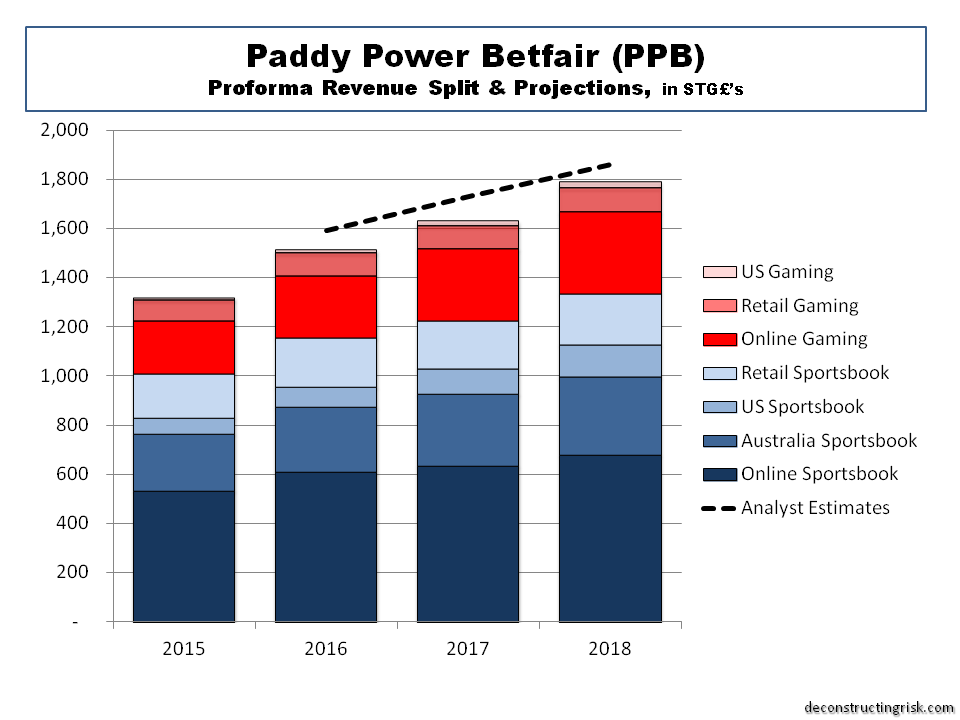
Top-line results for H1 do however indicate that 2016 revenue growth will likely not be as high as the 17% I had expected in November. The reality of issues in this regulated and highly competitive sector also served as a reminder that the path may not be as smooth as initially hoped for. Regulatory headwinds in Australia were an example. As a result, I revised my revenue estimates in November from £1.64 billion to £1.51 billion. The graph below shows the breakdown of my revenue estimates for the next few years with a comparison to overall average analyst estimates.

click to enlargePaddy Power Betfair pro-forma revenue split August 2016

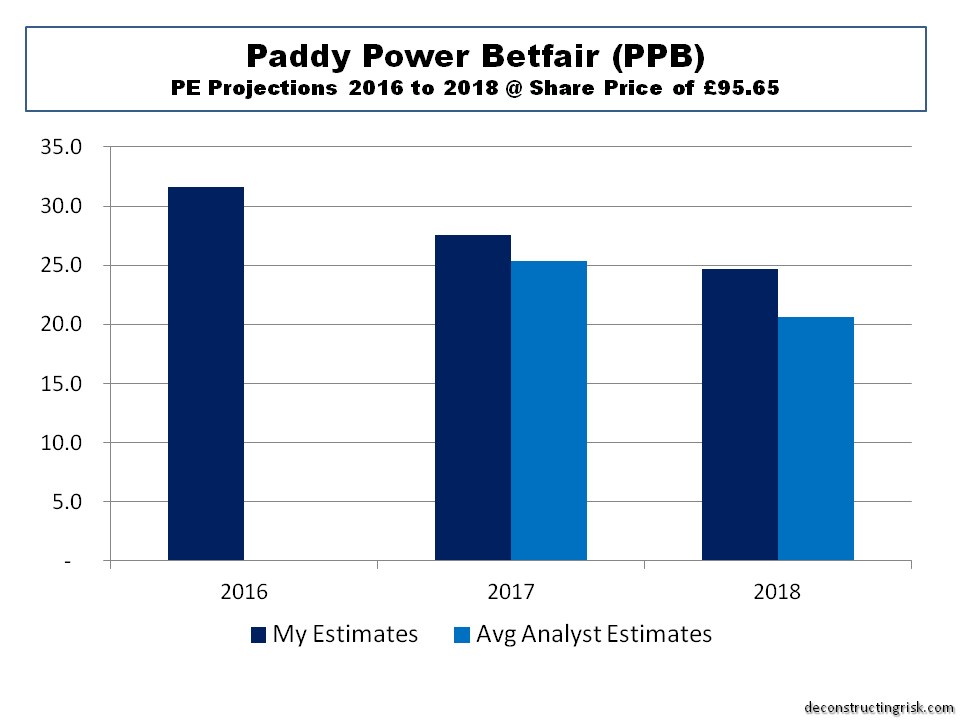
Also, I have revised my previous earnings estimates with an operating profit margin of 20% for 2016, growing to 22% in 2017 and 23% in 2018. Based upon a share count of 86 million as at end June 2016 (which includes 2 million treasury shares), I estimate the H2 EPS at £1.55 which when added to the H1 EPS of £1.45 gives a full year 2016 EPS of £3.02.[ This 2016 estimate does represent an operating EPS of £3.79 which compares to my November estimate of £3.85 albeit that the November estimate was based upon suspect figures like the share count!!]. At today’s share price of £95.65, the PE multiple for 2016 is a hefty 31.6. The graph below shows the multiple based on my EPS estimates for 2016, 2017 and 2018 compared to those using the average analyst estimates.

click to enlargePaddy Power Betfair PE Multiples 2016 to 2018

In conclusion, I remain optimistic about the business model of Paddy Power Betfair particularly given the proven quality of the management team and their history of execution. However, quality doesn’t come cheap and the current valuation is priced for perfection. For new investors, it may be prudent to wait for a better entry point.

Apple Average

It’s always strange when you have a relief rally in a stock (in after hours at least) because the actual results are not as bad as expected. So it seems to be with AAPL’s Q3 results. iPhone sales were not as bad as expected (albeit the lowest unit iPhone sales in 7 quarters at just above 40 million units) and the current quarter revenue guidance was above expectations. The average revenue per phone was below $600 for the first time in 2 years due to the the latest models with promises of improvements from management in future quarters. When the dust settles on the Q3 results though it could be time to finally reassess AAPL’s future trajectory.

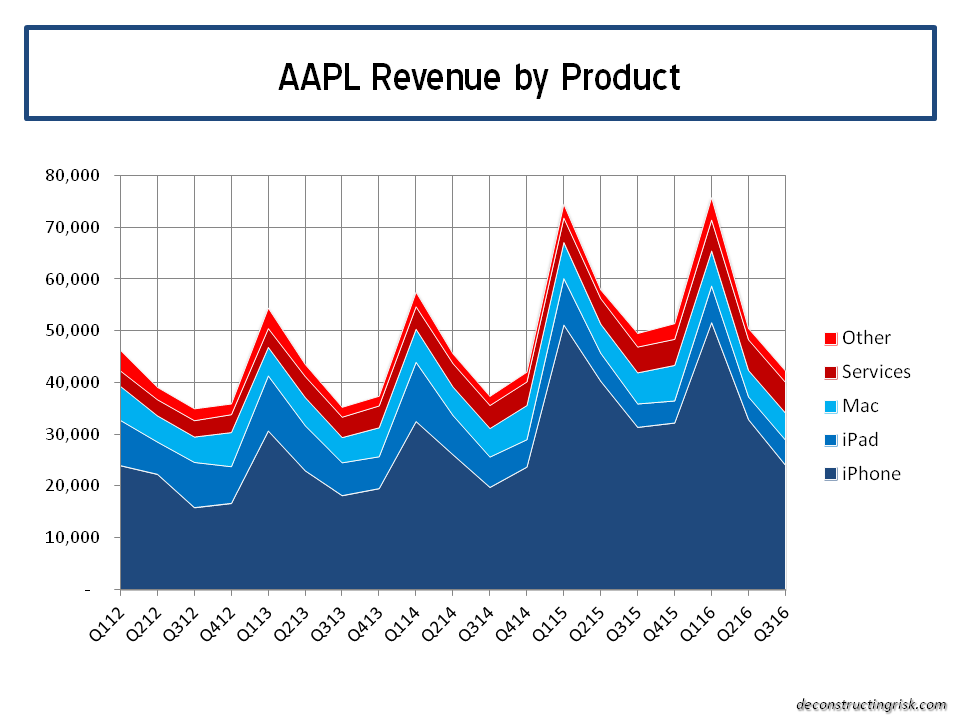
The graph below shows the latest results by product which illustrate just how poor a quarter this was relative to historical trends, with services being the sole bright spot.

click to enlarge

AAPL Revenue by product Q32016

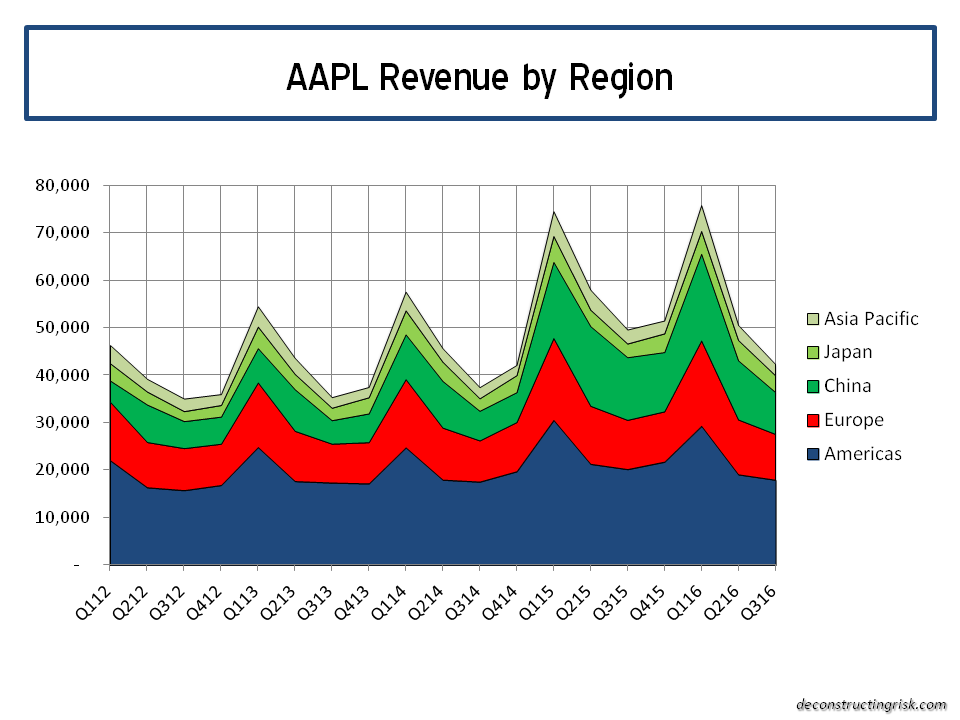
The split by revenue by region again illustrates the challenges AAPL is having in China. It also shows the lackluster response to Apple’s current products in the US.

click to enlargeAAPL Revenue by region Q32016

On valuation, AAPL still looks reasonable on a forward PE excluding cash basis (using analysts estimates for the next 4 quarters), as per the graph below.

click to enlarge

AAPL Forward 12 Month PE Ratio Q32016

The bulls are hyping up the iPhone 7 cycle as a source of future growth which is now the tired but only realistic growth thesis for AAPL. In the medium term however AAPL looks range bound around $100.

High Hopes

Wall Street has been getting the Hollywood treatment of late with a particular deep vein of subject matter emanating from the financial crisis. Margin Call and The Big Short are amongst my favourites. Although many are exaggerated for dramatic effect, the benefit of these movies is as a reference when particular topics arise in general conversation. If anybody ever mentions the prospect of investing in OTC or pink sheet penny stocks (these are generally smaller highly speculative stocks traded on inter-dealer markets), now all you have to do is reference The Wolf of Wall Street. In the movie, Jordan Belfort has a colourful description of such stocks (by reference to the world’s oldest profession) whilst Mark Hanna captures the Wild West character of the market in the statement that “it’s all a fugazi”.

With the failure of the prohibition on recreational marijuana or cannabis becoming increasingly apparent across the developed world, changes in policies, particularly in the US, has been an ideal subject for the needed hype in the OTC/pink sheet market to attract suckers. Recreational marijuana is now legal in four US States and medical marijuana laws have been approved in 24 US States. California has a ballot on the Adult Use of Marijuana Act scheduled for November. With an estimated 14 million stoners in the US alone, the potential is massive albeit that the legality of prohibition remains highly political. A multitude of dodgy firms with tenuous links to the drug were duly over-hyped and over-bought in the so-called pot bubble up to and through 2014 and 2015. Fugazi was one apt description.

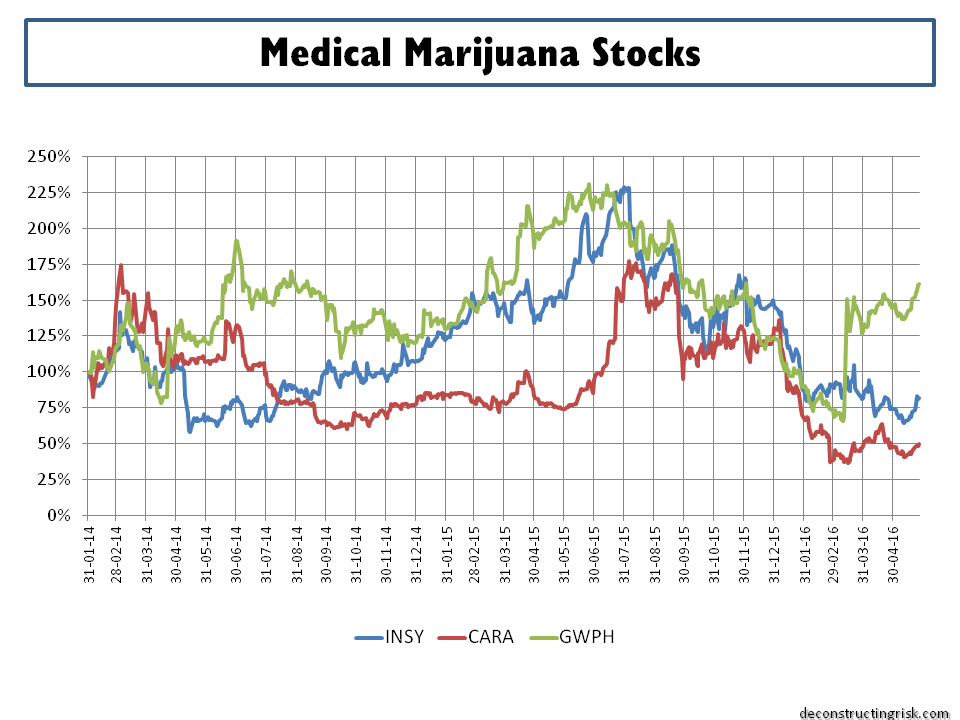
Away from the hype, there are a few respectable firms (trading on proper exchanges) involved in developing products in the medical marijuana sector. Three of these firms include GW Pharmaceuticals (GWPH), Insys Therapeutics (INSY) and Cara Therapeutics (CARA). All are highly speculative biotech plays at varying stages of the development and commercialisation of certain cannabinoid-based medicines. For example, GWPH and CARA trade at multiples of over 50 times revenue and are burning cash. GWPH has £150 million left of the £350 million raised from shareholders, spending approximately £45 million over the past 6 months. Last month, the FDA granted GWPH’s drug Epidiolex orphan status for treating tuberous sclerosis complex, a rare genetic disorder that causes epilepsy in about 80% to 90% of the patients affected. INSY has had problems with its existing cancer pain spray, Subsys, due to concerns over opioids and is awaiting an FDA decision, due in July, on its reformulation of the marijuana-based medicine, Marinol, to be sold under the brand name Syndros. CARA, who develop chemical substances to treat various degrees of pain by selectively targeting kappa opioid receptors, has also been hit by a FDA trial suspension. The graph below shows the wild ride that the share price of each firm has been on since January 2014.

click to enlargeMedical Marijuana Stocks

Although these types of firms are highly interesting, they are way outside my risk appetite. I just don’t know enough about the science to understand whether the hype around each is justified. Aside from the usual recreational activity in college many moons ago, my interest in this topic has been on the more boring end of the scale, around the commercial development of a cousin of the infamous cannabis variety but without the psychoactive component tetrehydrocannabinol (THC), commonly referred to as industrial hemp. Industrial hemp historically is known for the strength of its fiber, commonly used for rope making, but its development has suffered from its association with its higher THC cousin over the past 50 years.

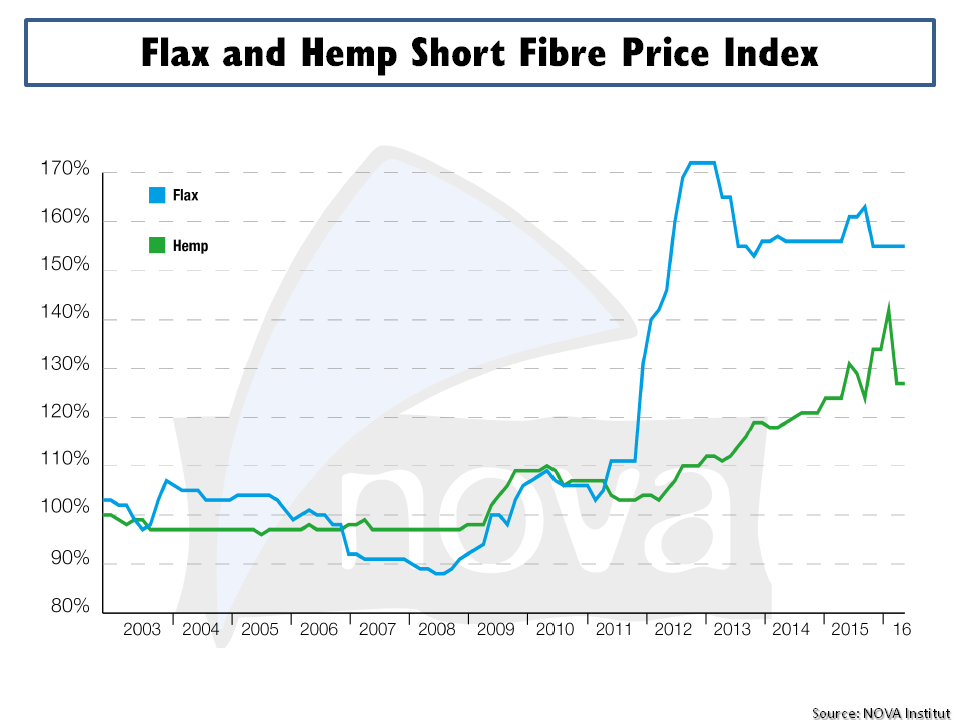
Interest in the unique qualities of industrial hemp have been revived in recent years but the harvesting and processing technologies for the plant remain firmly in the 19th century. Some years ago, I was involved with a project that tried to modernise the approach to harvesting and processing industrial hemp, more akin with the long fibre techniques developed for flax, which unfortunately ended in failure due to a lack of resources and, well, the naivety of youth. Extracting long fibers from hemp (a process called decortication) without damaging their strength through mechanical or chemical processes offers a high value use for the plant, as opposed to lower value uses in construction or animal bedding. Others across Europe continue to try and develop such new processes and a recent report from the European Industrial Hemp Association (EIHA) show that the uses for this plant are developing slowly. Newer uses include biocomposites (for the automotive sector), insulation material and other non-woven applications (such as technical textiles). It was interesting to see the recent increase in prices for short hemp and flax fibers, as per the graph below from the Nova Institut.

click to enlargeFlax & Hemp Short Fibre Price Index Nova Institut

Developing industrial hemp is far from the current hype surrounding its more infamous THC rich cousin. Nonetheless, developing an unjustifiably ignored natural resource with significant potential for uses across industry or developing new pain relief medicines for seriously ill patients are far more interesting to me than allowing people get legally high every now and again.