Category Archives: Telecom

Level3 hiccup

I have posted on one of my major holdings Level 3 (ticker LVLT), a facilities-based provider of a range of integrated telecommunications services, many times before, most recently here. One of the features of LVLT is its volatility and the past weeks have proven no exception. LVLT broke below $50 in late June to $47 before being buoyed to above $56 by a unsubstantiated rumour that the firm was “reviewing strategic alternatives to maximize holder value, including outright sale or large buyback”. After the quarterly report on the 27th of July when LVLT reported disappointing revenues but beat on the bottom line, the stock is now down below $50 again without any news from the firm on buybacks or M&A.

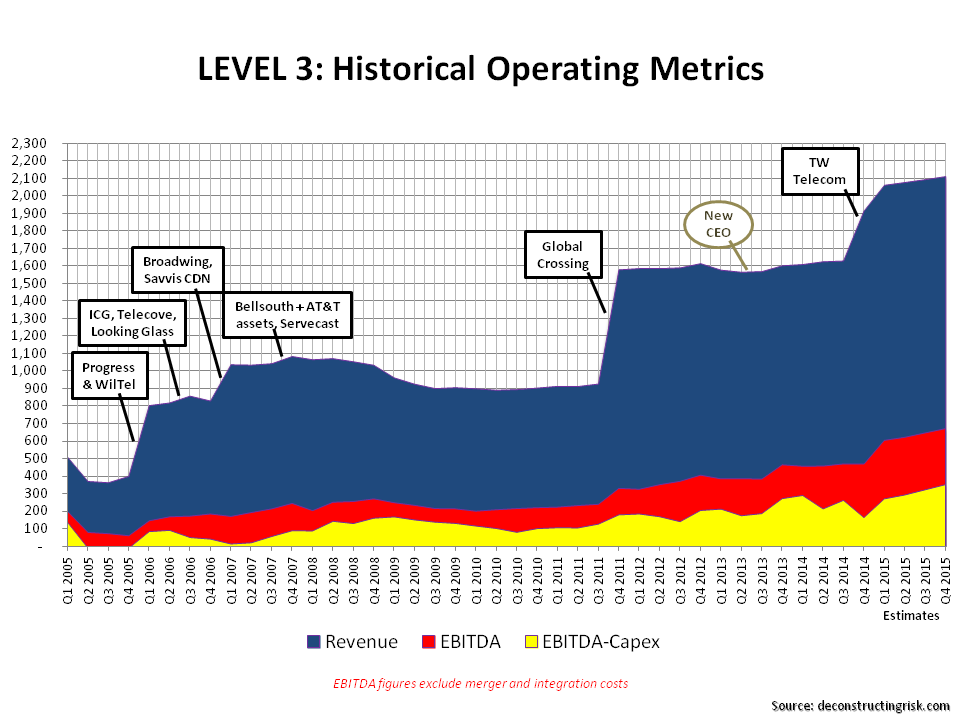
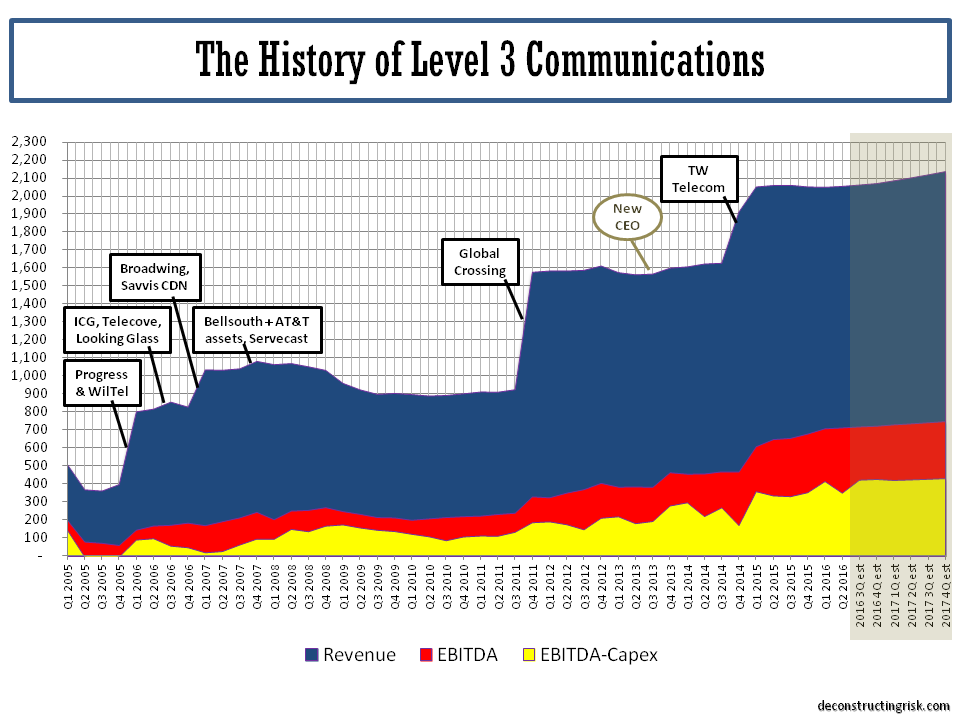
The revenue figures, particularly the increase in CNS monthly churn to 1.2%, was disappointing with the loss in accounts been driven by SME enterprise customers. One possible reason for the lack of focus was the temporary absence of the CEO due to a heart issue earlier in the year. As the chart below shows, LVLT does have form with revenue dips after initial successful M&A integration. Many, including me, thought that the current management was more on top of the issue this time around.

click to enlargeLevel3 Operating History 2005 to 2017e

Despite this disappointment, the revenue impact is likely to more contained this time around and I believe the case for LVLT in the longer term remains strong. I have reduced my revenue estimates in the graph above but the free cashflow that LVLT’s business is throwing off makes the bull case. My PV cash-flow analysis still has a price target of over $65, which represents a 2018 EV/EBITDA multiple of slightly below 10. Although the multiple is high compared to the incumbent US telcom giants, I think it is warranted given the quality of LVLT’s assets in an ever data hungry economy. The current favourable, albeit political, regulatory trends (net neutrality and the ban on lock-up agreements) are another plus factor.

I estimate that the FCF generated by LVLT could, in the absence of any M&A, mean the firm could afford $1 billion of buybacks in 2017, rising by $250 million a year thereafter. An aggressive buyback programme over a five year period, 2017 to 2021, could amount to approx $7.5 billion or approx 30% of current share count at an average price of $65.

In terms of M&A, management are obviously keen although they did emphasis the need for discipline. An interesting response to an analyst question on the Q2 call that any potential M&A fiber targets for LVLT trade at higher EV/EBITDA multiples was as follows:

“So as we look at M&A, and you mentioned fiber companies, we look at fiber companies post-synergies and believe that we are very good at acquiring and capturing synergies and moving networks together, combining networks, and creating value for shareholders through that. So I don’t feel that the M&A environment is necessarily constrained.”

One of the firms that the analyst was possibly referring to is Zayo, who interestingly just hired LVLT’s long time CTO Jack Waters. Zayo currently trade at over 10 times its 2017 projected EBITDA compared to LVLT currently at a 2017 multiple in the low 9s. Obviously a premium would be needed in any M&A so the synergies would have to be meaningful (in Zayo’s case with a 50% plus EBITDA margin, the synergies would likely have to be mainly in the capex line). COLT telecom is another potential M&A target as Fidelity’s self imposed M&A embargo runs out after 2016 (see this post).

A significant attraction however is for LVLT itself to become a target. One of the US cable firms, most likely Comcast, is touted as a potential to beef up their enterprise offerings to compete with the incumbents. Other potential candidates include the ever data hungry technology firms such as Google or Microsoft who may wish to own significant fiber assets and reduce their dependence on telecoms such as Verizon who are increasingly looking like competitors.

As ever with LVLT, the ride is never boring, but hopefully not ever ending….


Level-headed

After a week like the one just gone, where the S&P500 hit the 10% down threshold for the year, it’s perversely healthy to see debates rage about the likelihood of a recession, the future for oil prices, the bursting of the unicorn bubble, the impact of negative interest rates and the fallibility of central bank macro policy in the developed world, to name just a few. Considering and factoring in such risks are exactly what should be happening in a well functioning market, rather than one far too long reliant upon the supposed omnipresent wisdom of central bankers to answer any market ills that may come along. Although the market volatility during the opening months of 2016 hasn’t been pleasant and will hopefully find a floor soon, valuations didn’t reflect risks and an adjustment was needed.

I have no idea where the market is headed, although I suspect we are just one more shake-out from capitulation. Valuations have come off their unsustainable highs and a select few are beginning to look attractive. After some of this week’s indiscriminate falls, it’s always a good risk management discipline to assess current and possible new positions in light of developments. I assessed AAPL’s valuation recently in this post and offered my thoughts on the new Paddy Power Betfair in this post.

The subject of this post is Level 3 (ticker LVLT), a facilities-based provider of a range of integrated telecommunications services. Prior to their earnings on 4th of February, I had been re-examining my investment rationale on LVLT, one of my highest conviction positions that I last posted on a year ago. As I have highlighted before, LVLT is not an investment for the faint hearted and the past week has again proven that (a beta level of 1.5 according to Yahoo just doesn’t capture it!) with daily moves following the Q4 report of +6.9%,-5.7%,-9.4%,+3.7%,+3%, 0.5%, and Friday’s +1.7%. The graphic below shows the movement in the share price in LVLT, the S&P500 and the S&P High Beta index (SPHB) since the start of 2015. Also shown are the daily changes in LVLT against those of the S&P500.

click to enlargeLevel3 SP500 Share Price & Volatility

To recap on the bull case, the strength of LVLT is its deep and global IP optic network which following the recent mergers with Global Crossing and TW Telecom now has the business scale for the experienced management team to finally achieve operating margins to support its debt (current net debt to 2016 guided EBITDA is approx 3.5) and throw off meaningful cash-flow in the coming years (average FCF growth of 8% according to my estimates over the next few years). The Q4 2015 results and 2016 guidance showed the bull case is intact and the demand for new products such as the security and intelligent network services show how LVLT’s network is a competitive advantage in today’s technology driven world. The CEO Jeff Storey summarized their case at the Q4 conference call as follows:

“Most importantly, is our movement towards our vision of one, one set of products that we take to an expanding market, one network to deliver those products globally, one set of operational support systems to enable a differentiated customer experience, and one team with the singular goal of making Level 3 the premier provider of enterprise and networking services. As we look to 2016, our strategy remains the same. We are focused on operational excellence throughout our business, providing a superior experience to our customers and developing the products and capabilities to meet their complex and evolving networking needs.”

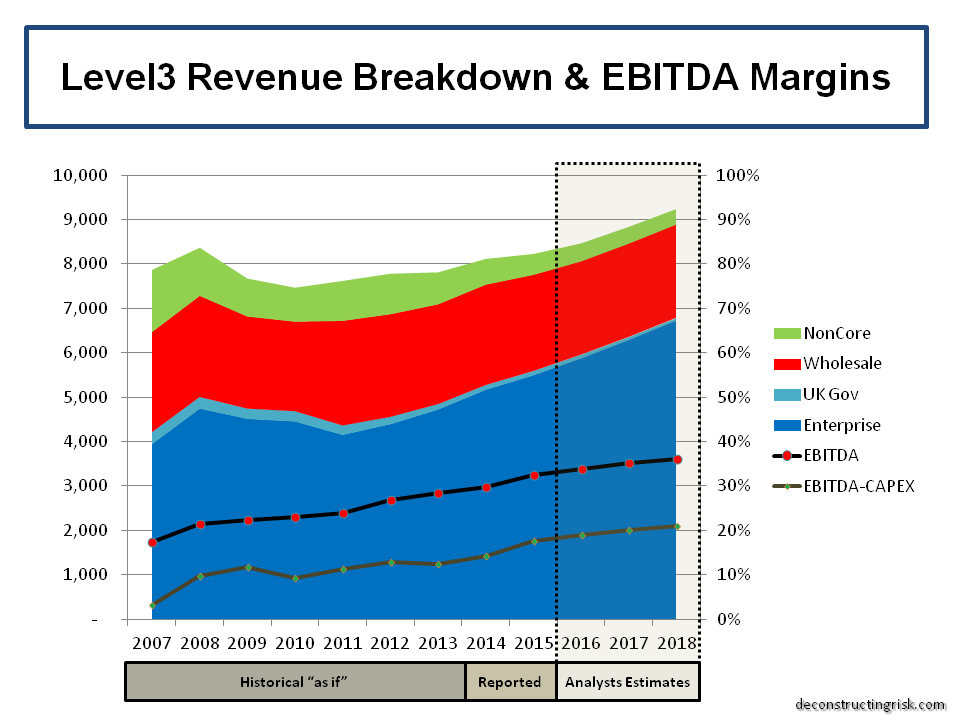
As the talk of a possible recession fuelled worries on business telecom spend, I thought it would be useful to look at the historical “as if” results of the now enlarged LVLT through the financial crisis. This involved looking through old Global Crossing and TW Telecom results and making numerous assumptions on the historical growth of acquired businesses and the business classifications (and numerous reclassifications) of each firm over time. The historical “as if” results combined with the reported figures for 2014 to 2015 and analyst estimates for 2016 to 2018 are shown below.

click to enlargeLVLT Proforma Revenue Split 2007 to 2018
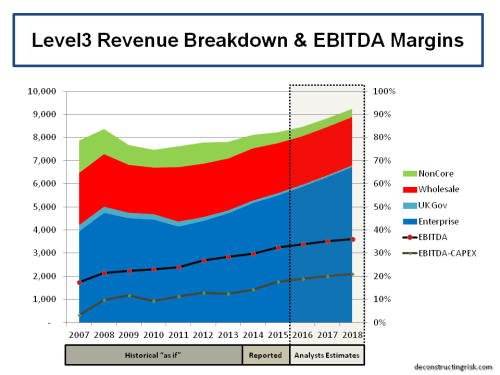
Within the context of the caveat above, the drop in enterprise revenue from 2008 to 2011 was 12.5%, primarily driven the financial crisis with other factors being Global Crossing refocusing its portfolio and the operational missteps by legacy Level3 in integrating its multiple acquisition from 2006-08. TW Telecom’s consistent top-line growth since 2007, despite the financial crisis, can be seen in this post. It’s interesting that the wholesale revenues have been relatively stable historically ranging between $2.10-2.35 billion, supporting the view that price decreases are offset by unit increases in IP traffic.

Since 2012, the benefits of scale combined with the integration prowess of the current LVLT management team (Jeff Storey became CEO in 2013) are vividly shown in the impressive increase in EBITDA margin from 22% in 2009 to 32% in 2015. After cutting capex in 2008-09, the combined business has required 14%-16% since then, now targeted at 15% to support the 8% annual growth in enterprise revenues (on a constant currency basis) that management have set as their target.

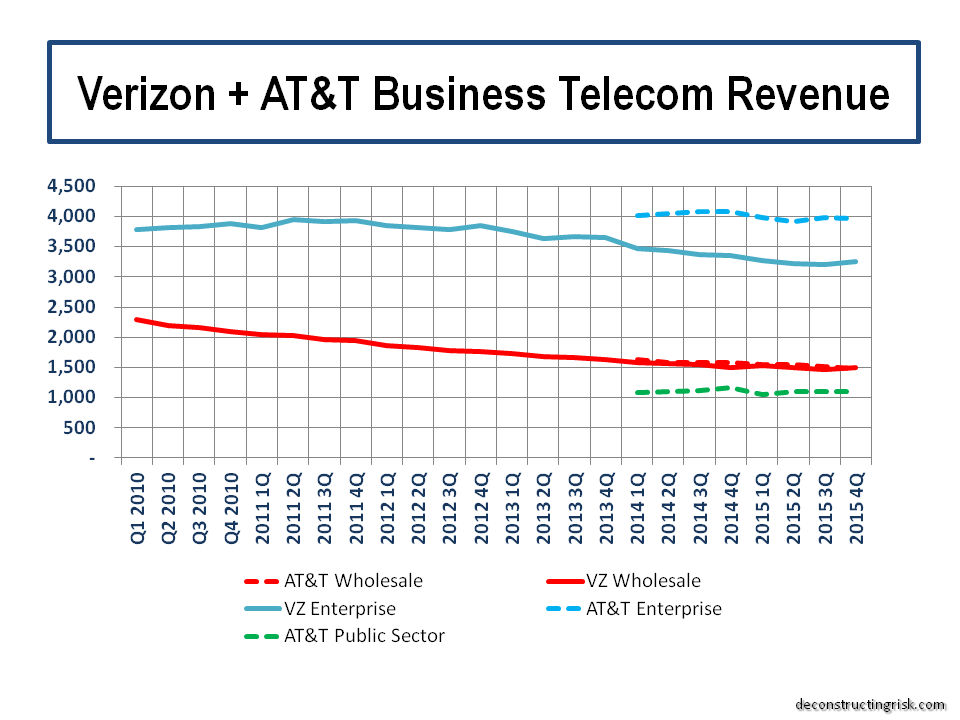
In Q4, LVLT’s revenue was derived 80% from the US and management claim that their enterprise business has only a single digit market share in the US leaving plenty of room for growth, particularly against the incumbents Verizon and AT&T. The graph below shows enterprise and wholesale revenues from each firm with AT&T showing revenue stability against a declined trend for Verizon.

click to enlargeVZ AT&T Business Telecom Revenue

Numerous analysts confirmed their estimates on LVLT following the Q4 results and the average target is above $60, approximately 30% above the current level. Regular readers will know that normally I don’t have much time for analysts’ estimates but in this case my own DCF analysis suggests a medium term target of per share in the low 60’s is reasonable. According to my estimates that translates into an EV/EBITDA multiple of approx 8.5 in 2018 which looks reasonable given LVLT’s free cash growth. I used the historical “as if” figures above to calculate a downside valuation for LVLT on the basis of a recession occurring over the next 2 years. I assumed that a 2016-2018 recession would have approx half the impact of the 2008-2011 crisis upon LVLT’s enterprise revenue (e.g. approx 7% decline) before stabilising and recovering. My valuation of LVLT in such a scenario was in the mid 30’s or an approx 25% downside potential from Friday’s close. So at a 25% downside and a 30% upside, LVLT’s risk profile is finely balanced.

LVLT itself may become a target for a firm like Comcast or CenturyLink or another large communication firm looking to bulk up its regional reach or network business. Two interesting items came out of LVLT’s Q4 call; the first being the tightening of its target leverage range to 3 to 4 times EBITDA (from 3 to 5 times) and the second being a renewed appetite by management to use free cash-flow for disciplined M&A rather than shareholder returns such as buy-backs or even initiating a dividend. With LVLT proving their ability to get in excess of $200 million in EBITDA savings from adding TW Telecom’s revenue base of $1.6 billion at the time of the merger (or an impressive 12.5% EBITDA pick-up), the case for disciplined M&A by LVLT’s management is strong. Possible targets in the US include Zayo (their share price is having a hard time of late) or Carl Icahn’s privately held XO Communications (now that the maestro has milked the firms of its tax losses), amongst others. In Europe, possible targets include the now private Fidelity owned COLT (see this post on background) or Interroute, another privately owned pan-European network.

Whatever happens, I am content to hold my position in LVLT at this level. I like the firm’s current risk profile, the developing product range in the ever important network age, and particularly the recent execution record of management. As ever, I would highlight the stock’s volatility and recommend the use of options to protect downside risks (which are not inconsiderable if the probability of recession grows). I again repeat that LVLT is not one for the faint hearted, particularly in this market where near term volatility looks all but certain, but one I trust will be an attractive investment.

Exabyte Zenith

There is a sense of déjà vu when you read about the competing plans of Greg Wyler’s OneWeb and Elon Musk’s SpaceX to build a network of low earth orbit satellites to provide cheap broadband across the globe over the next few years. Memories of past failures from the late 1990s telecom bubble come to mind with these network plans. Names like Iridium, GlobalStar, Teledesic, and SkyBridge. Maybe, this time, the dreamers with access to billions can get it right!

You never know, there may even be a comeback for broadband over power-lines (not likely according to this article)!

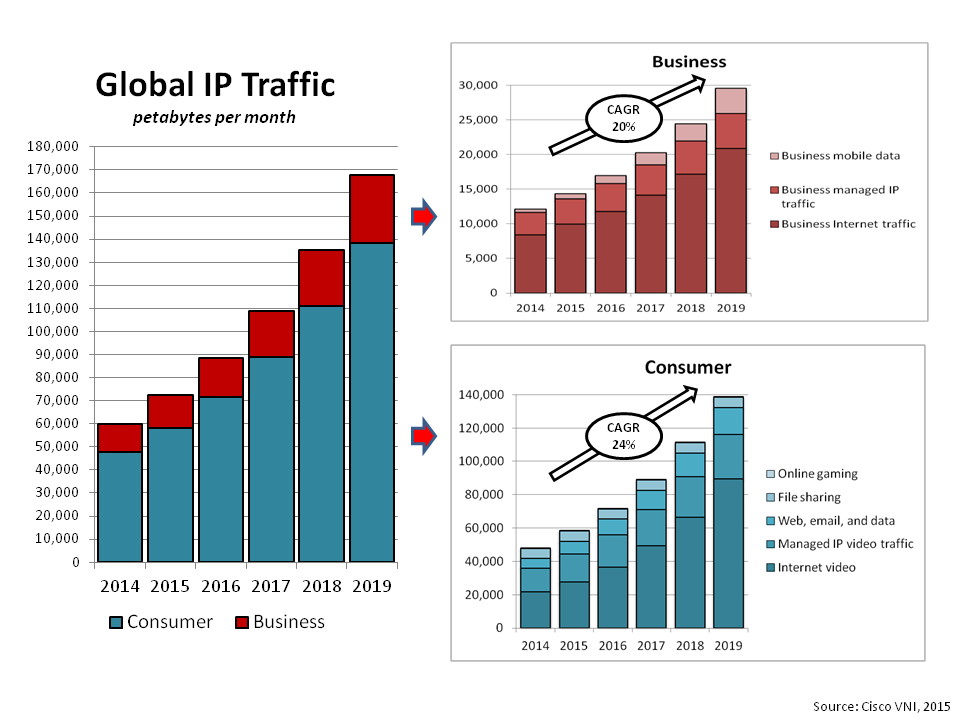
I did come across the latest figures from Cisco in their “ The Zettabyte Era – Trends and Analysis” piece, as previously referenced in this post. As a reminder, gigabyte/terabyte/petabyte/exabyte/zettabyte/yottabyte is a kilobyte to the power of 3, 4, 5, 6, 7 and 8 respectively. Cisco continues to predict a tripling of global IP traffic from 2014 to 2019. The graphics below give some colour on the detail behind the predictions.

Split by consumer and business traffic with each further split by traffic type. Unsurprisingly consumer video traffic is dominating the consumer 24% CAGR.

click to enlargeGlobal IP Traffic 2015 projections

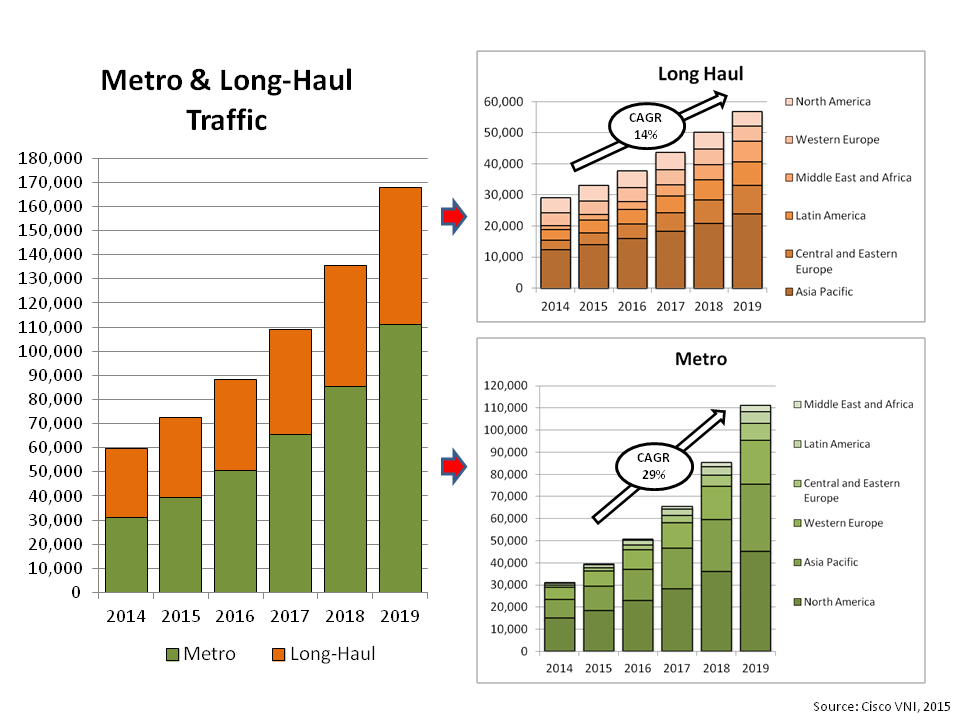
Growth in the US, Asia and Europe is driving the impressive 29% metro CAGR whilst Asia Pacific traffic is the prime driver for long-haul growth.

click to enlargeGlobal IP Metro LongHaul Traffic 2015 projections

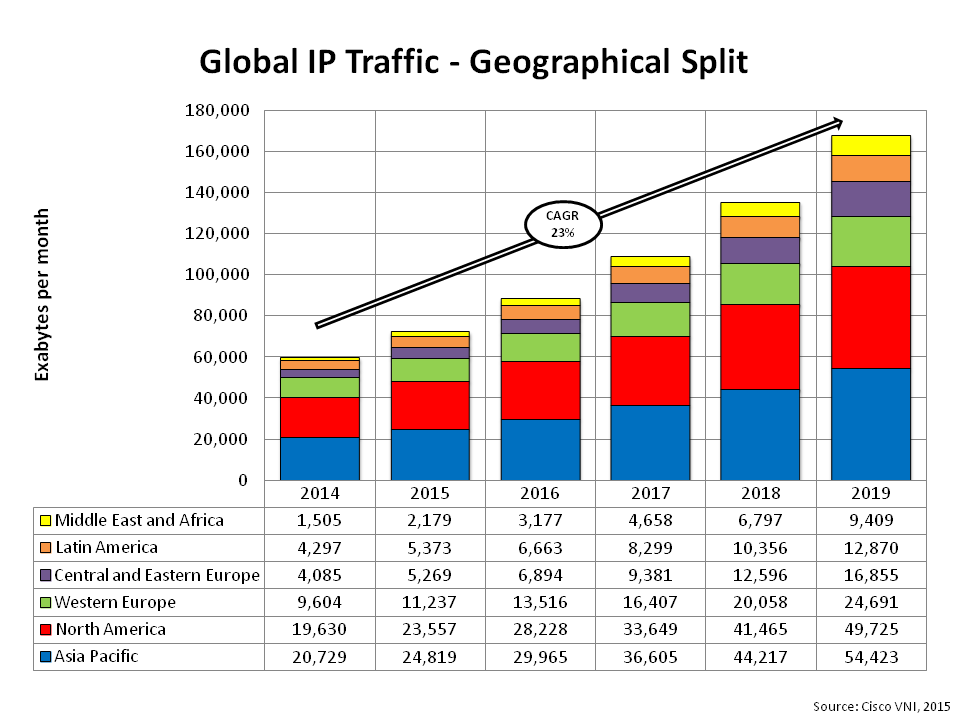
The split by region shows the status quo will be maintained in terms of traffic breakdown with Central/Eastern Europe and the Middle East /Africa regions projected to have growth rates of 30%+ and 40%+ respectively as opposed to approx 20% in the main markets.

click to enlargeGlobal IP Traffic Geographical Split

Exabytes are reaching their zenith and by next year global IP traffic is predicted to exceed a zettabyte.

Fidelity’s clever move on COLT

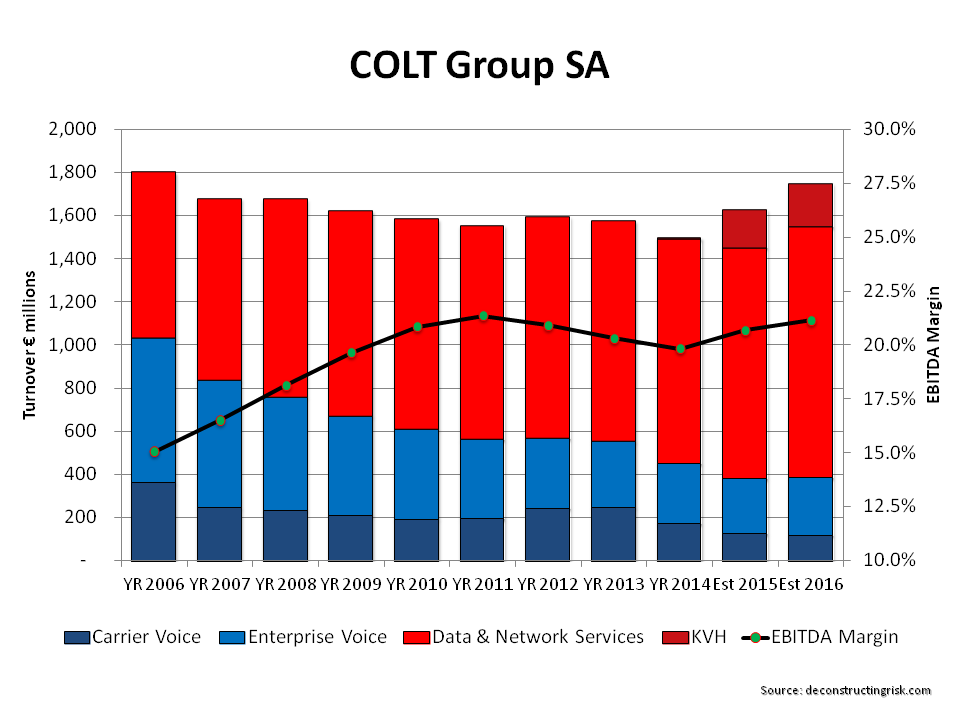
On Friday, Fidelity made a 190 pence offer, which is a 21% premium to the previous day’s close, for the approximately third of COLT that it doesn’t own. After years of underperformance and a series of restruturings, COLT has been long looking for a positive future. It bought the smaller Fidelity owned Asian carrier KVH last year (see previous posts here and here). COLT’s core European business has been slowly moving to higher growth and margin data and network business, as the graph below shows.

click to enlargeCOLT Telecom Revenue & EBITDA Margin 2006 to est2016

Fidelity’s offer values the debt-free business at £1.7 billion (or €2.4 billion or $2.7 billion at current FX rates) which I estimate to be 7 times 2015 EBITDA or 6.44 times 2016 EBITDA estimates (assuming 2015 EBITDA of €335 million and a 2016 10% EBITDA YoY growth). The independent directors have called the offer too low but haven’t made a recommendation due to the lack of options for minority shareholders.

From Fidelity’s viewpoint, this looks like a clever move to force any likely bidders out into the open or, failing any bidders emerging, to take the firm fully private at an attractive price. Robert Powell over at telecomramblings speculates that other European carriers such as Interroute or the US based Level 3 may be possible bidders. It will be fascinating to see how this one plays out.

Level3 flying high

It has been over 6 months since I have posted on the prospects for the telecommunications firm Level3 (LVLT) following its merger with TW Telecom (TWTC). I had previously posted on the strength of TW Telecom’s business model and its admirable operating history so I am extremely positive on the combination. At the time of the last post, LVLT was trading around $45 a share, a five year high. Since that time, the stock fell to a low of $38 in October 2014 before reaching a new high in recent weeks around $54.

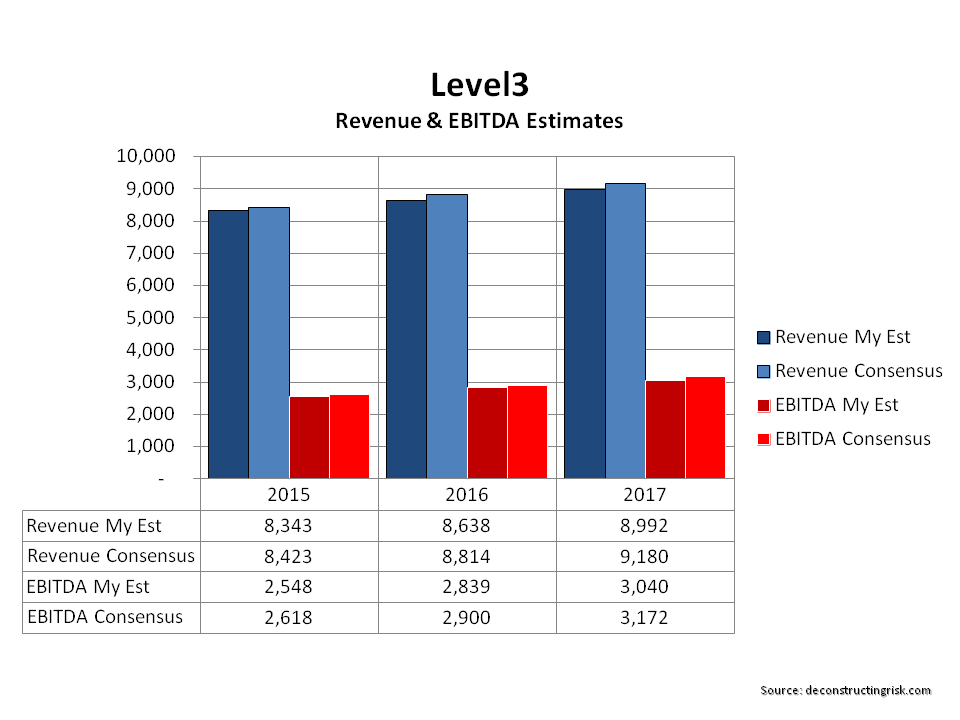
My previous post, using figures disclosed in a S-4 filing on the merger negotiations, made a projection that the combined entity could get to $9 billion of revenue and $3 billion of EBITDA by 2016. Based upon the Q4 figures, the firm’s guidance, and the recently filed 10K, I did some more detailed figures and now estimate that the $9B/$3B revenue/EBITDA threshold will more likely be in 2017 rather than 2016. My estimates for each against the consensus from analysts are below.

click to enlargeLevel3 Revenues and EBITDA estimates 2015 to 2017

LVLT is an acquisitive firm and has learned through multiple deals the optimal way of integrating new firms through a shape focus on the customer experience whilst prudently integrating operations and reducing costs. Taking the Global Crossing integration as a template, the graphic below illustrates how my estimates fit in the past.

click to enlargeLevel3 Operating Metrics 2005 to 2015

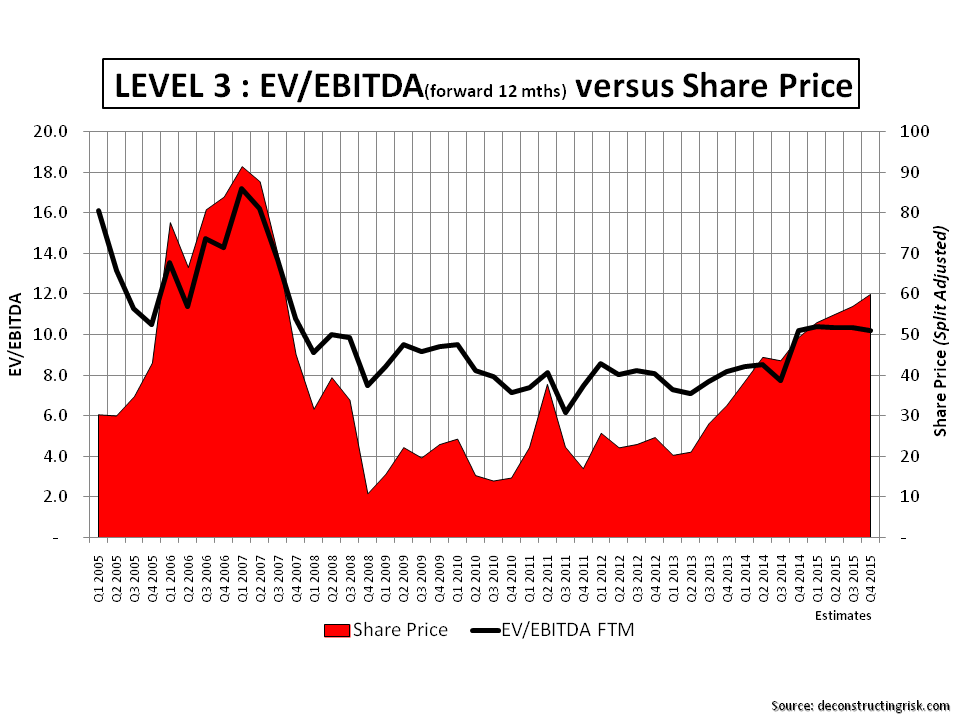
So, the question now is whether a share price in the mid to high 50s is justified (the average consensus is around $57 with the highest being Canaccord’s recent target of $63). Using an enterprise value to EBITDA multiple based upon a forward 12 month EBITDA figures (actual where relevant and my estimates from Q1-2015), I think a target between $50 and $60 is justified assuming a forward multiple of 10 to reflect growth prospects, as the graphic below illustrates. My DCF analysis also supports a target in the low 60s.

click to enlargeLevel3 10year EVtoEBITDA versus Share Price

Such a target range assumes operating results show positive momentum and that the overall market remains relatively stable with expectations on interest rate increases in the US within current estimates. Due to LVLT’s net debt load of just under $11 billion and a proforma leverage ratio of 4.4 to EBITDA, the stock is historically exposed to macro-economic volatility. A mitigant against such volatility is the increasing level of free cash that the business will generate (I estimate $600/$900/ $1,000 million over 2015 to 2017). Also, about $6.5 billion of its debt is fixed (current blended rate is 7.2%) and LVLT’s CFO has shown considerable skill in recent years at managing the interest rate down in this yield hungry environment. Its remaining floating debt (blended rate of 4.2%) has a minimum LIBOR rate of 1% and therefore offers headroom against movements in current LIBOR rates

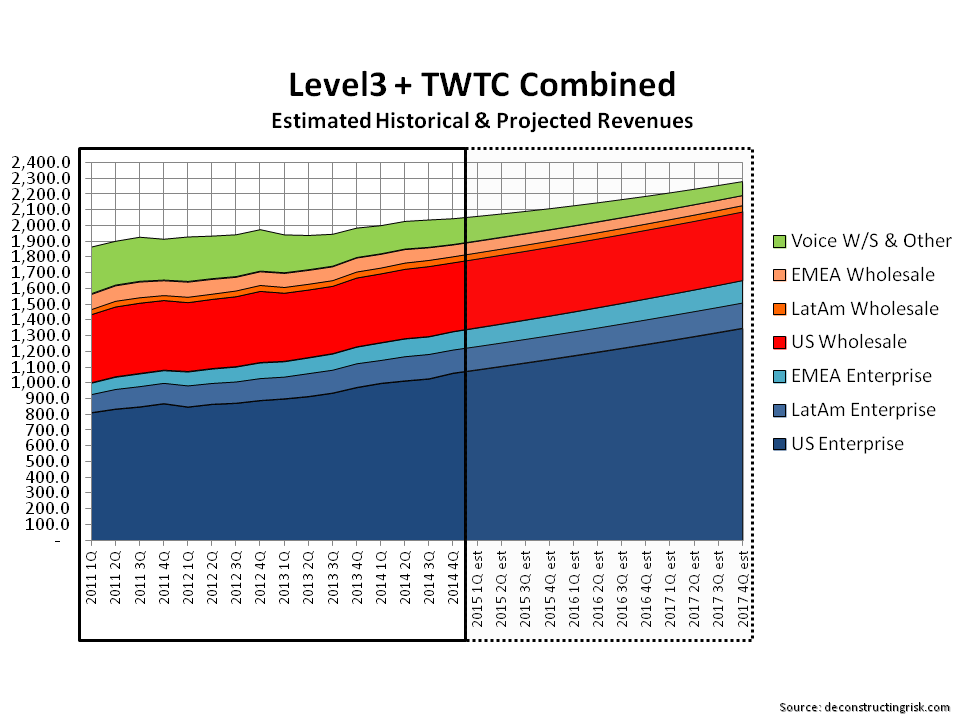
In my view, the key in terms of valuation is that the integration goes smoothly and that revenue growth in the enterprise market is maintained. One of the principal reasons for my optimism on LVLT is the operational leverage the business has as the mix of its business moves more towards the higher margin and stickier enterprise market, as the pro-forma revenue split shows.

click to enlargeLevel3 Proforma Revenue Split

As always with LVLT, I recommend using options to protect downside and waiting for a pull-back from current highs for any new investment. This stock has historically not been one for the faint hearted. I do believe however that they are on the path to a more stable future and it remains a core holding for me.