Tag Archives: collaterised reinsurance

Naive Newcomers

The insurance sector has been hit by the Brexit fallout on worries about macro-economic impacts; albeit not to the same extend as the banks. Swiss Re has their latest Sigma world insurance report out. The impact of investment returns on the life insurance sector is obvious but it is interesting to see the contribution from investment income on the profitability of the aggregate of the eight largest markets in the non-life insurance sector, as per the graph from the report below.

click to enlargeNonLife Insurance Sector Profit Breakdown
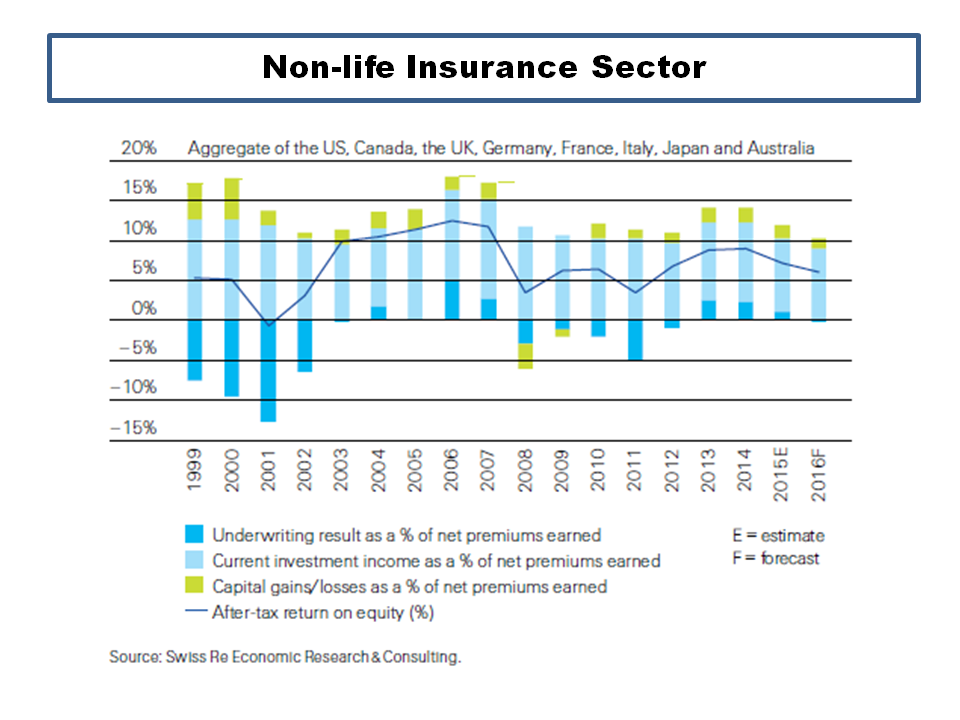
The insurance sector faces a number of challenges as a recent FT article pointed out. The reinsurance sector also faces challenges, not least of which is a competitive pricing environment and the destabilising influx of new yield seeking capital through new innovations in the insurance linked securities (ILS) market. I have posted my views on the ILS sector many times (more recently here) and in this post I offer more similar thoughts. It is interesting to compare the ROEs in the Sigma report from the non-life insurance sector against those from the reinsurance sector (with the ROEs since 2005 coming from the Guy Carpenter composite index), as per the graph below.

click to enlargeGlobal Insurance & Reinsurance ROEs 1999 to 2016e
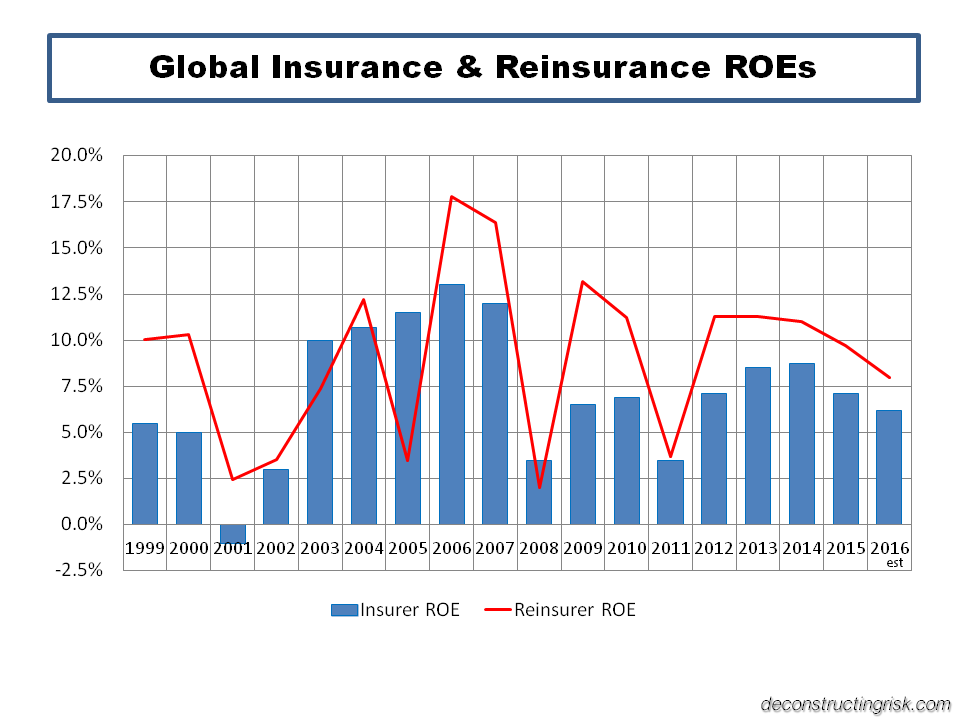
The graph is not exactly comparing like with like (e.g. non-life insurance versus composite reinsurance) but it gives the general idea of higher but more volatile ROEs in the reinsurance side compared to more stable but lower ROEs on the direct insurance side. The average since 1999 for insurance is 7% and 9% for reinsurance, with standard deviations of 3.6% and 4.6% respectively. It also confirms that ROEs are under pressure for both sectors and as capital markets continue to siphon off volatile excess catastrophe exposed business, the ROEs of the more proportional traditional reinsurance sector are converging on those of their direct brethren, although a differential will always exist given the differing business models.

It is important to note that these ROEs are returns on equity held by traditional insurers and reinsurers, the majority of which are highly rated by external agencies, who hold a small fraction of their total exposure (if measured as the sum of the policy limits issued) as capital. For example, the new European solvency framework, Solvency II, requires capital at a 1 in 200 level and it is generally assumed to be akin to a financial strength rating of BB or BBB, depending upon a firm’s risk profile.

As I argued previously (more recently in this post), these (re)insurers are akin to fractional reserve banks and I still struggle to understand how ILS structures, which are 100% collaterised, can offer their investors such an attractive return given their fully funded “capital” level in the ROE calculation. The industry argument is that investors have a lower cost of capital due to the uncorrelated nature of the pure insurance risk present in ILS.

My suspicion is that the lower cost of capital assigned by investors is reflective of a lack of understanding of the uncertainties surrounding the risks they are taking on and an over-reliance on modelling which does not fully consider the uncertainties. My fear is that capital is been leveraged or risks are been arbitraged through over-generous retrocession deals passing on under-priced risk to naive capital newcomers.

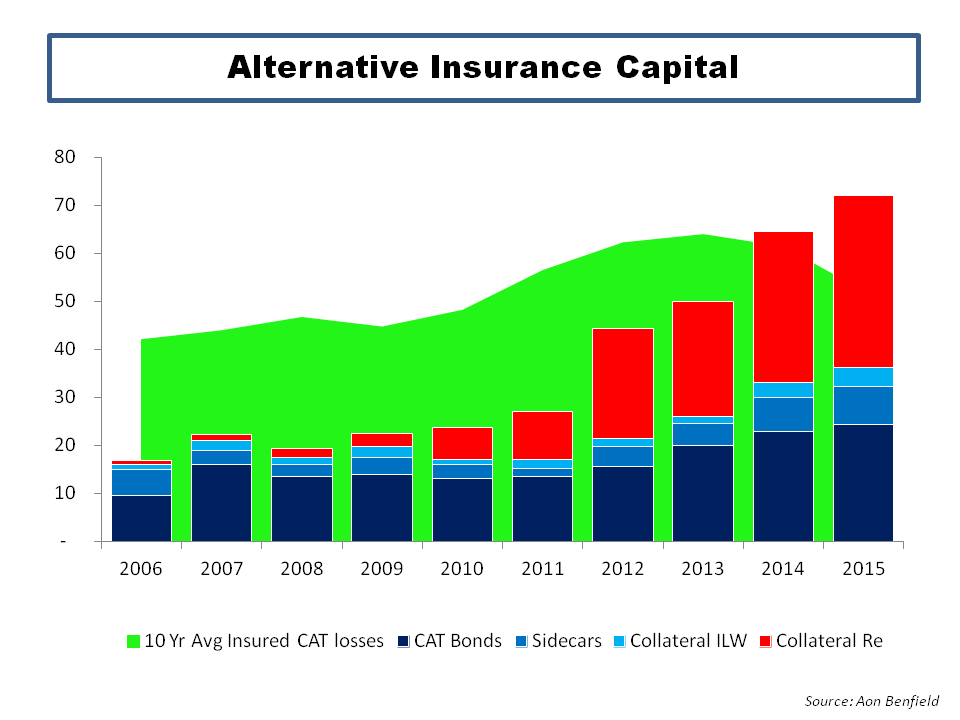
The accelerating growth in the so-called alternative capital in insurance is shown in the graph below from Aon Benfield, with growth in the private collaterised reinsurance being particularly strong in the last four years (now overshadowing the public CAT bond market). ILS funds, managed by professional asset manager specialists, are largely behind the growth in private collaterised deals with assets under management growing from $20 billion in 2012 to over $50 billion today. Private collaterised deals are usually lower down the reinsurance tower (e.g. attach at lower loss levels) and as such offer higher premiums (as a percentage of limits, aka rate on line or ROL) for the increased exposure to loss. On a risk adjusted basis, these don’t necessarily offer higher ROEs than higher attaching/lower risk CAT bonds.

click to enlargeAlternative Insurance ILS Capital Growth
Property catastrophe pricing has been under particular pressure in the past few years due to the lack of significant insured catastrophe losses. In a previous post, I crudely estimate CAT pricing to be 25% below its technical rate. Willis Re is the first of the brokers to have its mid-year renewal report out. In it, Willis said that ILS funds “were more aggressive on pricing during the second quarter as spreads declined for liquid reinsurance investments”. I also find it interesting that the collaterised ILW volumes have ticked up recently. Pricing and lax terms and conditions in the retrocession sector are historically a sign that discipline is breaking down. Asset managers in the ILS space must be under pressure in maintaining their high fees in a reduced CAT risk premia environment and this pressure is likely to be contributing to the potential for market indiscipline.

I therefore find the graph below very telling. I used the figures from Lane Financial (see here) for the annual total return figures from CAT bonds, which closely match those of the Swiss Re Total Return Index. For the ILS fund returns I used the figures from the Eurekahedge ILS Advisors Index which I adjusted to take out the not unconsiderable typical ILS fund management fees. The 2016 figures are annualized based upon published year to date figures (and obviously assume no major losses).

click to enlargeCAT Bond vrs ILS Fund Returns
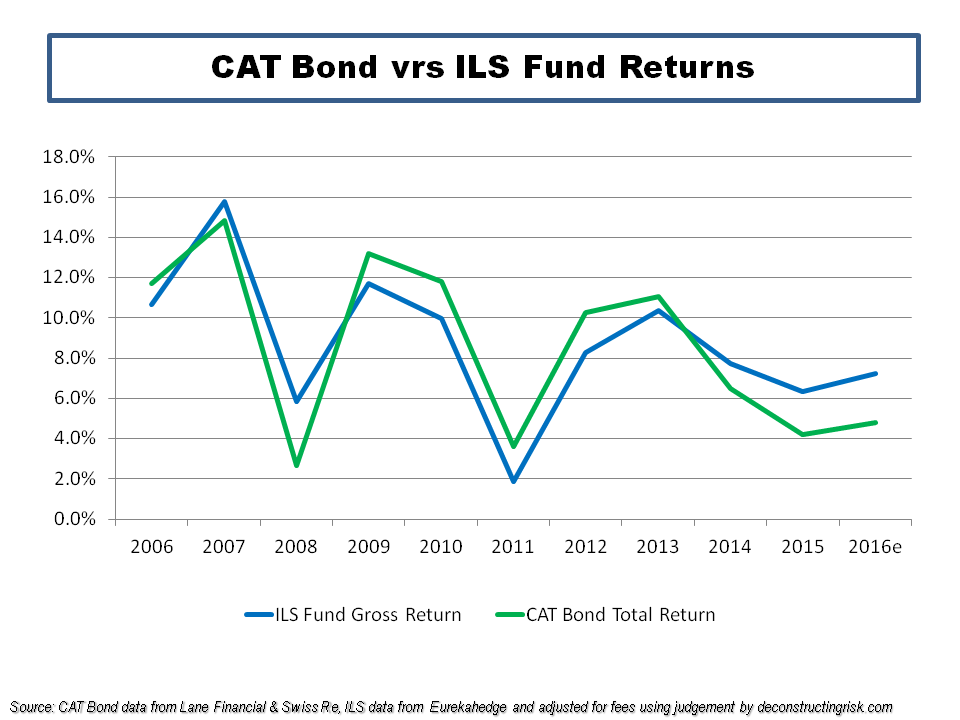
The graph shows that ILS fund returns have broken with historical patterns and diverged away from those of CAT bonds as the prevalence in private collaterised deals has grown in recent years. In other words, ILS funds have moved to higher rate on line business, which is by definition higher risk, as they push to service the larger level of assets under management. The question is therefore do the investors really understand the significance of this change? Have they adjusted their cost of capital to reflect the increased risk? Or are some ILS funds representing the higher returns as their ability to get higher returns at the same risk level (against the trend of everybody else in the industry in a softening market)?

Innovation is to be encouraged and a necessary part of progress. Innovation dependent on the naivety of new investors however does not end well.

I can’t but help think of Michael Wade’s comment in 2009 about the commonality between the financial crisis and problems at Lloyds of London (see this post on lessons from Lloyds) when he said that “the consequence with the excess capital was that underlying risks could be underpriced as they were being passed on”. My advice to ILS investors is the next time they are getting a sales pitch with promises of returns that sound too good, look around the room, and ask yourself who is the greater fool here….
CaT pricing “heading for the basement”

Edward Noonan of Validus is always good copy and the Q1 conference call for Validus provided some insight into the market ahead of the important July 1 renewals. When asked by an analyst whether the catastrophe market was reaching a floor, Noonan answered that “I’m starting to think we might be heading for the basement”.

He also said “I think the truly disruptive factor in the market right now is ILS money. I made a comment that we’ve always viewed the ILS manager business behaving rationally. I can’t honestly say that (anymore with) what we’re seeing in Florida right now. I mean we have large ILS managers who are simply saying – whatever they quote we will put out a multi-hundred million dollar line at 10% less.

I have posted many times on the impact of new capital in the ILS market, more recently on the assertion that ILS funds havw a lower cost of capital. Noonan now questions whether investors in the ILS space really understand the expected loss cost as well as experienced traditional players. Getting a yield of 5% or lower now compared to 9% a few short years ago for BBB – risks is highlighted as an indication that investors lack a basic understanding of what they are buying. The growing trend of including terrorism risks in catastrophe programmes is also highlighted as a sign that the new market players are mispricing risk and lack basic understanding on issues such as a potential clash in loss definitions and wordings.

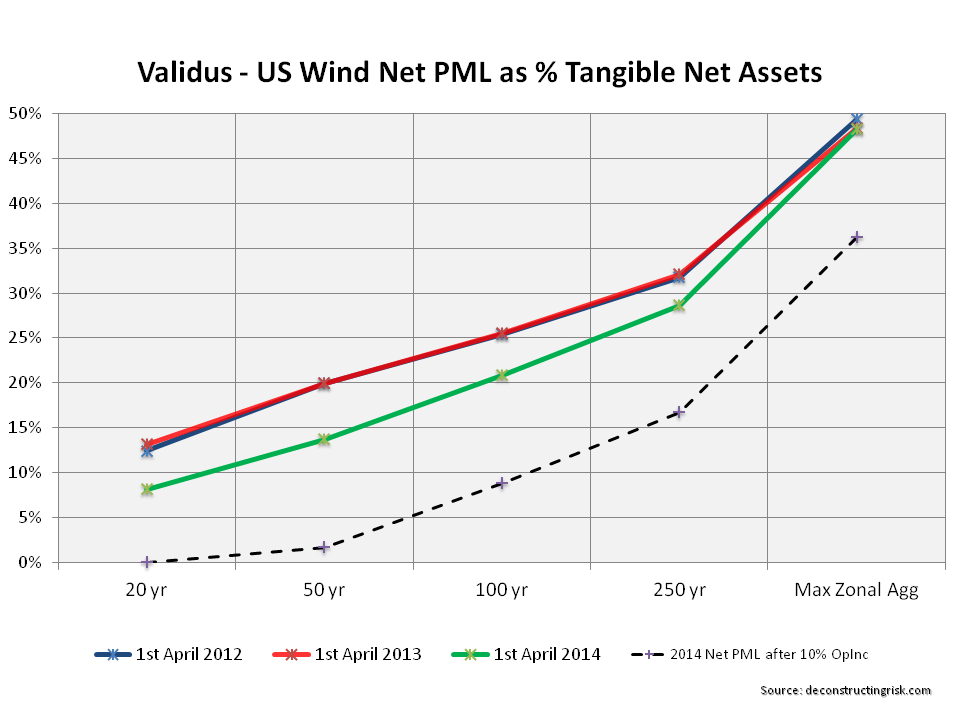
Validus highlight how they are disciplined in not renewing underpriced risk and arbitraging the market by purchasing large amounts of collaterised reinsurance and retrocession. They point to the reduction in their net risk profile by way of their declining PMLs, as the graph below of their net US wind PMLs as a percentage of net tangible assets illustrates.

This is positive provided the margins on their core portfolio don’t decrease faster than the arbitrage. For example, Validus made underwriting income in 2012 and 2013 of 6% and 17% of their respective year-end net tangible assets. The graph below also shows what the US Wind PML would be reduced by if an operating profit of 12% (my approximation of a significant loss free 2014 for Validus) could be used to offset the US Wind net losses. Continuing pricing reductions in the market could easily make a 12% operating profit look fanciful.

click to enlargeValidus Net US Wind PML as % of tangible net assets

I think that firms such as Validus are playing this market rationally and in the only way you can without withdrawing from core (albeit increasingly under-priced) markets. If risk is continually under-priced over the next 12 to 24 months, questions arise about the sustainability of many existing business models. You can outrun a train moving out of a station but eventually you run out of platform!

Insurance & capital market convergence hype is getting boring

As the horde of middle aged (still mainly male) executives pack up their chinos and casual shirts, the overriding theme coming from this year’s Monte Carlo Renez-Vous seems to be impact of the new ILS capacity or “convergence capital” on the reinsurance and specialty insurance sector. The event, described in a Financial Times article as “the kind of public display of wealth most bankers try to eschew”, is where executives start the January 1 renewal discussions with clients in quick meetings crammed together in the luxury location.

The relentless chatter about the new capital will likely leave many bored senseless of the subject. Many may now hope that, just like previous hot discussion topics that were worn out (Solvency II anybody?), the topic fades into the background as the reality of the office huts them next week.

The more traditional industry hands warned of the perils of the new capacity on underwriting discipline. John Nelson of Lloyds highlighted that “some of the structures being used could undermine some of the qualities of the insurance model”. Tad Montross of GenRe cautioned that “bankers looking to replace lost fee income” are pushing ILS as the latest asset class but that the hype will die down when “the inability to model extreme weather events accurately is better understood”. Amer Ahmed of Allianz Re predicted the influx “bears the danger that certain risks get covered at inadequate rates”. Torsten Jeworrek of Munich Re said that “our research shows that ILS use the cheapest model in the market” (assumingly in a side swipe at AIR).

Other traditional reinsurers with an existing foothold in the ILS camp were more circumspect. Michel Lies of Swiss Re commented that “we take the inflow of alternative capital seriously but we are not alarmed by it”.

Brokers and other interested service providers were the loudest cheerleaders. Increasing the size of the pie for everybody, igniting coverage innovative in the traditional sector, and cheap retrocession capacity were some of the advantages cited. My favourite piece of new risk management speak came from Aon Benfield’s Bryon Ehrhart in the statement “reinsurers will innovate their capital structures to turn headwinds from alternative capital sources into tailwinds”. In other words, as Tokio Millennium Re’s CEO Tatsuhiko Hoshina said, the new capital offers an opportunity to leverage increasingly diverse sources of retrocessional capacity. An arbitrage market (as a previous post concluded)?

All of this talk reminds me of the last time that “convergence” was a buzz word in the sector in the 1990s. For my sins, I was an active participant in the market then. Would the paragraph below from an article on insurance and capital market convergence by Graciela Chichilnisky of Columbia University in June 1996 sound out of place today?

“The future of the industry lies with those firms which implement such innovation. The companies that adapt successfully will be the ones that survive. In 10 years, these organizations will draw the map of a completely restructured reinsurance industry”

The current market dynamics are driven by low risk premia in capital markets bringing investors into competition with the insurance sector through ILS and collaterised structures. In the 1990s, capital inflows after Hurricane Andrew into reinsurers, such as the “class of 1992”, led to overcapacity in the market which resulted in a brutal and undisciplined soft market in the late 1990s.

Some (re)insurers sought to diversify their business base by embracing innovation in transaction structures and/or by looking at expanding the risks they covered beyond traditional P&C exposures. Some entered head first into “finite” type multi-line multi-year programmes that assumed structuring could protect against poor underwriting. An over-reliance on the developing insurance models used to price such transactions, particularly in relation to assumed correlations between exposures, left some blind to basic underwriting disciplines (Sound familiar, CDOs?). Others tested (unsuccessfully) the limits of risk transfer and legality by providing limited or no risk coverage to distressed insurers (e.g. FAI & HIH in Australia) or by providing reserve protection that distorted regulatory requirements (e.g. AIG & Cologne Re) by way of back to back contracts and murky disclosures.

Others, such as the company I worked for, looked to cover financial risks on the basis that mixing insurance and financial risks would allow regulatory capital arbitrage benefits through increased diversification (and may even offer an inflation & asset price hedge). Some well known examples* of the financial risks assumed by different (re)insurers at that time include the Hollywood Funding pool guarantee, the BAe aircraft leasing income coverage, Rolls Royce residual asset guarantees, dual trigger contingent equity puts, Toyota motor residual value protection, and mezzanine corporate debt credit enhancement  coverage.

Many of these “innovations” ended badly for the industry. Innovation in itself should never be dismissed as it is a feature of the world we live in. In this sector however, innovation at the expense of good underwriting is a nasty combination that the experience in the 1990s must surely teach us.

Bringing this back to today, I recently discussed the ILS market with a well informed and active market participant. He confirmed that some of the ILS funds have experienced reinsurance professionals with the skills to question the information in the broker pack and who do their own modelling and underwriting of the underlying risks. He also confirmed however that there is many funds (some with well known sponsors and hungry mandates) that, in the words of Kevin O’Donnell of RenRe, rely “on a single point” from a single model provided by to them by an “expert” 3rd party.

This conversation got me to thinking again about the comment from Edward Noonan of Validus that “the ILS guys aren’t undisciplined; it’s just that they’ve got a lower cost of capital.” Why should an ILS fund have a lower cost of capital to a pure property catastrophe reinsurer? There is the operational risk of a reinsurer to consider. However there is also operational risk involved with an ILS fund given items such as multiple collateral arrangements and other contracted 3rd party service provided functions to consider. Expenses shouldn’t be a major differing factor between the two models. The only item that may justify a difference is liquidity, particularly as capital market investors are so focussed on a fast exit. However, should this be material given the exit option of simply selling the equity in many of the quoted property catastrophe reinsurers?

I am not convinced that the ILS funds should have a material cost of capital advantage. Maybe the quoted reinsurers should simply revise their shareholder return strategies to be more competitive with the yields offered by the ILS funds. Indeed, traditional reinsurers in this space may argue that they are able to offer more attractive yields to a fully collaterised provider, all other things being equal, given their more leveraged business model.

*As a complete aside, an article this week in the Financial Times on the anniversary of the Lehman Brothers collapse and the financial crisis highlighted the role of poor lending practices as a primary cause of significant number of the bank failures. This article reminded me of a “convergence” product I helped design back in the late 1990s. Following changes in accounting rules, many banks were not allowed to continue to hold general loan loss provisions against their portfolio. These provisions (akin to an IBNR type bulk reserve) had been held in addition to specific loan provision (akin to case reserves). I designed an insurance structure for banks to pay premiums previously set aside as general provisions for coverage on massive deterioration in their loan provisions. After an initial risk period in which the insurer could lose money (which was required to demonstrate an effective risk transfer), the policy would act as a fully funded coverage similar to a collaterised reinsurance. In effect the banks could pay some of the profits in good years (assuming the initial risk period was set over the good years!) for protection in the bad years. The attachment of the coverage was designed in a way similar to the old continuous ratcheting retention reinsurance aggregate coverage popular at the time amongst some German reinsurers. After numerous discussions, no banks were interested in a cover that offered them an opportunity to use profits in the good times to buy protection for a rainy day. They didn’t think they needed it. Funny that.