Tag Archives: BetFair

Summer Blues

After the holidays, it’s time to pack the bucket and spades away and get back into the routine. It has been a volatile August.  A bear call in a post in early May is looking pertinent (as is the post on a suggested tie-up between Paddy Power and Betfair!) given the 7% drop in the S&P500 since then, although it is more likely dumb luck.

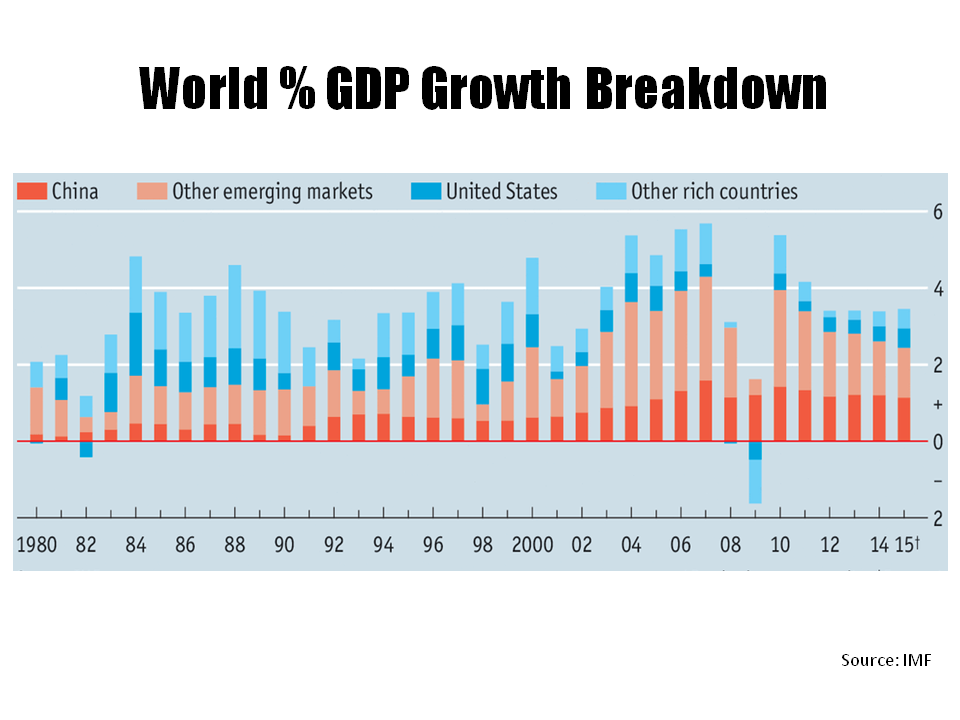
The market concern is centred on the prospects for China’s economy. Growth is widely believed to be a lot lower than the official 7% with exports down, concerns about zombie loans and the political ramifications of managing a lower growth economy. The Economist, in an article this week, highlighted the potential impact of a slow-down in China and other emerging markets on global growth, as per the graph below.

click to enlargeGlobal GDP Growth Breakdown 1980 to 2015

Amongst the usual holiday reading, I brought two books on economics for the beach. The first was the FT’s Martin Wolf’s “The shifts and the shocks” from late in 2014 and the second is the recently published “Postcapitalism” by Paul Mason. Although often a laboured read, I did manage to finish the former whilst I only got to start the latter (which is a much easier read).

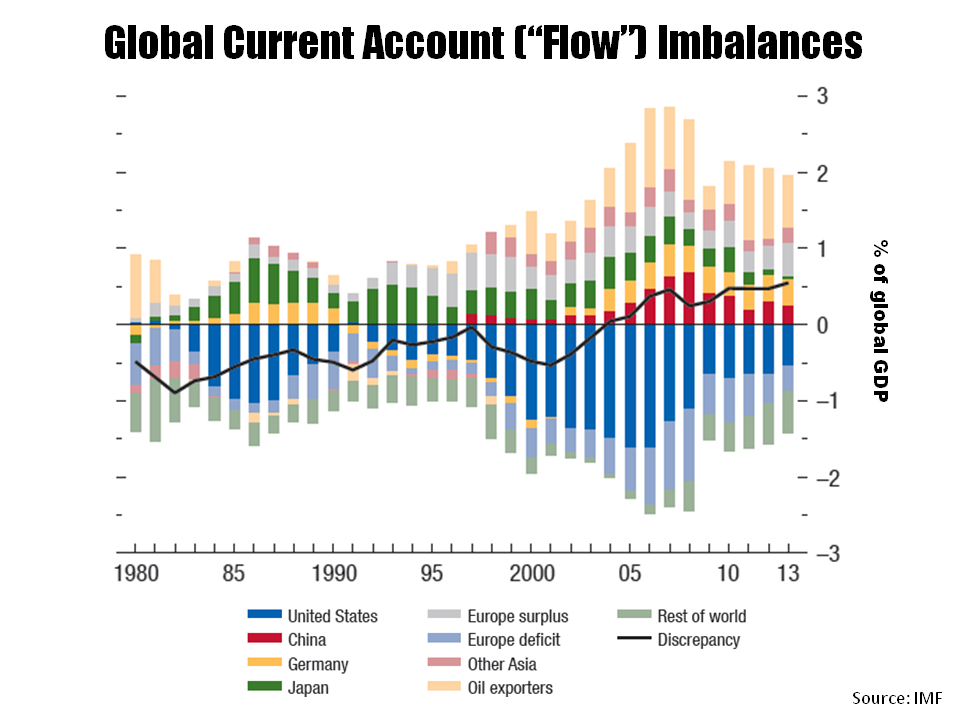
Reading Wolf’s book as the China led volatility was unfolding only led to an enhanced feeling of negativity from the themes of the book, namely the lessons as yet unlearned from the crisis. Wolf competently covers much of the causes of the crisis and its aftermath – a global savings glut and associated global imbalances, an expansionary monetary policy that ignored asset prices and credit, an unstable liberalized financial system supervised by naïve regulation. The following graph from the IMF reminds of the global imbalances that proved so toxic when combined with a rampant financial sector.

click to enlargeGlobal Current Account Imbalances 1980 to 2013

Wolf questions the “belief that government borrowing is the illness for which private borrowing is the cure has survived all that has happened”. Some of the solutions that Wolf proposes include much higher capital requirements for banks than is currently being implemented under Basel III, deleveraging initiatives such as tax incentives towards equity and away from debt, corporate tax changes to encourage corporate investment, changes in debt contracts to convert to equity on macro-economic metrics, policies to address income inequality and to promote research and education.

A more radical reform of the financial system, along the lines of the Chicago Plan for 100% reserve banking whereby the ability to create money is taken away from profit seeking banks and given solely to central banks, is a step that Wolf favours but believes is unrealistic given the realpolitik of the developed world system. On the globalised financial system, Wolf believes that the “obvious truth that unless regulation and the supply of fiscal backstops is to be much more global, finance should be far less so” and suggests a greater segmentation of the world’s financial system.

There are many themes in Wolf’s book that got me thinking and I am hoping that Mason’s book will do the same, albeit from a totally different perspective. I think the market volatility has more time to play out and hopefully my summer reading, although yet to be completed, will assist in understanding what may come next.

Gambling Problems

It has been about 6 months since I posted on the gambling and gaming sector (also earlier here) and there has been a lot going on. BWIN, after being on the block for some time, is closing in on a sale of its business with 888 and GCV (in conjunction with PokerStars and FullTilt owner Amaya) the speculated favourites. 888 itself rejected an offer from William Hill earlier in February this year. Meanwhile, Betfair and PaddyPower opted to return their cash piles of £200 million and €440 million respectively to shareholders rather than get involved in any M&A.

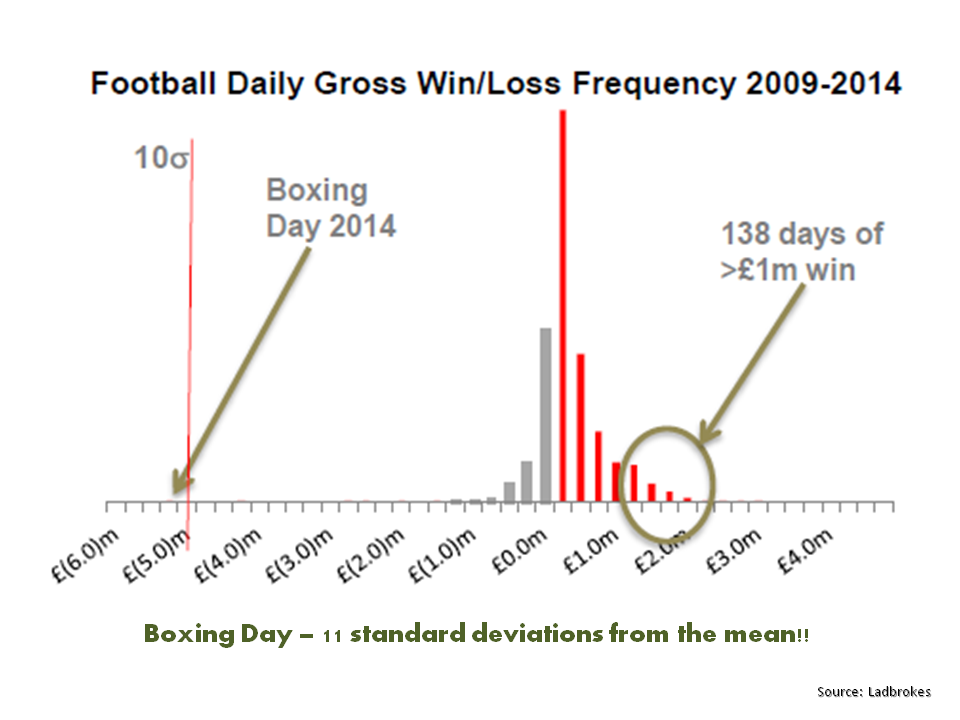
Ladbrokes, after a series of poor results, promoted the digital head Jim Mullen to CEO who is currently involved in a route and branch review of the firm with the outcome due to announced in June. His first move was to put the Irish business into examinership. Ladbrokes woes have continued with poor gambling Q1 results, continuing a run of bad luck after a disastrous boxing day football gross loss, as the exhibit below shows.

click to enlarge2014 Boxing Day 11 standard deviations

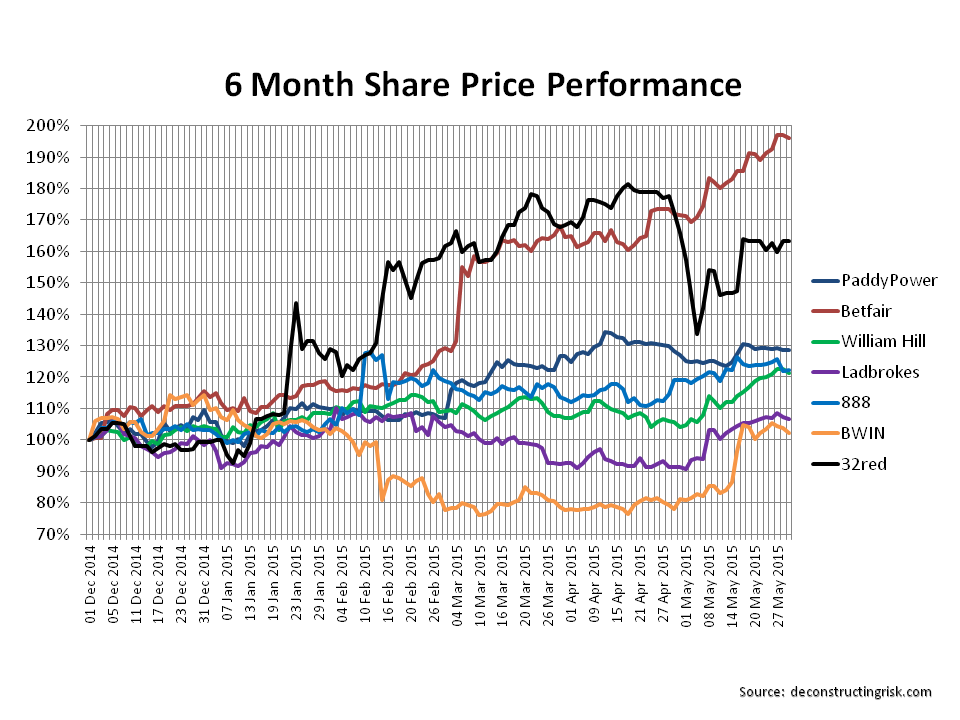
As can be seen by the graph below, Breon Corcoran’s rehabilitation of Betfair’s exchange model has resulted in an outstanding performance with a near doubling of the stock. The ex-Paddy Power executive has delivered on his plans for the betting exchange (as detailed in this post). [Update: Numis just released a note on Betfair’s rich valuation as per this article.] The tiny casino player 32Red has also had a good run due to solid 2014 results and M&A speculation.

click to enlargeShare Price 6months to May 2015 William Hill Ladbrokes Paddy Power Betfair 888 BWIN 32red

Internal candidates in William Hill and Paddy Power, James Henderson and Andy McCue respectively, also took over the CEO role.

The challenges for the sector are considerable. In the UK, the point of consumption (POC) tax of 15% has been in force in the UK since December and a new 25% rate of Machine Games Duty (MGD) applied from the 1st of March. Uncertain regulation across Europe and the lack of traction in opening of US markets are other headwinds.

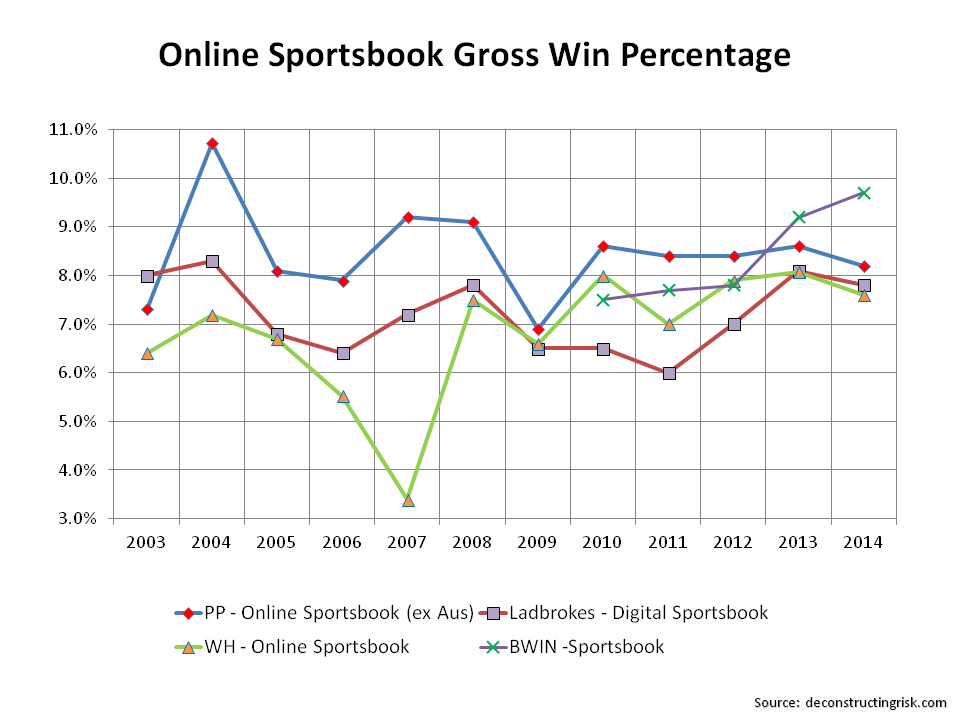
Operator’s ability to reduce pay-outs to punters to counter tax increases is restricted by the competitive nature of the market, particularly online as the graph below on gross win percentages illustrates.

click to enlargeOnline Sportsbook Gross Win Percentage

Taking the commentary from the operators on the impact of increased taxes, I estimated the likely impact on net margins for a number of firms (as the graph below shows).

click to enlargeNet Margin estimates to 2015 gambling firms

The market is giving Betfair and Paddy Power credit for their recent revenue growth, strong operating results, product development and strong mobile adoption. Based upon my estimates, both trade on a 2015 PE in the low 30’s.

click to enlargeMarket valuations gambling firms

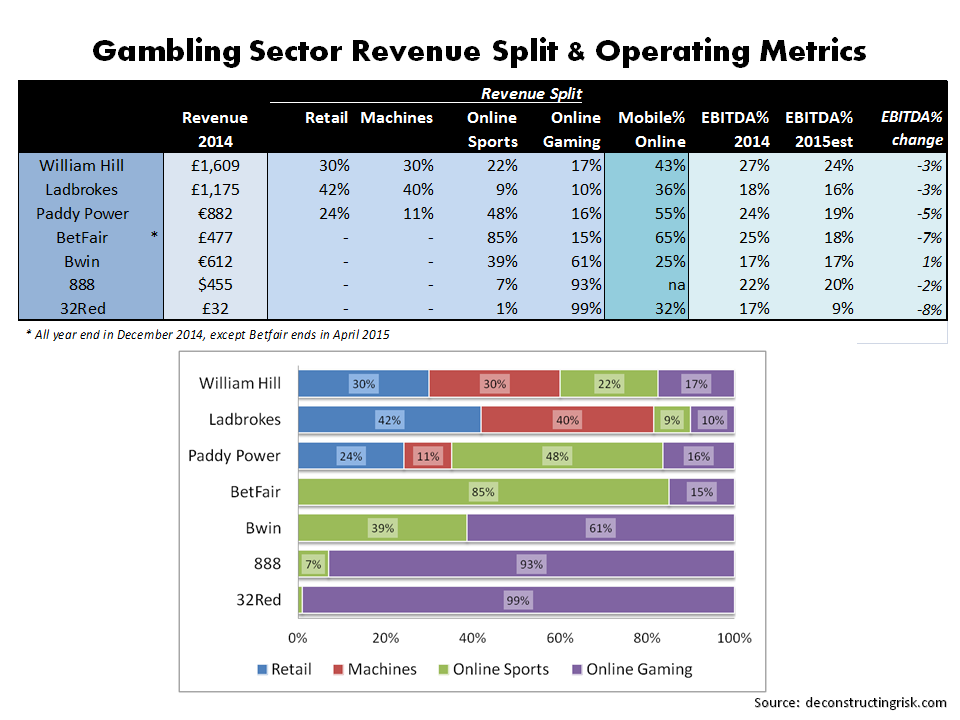
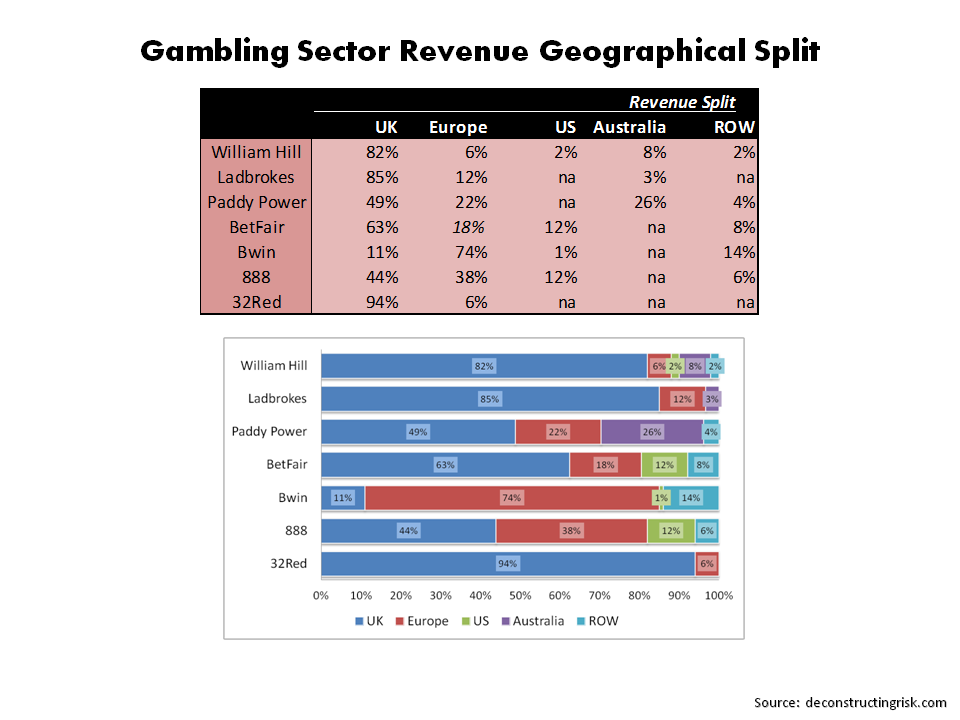
A brief review of the business profile of a selection of firms illustrates the differing models, as per the exhibits below.

click to enlargeGambling Sector Revenue Split & EBITDA estimates

click to enlargeGambling Sector Revenue Geographical Split 2015

It will be fascinating to see how the remainder of 2015 plays out for this sector. Scale is undoubting going to be a strength for firms in the future. What the large UK operators, Ladbrokes and William Hill, will do to counter headwinds will be intriguing. Although there is nothing to suggest it is remotely likely, it occurs to me that a tie-up between Paddy Power and Betfair would make a powerful combination.

Uniting Gamesters

BWIN’s on-going search to “create shareholder value” seems to be moving on with the announcement that it “has entered into preliminary discussions with a number of interested parties regarding a variety of potential business”. A previous post on a number of the main players in the European gambling sector highlighted that William Hill and Paddy Power were speculated to be potential bidders for all or parts of BWIN, a European online gaming firm with a concentration of approx 25% of revenues from Germany. Now press reports speculate the potential interested parties include the Canadian firm Amaya, who purchased PokerStars/Full Tilt earlier this year, and Playtech, a software gaming firm that are “seeking transformational M&A opportunities to take the business to the next level”.

Commentators raised an eyebrow about the speculated 45% premium on offer (from before discussions were reported) given BWIN’s operating metrics and the uncertainty over the key German market. Speculation involving Playtech focussed on their recent debt raising which brings their cash-pile to around €700 million. Playtech’s shareholders may not be too pleased if their new strategy moves too far away from the very profitable software business, particularly considering the alternative of continuing with their generous special dividends. Taking on businesses such as BWIN, or even another speculated target like Ladbrokes, is a far cry from what made Playtech such a star.

In fact, the best performer in the sector (in fact the only name that’s in positive territory!) is the reinvigorated Betfair under Breon Corcoran (see previous post on Betfair) as can be seen below (they also have cash to spend on potential M&A).

click to enlargeShare price YTD selected betting stocks

This is a fascinated sector that is in the midst of considerable change. Although I have no financial interest in the sector, I am an intrigued bystander. Bring on the next development.

The fascinating case of Betfair

With the ending of the World Cup, my attention turned again to my attempts at understanding the issues facing the betting and gambling sector. For the sake of full disclosure, I am a novice on the sector (I am not a gambler if investing and the odd poker game are not included as such) and have no positions in any betting or gaming stock. My ramblings here, and in previous posts, simply illustrate my attempts to satisfy my curiosity about a sector that is at a fascinating point of change.

In a previous post, I highlighted the changes that the internet has had on the betting and gaming sectors. At that time, I thought the impact of the disintermediating betting exchanges on traditional business models could provide interesting insights into other disintermediating businesses in the financial sector. However, as I have found out more about the sector, such as the results of the traditional betting firms in the UK as per this post, there are a multitude of issues facing the sector such that a review of the impact of the betting exchanges in isolation is not that informative and (frankly) outdated given current developments. Recent developments include regulatory changes such as those in the US which has prompted the purchase of the largest online poker firm Pokerstars by approximately $5 billion by Amaya Gaming and new online taxes such as the forthcoming UK point of consumption (POC) tax of 15% due in December.

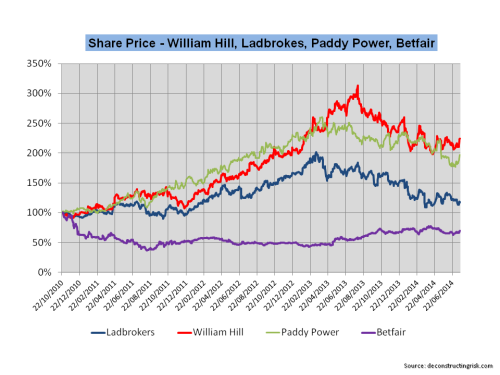
As the graph of Betfair’s share price since its floatation in late 2010 shows, the betting exchange model clearly has not had much of a disruptive impact on the traditional business models in recent years.

click to enlargeBetfair historical share price
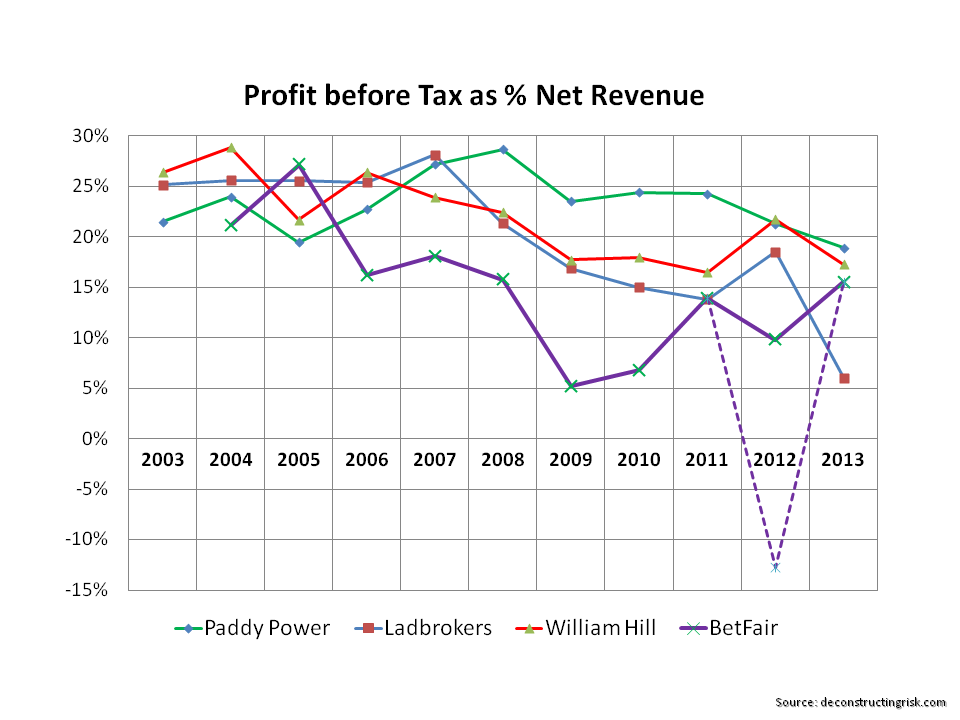
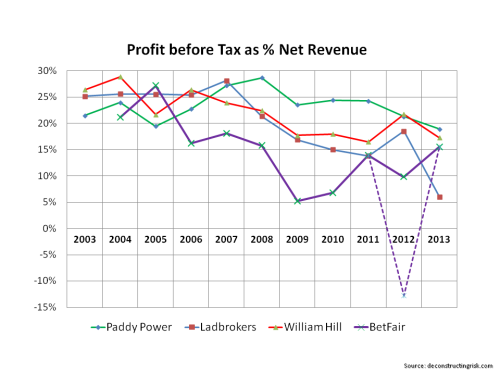
Rather than go over Betfair’s eventful past in detail here, I will focus on current issues. Niall O’Connor in his blog, bettingmarket.com, has a number of informative articles on the history of Betfair, including this one. Below, I show a graph of Betfair’s profit before tax against the other UK betting firms which illustrates its difficulties in the recent past. The 2012 results (which are Betfair’s YE 2013 results as their year ends in April) exclude some write-offs and adjustments as a result of Betfair’s turnaround plan (which are included in the dotted line). The plan involved refocusing on sustainable geographical betting markets with accommodative regulations and developing a fixed odds betting business alongside the exchange to optimise the liquidity advantages of each model.

The new plan, in effect, admitted that the stand alone betting exchange model was flawed and that some markets “may not have sufficient liquidity to offer an optimal betting experience, notably in ante post and ancillary markets“. The firm estimates its share of the sophisticated bettor market of £150 million at 60-70% but its share of the recreational and occasional bettor market of £500 million at less than 10%. This market is where they see growth and Breon Corcoran, previously Paddy Power’s COO, was brought in as Betfair’s new CEO in August 2012 to execute on the new direction. The most recent results show that the new strategy is delivering better results.

click to enlargeBetfair 10 year Profit Before Tax margins
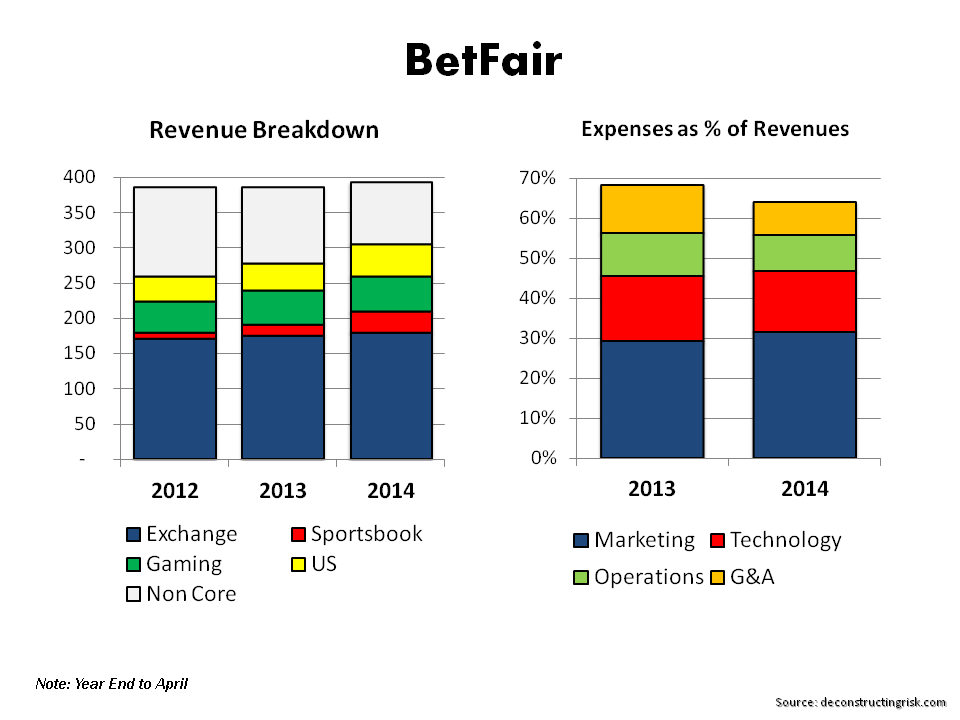
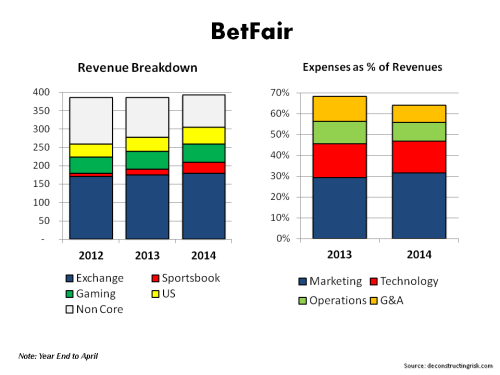
The focus on sustainable betting markets and cost cutting whilst increasing marketing spending (Betfair were high profile in recent World Cup advertising) can be seen in the graph below. Product development in features such as cash out and price rush (automatically gives the best odds from fixed odds and exchange) are being heavily pushed, particularly in the growingly important mobile market.

click to enlargeBetfair Revenue & Expense Breakdown
As mentioned in the previous post, there is a vast body of academic research on the gambling market and with the wealth of data that Betfair offers, the betting exchange market has been no exception in the studies. The Institute for Strategy and Business Economics in the University of Zurich in particular has some interesting papers. This one, for example, contends that there is a growing body of evidence that exchange markets “exhibit high prediction accuracy as they regularly outperform non-market forecasting methods”. The well-documented long-shot bias where the tendency to overvalue underdogs by fixed odd markets “is less pronounced in person-to-person betting” and this can be used by traders on the betting exchange to arbitrage price differences.

There is a particularly interesting paper by Egon Franck, Raphael Flepp and Stephan Nüesch in the University of Zurich from December 2013 on the importance of liquidity in determining price competitiveness which the authors offer as one of the reasons behind BetFair’s move into fixed odds online betting. Other arbitrage opportunities indentified by research include bookmakers actively shading prices in the presence of a partly irrational betting audience in order to increase their profit (e.g. sentiment bias in football games by the home fans) or the movement in odds prior and during games with the growth of in-play betting.

The development of sports investment funds was previously highlighted in a Bloomberg article and despite an early hic-cup with the collapse of a fund called Centaur there are many now developing predictive algorithms which try to take advantage of arbitrage opportunities. BetFair is consistently looking at how it can optimise its pricing (on the exchange it earns its commissions on winnings by a sliding scale on volume) in different geographical areas and sports to maximise its commissions, despite an outcry from a pricing charge change a few years ago.

Although BetFair face considerable challenges (e.g. I estimate that 95% of BetFair’s sustainable revenues are concentrated in the UK and the firm disclosed that the POC tax, if implemented as currently envisaged, would of cost them £36 million for their 2014 year, one with £61 million of operating profit!) in the short to medium term, one of their strengths is the balance sheet with a net asset ratio of 55% and a cash pile of over £200 million and a strong cash generating business. In their latest results Corcoran commented that “the flexibility we retain through our strong balance sheet provides a competitive advantage during uncertain times for the gaming sector. We will continue to review our balance sheet on a regular basis.” Although Betfair are a fascinating case to keep an eye on, the uncertainties on the POC tax issues outweigh any positive investment case for now.

In my attempts at understanding the sector more, these comments led me to look at some other models (and possible acquisition targets) in the other publically traded online firms, mainly on the gaming side. Names that I have looked at include 888, BWIN (currently looking at strategic options!) and 32Red. I am also intrigued by the software gaming firm Playtech which provides the underlying software to many firms in the sector. I will follow-up with a post on further musings.

Bookies’ Year-End Numbers and Budget Woes

This was an interesting week for certain sectors given the UK budget. Annuity insurers were stunned by the scraping of the requirement to purchase annuities upon retirement, thereby denying the sector of a statutory ability to rip off customers. Hopefully, the move will result in innovation in the insurance and fund sectors in providing customers with retirement products of genuine value by way of low cost index following returns with elements of longevity protection.

The other sector which got hit was the bookmakers with an increase in taxes on gaming machines (aka fixed odds betting terminals or FOBTs) to 25% from 20% and an extension of the horse racing betting levies to include offshore operators. A previous post on the betting sector outlined some of the dynamics at play (I still have to follow that up with a post on betting exchanges, specifically Betfair). The FOBT tax increases apply to both category B2 machines (casino games) and B3 machines (slot games). The timing of the tax increase caused surprise as the UK Department for Culture Media and Sport are looking into how the FOBT can be restricted to reduce its appeal to younger men with low incomes and gambling problems.

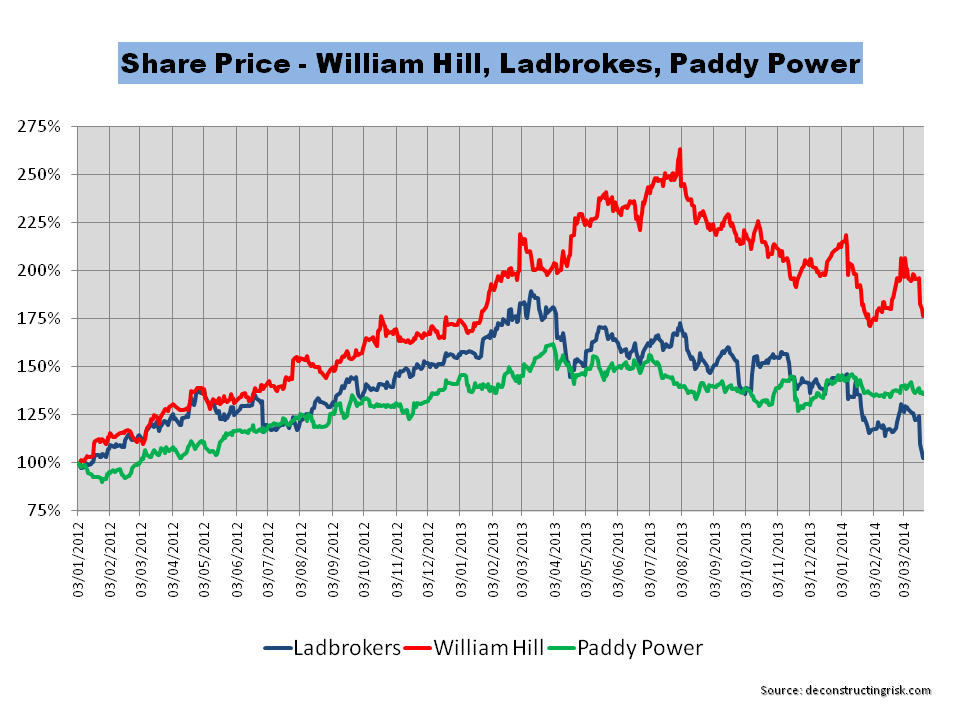
Shares of UK bookmakers took a hit from the news, particularly Ladbrokes as the UK bookmaker most dependent upon FOBTs. The graph below shows the impact.

click to enlargeShare Price 2012 to March2014 William Hill Ladbrokes Paddy Power

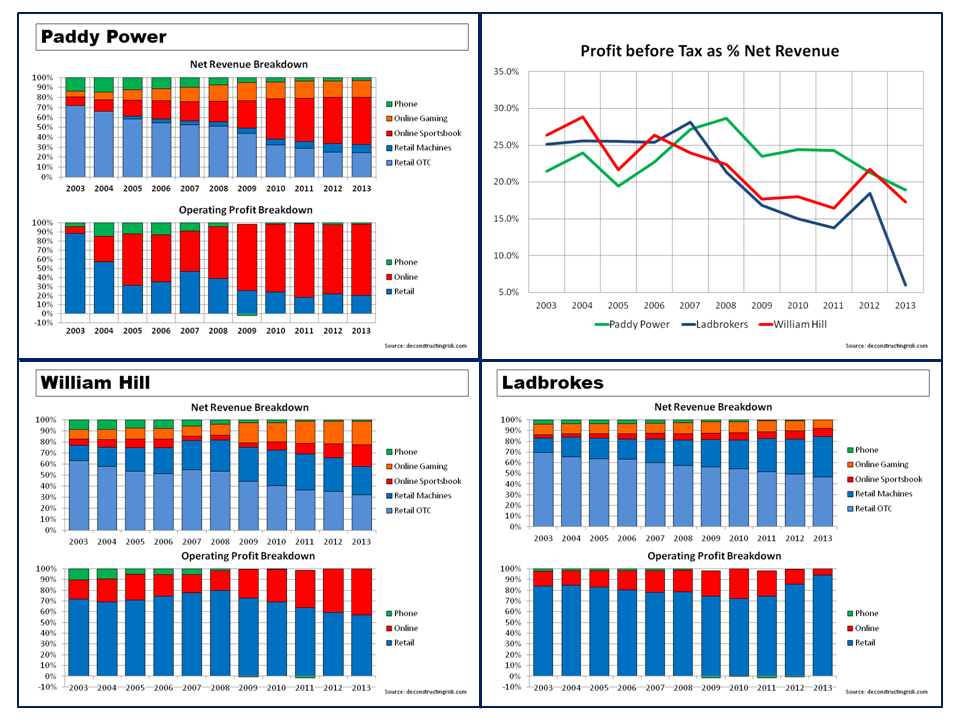
The reason for Paddy Power’s performance over Ladbrokes and William Hill is explained by their relative low exposure to gaming machines as the exhibit below shows (which updates revenue and operating profit breakdowns for the three firms).

click to enlargeBookie's books YE2013

Analysts estimate that the FOBT tax increase could impact the profits of Ladbrokes and William Hill by £20 million and £16 million respectively (compared to 2013 net income of £67 million and £226 million respectively).

The budget increases are on top of the introduction of the online point of consumption (POC) tax of 15% due in the UK from December. The impact of this tax upon the online operations of bookies (and indeed upon Betfair) is unknown and something I will hopefully return to in the future. In its 2013 annual report, William Hill offered the following:

Taken together, the competitiveness of our digital offering and our healthy financial position leave us well positioned to tackle both opportunities and challenges created by the posited introduction of a Point of Consumption tax on UK online gambling in December 2014 which we believe is likely to result in a dislocation of the UK online gambling market given its likely impact on industry operating profit margins. While it will lead to a significant additional cost for the Group – of a size we consider impossible to mitigate in full in the short term – we do believe there is potential for larger scale operators to benefit from increased market share as smaller operators may be squeezed out of the market by the additional tax burden.

As can be seen from the above graphs, Ladbrokes looks like a business under real pressure. Its brand is strong but its business is far too reliant upon UK retail and gaming machines in particular. Many analysts favour William Hill due to its balance between retail & online and between sports & gaming.  Paddy Power’s 500% share price rise over the past 5 years has been muted in the past year due to industry headwinds and how they manoeuvre the POC issue will be fascinating (as it will be for other pure online bookies and the betting exchange BetFair).