Tag Archives: digital technologies

From flowmageddon to paymageddon

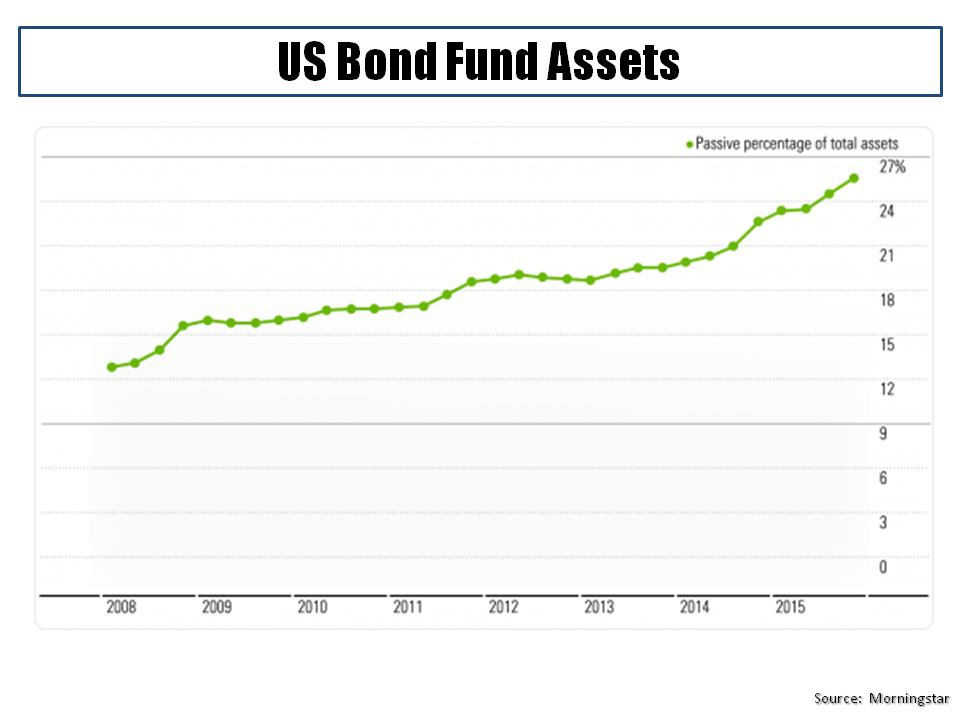
Morningstar have coined the witty term flowmageddon, in this article, for the on-going outflows that many in the active asset management sector are experiencing. In the US, passive equity funds have doubled their market share over the past decade and now make up over 40% of invested assets whilst bond fund assets have grown to over a quarter of the market, as the graph below shows.

click to enlargePassive % of US Bond Funds

The competition from passive investments such as ETFs has forced fees down for active managers. As per this FT article, Tim Guinness, chief investment officer of Guinness Global Money Managers Fund commented that “the days of great prosperity for active fund management may be behind us”. In other words, flowmageddon is leading to paymageddon!

According to this recent Economist article, the future for many active asset managers does not look too bright given the costs of increased regulation, such as the new fiduciary rules from the Department of Labour in the US, and the increased ability of technology to replicate complex investment strategies without the need for a load of vastly overpaid investment managers . Given that the majority of active managers consistently fail to beat their benchmarks after fees, the on-going shakeup is no bad thing.

Time for a gamble?

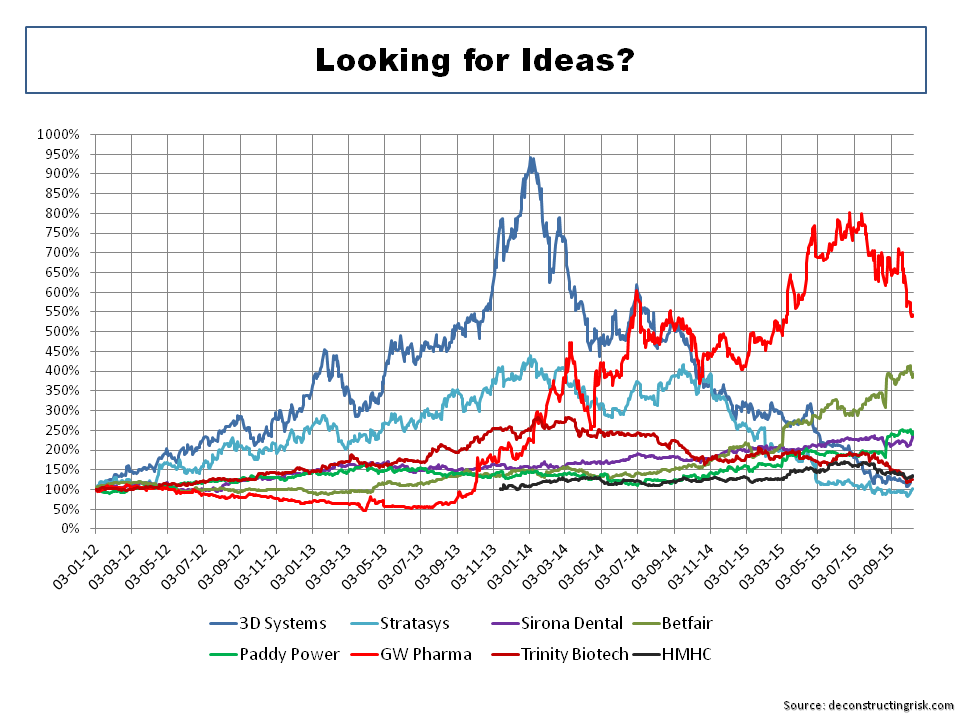
While waiting for earnings season to show how firms are forecasting the impact of macro trends, it’s a good time to look over some investing ideas for the future. Having a few names selected that can be picked up in market weakness is always a good way of building quality positions. It also helps in viewing current positions to see if they stack up to alternatives.

Regular readers will know that I think the insurance sector is best left alone given pricing and competitive pressures. Despite the odd look from afar, I have never been able to get comfortable with hot sectors such as the Chinese internet firms (as per this July post). The hype around new technologies such as 3D printing has taken a battering with firms like 3D Systems and Stratasys bursting the bubble. A previous post in 2014 highlighted that a focussed play on 3D printing such as Sirona Dental makes better sense to me. The Biotech sector is not one I am generally comfortable in as it seems to me to be akin to leveraged one way bets (loss making firms with massive potential trading a large multiples of revenue). Firms such as GW Pharma which are looking at commercializing cannabinoid medicines for multiple sclerosis, cancer and epilepsy have had the shine taken off their gigantic runs in the recent volatility. My views on Trinity Biotech (which is not really a biotech firm) were expressed in a recent post in May and haven’t really changed despite a subsequent 25% drop. I need to see more results from TRIB to get comfortable that the core business justifies the current valuation with the upside being in the FDA approval of the Troponin point-of-care cardiac tests. Other ideas such as online education firm Houghton Mifflin Harcourt (in this post) have failed to sparkle.

click to enlargeInvesting Ideas October 2015

This leads me to the online gambling sector that I have posted on many times (here and here for example) and specifically to the Paddy Power/Betfair merge. My interest in this sector has not been one from an investment point of view (despite highlighting that PP and Betfair would make a good combination in May!) but I can’t get the recent performance of these two firms out of my head. The graph below shows the profit before tax margins of each (with my estimate for 2015).

click to enlargePaddy Power Betfair Historical PBT Margins

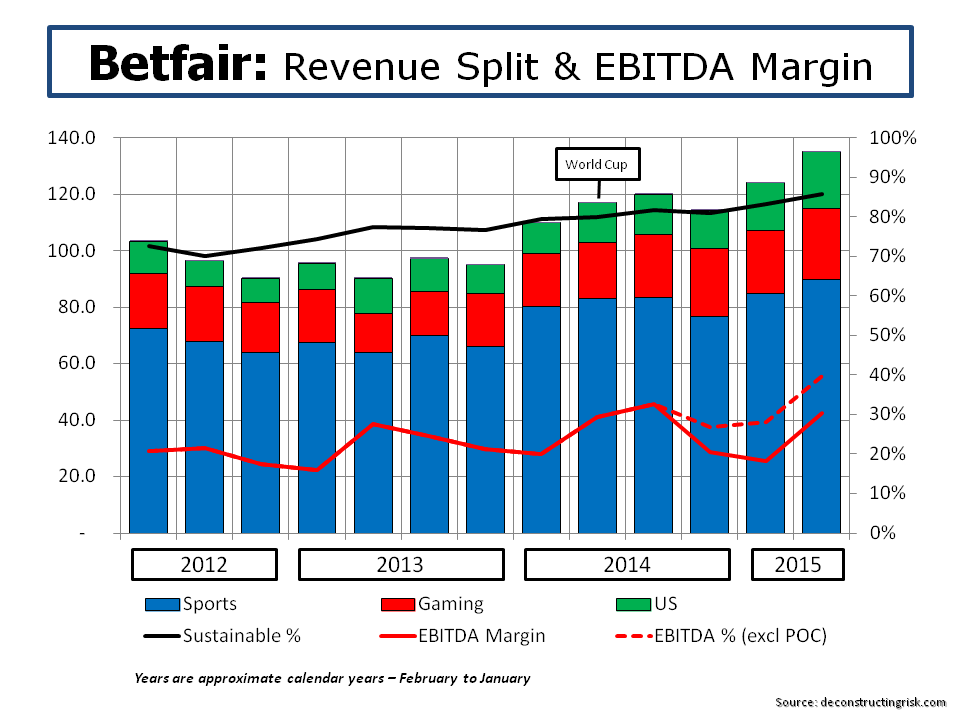
One of the things that stand out is how Betfair’s margin has improved, despite the recent headwinds such as the UK point of consumption (POC) tax. Indeed the market view that Betfair CEO Breon Corcoran is the new messiah can best be illustrated in the graph below on the firm’s performance since he took charge (revenue in sterling). It shows solid revenue growth (particularly from sustainable markets) and the incredible recent growth in EBITDA margin despite the drag of 9% of EBITDA margin from the POC tax.

click to enlargeBetfair Revenue Split & EBITDA Margin to July 2015

At the most recent results, Corcoran did highlight some headwinds that would bring the margins down (e.g. phasing of marketing spend and increased product investment) but emphasised the “high level of operational gearing” in the business and the “top-line momentum”. The merger of these two high class firms under a proven management team does make one giddy with the possibilities. The brokers Davy have a price target of €129 on the Paddy Power shares (currently trading just below €100). More information should emerge as documents for the shareholder votes are published (closing date expected in Q1 2016). An investor presentation does offer some insight (for example, as per the graphic below).

click to enlargeOnline Gambling Sector

I have calculated some initial estimates of what the combined entity will look like. Using an assumed constant sterling to euro FX rate of 1.30 and trying to adjust for Betfair’s funny reporting calendar, I estimate calendar year revenue growth 2016 to 2015 at 17% assuming a sterling reporting currency, as per the split below.

click to enlargePaddy Power Betfair pro-forma revenue split

I also calculated a profit before tax margin for the combined entity of 18% which increases to 21% post cost savings. Given approx 91 million shares in the new entity, my estimated operating EPS for 2016 is therefore approx £3.85 or approx €5.00 which gives a 20 multiple to operating earnings at the Paddy Power share price around €100 today.

So is buying into the merger of two quality firms with top management in a sector that is undergoing rapid change at a multiple of 20 sensible in today’s market? That depends whether you think it’s time for a gamble or whether patience will provide a more opportune time.

MGI Global Flows In A Digital Age Report

McKinsey Global Institute has an interesting report out entitled “Global flows in a digital age: How trade, finance, people, and data connect the world economy”. The report goes into different aspects of flows across the globe with a central assertion as follows:

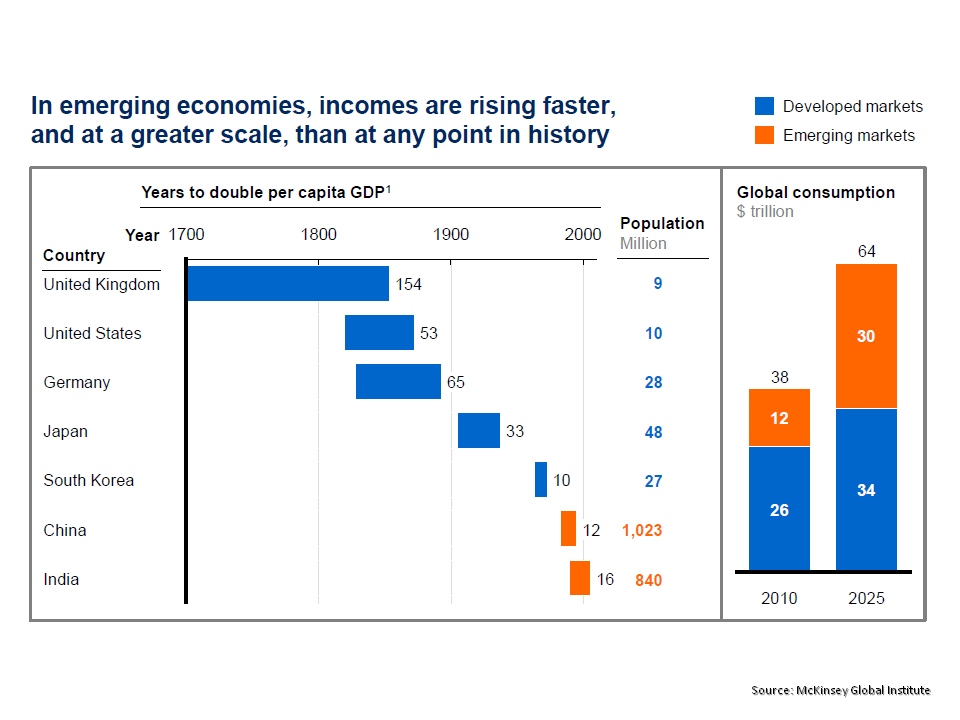
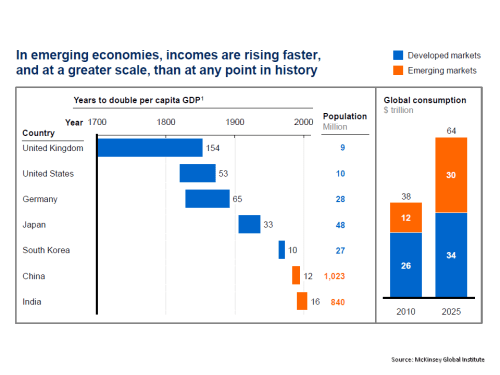
Two major forces are now accelerating the growth and evolution of global flows. The first is increasing global prosperity. By 2025, 1.8 billion people around the world will enter the consuming class, nearly all from emerging markets, and emerging-market consumers will spend $30 trillion annually, up from $12 trillion today. This will create enormous new hubs for consumer demand and global production. The second major force is the growing pervasiveness of Internet connectivity and the spread of digital technologies. More than two-thirds of us have mobile phones. In 2012, there were 2.7 billion people connected to the Internet. A torrent of data now travels around the world. Cross-border Internet traffic grew 18-fold between 2005 and 2012.

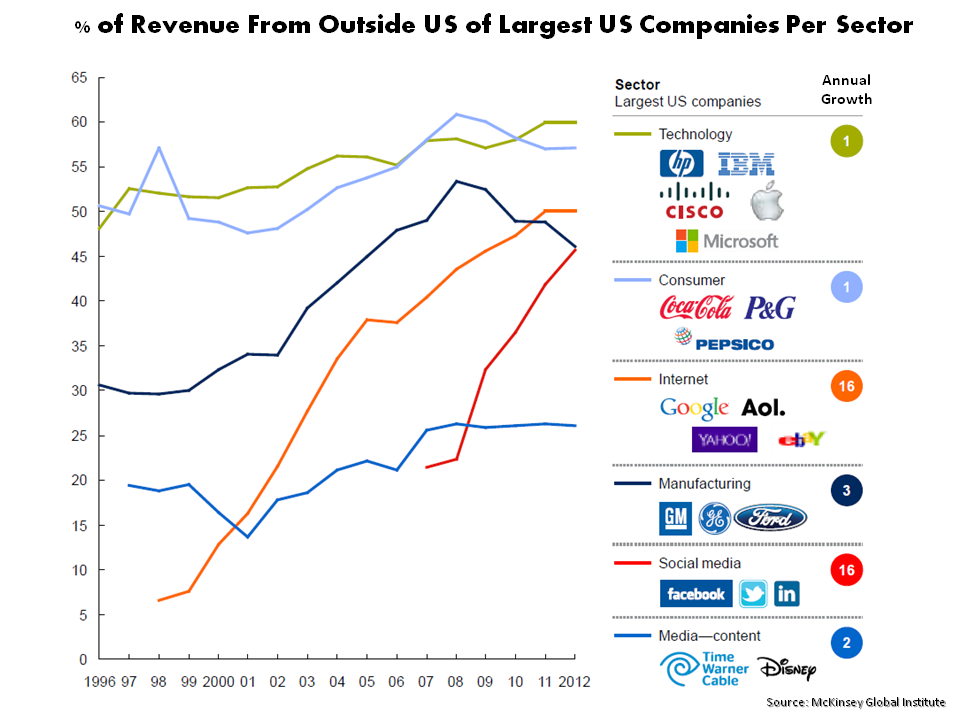
One graph in the report that caught my attention was the one below of the growth in foreign revenues from top US firms across different sectors. This is interesting and feeds directly into some of the contentions asserted by Jeremy Siegel in justifying a high CAPE ratio (as discussed in this post).

click to enlargeMGI Revenue % of US firms from foreign markets
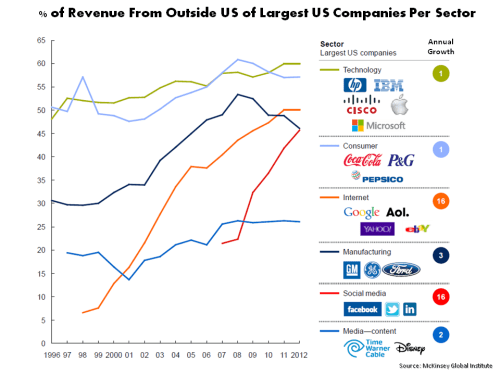
What is interesting about the graph above is the fall in the manufacturing firms since the financial crisis and the relatively slow growth of revenues outside of the US from the “established” technology and consumer firms in the US. Given the growth in global flows, it suggests they need to be more focused on the opportunities outside the US, particularly if the graph below on future consumption in 2025 turns out to accurate.

click to enlargeMGI emerging economies per capita GDP
I was particularly taken with the pieces of the report in relation to the impact of the internet and e-commerce. The following extract highlighted the impact:

“The power of digitization comes especially from its marginal cost economics that reduce costs associated with access, discovery, and distribution of goods and services to nearly zero. As a result, the cost of participating in flows is lowered for individuals, small firms, and entrepreneurs. This is already leading not only to innovations in business models but also to the emergence of micromultinationals, microwork, and microsupply chains that are able to tap into global opportunities. This significantly removes barriers to participating in global flows, broadening opportunities. It also will put pressure on all companies to innovate their business models to capture the opportunities and respond to new sources of competition, and to counter the pressure on their existing business models from digitization’s marginal-cost economics.”

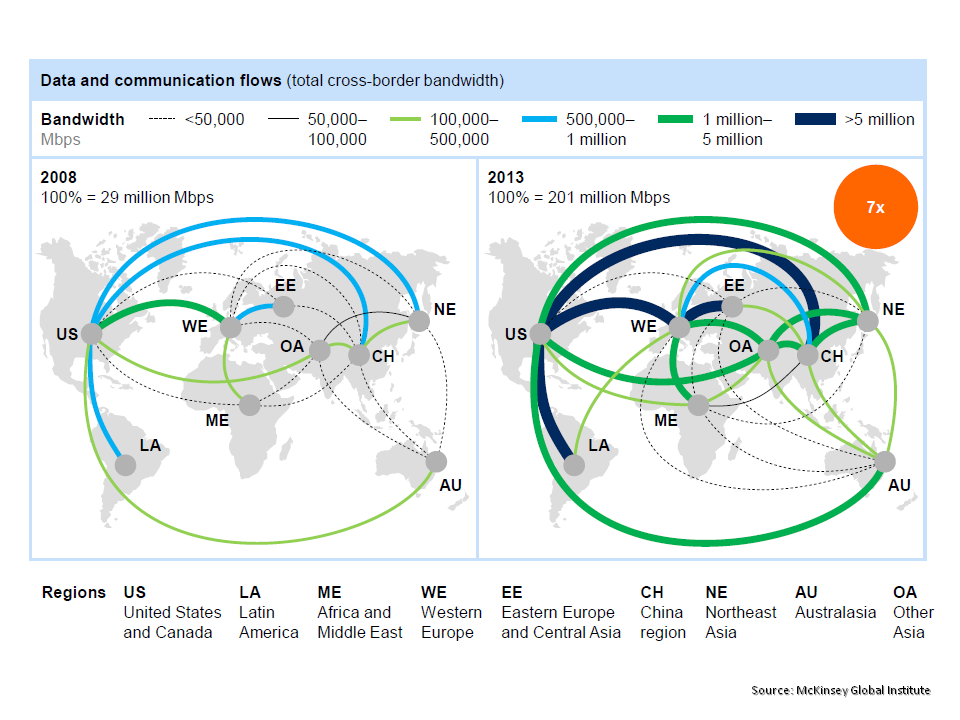
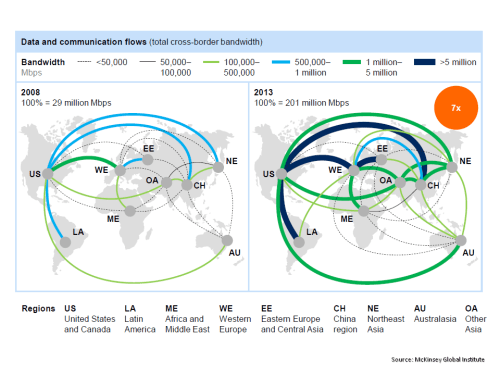
The graph below shows the changes in data and communication flows over the past 5 years. The growth in traffic between the US and China and between the US and Latin America is noteworthy.

click to enlargeMGI data & communication change 2008 to 2013
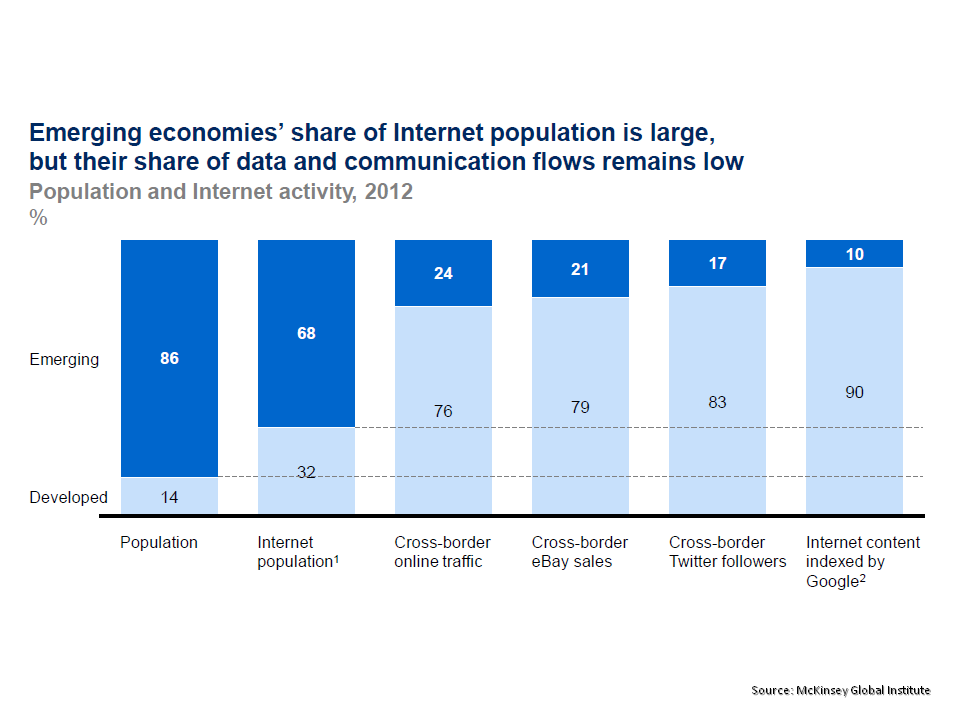
The report does highlight that emerging economies lag significantly behind developed economies in cross-border internet traffic with impediments to growth such as high bandwidth prices and IP transit costs. The graph below highlights the dominance of the developed economies in areas such as content and online sales.

click to enlargeMGI emerging economies Internet & Data
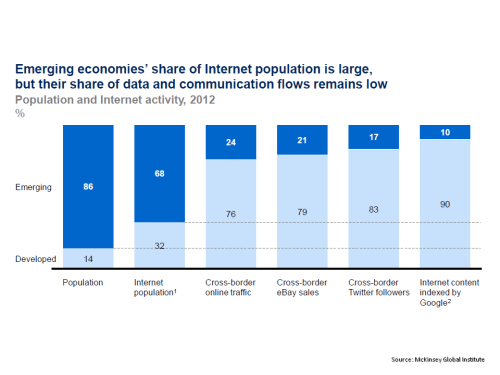
It does however also show how things may grow as emerging economies take advantage of the power of the wired world. As the report states: “the pace of change is likely to accelerate even more dramatically as more of the world goes online”.

There is some other interesting stuff in the MGI report and its worth a quick read.