Tag Archives: McKinsey

More on Non-existent Deleveraging

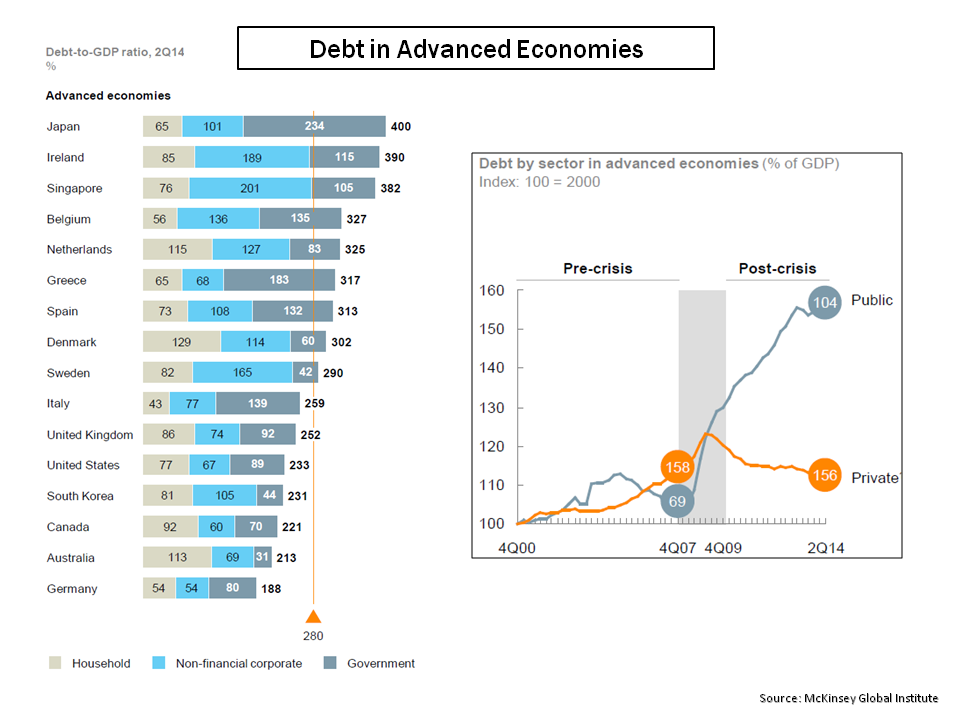
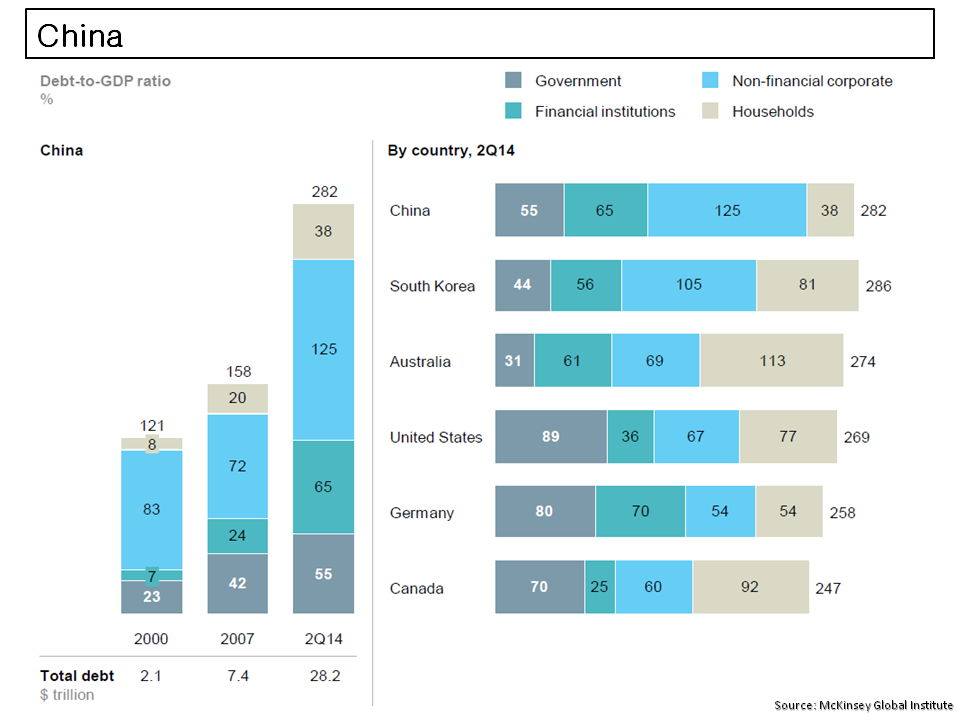
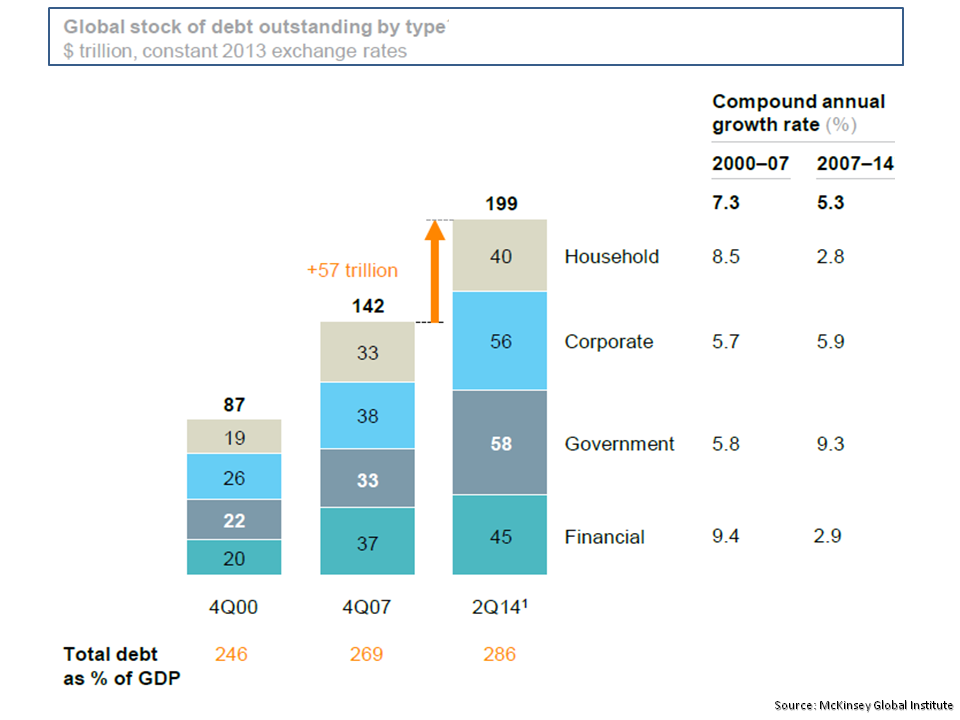
McKinsey released their third report on global debt levels recently, entitled “Debt and (not much) Deleveraging”. Covering much of the same ground as the Geneva report in September (see previous post), the highlights of the report include detail behind the rise in public sector and household debt, the growth rates needed to start real deleveraging, the higher capital levels in the banking sector, the detail behind China’s rising debt, and some suggestions to live with high debt levels in the future. I would recommend the report to anybody interested in the macroeconomics.

The report is the subject of the Buttonwood piece this week where he also talks about the challenges that higher global debt brings. A recent post on changes to global demographic profiles is also relevant when thinking about servicing future public and private debt.

Below are a few of the graphics of interest from the report on the size and split of global debt, the mix between private and public debt in developed countries and the growth rate needed to start deleveraging, and the debt in China.

click to enlargeMGI Global Debt
click to enlargeMGI Advanced Economies Public vrs Private Debt

click to enlargeMGI GDP required to start deleveraging

click to enlargeMGI China Debt to GDP

Judicious Volatility

The market has a tendency to take an extreme position, either everything is on the up or the sky is about to fall in. Well, fear is the flavour of the markets these days and that’s no bad thing given where we have come from. Still it’s annoying to hear the media full of hysterical noise on Ebola, the Middle East, Europe, Japan, Russia, oil, end of QE, deflation, etc. Hopefully, we’ll start to get some more considered arguments on what the medium term economic and earnings outlook may look like. Vitaliy Katsenelson had a nice piece on thinking through the effects of a few scenarios. Hopefully, the end of the happy-clappy market (it will likely not go easily and may well return before long) will lead to some more thoughtful pieces like that.

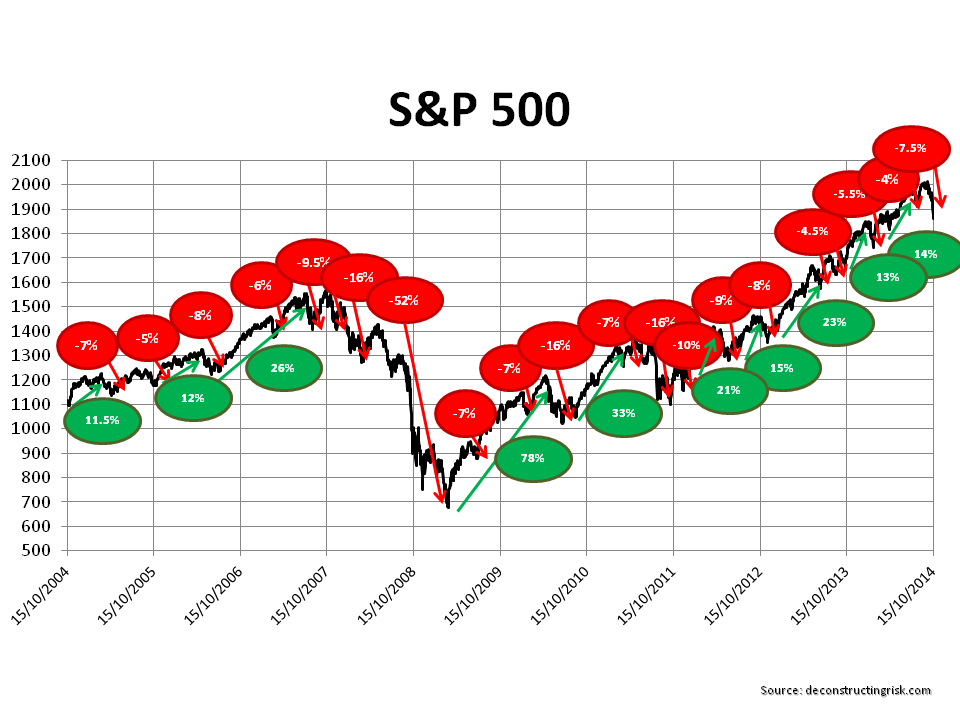
For now though, the smell of fear is in the air and the graph below on the ups and downs in the S&P500 show that the recent volatility is not even near correction territory (i.e. greater than 10% fall). In fact, we really haven’t had a proper correction since late 2011. As to whether this volatility will turn into a correction, I have no idea (I suspect it might take a while yet but it will get there).

click to enlargeS&P500 ups and downs

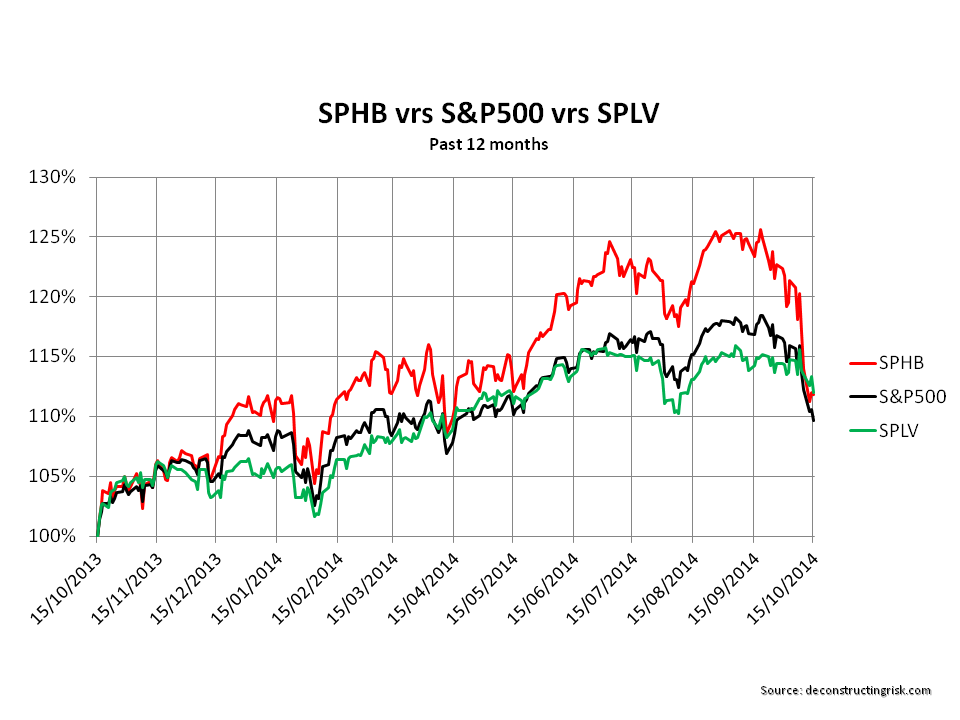
The graph below shows that the high beta stocks as measured by the Powershares high beta ETF (SPHB), as you would expect, have been hit hard here compared to the S&P500 and the low volatility ETF.

click to enlargeS&P high beta ETF

It will be interesting to see how the market develops over the coming weeks. Earnings, particularly guidance for Q4, will likely play a large part it how it plays out.

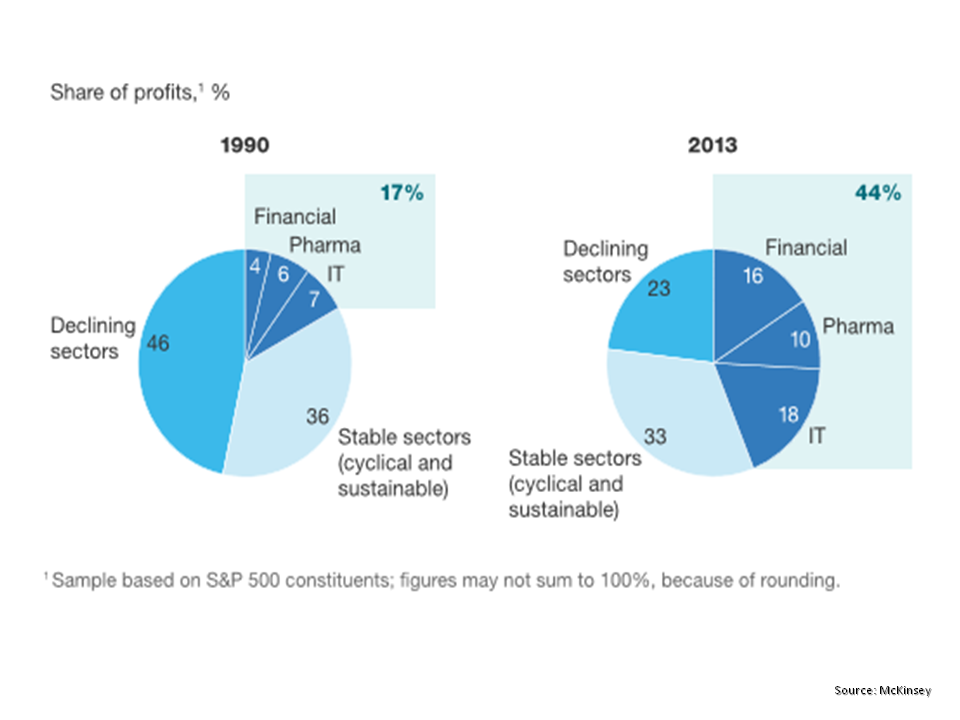
On the debate about whether historically high earnings can continue, McKinsey had an interesting article recently on the earnings and the market. The graph below from McKinsey illustrates the increased important of technology, pharma, and financials in the higher profits.

click to enlargeMckinsey Share of S&P500 profits

Spending time looking for thoughtful arguments on the impact of macro-economic, demographic and social pressure in today’s world on these sectors is a better way to understanding the medium term direction of the market. As McKinsey says “assessing the market’s current value ultimately depends on whether the profit margins are sustainable”. The rest is really just noise, best ignored or viewed from a distance.

QE effects and risks: McKinsey

McKinsey had an interesting report on the impact of QE and ultra low interest rates. There was nothing particularly earth shattering about what they said but the report has some interesting graphs and commentary on the risks of the current global monetary policies.

The main points highlighted included:

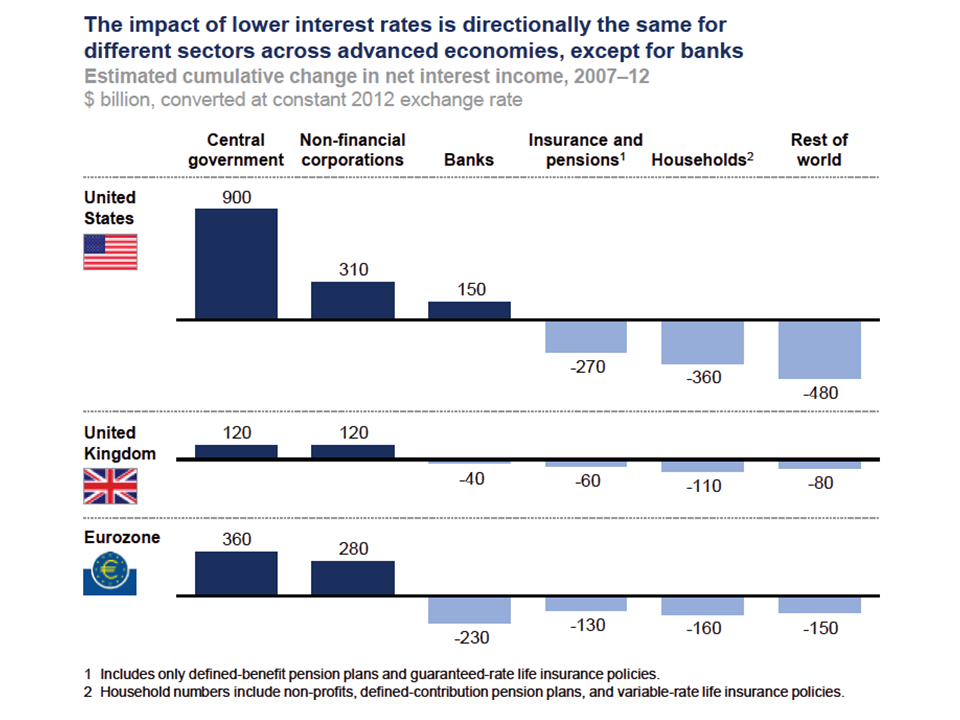
  • By the end of 2012, governments in the US, the UK, and the Eurozone had collectively benefited by $1.6 trillion (through reduced debt service costs and increased central bank profits) whilst households have lost $630 billion in net interest income (impacting those more dependent upon fixed income returns).
  • Non-financial companies across the US, the UK, and the Eurozone have benefited by $710 billion through lower debt service costs. This boosted corporate profits by about 5%, 3% and 3% for the US, UK and Eurozone respectively. The 5% US boost accounted for approx 25% of profit growth for US corporates.
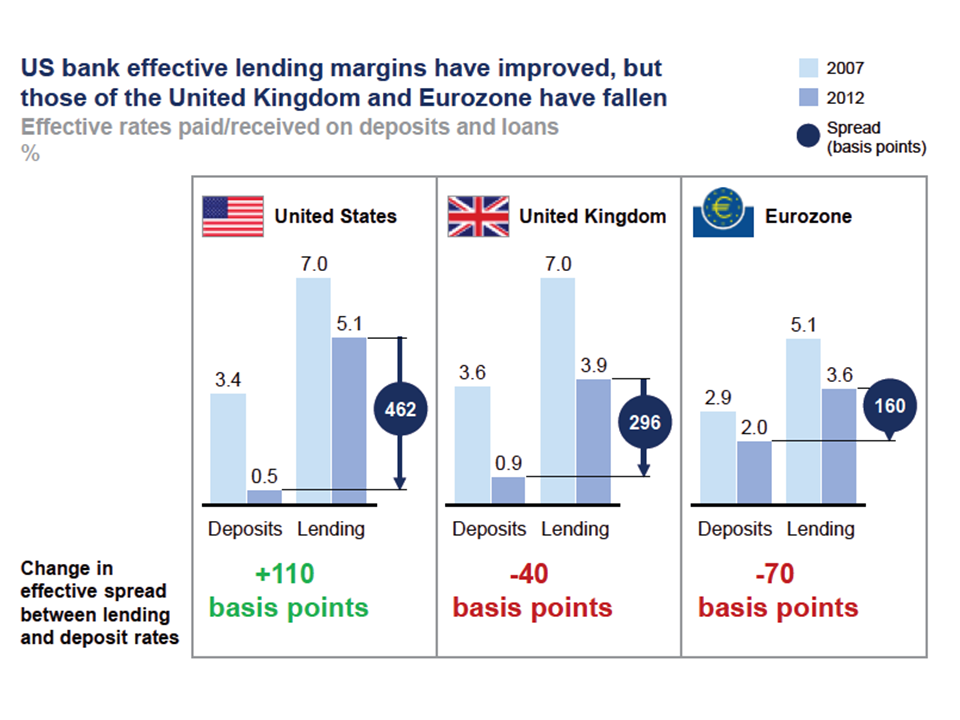
  • Effective net interest margins for Eurozone banks have declined significantly and their cumulative loss of net interest income totalled $230 billion between 2007 and 2012. Banks in the US have experienced an increase in effective net interest margins by $150 billion as interest paid on deposits and other liabilities has declined more than interest received on loans and other assets. The experience of UK banks falls between these two extremes.
  • Life insurance companies, particularly in several European countries where guaranteed returns are the norm (e.g. Germany), are being squeezed by ultra-low interest rates. If the low interest-rate environment were to continue for several more years, many insurers who offered guaranteed returns would find their survival threatened.
  • The impact of ultra-low rate monetary policies on financial asset prices is ambiguous. Bond prices rise as interest rates decline and, between 2007 and 2012, the value of sovereign and corporate bonds in the US, the UK, and the Eurozone increased by $16 trillion.
  • Little conclusive evidence that ultra-low interest rates have boosted equity markets was found.
  • At the end of 2012, house prices may have been as much as 15 percent higher in the US and the UK than they otherwise would have been without ultra-low interest rates.

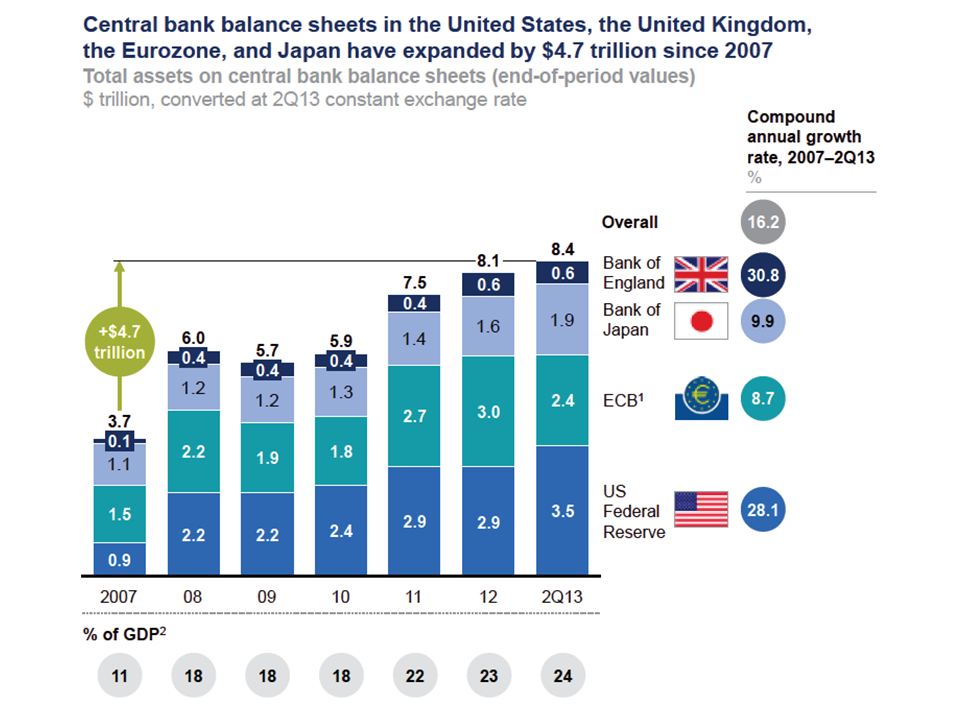
Some interesting graphs from the report are reproduced below:

click to enlargeCentral Bank Balance Sheets 2007 to Q2 2013

click to enlargeImpact of lower interest rates 2007 to 2012

 click to enlargeEffective Bank Margins 2007 to 2012

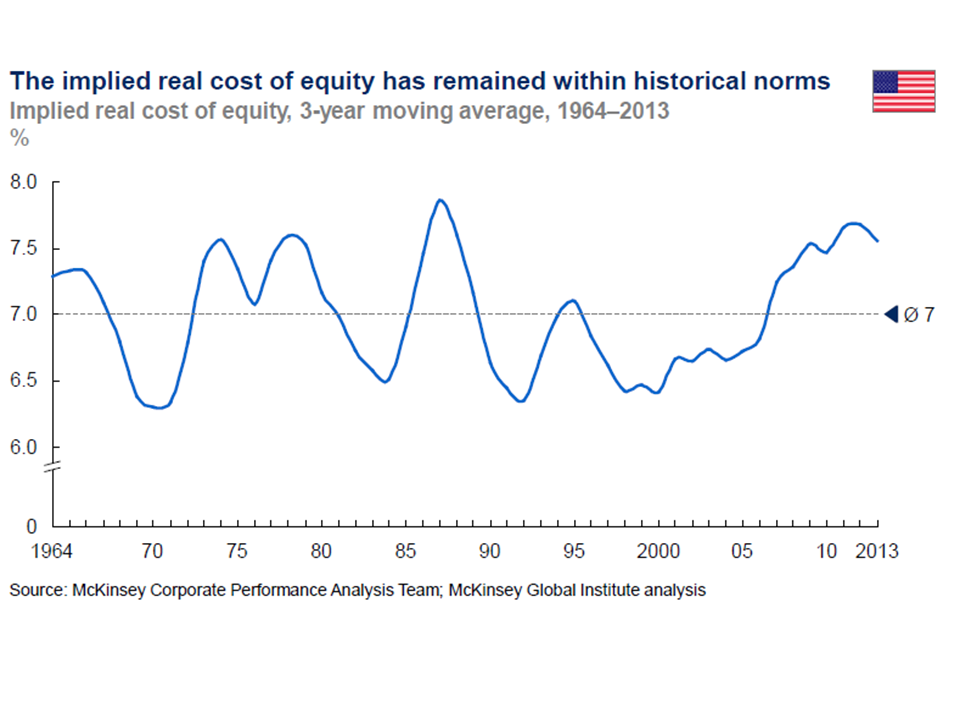
click to enlargeImplied Real Cost of Equity US 1964 to 2013

If the current low rate environment were to continue, McKinsey highlight European life insurers and banks as being under stress and believe that each will need to change their business models to survive. Defined-benefit pension schemes would be another area under continuing stress. A continuation of the search for yield for investors may lead to increased leverage (and we know how that ends!).

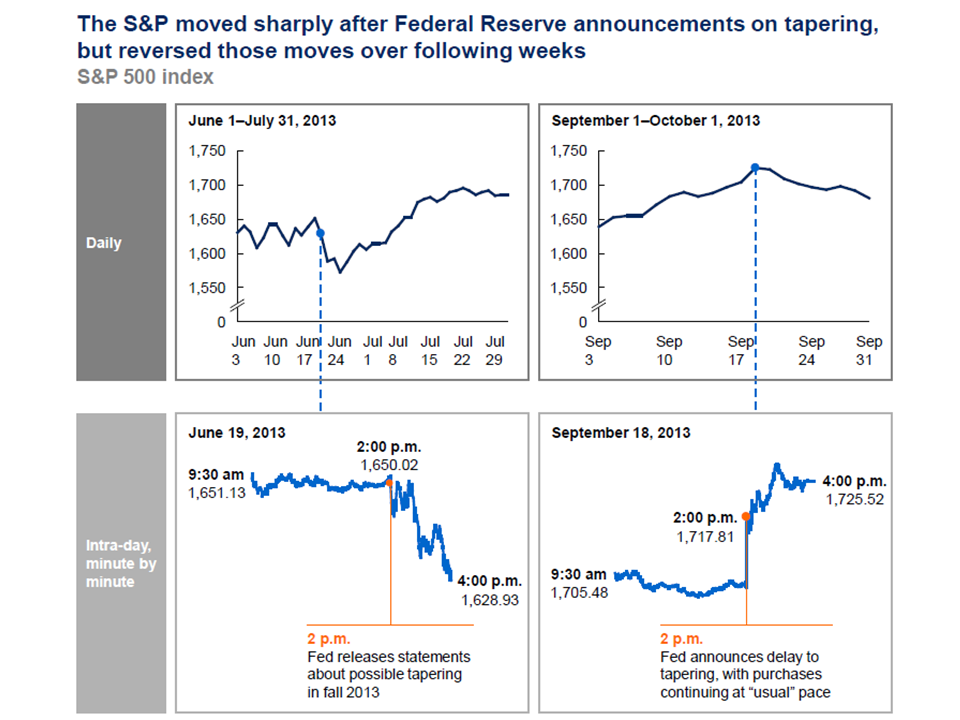
Increases in interest rate would have “important implications for different sectors in advanced economies and for the dynamics of the global capital market.” Not least, many working in investment firms and banks will never have experienced an era of increased rates in their careers to date! The first impact is likely to be an increase in volatility. Such volatility combined with market price reductions in interest sensitive assets may have an impact across the market and asset classes. McKinsey state that “a risk that volatility could prove to be a headwind for broader economic growth as households and corporations react to uncertainty by curtailing their spending on durable goods and capital investment.

click to enlargeS&P movement to tapering

The report highlight the average maturity on sovereign debt has lengthened with 5.4 years, 6.5 years, 6 years and 14.6 years for the US, Germany, Eurozone and the UK. Higher interest rates will obviously mean higher interest payments for governments. A 3% increase in US 10 year rates would mean $75 billion more in repayments or 23% higher than 2012. If, as seems likely, rates increase in the US first, the impact of capital outflows on other governments could be material, particularly in the Eurozone. A resulting Euro depreciation is highlighted (although I am not sure this would be too unwelcome currently in Europe).

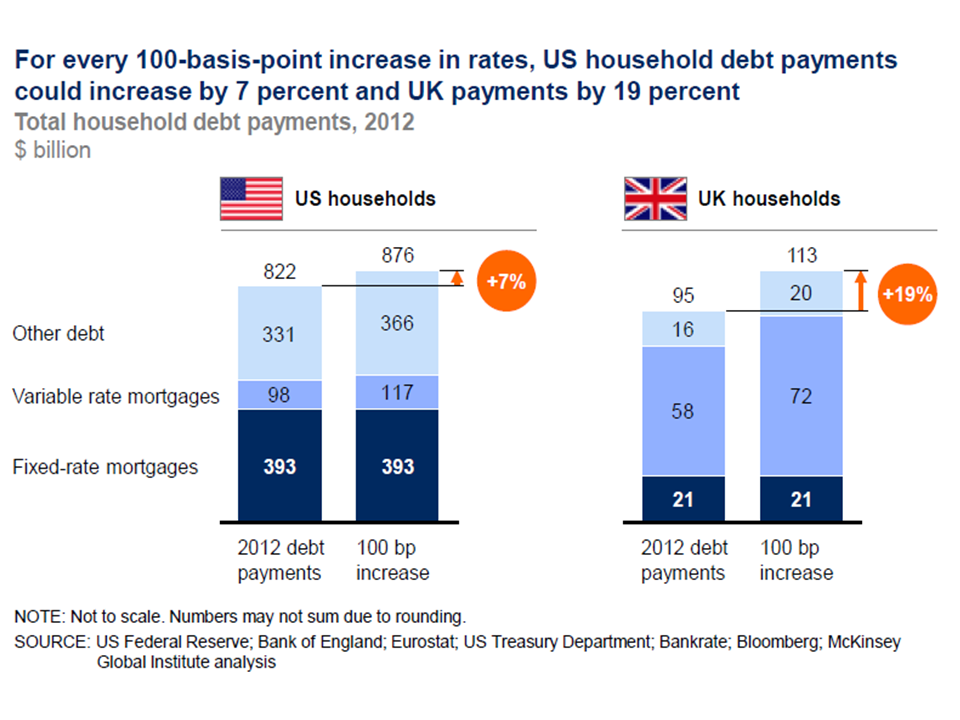
click to enlargeImpact of 1% rate increase on household income

Mark to market losses on fixed income portfolios will follow. Some, such as many non-life insurers have purposely run a short asset:liability mismatch in anticipation of rates increasing. Others such as life insurers or banks may not be in such a fortunate position. Hopefully, the impact of improved economies which is assumed to have accommodated the rise in interest rates will solve all ills.