Category Archives: Equity Market

From flowmageddon to paymageddon

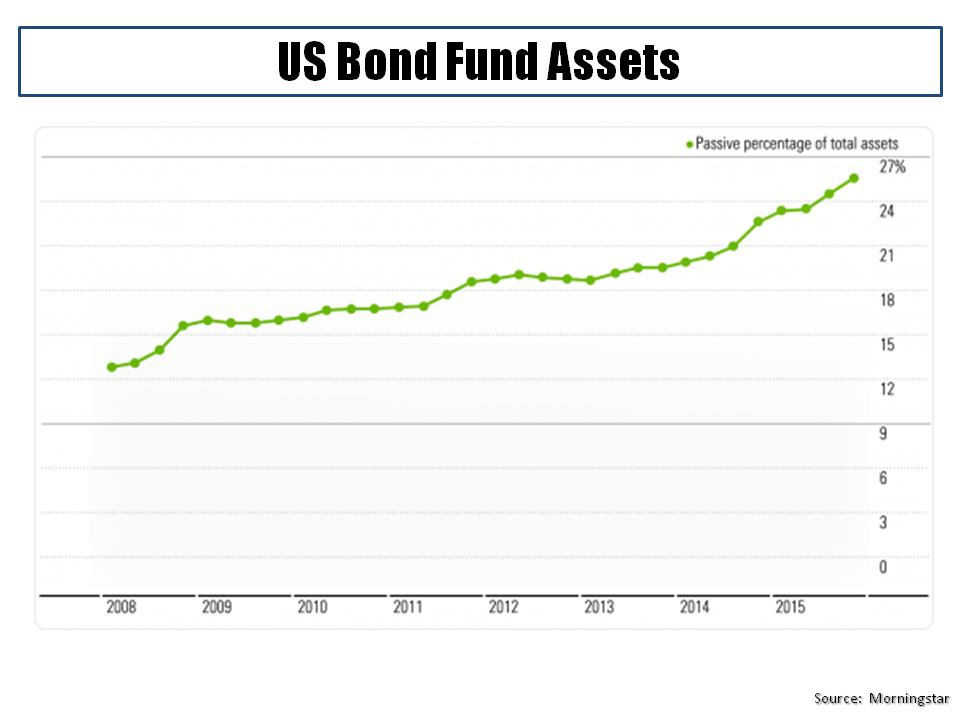
Morningstar have coined the witty term flowmageddon, in this article, for the on-going outflows that many in the active asset management sector are experiencing. In the US, passive equity funds have doubled their market share over the past decade and now make up over 40% of invested assets whilst bond fund assets have grown to over a quarter of the market, as the graph below shows.

click to enlargePassive % of US Bond Funds

The competition from passive investments such as ETFs has forced fees down for active managers. As per this FT article, Tim Guinness, chief investment officer of Guinness Global Money Managers Fund commented that “the days of great prosperity for active fund management may be behind us”. In other words, flowmageddon is leading to paymageddon!

According to this recent Economist article, the future for many active asset managers does not look too bright given the costs of increased regulation, such as the new fiduciary rules from the Department of Labour in the US, and the increased ability of technology to replicate complex investment strategies without the need for a load of vastly overpaid investment managers . Given that the majority of active managers consistently fail to beat their benchmarks after fees, the on-going shakeup is no bad thing.

The bowels of the system and helicopters

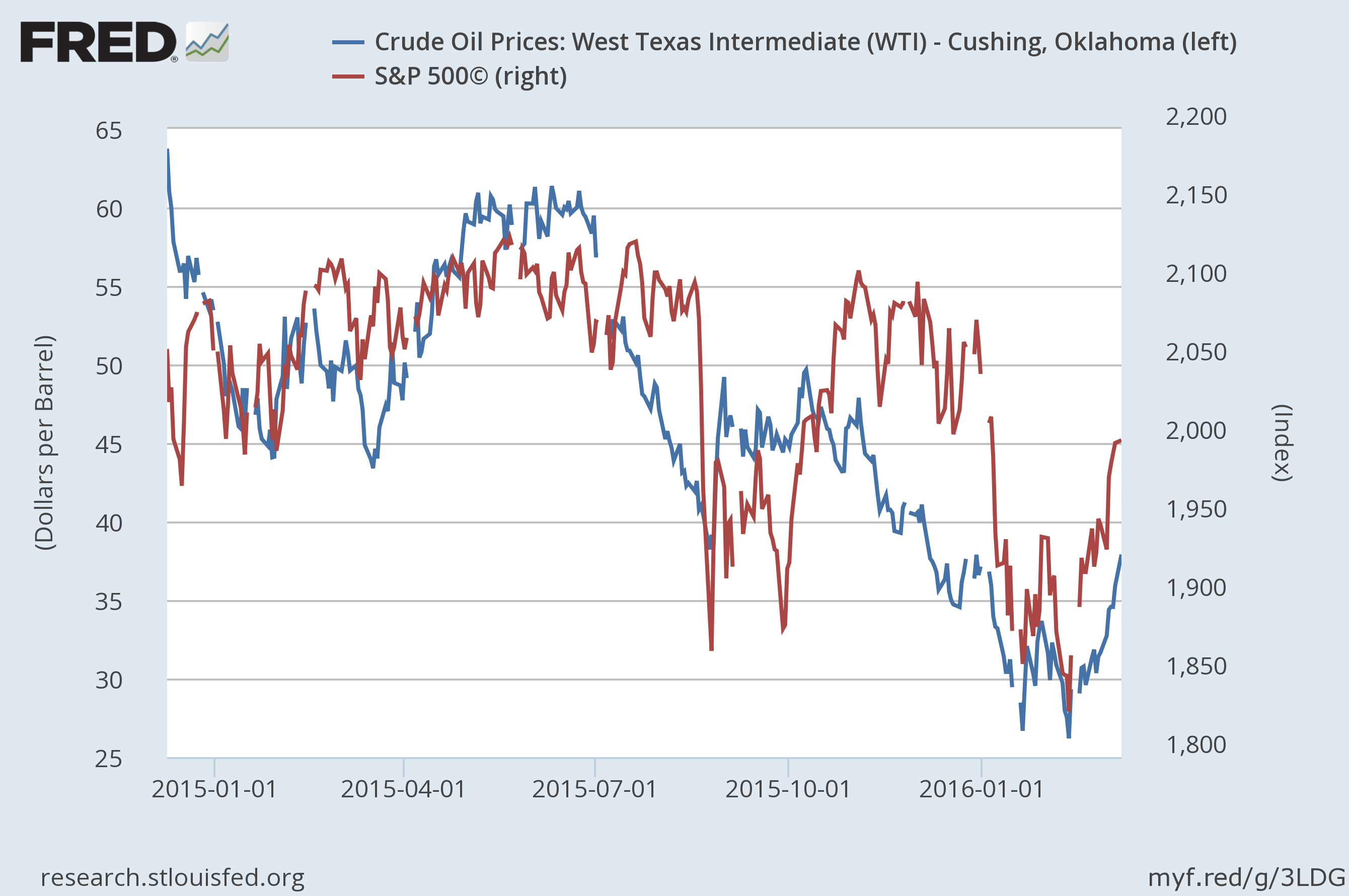
The market volatility in 2016 did seem odd in certain respects. Valuations were too high and a correction was needed. No doubt. It’s more the way the selling seemed to be indiscriminate at certain points with oil and equity prices locked in step. Some argue that China selling reserves to support their currency or oil producing countries selling assets to make up for short falls in oil revenue may be behind some of the erratic behaviour. Buttonwood had an interesting piece over the past weeks on how consequences from new bank regulations are impacting market liquidity with unusual activity in derivative pricing such as negative swap rates and relative CDS rates.

Gilian Tett, in a FT article in January, pointed to the example of capital outflows from China. Whether repaying US debt (or as Tett succinctly calls it, a quasi carry trade in reverse) in face of likely further yuan weakness or withdrawals from overzealous M&A (about a quarter of China outbound deals are said to be in trouble) or other reasons behind the veil of the Chinese economy, the outflows are having impacts. Tett said:

“Capital flows, fuelled by politics and policy change, are where the important action is taking place. Deep in the bowels of the system all manner of financial flows are switching course, creating unexpected knock-on effects for many asset prices. Capital flight from China is one example. The energy sector is another.”

The strangle lockstep between oil and the S&P500 can be seen below.

click to enlargeoil and sp500

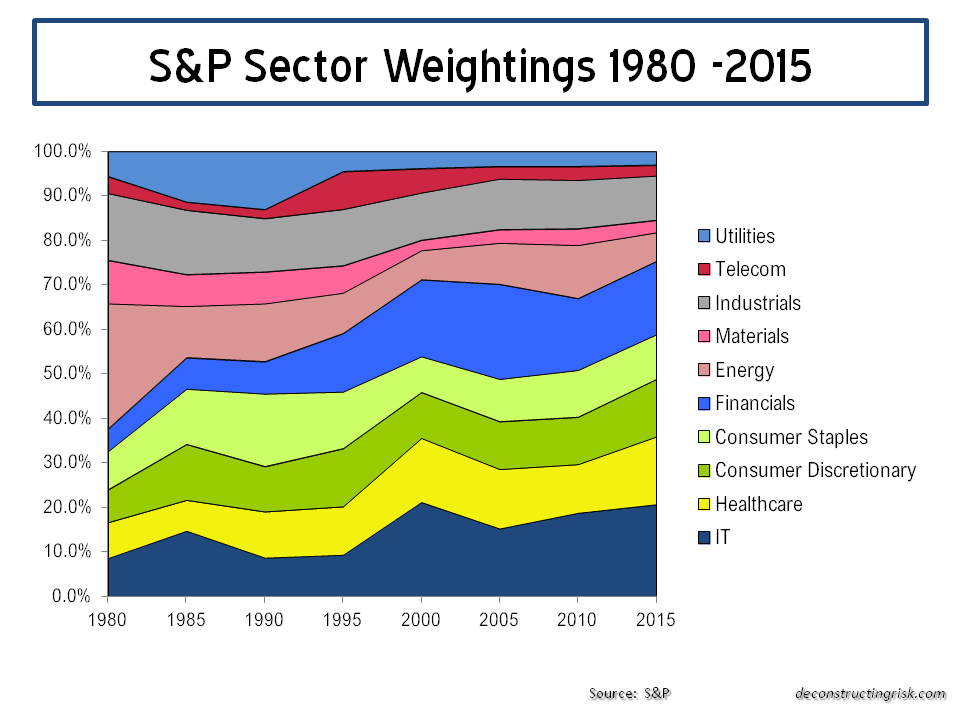
Energy has only a small impact on the S&P500 makeup, as can be seen below, and on the operating profit profile.

click to enlargeS&P Sector Weightings 1980 to 2015

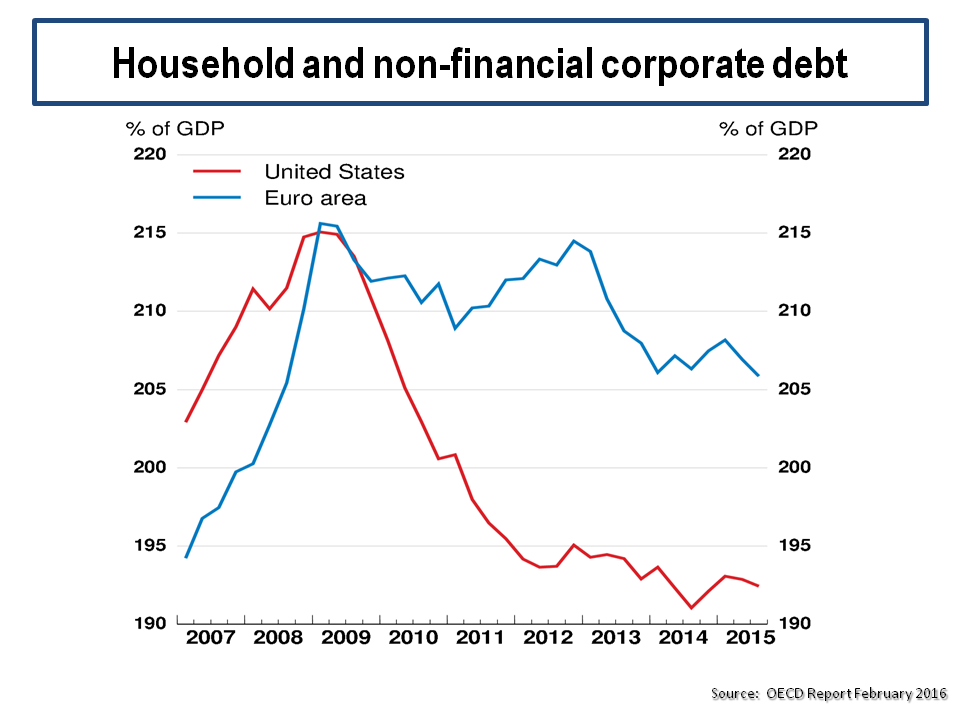
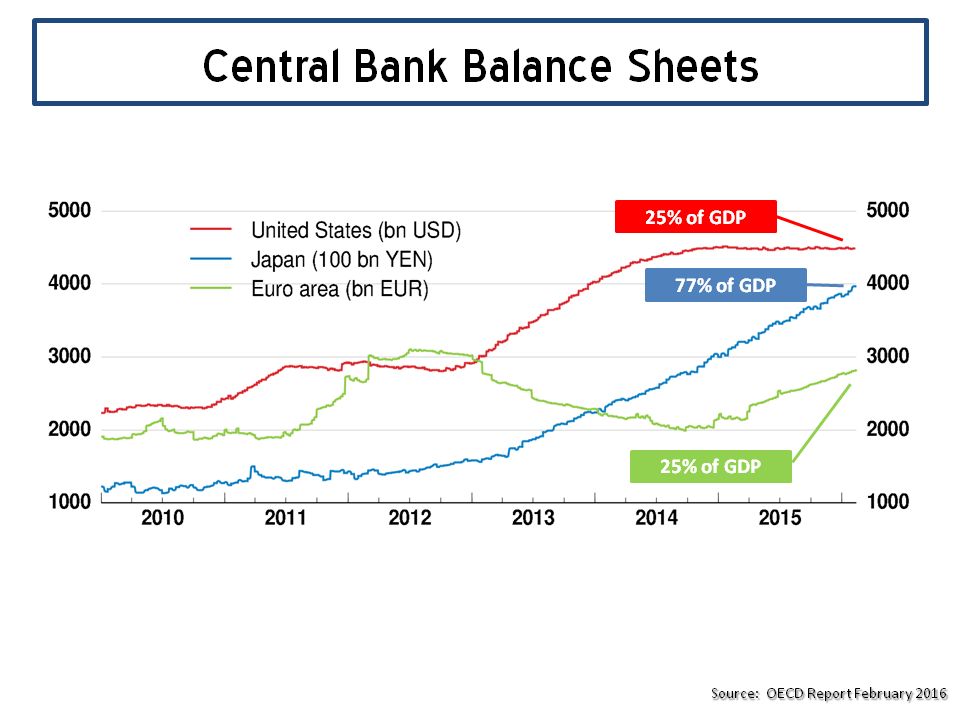
The OECD interim economic outlook by Catherine Mann on 18th February recommended “maintaining accommodative monetary policy, supportive fiscal policies on investment led spending and more ambition on structural policies which raise global growth and reduce financial risks”. Ah, yes the old structural reform answer to all of our ills. The OECD gave some graphic reminders of where we are, as below.

click to enlargeUS & Euro Household & Nonfinancial Corporate Debt 2015

click to enlargeCentral Bank Balance Sheets 2015

Central Bank policies remain stuck to QE and increasingly exotic forms of monetary policy despite the obvious failure so far for QE to kick-start either inflation or growth. The latest experiment is on negative interest rate which has had funny impacts on banks and the lending rates they need to charge. Japan in particular has shown how their brand of negative rates was countered by a currency whiplash. Mark Carney, the Governor of the Bank of England, offered the view that “for monetary easing to work at a global level if cannot rely on simply moving scarce demand from one country to another.

A recent BIS article on negative interest rates in Switzerland, Europe and Japan stated that “there is great uncertainty about the behaviour of individuals and institutions if rates were to decline further into negative territory or remain negative for a prolonged period. It is unknown whether the transmission mechanisms will continue to operate as in the past and not be subject to tipping points“.

This week Mario Draghi came up with a new twist on negative interest rates, relying on targeted long-term refinancing operations (TLTROs) to give banks effectively free money. The currency impact will be interesting, particularly to see if the Japanese whiplash will repeat. One of the results of all this QE is that central banks are a much larger player in the system and have basically taken over the government bond markets in Europe, Japan, and America. The ECB even buys low-rated bonds, not just the AA and AAA positions taken by the Fed, and makes billions of euros in low-interest-rate loans to banks.

No less that Adair Turner, Martin Wolf and Ray Dalio have all made favourable comments about another evolution in QE, so called helicopter money (named after Milton Friedman).  Wolf argues that central banks should enter the arena of public investment in the face of inaction by fiscal authorities (by which I assume he means elected politicians). He passionately says “policymakers must prepare for a new “new normal” in which policy becomes more uncomfortable, more unconventional, or both.” Turner believes that targeted stimulus of nominal demand poses “less risk to future financial stability than the unconventional monetary policies currently being deployed“.

The recent anxiety by electorates across the developed world in expressing a desire for the certainty of the past, whether it be the popularity of Donald Trump, anti-immigrant rhetoric in Europe or the arguments in the UK to leave the EC, show that ordinary people are worried about the future and no end of short term monetary stimulus is likely to change that. Helicopter money sounds like a medicated solution to the symptoms of low growth rather than any real answer to the problem of slowing growth, Chinese and Japanese unsustainable debt loads and global productivity challenges due to aging populations.

Maybe it’s just me, and I do respect the views of Wolf, Turner and Dalio, but it looks to me a measure that is open to so much moral hazard as bordering on the surreal. It gives Central Banks more power in the markets and that could be dangerous without more thought on the unintended consequences. If we are moving piecemeal towards a Chicago Plan or some other alternate economic model, then somebody should get the public on board. I think they are desperately looking for new answers to the way we run our economies.

Apple below $100

In a market like this one, it’s impossible to tell what is going to happen next. The smell of fear has been in the air with greed cowered by uncertainty. Greed may push back soon with earnings, and particularly guidance, dictating the short term path whilst oil and China, amongst other macro factors, will continue to dominate the overall direction.

Overall I remain cautious on equities with a downward bias. I am sticking to my conviction stocks whilst keeping cash on the sidelines until I find a blatant bargain or two. Notwithstanding that stance, it’s always good to look at your positions and see if some risk management re-weighting is called for. And that’s the reason for a quick look over Apple before its earnings next Tuesday.

Apple is in a hapless position currently and likely has to blow away the December quarter estimates (on the number of iPhones sold, the average price, and the gross margin received) PLUS give a strong March quarter guidance to move up in a meaningful way. Given that a repeat of the outstanding results of last December’s quarter (see post here) compared to current expectations is improbable, I would suggest Apple could trade around or below $100 for a while yet. Analysts, whilst screaming about its valuation, have become increasing negative on the December quarter and guidance for their Q2 quarter. Apple may struggle to come in much above the top end of its guidance of 77.5 million iPhones (it has come in above guidance for 5 consecutive quarters albeit at a steadily reducing level above the top estimate).

The geographic split of revenue, as per the graph below, will also be closely watched to see if China’s economy is impacting Asian growth.

click to enlargeAAPL Revenue by region Q42015

Despite its best efforts, Apple remains primarily a phone company with last year’s iPhone revenues making up two-thirds of the total, as per the graph below (with my estimates for Q1).

click to enlargeAAPL Revenue by product Q42015

I played with some estimates to stress the view on an AAPL valuation below $100. Taking a jaundice view of adjusting average analyst non-GAAP estimates for 2016 and 2017 plus some pessimistic estimates of my own on 2016 and 2017 (with iPhone slowing to sales of 220 million and 200 million compared to around 230 million for 2015), I estimated the forward PEs, excluding net cash (currently around $150 billion), as per the graph below (based upon diluted GAAP EPS, not the adjusted EPS analysts love) using tonight’s close of $96.30. The multiples are quarterly point estimates using the share price one month after the quarter’s end.

click to enlargeAAPL Forward 12 Month PE Ratios Q4 2015

The graph above clearly shows the swings in sentiment on Apple over recent years as the market grapples with the future demand for the iPhone after each upgrade cycle. Tuesday will indicate whether the current concerns about iPhone sales and margins peaking are justified. Other concerns, such as a possible $8 billion tax bill from the EU, pale in comparison to those iPhone concerns. Notwithstanding these real concerns, forward multiples of below 8 look too low to me given Apple’s operating record (unless you buy into the Apple could be the next Nokia thesis which I don’t).

By way of a comparison, my estimate for a similar graph for Google is below (again using diluted GAAP EPS). Google will be another stock where earnings for Q4 will be very interesting as they split out their figures in line with the new Alphabet structure and (maybe) demonstrate again their new emphasis on cost control. Expectations look high based upon its current valuation.

click to enlargeGoogle Forward 12 Month PE Ratios Q4 2015

The comparison does reflect positively on Apple’s current valuation multiple and I’m happy to hold the AAPL position I have. A key outcome from the AAPL earnings call will be if Cook can provide sufficient catalysts for Apple’s value to trade significantly above $100.

As always, time will tell.


Follow-0n Evening 26th after earnings: Over the next few days and weeks, I’m sure the chatter about Apple and the iPhone will likely get over-bearing. The delicately posed share price of $99.99 before earnings will come under pressure. Q1 revenues were at the lower range of expectations and Q2 guidance at $50-$53 billion is weaker than expected. China revenues showed slowing growth. On the positive side, the average revenue per iPhone in Q1 was higher than expected and operating margins were strong. I revised down my estimates for AAPL’s 2016 and 2017 diluted EPS (to $9.15 and $8.60) and iPhone sales to 210 million and 190 million. The revised revenue splits and forward PE multiples (at share price of $99.99) are shown below. Thesis, as per post above, on AAPL’s valuation remains basically unchanged although the share price see some selling pressure in the short term.

click to enlargeAAPL Revenue by region Q12016

click to enlargeAAPL Revenue by product Q12016

click to enlargeAAPL Forward 12 Month PE Ratios Q1 2016.png

So….2016

As the first week of January progressed and markets tumbled, I was thinking about this post and couldn’t get away from the thought that 2016 feels very like 2015. The issues that were prominent in 2015 are those that will be so again in 2016 plus a few new ones. The UK vote on the EU and a US presidential race are just two new issues to go with China economic and political uncertainty, Middle East turmoil, Russian trouble making, a political crisis in Brazil, the insidious spread of terrorism, a move towards political extremes in developed countries and the on-going fault lines in Europe and the Euro. All of these macro factors together with earnings and the impact of rising interest rates are going to dominate 2016.

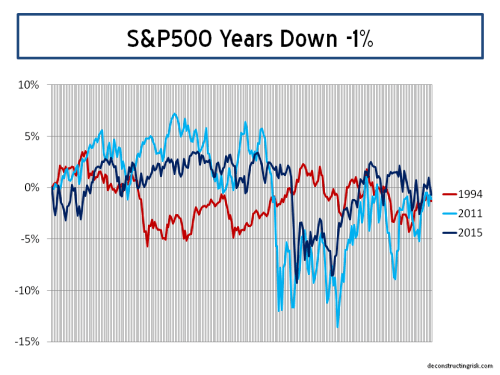
2015 joins two other years, 2011 and 1994, in being a -1% year for the S&P500 in recent times, as the graph below shows. In fact, the movements of the S&P500 in 2015 show remarkable similarity with 2011. However, there the similarities end. 2011 was the year of the Euro crisis, the Arab spring and the Japan quake. Interest rates were falling, earnings stable, and PE multiples were around 15. 1994 was even more different than 2015. In 1994, the economy was taking off and the Fed was aggressively raising rates, earnings were stable and PE multiples fell to around 15. Interesting the next 5 years after 1994 on the stock market were each 20%+ years! With 2015 around a 20 PE and earnings falling, the comparisons are not favourable and may even suggest we got off lightly with just a -1% fall.

click to enlargeS&P500 Years Down -1%
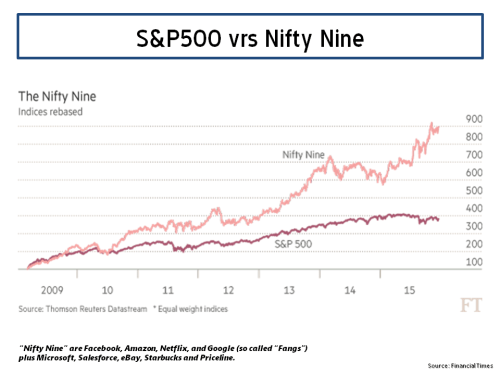
A recent article in the FT does point to the influence of a limited number of stocks on the 2015 performance with the top 10 stocks in the S&P500 up 14% in 2015 and the remaining 490 stocks down 5.8% collectively. The performance of the so-called nifty nine is shown below. The article highlights that “dominance by a few big companies – or a “narrowing” market – is a symptom of the end of a bull run, as it was in the early 1970s (dominated by the “Nifty Fifty”) or the late 1990s (dominated by the dot-coms).”

click to enlargeS&P500 vrs Nifty Nine
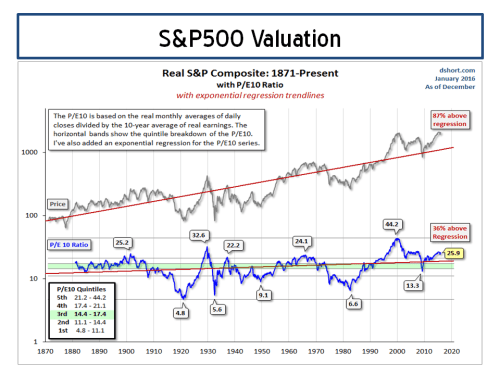
Bears have long questioned valuations. The impact of continuing falls in oil prices on energy earnings and a fall off in operating margins are signalling a renewed focus on valuations, as the events of this past week dramatically illustrate. A graph of the PE10 (aka Shiller CAPE) as at year end from the ever insightful Doug Short shows one measure of overvaluation (after this week’s fall the overvaluation on a PE10 basis is approx 30%).

click to enlargeS&P500 Valuation PE10 Doug Short
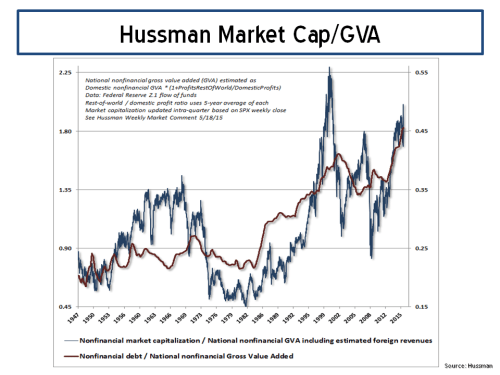
One of the longstanding bears, John Hussman, had an article out this week called “The Next Big Short”, in honour of the movie on the last big short. Hussman again cites his favourite metrics of the ratio of nonfinancial market capitalization to corporate gross value added (GVA) and the ratio of nonfinancial corporate debt to corporate GVA (right scale) as proof that “the financial markets are presently at a speculative extreme”.

click to enlargeHussman Market Cap to GVA
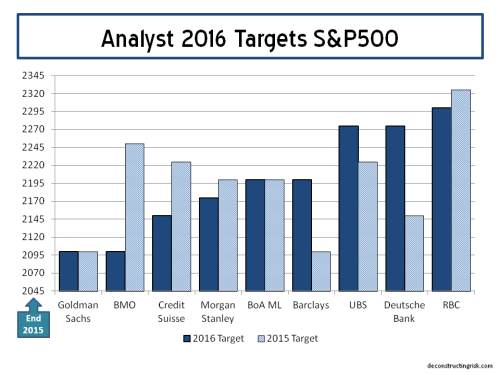
Many commentators are predicting a flat year for 2016 with some highlighting the likelihood of a meaningful correction. Whether the first week in January is the beginning of such a correction or just a blip along the path of a continually nervous market has yet to be seen. Analysts and their predictions for 2016 have been predictably un-inspiring as the graph below shows (particularly when compared to their 2015 targets).

click to enlarge2016 S&P500 Analyst Targets
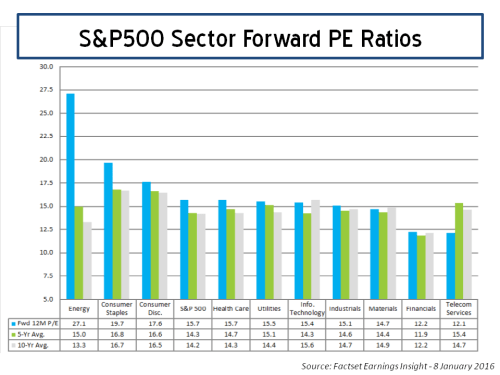
Some, such as Goldman Sachs, have already started to reduce their EPS estimates, particularly for energy stocks given the increasingly negative opinions on oil prices through 2016. The 12 month forward PEs by sector, according to Factset Earning Insight dated the 8th of January as reproduced below, show the different multiples explicit in current estimates with the overall S&P500 at 15.7.

click to enlargeS&P500 Sector Forward PE Factset 08012016
Current earnings estimates for 2016 as per the latest Yardeni report (EPS growth graph is reproduced below), look to me to be too optimistic compared to the trends in 2015 and given the overall global economic outlook. Future downward revisions will further challenge multiples, particularly for sectors where earnings margins are stagnating or even decreasing.

click to enlargeS&P500 Earnings Growth 2016 Yardeni
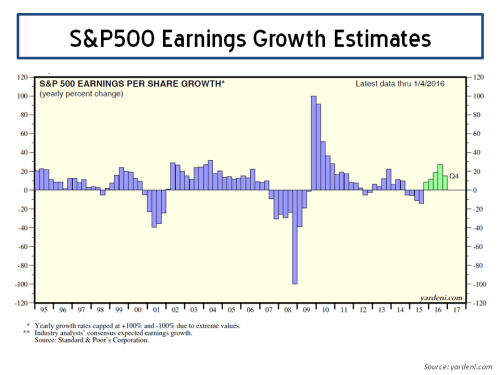
To further illustrate the experts’ views on EPS estimates, using S&P data this time, I looked at the evolution in actual operating EPS figures and the 2015 and 2016 estimates by sector, as per the graph below.

click to enlargeS&P500 Operating EPS by sector
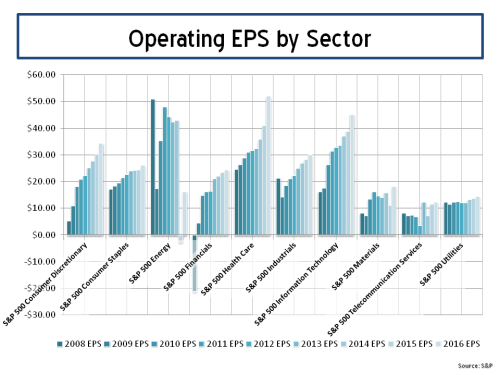
With US interest rates rising (albeit only marginally off generational lows), the dollar will likely continue its strength and higher borrowing costs will influence the environment for corporate profits. Pent up labour costs as slack in the US economy reduces may also start to impact corporate profits. In this context, the EPS estimates above look aggressive to me (whilst accepting that I do not have detailed knowledge on the reasoning behind the EPS increases in individual sectors such as health care or materials), particularly when global macro issues such as China are added into the mix.

So, as I stated at the start of this post, the outlook for 2016 is looking much like 2015. And perhaps even a tad worse.

The Next Wave

As part of my summer reading, I finished Paul Mason’s book “PostCapitalism: A Guide To Our Future” and although it’s an engaging read with many thoughtful insights, the concluding chapters on the future and policy implications were disappointing.

Mason points to many of the same issues as Martin Wolf did in his book (see post) as reasons for our current situation, namely the inherent instability in allowing private profit seeking banks to create fiat money, ineffective regulation (and the impossibility of effective regulation), increased financialization, global flow imbalances, aging populations, climate change and the disruptive impact of new information technologies. This 2005 paper from Gretta Krippner on the financialization of the US economy and reports from S&P (here and here) on the policy implementations of aging demographics are interesting sources cited in the book.

It is on the impact of the information technology and networks that Mason has the most interesting things to say. Mason uses Nikolai Kondratieff’s long wave theory on structural cycles of 50-60 years to frame the information technological age as the 5th wave. The graphic below tries to summarise one view of Kondratieff waves (and there are so many variations!) as per the book.

click to enlargeHistory Rhyming in Kondratieff Waves

The existence of such historical cycles are dismissed by many economists and historians, although this 2010 paper concludes there is a statistical justification in GDP data for the existence of such waves.

Mason shows his left wing disposition in arguing that a little known theory from Karl Marx’s 1858 notebook called the Fragment on Machines gives an insight into the future. The driving force of production is knowledge, Marx theorises, which is social and therefore the future system will have to develop the intellectual power of the worker, enhancing what Marx referred to as the general intellect. Mason contends that the intelligent network we are seeing unfold today fits into Marx’s theory as a proxy for the general intellect.

Mason also promotes the labour theory of value, as espoused by Marx and others, where automation is predicted to reduce the necessary labour in production and make work optional for many in a post-capitalist world. To highlight the relevance of this possibility, a 2013 study asserted that 47% of existing jobs in the US would be replaced by automation. References to Alexander Bogdanov’s sci-fi novel Red Star in 1909 may push the socialist utopia concept driven by the information age too far although Mason does give realistically harsh assessments of Soviet communism and other such misguided socialist experiments.

The network effect was first discussed by Theodore Vail of Bell Telephone 100 years ago with Robert Metcalfe, the inventor of the Ethernet switch, claiming in 1980 that a network’s value is the number of users squared. Mason argues that the intelligent network, whereby every person and thing (through the internet of things) is wired to the network, could even reduce the marginal cost of energy and physical goods in the same way the internet has for digital products. Many of these ideas are also present in Jeremy Rifken’s 2014 book “Zero Marginal Cost Society”. Mason further argues that the network makes it possible to organise production in a decentralized and collaborative way, utilizing neither the market nor management hierarchy, and that info-capitalism has created a new agent of change in history: the educated and connected person.

The weakest part of the book are the final chapters on possible policy responses which Mason calls Project Zero with the following aims: a zero carbon energy system, the production of products and services with near zero marginal costs, and the goal of pushing the necessary labour time close to zero for workers. Mason proposes a trial and error process using agent based modelling to be adopted by policy makers to test post-capitalism concepts. He refers to a Wiki-State, a state that acts like the business model of Wikipedia nurturing new economic forms without burdensome bureaucracies. Such a state should promote collaborative business models, suppress or socialize info-monopolies, end fractional banking (as per the Chicago Plan), and follow policies such as a minimum basic wage for all to accommodate the move to new ways of working. All very laudable but a bit too Red Star-ish for me!

Nonetheless, Mason’s book has some interesting arguments that make his book worth the read.


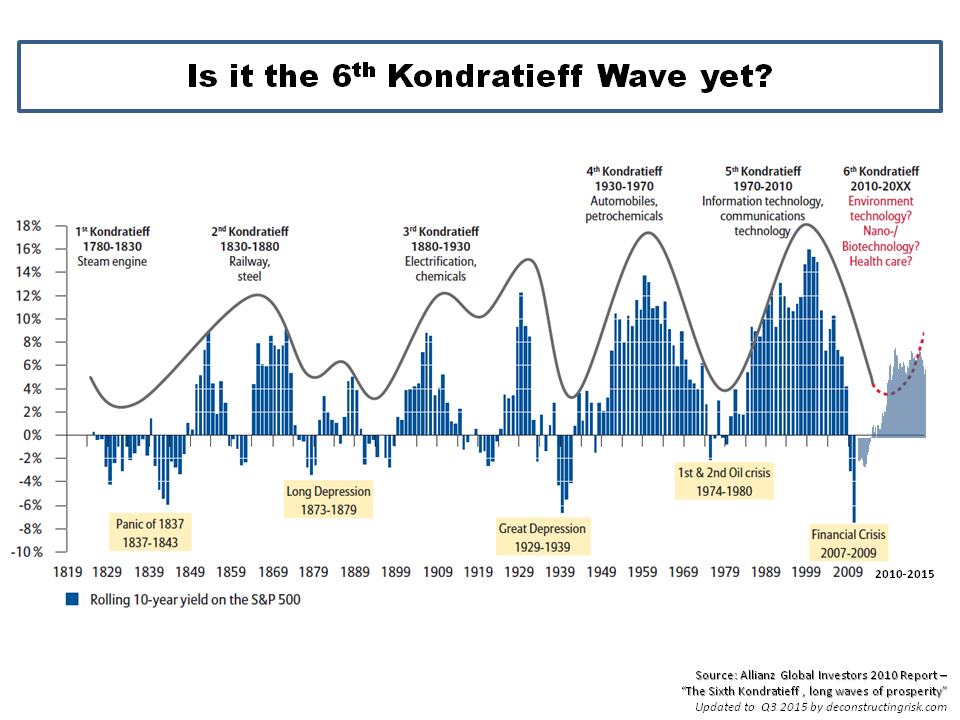
An aside – As highlighted above, there are many variations on the Kondratieff long wave out there. An interesting one is that included in a 2010 Allianz report which, using the 10 year average yield on the S&P500 as the determinant, asserts that we are actually entering the 6th Kondratieff wave (I have updated it to Q3 2015)!

click to enlarge6th Kondratieff Wave

Looking through some of the mountain of theories on long waves reminds me of a 2004 quote from Benoit Mandelbrot that “Human nature yearns to see order and hierarchy in the world. It will invent it if it cannot find it.