Category Archives: Gambling Sector

More musings on the online gambling sector

A previous post on Paddy Power, William Hill and Ladbrokes showed how online sportsbook and gaming revenue are becoming an important part of the revenues of these firms. Another recent post on Betfair showed a similar import. This post will focus on the online gaming (which is a gentlier word used in the sector for what is more aptly described as online gambling) part of the equation.

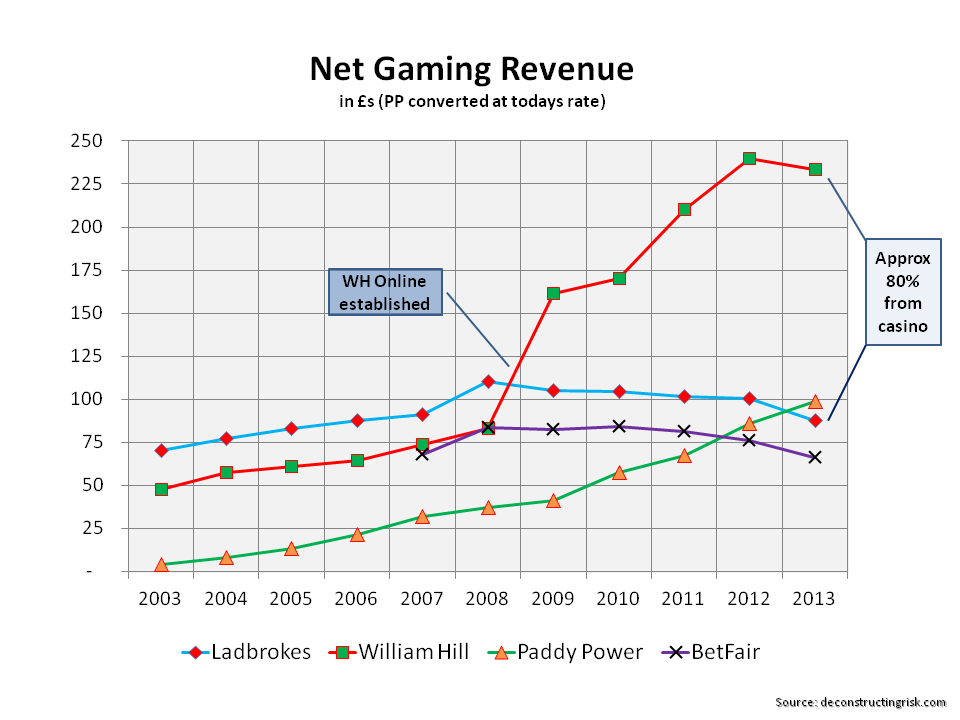
As a recap, the graph below shows the online gaming revenues from Paddy Power, William Hill, Ladbrokes and Betfair (with PP converted to sterling at today’s rate) which make up 17%, 16%, 8% and 17% of their 2013 revenues respectively. Ladbrokes has approximately half the amount of its competitors. The considerable growth in William Hill’s online gaming (mainly casino) revenue after the creation of WH Online (WHO) in 2008 can clearly be seen. H2 Gambling Capital are forecasting an approximate 9% annual growth in online gaming gross win figures over the next few years

click to enlargeNet Gaming Revenue
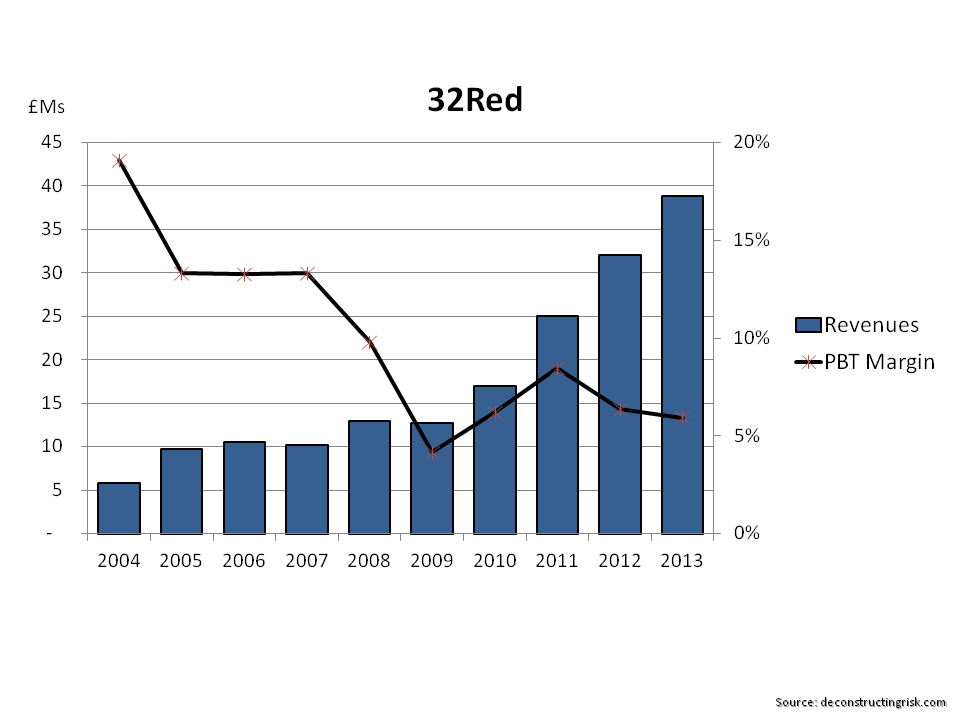
None of the firms above split out their operating margins for the online gaming sectors. As casino is the dominant source of revenue for many of the firms, it is interesting to look at a diminutive online casino firm called 32Red, as per the graph below. Although 32Red is relatively small, the reduction in its margin to an average of 6% suggests that competition has pushed margins down in this business.

click to enlarge32Red Operating Metrics
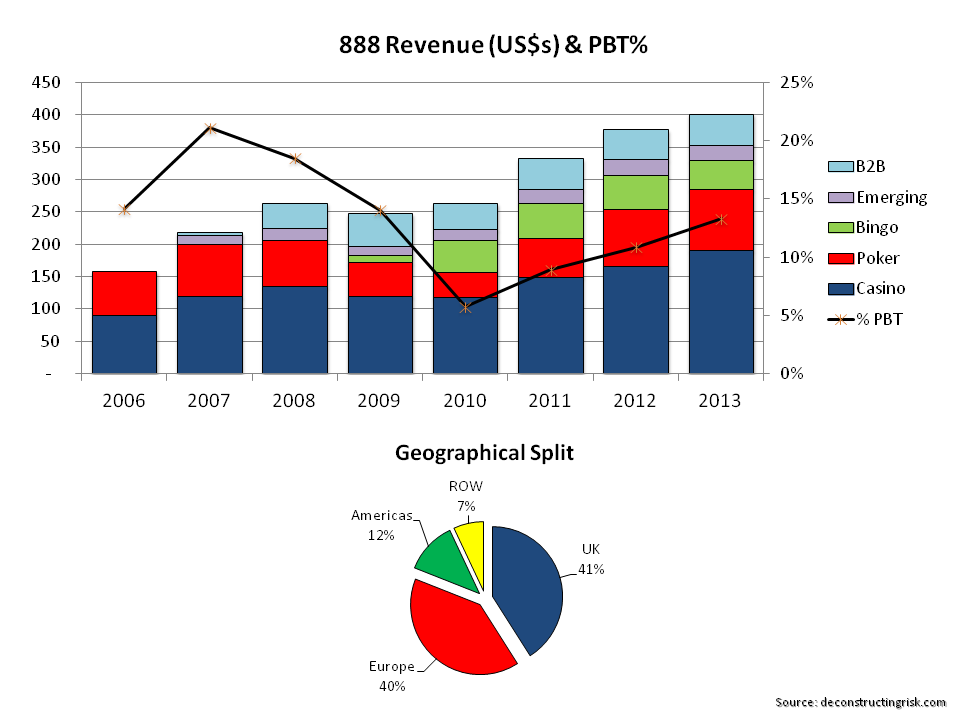
Another two public firms that have a majority of their business in online gaming are 888 and BWIN. 888 is a well established player, particularly in the online casino market, with 40% of revenues in the UK and 40% in the rest of Europe in 2013, and it has been rebuilding its profit margins in recent years. 888’s operating metrics are summarized in the graph below.

click to enlarge888 Operating Metrics
BWIN, following its merger with PartyGaming in 2011, has a higher revenue base across Europe (excluding UK) making up approx 70% of 2013 revenues (25% from Germany) with only 10% from the UK. After some poor results and pressure from shareholders, BWIN is currently cutting its expense base by €30 million or approx 5.5% and is looked at ways it “can increase shareholder value”. BWIN’s operating metrics are summarized in the graph below.

click to enlargeBWIN Operating Metrics

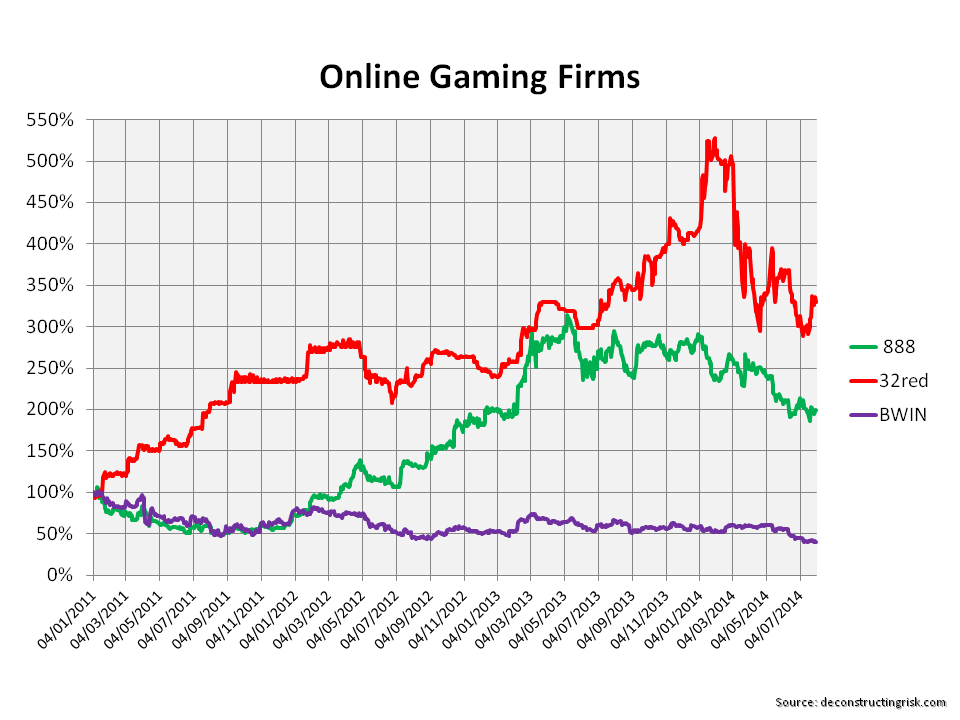
The share performance of these firms has been distinctly mixed in recent years with little old 32Red blowing the others away, as per the graph below. BWIN has clearly underperformed and may likely be broken up. Analysts have speculated that a number of potential bidders, including William Hill and Paddy Power, are looking at various BWIN assets. Janus Capital Management has being building its stake in BWIN over recent months to 11% as at mid-July.

click to enlargeShare price since 2011 888 BWIN 32Red
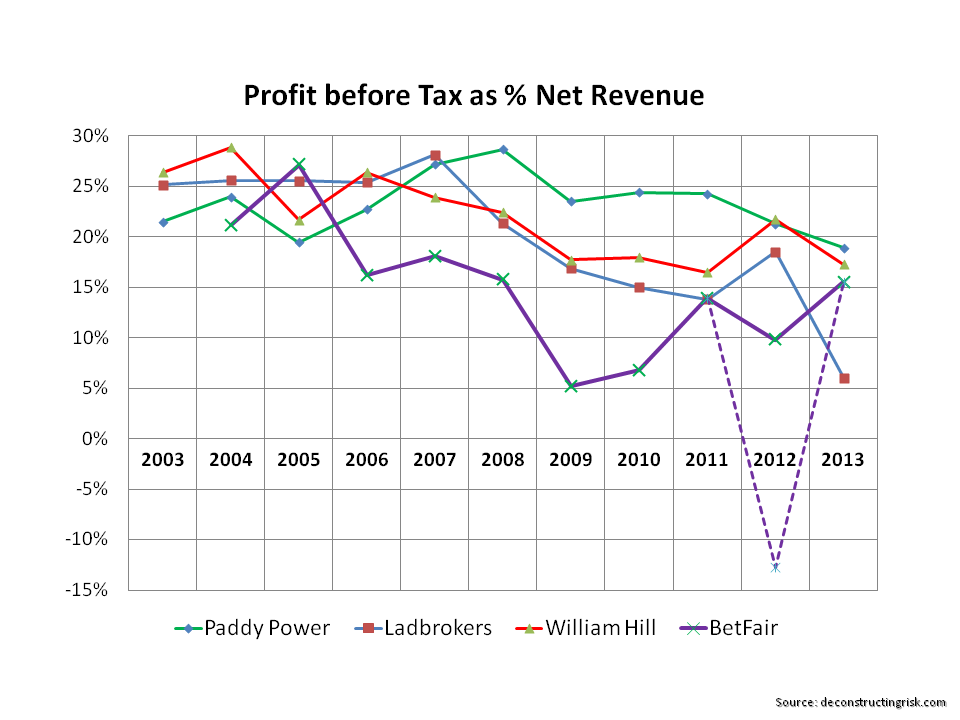
Comparing the mainly online gaming firms with their more established betting firms in terms of the PBT margin shows the trend for both is downwards, as per the graph below. Headwinds include increased regulation and taxes such as the proposed UK POC tax. Opportunities include the explosion in mobile gambling, the slow re-opening of the US market (although I am sure established US bricks and mortar gambling firms will fight hard for their turf), new product development such as social gaming and the expected market consolidation. Amaya’s recent purchase of PokerStars has focussed minds on what will be needed to succeed in the US.

click to enlarge2003 to 2013 PBT Margin Betting & Online Gaming Firms

One of the more colourful firms in the sector, Playtech, has some interesting things to say about where the future is leading. On increased regulation, Playtech say that “the regulation of online gambling can be a catalyst for market growth, depending on how regulation is introduced, what product verticals the regulator allows and the tax rate applied” and that ”opportunities exist as markets move from a ‘dot.com’ to a ‘dot.national’ regime, although some uncertainties through the transition period are expected”.

Specifically on the UK, Playtech commented that “many smaller operators are understood to generate operating margins lower than the expected tax rate of 15% and in the view of industry experts, will struggle to compete. Larger operators can rely on economies of scale and their leading brands to remain competitive. Analysts expect that in 2015 the UK market will undergo significant change led by consolidation, as those operators with the strongest brands, best technology and means to invest in marketing will prevail”.

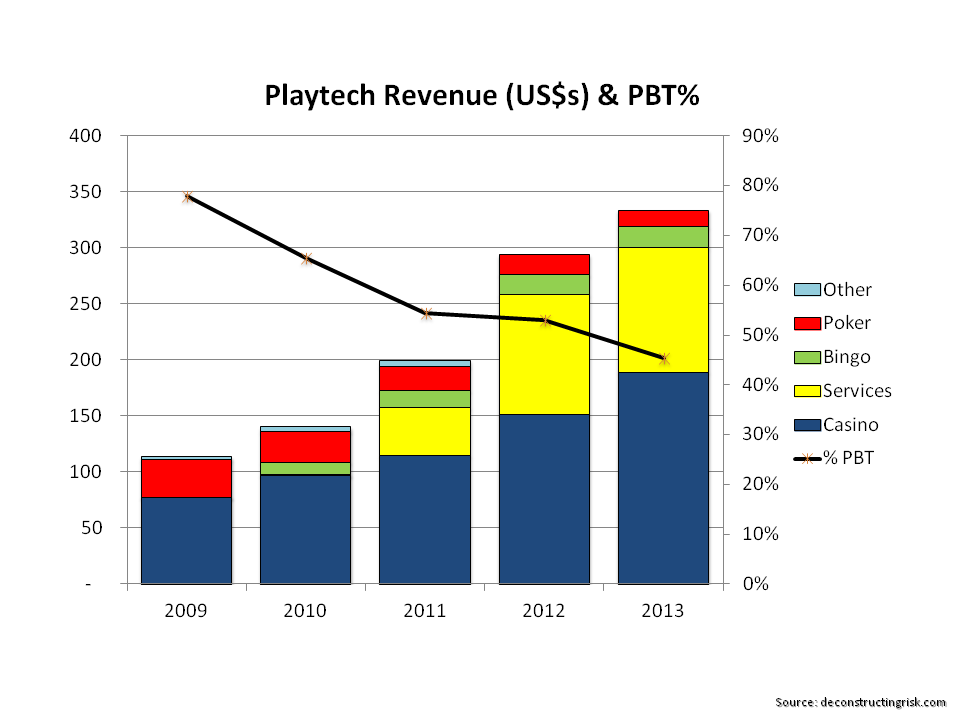
Playtech is a software gaming firm which offers a fully integrated platform across games and sports-betting called IMS that many of the main players use (licensees include Betfair, bet365, William Hill, Paddy Power and Sky, amongst others). They also run a white label turn-key operation called PTTS and a joint venture business. Their most well known joint venture was one where they very successfully partnered with William Hill in 2008 in the creation of William Hill Online (WHO). William Hill recently bought out Playtech of their 29% stake for £424 million. In March 2013, Playtech entered into a deal with Ladbrokes (in an attempt by Ladbrokes to diversify their business and catch up with their competitors – see first paragraph of this post) where, according to Morgan Stanley, Playtech “has effectively been given a quasi-equity stake, where it will “own” 27.5% of any increase in profits”. A Morgan Stanley report, although over a year old, has more interesting background on Playtech (they are still hot on the stock). The graph below highlights some of the metrics behind Playtech.

click to enlargePlaytech Revenues and PBT Margin 2009 to 2013
Much of the colour behind the firm has been provided by its 40 year old Israeli playboy founder, Teddy Sagi, who has a bribery and insider trading conviction from his youth in the 1990s. Playtech bought many of the assets used in the WHO 2008 deal from Sagi and also the PTTS assets (70% of this business is from Imperial e-Club licensed in Antigua and Barbuda!) in 2011 which caused concerns about conflicts of interest. Concern over such conflicts on what Playtech may do with its new cash pile from the WHO sale (they returned £100 million in a special dividend earlier this year but still have £376 million in cash as at end Q1) and on potential problems that Sagi’s ownership position may do in gaining access to the US resulted in an offering in March this year which reduced his 49% stake to 34%.

Playtech has stated that their “the Board is seeking transformational M&A opportunities to take the business to the next level.” Although it’s a bit too colourful for me, a number of analysts estimate a 20%+ upside on its current share price and it’s interesting to note that David Einhorn’s Greenlight Capital is a believer with an ownership of 3.8%. That, I think, is a good place to end a post on gambling!

The fascinating case of Betfair

With the ending of the World Cup, my attention turned again to my attempts at understanding the issues facing the betting and gambling sector. For the sake of full disclosure, I am a novice on the sector (I am not a gambler if investing and the odd poker game are not included as such) and have no positions in any betting or gaming stock. My ramblings here, and in previous posts, simply illustrate my attempts to satisfy my curiosity about a sector that is at a fascinating point of change.

In a previous post, I highlighted the changes that the internet has had on the betting and gaming sectors. At that time, I thought the impact of the disintermediating betting exchanges on traditional business models could provide interesting insights into other disintermediating businesses in the financial sector. However, as I have found out more about the sector, such as the results of the traditional betting firms in the UK as per this post, there are a multitude of issues facing the sector such that a review of the impact of the betting exchanges in isolation is not that informative and (frankly) outdated given current developments. Recent developments include regulatory changes such as those in the US which has prompted the purchase of the largest online poker firm Pokerstars by approximately $5 billion by Amaya Gaming and new online taxes such as the forthcoming UK point of consumption (POC) tax of 15% due in December.

As the graph of Betfair’s share price since its floatation in late 2010 shows, the betting exchange model clearly has not had much of a disruptive impact on the traditional business models in recent years.

click to enlargeBetfair historical share price

Rather than go over Betfair’s eventful past in detail here, I will focus on current issues. Niall O’Connor in his blog, bettingmarket.com, has a number of informative articles on the history of Betfair, including this one. Below, I show a graph of Betfair’s profit before tax against the other UK betting firms which illustrates its difficulties in the recent past. The 2012 results (which are Betfair’s YE 2013 results as their year ends in April) exclude some write-offs and adjustments as a result of Betfair’s turnaround plan (which are included in the dotted line). The plan involved refocusing on sustainable geographical betting markets with accommodative regulations and developing a fixed odds betting business alongside the exchange to optimise the liquidity advantages of each model.

The new plan, in effect, admitted that the stand alone betting exchange model was flawed and that some markets “may not have sufficient liquidity to offer an optimal betting experience, notably in ante post and ancillary markets“. The firm estimates its share of the sophisticated bettor market of £150 million at 60-70% but its share of the recreational and occasional bettor market of £500 million at less than 10%. This market is where they see growth and Breon Corcoran, previously Paddy Power’s COO, was brought in as Betfair’s new CEO in August 2012 to execute on the new direction. The most recent results show that the new strategy is delivering better results.

click to enlargeBetfair 10 year Profit Before Tax margins

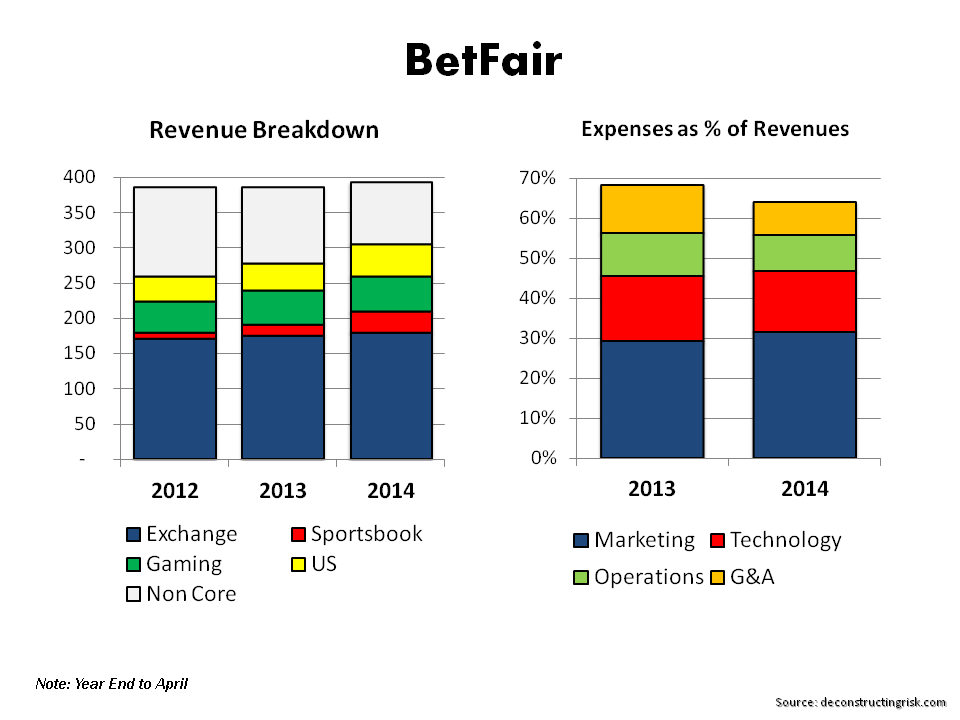
The focus on sustainable betting markets and cost cutting whilst increasing marketing spending (Betfair were high profile in recent World Cup advertising) can be seen in the graph below. Product development in features such as cash out and price rush (automatically gives the best odds from fixed odds and exchange) are being heavily pushed, particularly in the growingly important mobile market.

click to enlargeBetfair Revenue & Expense Breakdown

As mentioned in the previous post, there is a vast body of academic research on the gambling market and with the wealth of data that Betfair offers, the betting exchange market has been no exception in the studies. The Institute for Strategy and Business Economics in the University of Zurich in particular has some interesting papers. This one, for example, contends that there is a growing body of evidence that exchange markets “exhibit high prediction accuracy as they regularly outperform non-market forecasting methods”. The well-documented long-shot bias where the tendency to overvalue underdogs by fixed odd markets “is less pronounced in person-to-person betting” and this can be used by traders on the betting exchange to arbitrage price differences.

There is a particularly interesting paper by Egon Franck, Raphael Flepp and Stephan Nüesch in the University of Zurich from December 2013 on the importance of liquidity in determining price competitiveness which the authors offer as one of the reasons behind BetFair’s move into fixed odds online betting. Other arbitrage opportunities indentified by research include bookmakers actively shading prices in the presence of a partly irrational betting audience in order to increase their profit (e.g. sentiment bias in football games by the home fans) or the movement in odds prior and during games with the growth of in-play betting.

The development of sports investment funds was previously highlighted in a Bloomberg article and despite an early hic-cup with the collapse of a fund called Centaur there are many now developing predictive algorithms which try to take advantage of arbitrage opportunities. BetFair is consistently looking at how it can optimise its pricing (on the exchange it earns its commissions on winnings by a sliding scale on volume) in different geographical areas and sports to maximise its commissions, despite an outcry from a pricing charge change a few years ago.

Although BetFair face considerable challenges (e.g. I estimate that 95% of BetFair’s sustainable revenues are concentrated in the UK and the firm disclosed that the POC tax, if implemented as currently envisaged, would of cost them £36 million for their 2014 year, one with £61 million of operating profit!) in the short to medium term, one of their strengths is the balance sheet with a net asset ratio of 55% and a cash pile of over £200 million and a strong cash generating business. In their latest results Corcoran commented that “the flexibility we retain through our strong balance sheet provides a competitive advantage during uncertain times for the gaming sector. We will continue to review our balance sheet on a regular basis.” Although Betfair are a fascinating case to keep an eye on, the uncertainties on the POC tax issues outweigh any positive investment case for now.

In my attempts at understanding the sector more, these comments led me to look at some other models (and possible acquisition targets) in the other publically traded online firms, mainly on the gaming side. Names that I have looked at include 888, BWIN (currently looking at strategic options!) and 32Red. I am also intrigued by the software gaming firm Playtech which provides the underlying software to many firms in the sector. I will follow-up with a post on further musings.

Bookies’ Year-End Numbers and Budget Woes

This was an interesting week for certain sectors given the UK budget. Annuity insurers were stunned by the scraping of the requirement to purchase annuities upon retirement, thereby denying the sector of a statutory ability to rip off customers. Hopefully, the move will result in innovation in the insurance and fund sectors in providing customers with retirement products of genuine value by way of low cost index following returns with elements of longevity protection.

The other sector which got hit was the bookmakers with an increase in taxes on gaming machines (aka fixed odds betting terminals or FOBTs) to 25% from 20% and an extension of the horse racing betting levies to include offshore operators. A previous post on the betting sector outlined some of the dynamics at play (I still have to follow that up with a post on betting exchanges, specifically Betfair). The FOBT tax increases apply to both category B2 machines (casino games) and B3 machines (slot games). The timing of the tax increase caused surprise as the UK Department for Culture Media and Sport are looking into how the FOBT can be restricted to reduce its appeal to younger men with low incomes and gambling problems.

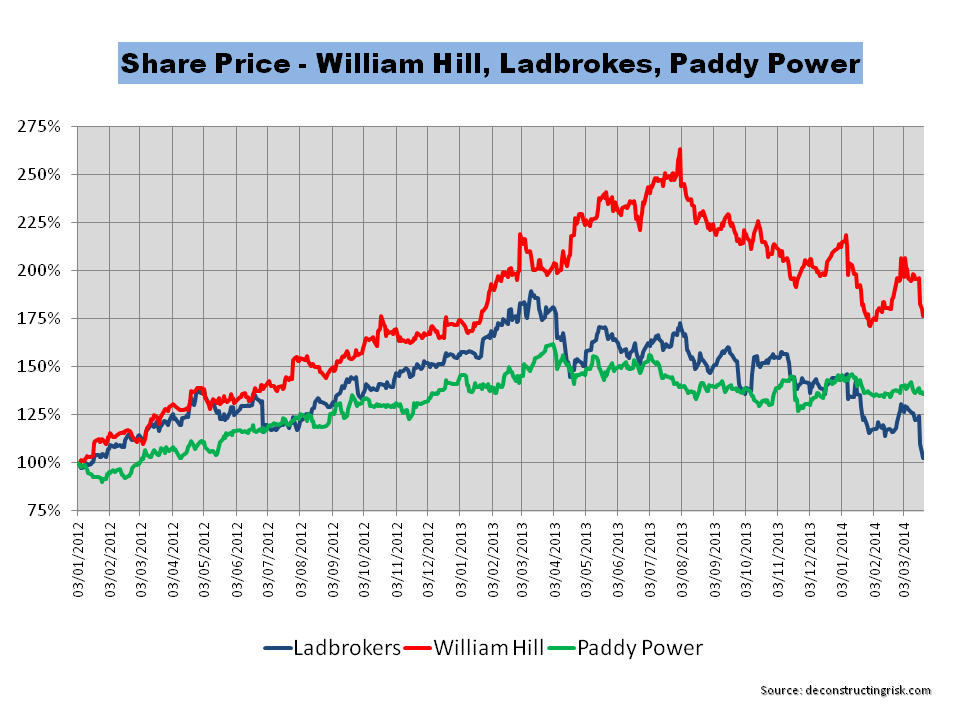
Shares of UK bookmakers took a hit from the news, particularly Ladbrokes as the UK bookmaker most dependent upon FOBTs. The graph below shows the impact.

click to enlargeShare Price 2012 to March2014 William Hill Ladbrokes Paddy Power

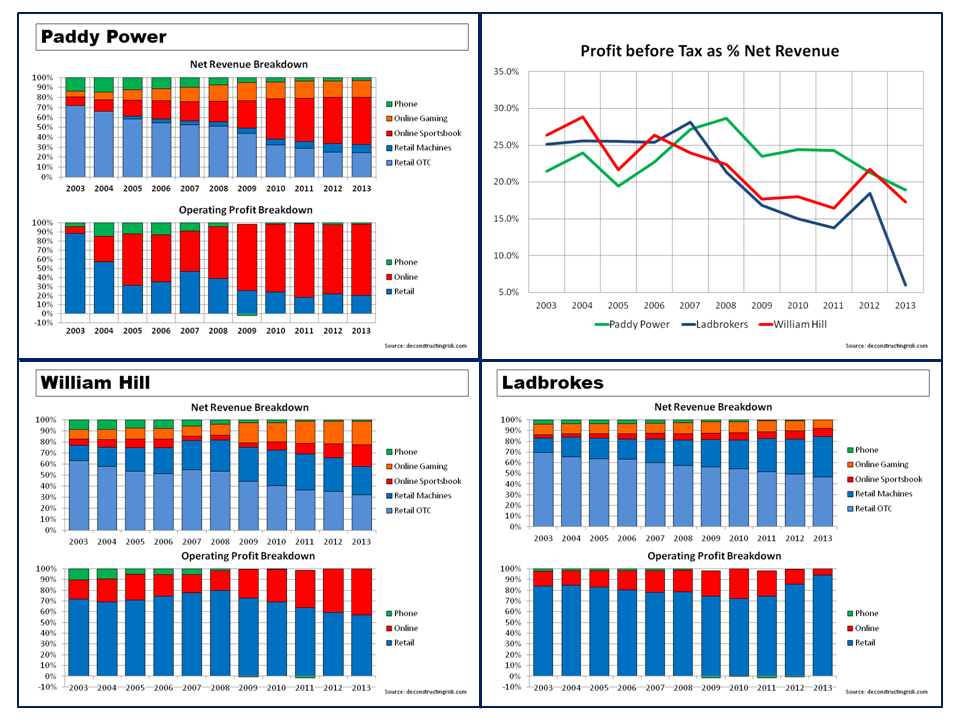
The reason for Paddy Power’s performance over Ladbrokes and William Hill is explained by their relative low exposure to gaming machines as the exhibit below shows (which updates revenue and operating profit breakdowns for the three firms).

click to enlargeBookie's books YE2013

Analysts estimate that the FOBT tax increase could impact the profits of Ladbrokes and William Hill by £20 million and £16 million respectively (compared to 2013 net income of £67 million and £226 million respectively).

The budget increases are on top of the introduction of the online point of consumption (POC) tax of 15% due in the UK from December. The impact of this tax upon the online operations of bookies (and indeed upon Betfair) is unknown and something I will hopefully return to in the future. In its 2013 annual report, William Hill offered the following:

Taken together, the competitiveness of our digital offering and our healthy financial position leave us well positioned to tackle both opportunities and challenges created by the posited introduction of a Point of Consumption tax on UK online gambling in December 2014 which we believe is likely to result in a dislocation of the UK online gambling market given its likely impact on industry operating profit margins. While it will lead to a significant additional cost for the Group – of a size we consider impossible to mitigate in full in the short term – we do believe there is potential for larger scale operators to benefit from increased market share as smaller operators may be squeezed out of the market by the additional tax burden.

As can be seen from the above graphs, Ladbrokes looks like a business under real pressure. Its brand is strong but its business is far too reliant upon UK retail and gaming machines in particular. Many analysts favour William Hill due to its balance between retail & online and between sports & gaming.  Paddy Power’s 500% share price rise over the past 5 years has been muted in the past year due to industry headwinds and how they manoeuvre the POC issue will be fascinating (as it will be for other pure online bookies and the betting exchange BetFair).

A look over some bookmakers’ books

I have been doing some digging into the dynamics of betting exchanges, the largest and best known of which is BetFair. The betting and gaming sector itself has been the subject of a mountain of academic research, there is even a journal dedicated to it! Quants have moved in and are actively pitting their algorithms against human gambling behaviour on the exchanges. A recent intriguing Bloomberg article on tennis betting illustrates some strategies now common in the marketplace.

Technology has driven disruptive disintermediation across many sectors such as the travel & airline industry and more recently across the retail sector. There was a fascinating documentary on the BBC by Robert Preston late last year on the UK retail sector which concluded that the future for many clothing retail outlets would be to act like galleries for consumers to peruse items with the ultimate purchase decision being made online.

The betting and gaming sector is one undergoing structural changes due to the massive increase in online activity. Additional competitive threats from disintermediated business models such as betting exchange pose interesting questions for the sector. Such structural market changes may be useful in understanding the impact of new business models in other sectors such as financial services –  peer to peer (P2P) lending in banking or the ILS market in insurance come to mind. On the growing P2P lending sector, there was an article on the front page of Friday’s FT on how a UK developer sourced £4 million of debt through online P2P platform Lendinvest which may prove to be defining moment of change. On the impact of the ILS market, there was another interesting FT article that contended that the ILS market is resulting in structural changes in a market with “a lot of excessive overhead, ie highly paid staff, that can be eliminated”.

Before looking deeper into structural changes in the betting and gaming sector, I needed to understand the “traditional” betting market better. Besides the odd poker tournament (with real people), I am not a gambler and therefore not a user of the services provided by betting firms. I know enough that the odds are obviously in the bookies favour but I know very little about the economics of the betting industry. As such, this post details my research on the UK betting industry. A follow on post will go into the broader picture and some (likely rambling) thoughts on the impact of structural changes from betting exchanges like Betfair.

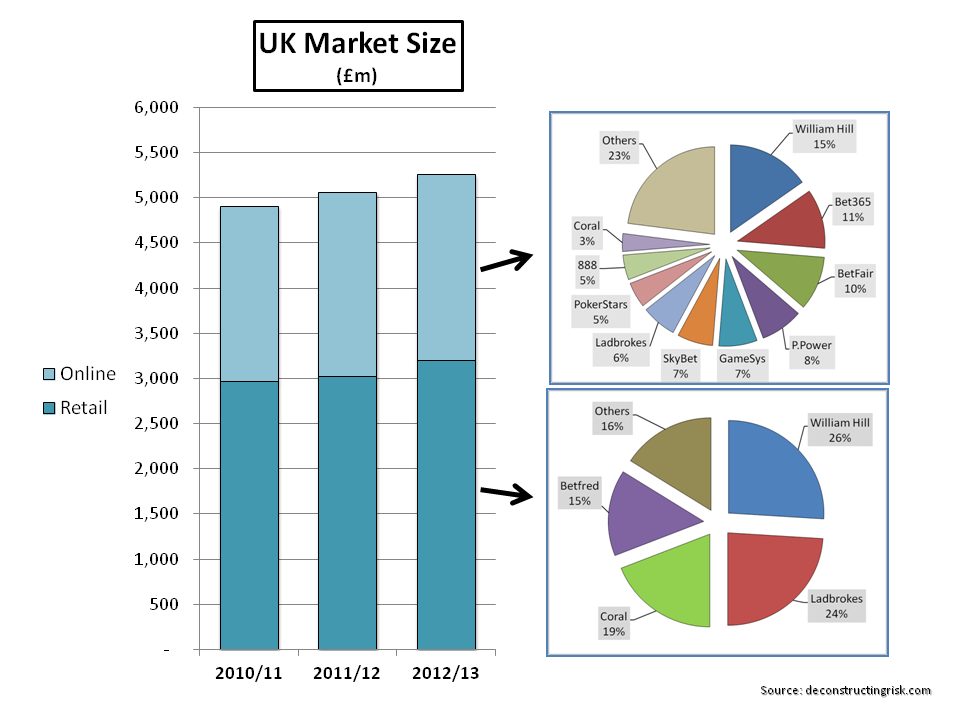
So, I concentrated on the UK market where data is freely available. The graphic below outlines the size of the UK betting and gaming market with the main providers. The market is split by revenue approx 60% retail and 40% online. The retail market is split approx 50:50 between over the counter betting at shops and gaming on machines (aka fixed odds betting terminals or FOBTs). On the online side, sports betting (commonly referred to as the Sportsbook) is approx 40% with gaming making up the remainder, led by casino (approx 30%), poker and bingo (approx 15% each).

click to enlargeUK Gambling Market Size

The main players on the retail side stress the advantages of their multi-access models and, to counter the impression that retail betting shops attach the older demographic, cite statistics that show even younger customers often use retail outlets (more and more in combination with online and mobile).

The gaming machine/FOBT sector has come under renewed focus recently. Derek Webb, a successful gambler, is one of the principles behind the Campaign for Fairer Gambling and has described the machines as “crack cocaine”. Campaigners point to the rapid rise in revenue from FOBT, which were only widely introduced in the early 2000s, the addictive nature of the machines and that users are high frequency gamblers with a concentration amongst younger men with low incomes. Bookies point to the high payouts (the margin taken by the bookmaker is generally about 3% to 4% of the amount staked whereby such margin is referred to as the gross win) and the importance of machines supporting the retail shop model (I estimate that FOBT can contribute 70% to 80% of retail operating profits). Political pressure is mounting to restrict the amount that can be bet on the machines and JP Morgan recently cut its rating on Ladbrokes and William Hill saying that the likely change “could make the bottom 20pc of Ladbrokes and William Hill shops loss-making, with a further 20pc only marginally profitable, and require significant restructuring to close shops in order to cut costs.

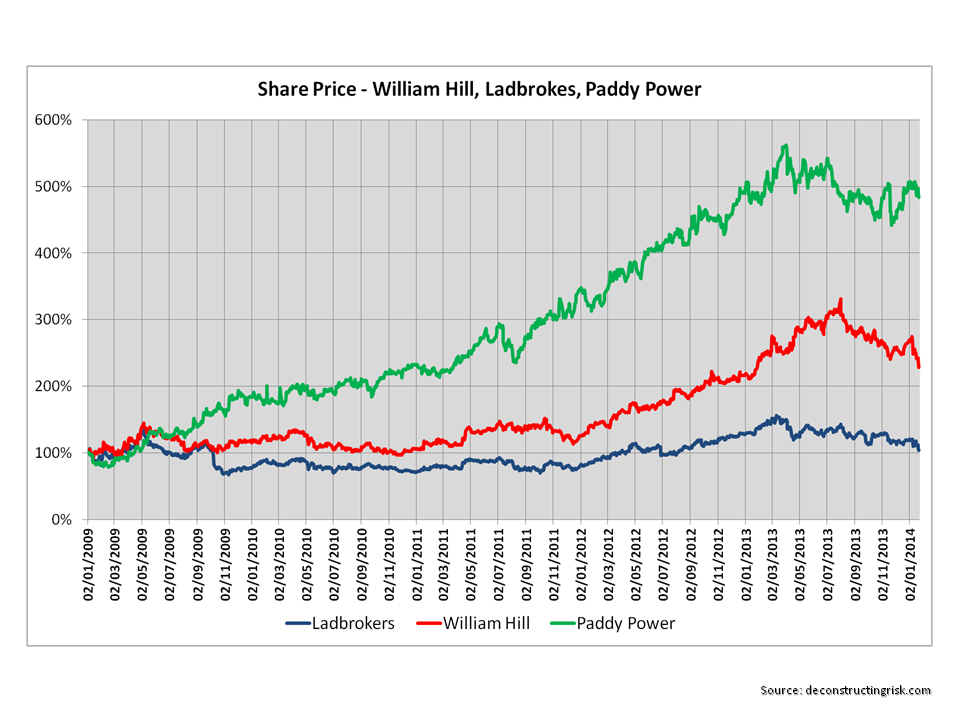
I selected Ladbrokes, William Hill and Paddy Power as firms to do some deeper analysis. William Hill and Ladbrokes are long established firms, particularly in the retail sector. William Hill is also the market leader in the online sector with a particular strength in online casino gaming. Paddy Power is the new kid on the block growing aggressively in online, particularly over the past 5 years, from its Irish base into the fourth largest in the online sector. Size wise, William Hill and Ladbrokes had revenue of £1.3 billion and £1 billion in 2012 respectively while Paddy Power had 2012 revenue of €650 million (approx £570 million). It would have been interesting to have a deeper look at the online only Bet365, which was founded in 2000 by Denise Coates and is now the number 2 in the UK online market with over £200 million in revenue, but unfortunately Bet365 is private. The graph below shows the share price moves of the selected firms since 2009.

click to enlargeShare Price William Hill Ladbrokes Paddy Power

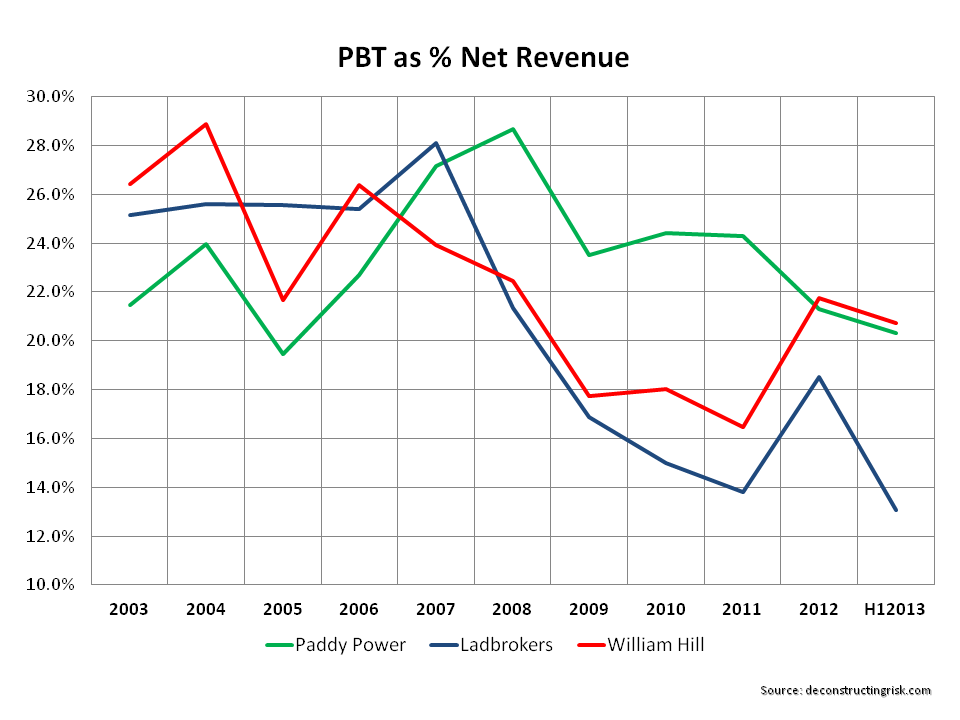
The graph below shows the profit before tax margins of the firms since 2003. As can be seen, profit margins have been under pressure, particularly for Ladbrokes in recent years.

click to enlargePBT % William Hill Ladbrokes Paddy Power

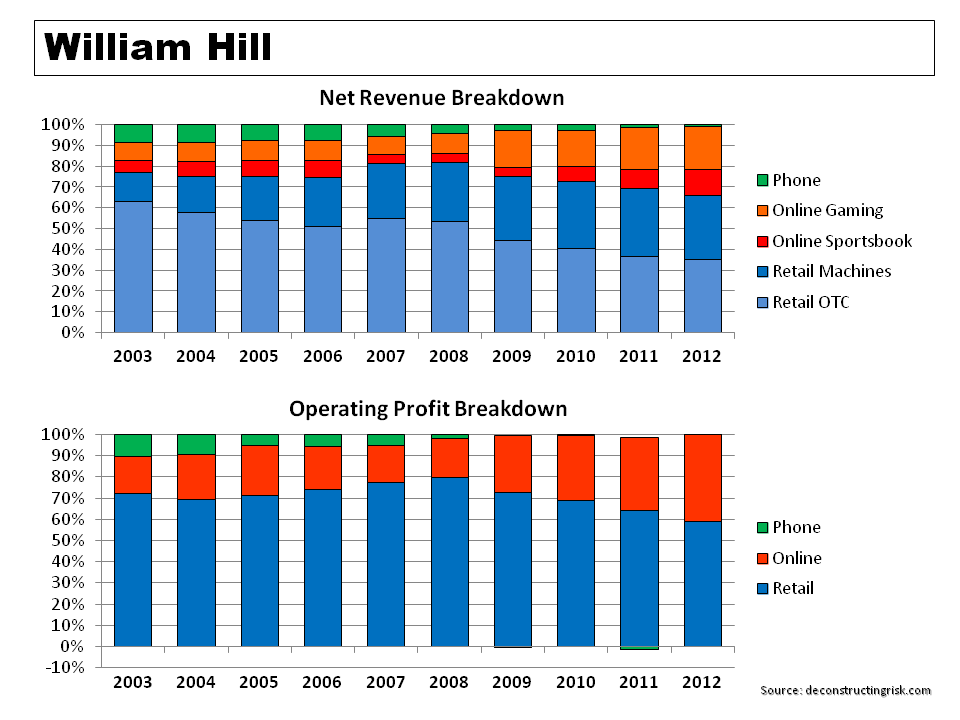
Revenue and operating profit breakdown for William Hill is below.

click to enlargeWilliam Hill Revenue & Operating Profit Breakdown

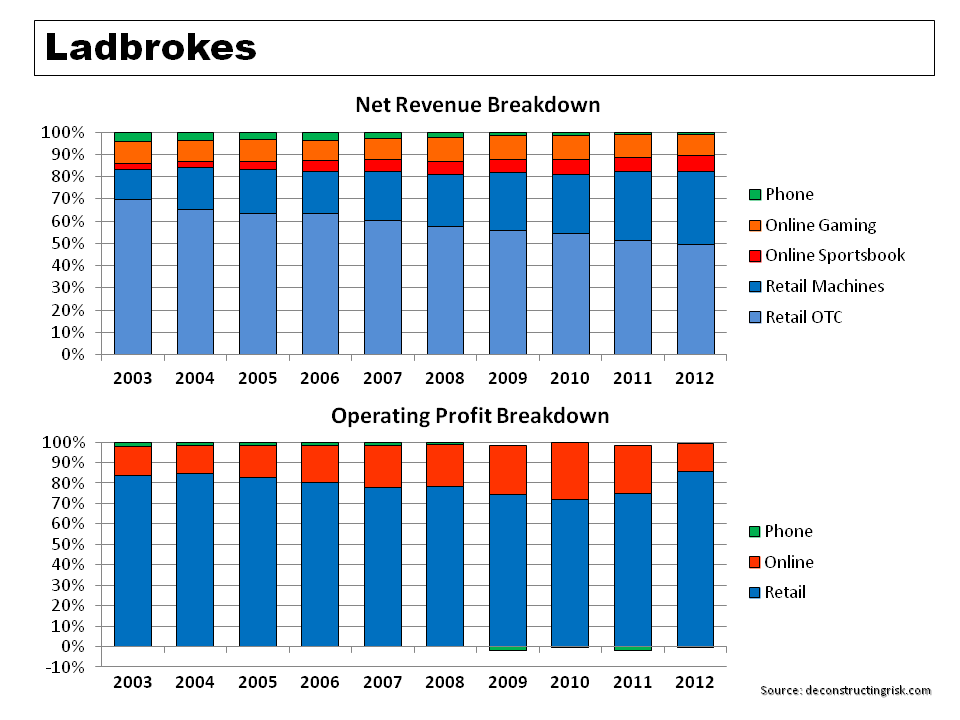
Revenue and operating profit breakdown for Ladbrokes is below.

click to enlargeLadbrokes Revenue & Operating Profit Breakdown

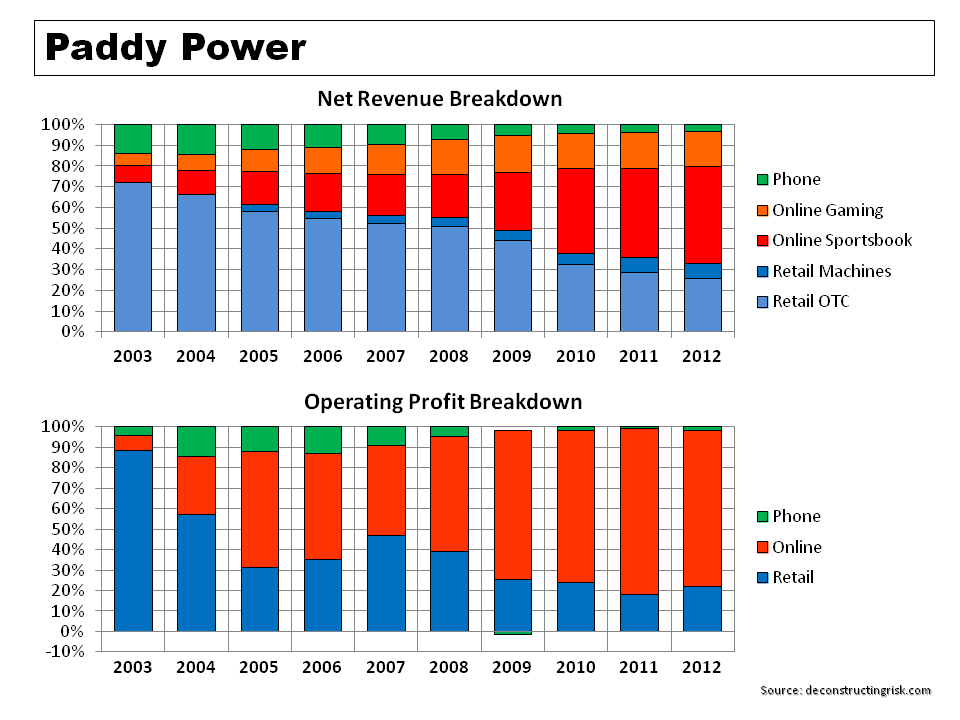
Revenue and operating profit breakdown for Paddy Power is below.

click to enlargePaddy Power Revenue & Operating Profit Breakdown

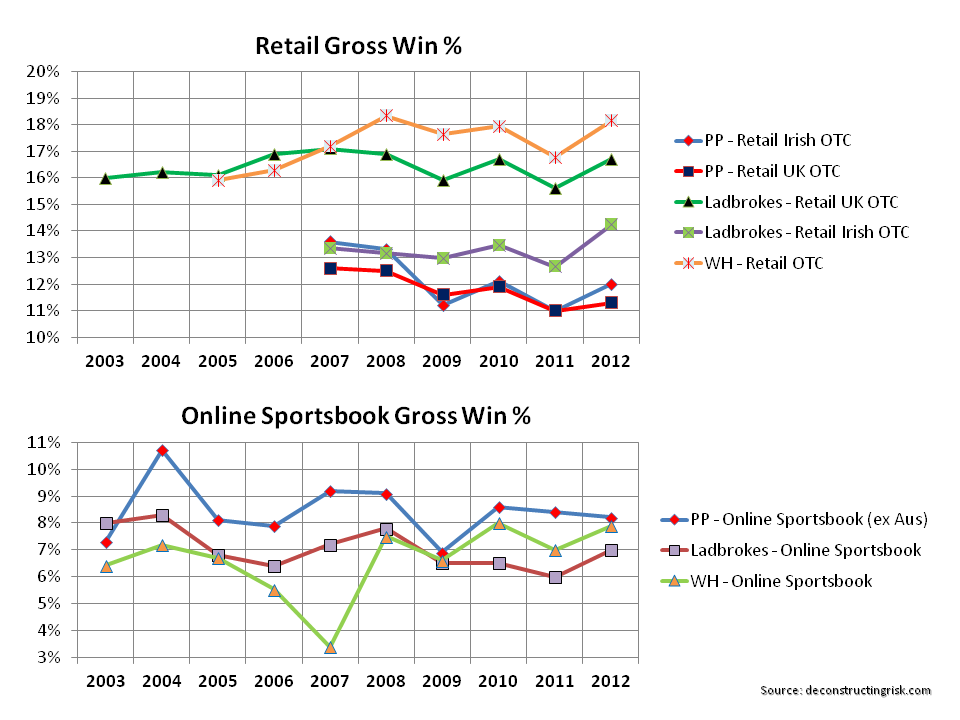
As mentioned above, the percentage that a bookmaker takes as a margin in each business is called the gross win (another commonly used term is the overround which refers to the excess above the sum of the odds). Net revenues are gross wins less VAT and fair-value adjustments for free bets, promotions and bonuses. Care needs to be taken when comparing gross win percentages (i.e. gross win divided by amounts staked) across firms as the make-up of the underlying books is important (gross wins varies by sport type such as football, horses, tennis, etc and by geography). Also items such as betting levies and charges vary and some are not deducted in the gross win to net revenue calculations but rather in operating expenses. Items such as the new UK point of consumption (POC) tax that is due to be introduced later this year also need to be understood in their potential accounting treatment. The graph below compares the reported gross win percentages amongst the firms in the retail over the counter (OTC) business and in the online Sportsbook businesses for the firms.

click to enlargeGross Win Percentage

I have found it difficult to get metrics for the profitability of both the retail and the online gaming businesses. As discussed above on the FOBT business, the operating profit contribution from gaming can be significant. I suspect that online gaming also contributes significantly to the online operating profit although not as high as the 70% to 80% contribution that I estimated for the retail business

Online gaming is also a more cross border business and is the fastest growing segment of the gambling industry. H2 Gambling Capital, a leading supplier of data and market intelligence on the global gambling industry, puts the size of the global online gaming market at approx $30 billion. Large markets such as the US are seen as ultimately providing a massive opportunity for growth once regulatory issues are resolved. Although firms withdrew from the US in 2006 after the passing of the Unlawful Internet Gambling Enforcement Act (UIGEA), individual States such as Nevada and New Jersey are looking at ways that they can approve online gaming and challenge federal restrictions.

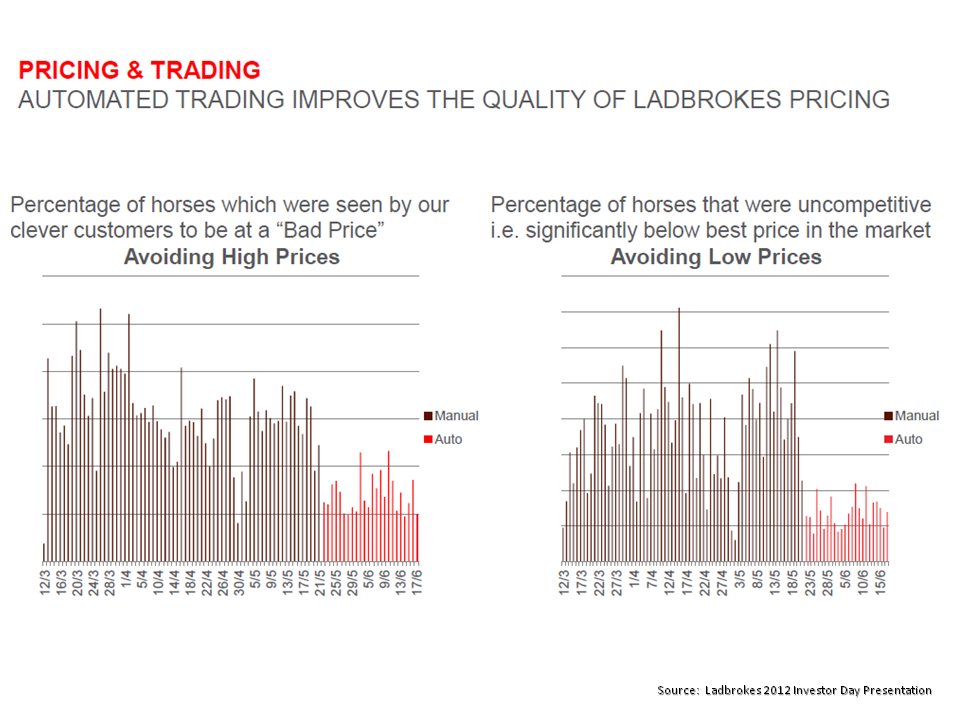
Although the established firms like William Hill and Ladbrokes are facing headwinds in their business with significant competition from online upstarts like Paddy Power, Bet365 and Betfair, they have size and powerful brands on their side. Both have made significant investments in IT infrastructure to support their business. The area of liability management is one that is particularly interesting. Ladbrokes, for example, has made significant investment in enhancing their trading abilities through the development of Morse, their own algorithmic robot. They cite the use of Morse in improving pricing which is particular important in the growing bet in play (BIP) market, as the exhibit shows.

click to enlargeLadbrokes Pricing & Trading Exhibit 2012 Investor Day

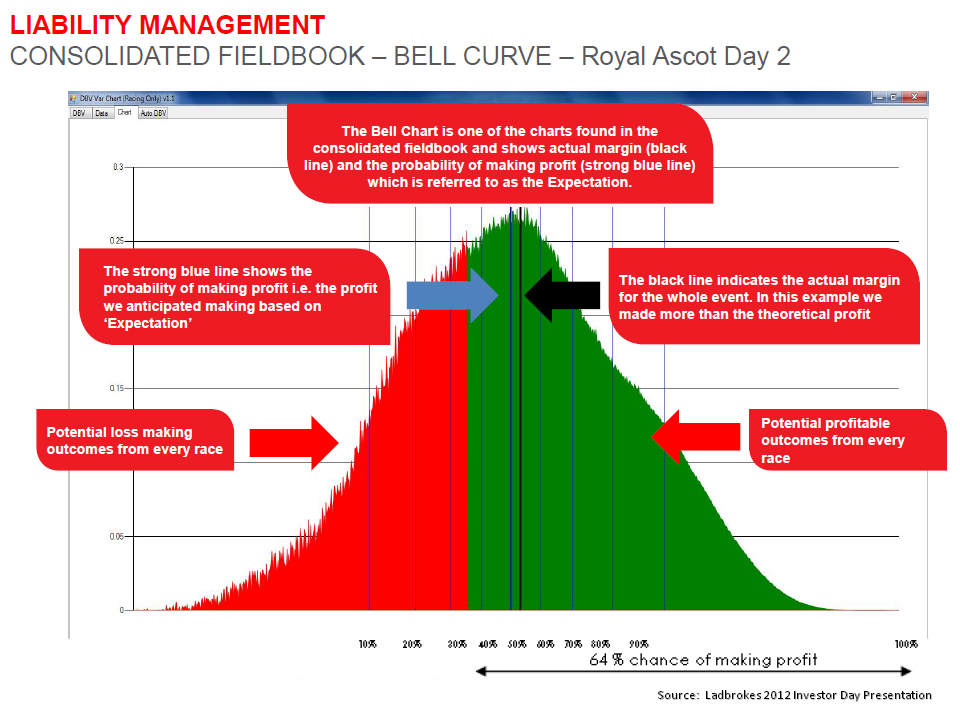
They also cite the use of such active liability management tools in improving outcomes such as the Royal Ascot results below.

click to enlargeLadbrokes Liability Management Exhibit 2012 Investor Day

Changes in the whole betting and gaming sector have been rapidly evolving over recent years. These changes and the impact of betting exchanges will be the subject of a follow on post with some further musings in the coming weeks.