Tag Archives: reinsurance pricing

The Float Game Goes Into Overdrive

The IMF today warned about rising global financial stability risks. Amongst the risks, the IMF highlighted the “continued financial risk taking and search for yield keep stretching some asset valuations” and that “the low interest rate environment also poses challenges for long term investors, particularly for weaker life insurance companies in Europe”. The report states that “the roles and adequacy of existing risk-management tools should be re-examined to take into account the asset management industry’s role in systemic risk and the diversity of its products”.

In late March, Swiss Re issued a report which screamed that the “current high levels of financial repression create significant costs and lower long-term investors’ ability to channel funds into the real economy”. The financial repression, as Swiss Re calls it, has resulted in an estimated loss of $470 billion of interest income to US savers since the financial crisis which impacts both households and long-term investors such as insurance companies and pension funds.

Many market pundits, Stanley Druckenmiller for example, have warned of the destabilizing impacts of long term low interest rates. I have posted before on the trend of hedge funds using specialist insurance portfolios as a means to take on more risk on the asset side of the balance sheet in an attempt to copy the Warren Buffet insurance “float” investment model. My previous post highlighted Richard Brindle’s entry into this business model with a claim that they can dynamically adjust risk from one side of the balance sheet to the other. Besides the influx of hedge fund reinsurers, there are the established models of Fairfax and Markel who have successfully followed the “Buffet alpha” model in the past. A newer entry into this fold is the Chinese firm Fosun with their “insurance + investment twin-driver core strategy”.

The surprise entry by the Agnelli family’s investment firm EXOR into the Partner/AXIS marriage yesterday may be driven by a desire to use the reinsurer as a source of float for its investments according to this Artemis article on the analyst KBW’s reaction to the new offer. In the presentation on the offer from EXOR’s website, the firm cites as a rationale for a deal the “opportunity to exploit know-how synergies between EXOR investment activities” and the reinsurer’s investment portfolio.

Perhaps one of the most interesting articles on the current market in recent weeks is this one from the New York Times. The article cites the case of how the private equity firm Apollo Global Management purchased Aviva’s US life insurance portfolio, ran it through some legit regulatory and tax arbitrage structures with Goldman Sachs help, and ended up using some of the assets behind the insurance liabilities to prop up the struggling casino company behind Caesars and Harrah’s casinos. Now that’s a story that speaks volumes to me about where we are in the risk appetite spectrum today.
Lancashire finds the love

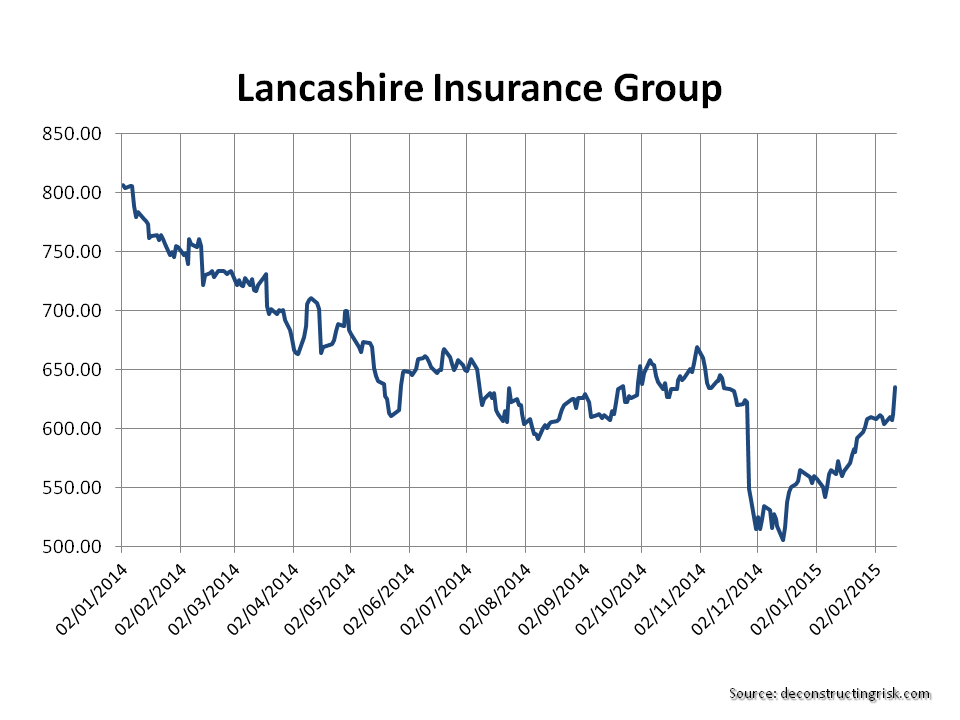
After going ex-dividend in November, investors went mega bearish on Lancashire (LRE.L) when it nearly dropped below the 500p level, as the graph below shows. A previous post highlighted the reasons behind the change in sentiment over the first half of 2014 on the once darling of the specialty insurance sector.

click to enlargeLancashire Insurance Group 2014 Share Price

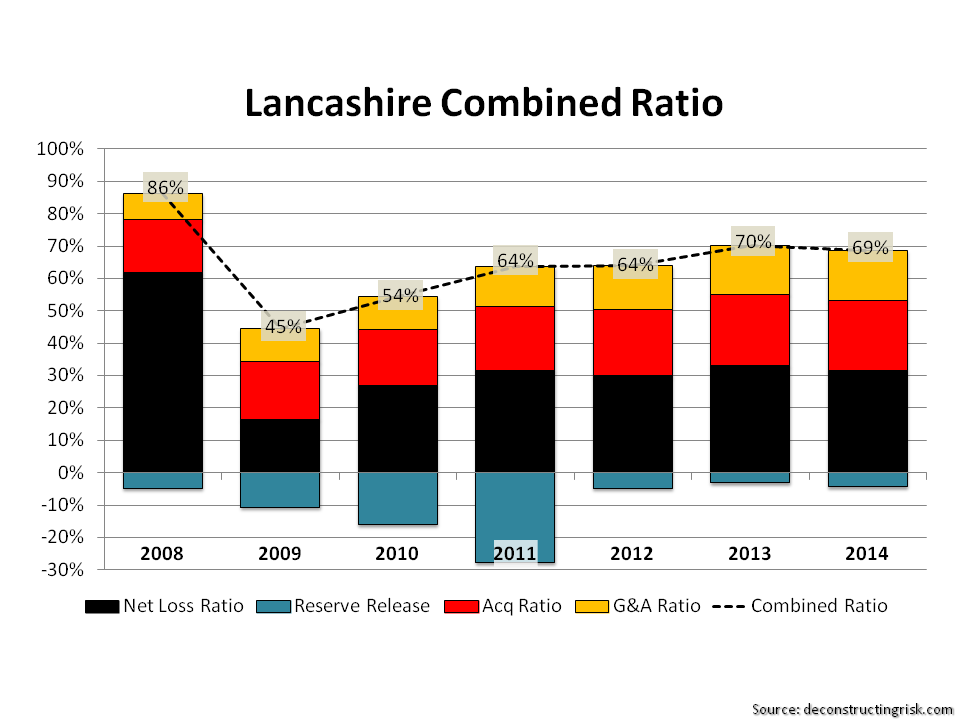
The firm released its Q4 today and announced another special dividend of $0.50 on top of the regular $0.10 dividend. Driven by stable results, as per the graph below, and by the chatter that Lancashire could be an M&A target, the price today reflects a respectable 160% multiple to diluted tangible book. It was odd that although the firm’s executives joked about having prepared an answer to the M&A question, no analyst actually asked the question in the conference call today!

click to enlargeLancashire Historical Combined Loss 2008 to 2014

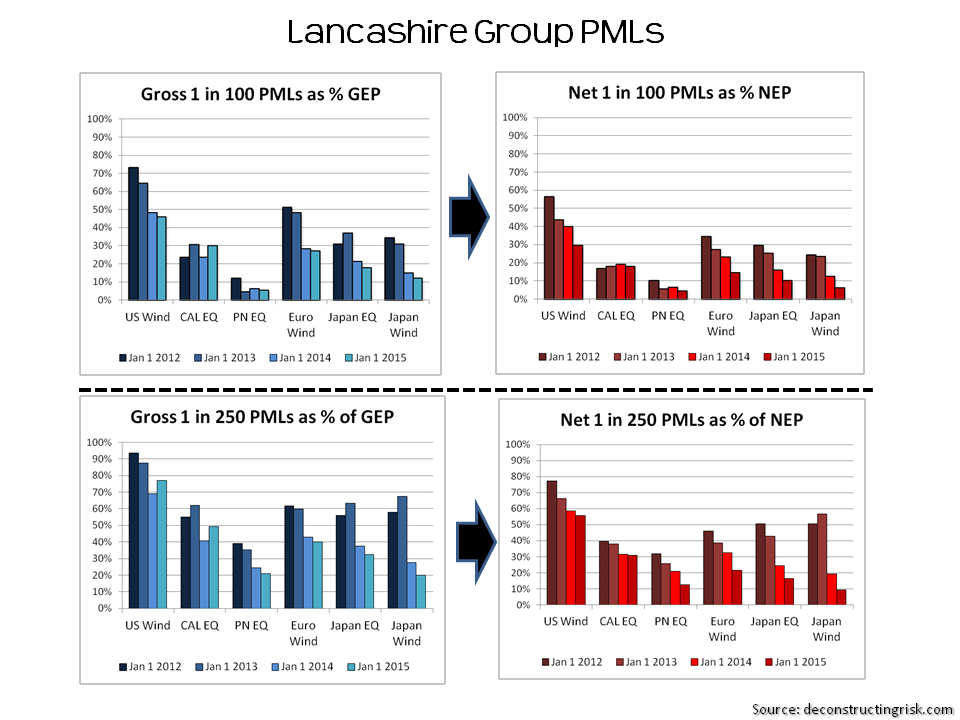
One of the big positives from the call today was the news that the firm has restructured their reinsurance programme that protects their book to give them more event coverage with reinstatements (away from previous aggregate cover). This provides more protection to Lancashire from multiple events. The PMLs as at January expressed as a percentage of the calendar year earned premiums (estimated figures for 2015) show the reduced net risk profile of this arbitrage strategy.

click to enlargeLancashire PMLs January 2015

It’s nice to see Lancashire recover some of its shine and it will be intriguing to see if it does become an M&A target in the coming months.

Same old guff

Now that the US hurricane season is over without any material events, I had a quick look over a few transcripts of conference calls in the specialty insurance and reinsurance sectors to see if there was any interesting comments on where the market is going.

Nearly everybody claims to be mitigating the challenging market conditions by ducking & diving between business classes whilst keeping their overall underwriting discipline. The softness in the reinsurance market has spread into the insurance market, albeit not to the same extent. The reality is that results continue to be flattered by reserve releases, low loss activity and improved loss trends. Market realities are slowly being reflected in ROEs which are coming down to the low double digits.

Nearly all of the reinsurers are claiming to be the winners in the structural changes in the “tiering” of the market whereby cedants are reducing their reinsurance spend and concentrating that spend amongst a select group of reinsurers. Everybody has special relationships and the gravity defying underwriters! That same old guff was the typical response in the late 1990s.

The only interesting comment that I could find was from the ever colourful Ed Noonan of Validus who, after claiming that not everybody is as disciplined as they claim (he was talking about the large generalist reinsurers), said the following:

“It’s unfortunate because the market has had such strong discipline for the last decade. There are no magical segments that are beautifully priced, and the idea that a well-diversified portfolio poorly priced risk makes sense is an economic capital model-based fantasy.”

The last sentence reminds me of one of my favourite quotes from Jim Leitner of Falcon Management that “there is no real diversification in owning a portfolio of overvalued assets“.

My view is that few economic capital models in the insurance market which are currently being used to allocate capital to business classes are taking such arguments seriously enough and most are likely over-estimating the benefit of diversification across soft or under-priced portfolios.


Lancashire is looking unloved

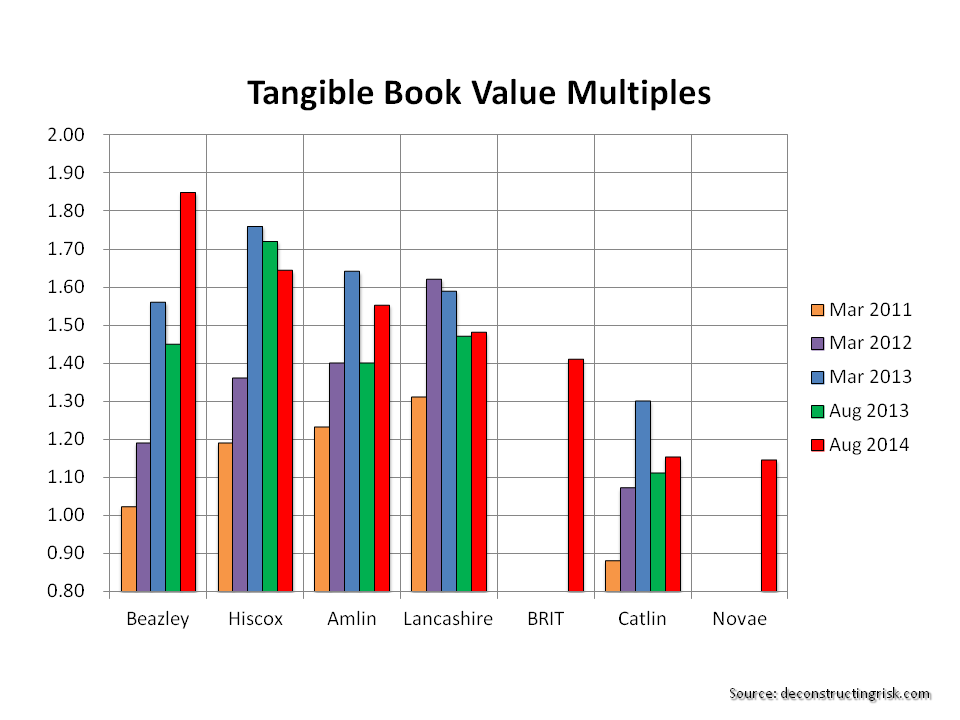
With exposure adjusted rates in the specialty insurance and reinsurance sector continually under pressure and founder/former CEO, Richard Brindle, making an unseemly quick exit with a generous pay-out, Lancashire’s stock has been decidedly unloved with the price trading well below the key £7 threshold highlighted in my last post on the subject in February. Although we remain in the middle of the US hurricane season (and indeed the Napa earthquake is a reminder that its always earthquake season), I thought it was a good time to have a quick look over Lancashire’s figures again, particularly as the share price broke below the £6 threshold earlier this month, a level not seen since early 2011. The stock has clearly now lost its premium valuation compared to others in the London market as the graph below shows.

click to enlargeLondon Market Specialty Insurers Tangible Book Value Multiples August 2014

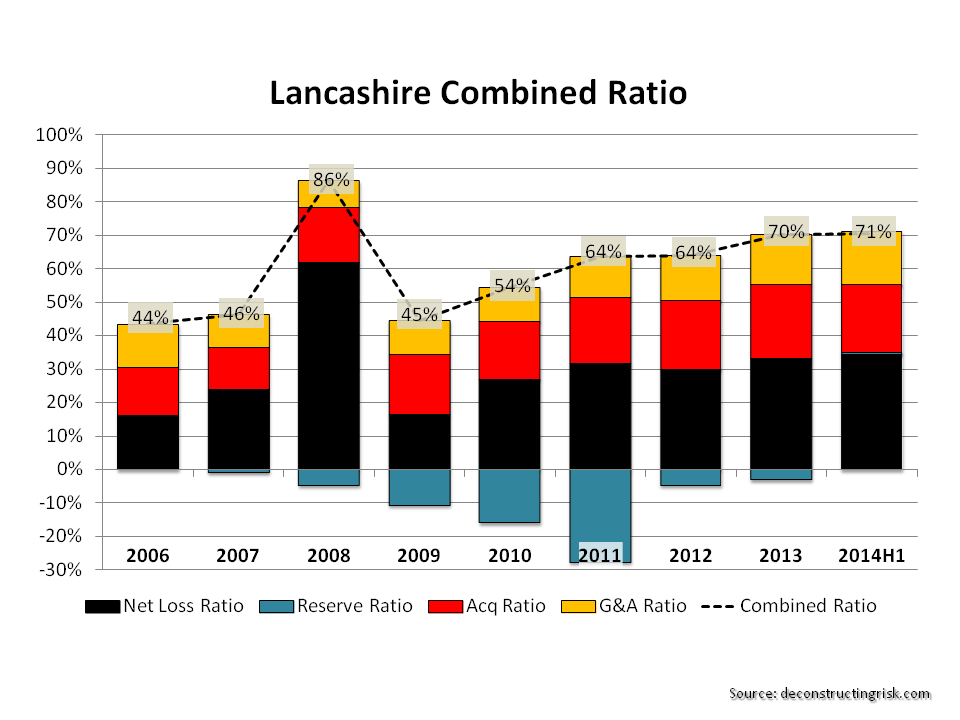
Results for H1-2014, which include full numbers from the November 2013 acquisition of Cathedral, show a continuing trend on the impact of rate reductions on loss ratios, as per the graph below.

click to enlargeLancashire Historical Combined Loss 2006 to H12014

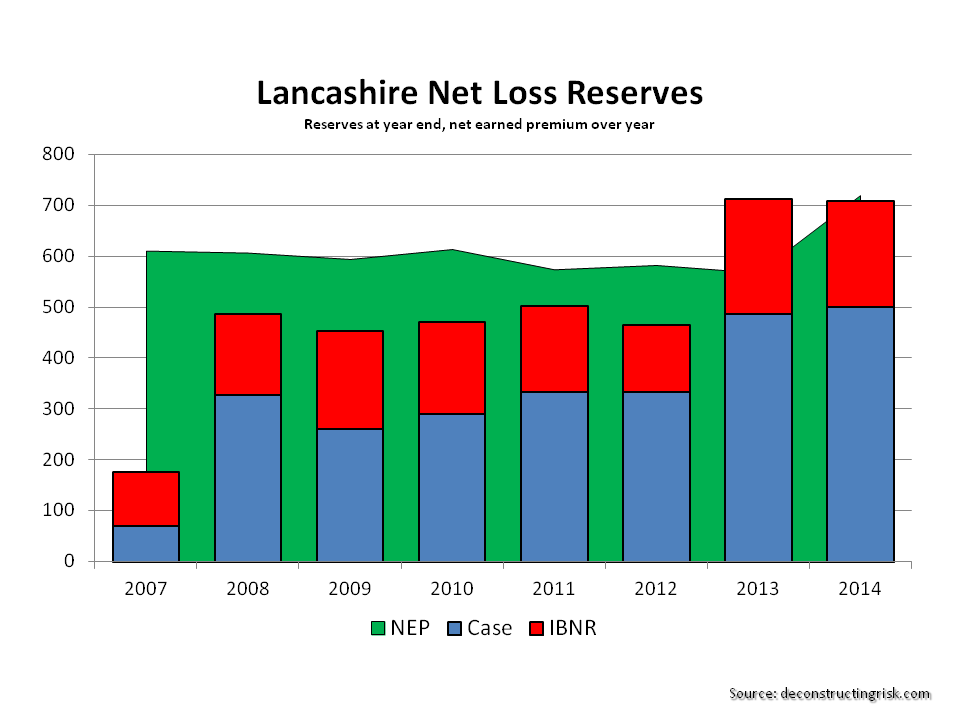
The impact of the Cathedral deal on reserve levels are highlighted below. The graph illustrates the consistent relative level of IBNR to case reserves compared to the recent past which suggests a limited potential for any cushion for loss ratios from prior year reserve releases.

click to enlargeLancashire Historical Net Loss Reserves

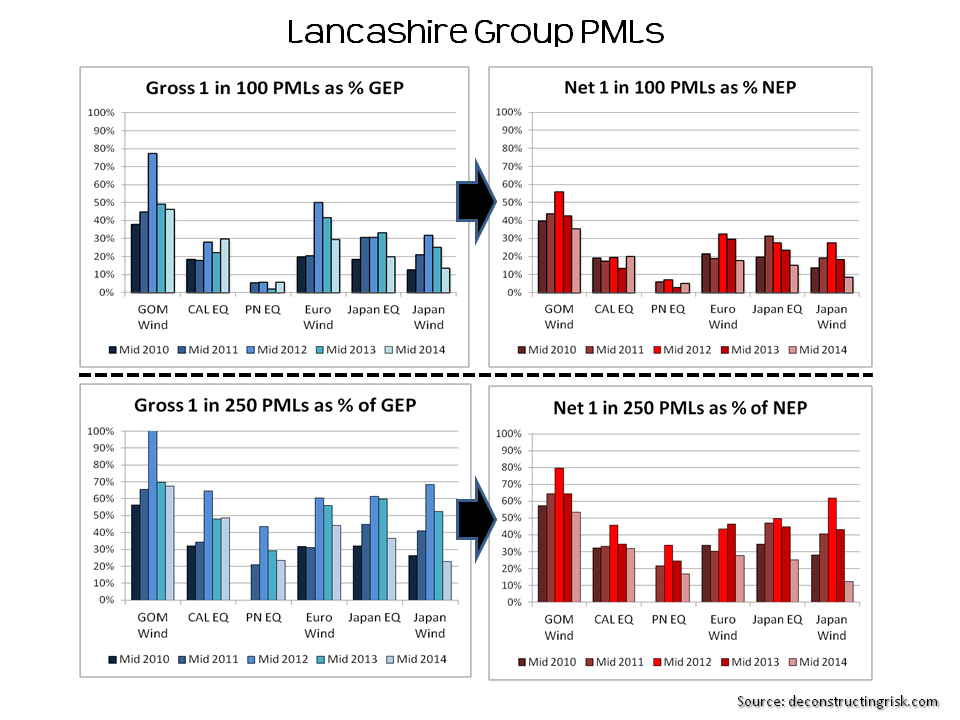
The management at Lancashire have clearly stated their strategy of maintaining their discipline whilst taking advantage of arbitrage opportunities “that allow us to maintain our core insurance and reinsurance portfolios, whilst significantly reducing net exposures and enhancing risk adjusted returns”. In my last post, I looked at post Cathedral gross and net PMLs as a percentage of earned premiums against historical PMLs. More applicable figures as per July for each year, against calendar year gross and net earned premiums (with an estimate for 2014), are presented below. They clearly show that the net exposures have reduced from the 2012 peak. It is important to note however that the Gulf of Mexico net 1 in 100 figures are high at 35%, particularly compared to many of its peers.

click to enlargeLancashire PMLs July 2010 to July 2014

There is of course always the allure of the special dividend. Lancashire has indicated that in the absence of attractive business opportunities they will look at returning most, if not all, of their 2014 earnings to shareholders. Assuming the remainder of 2014 is relatively catastrophe free; Lancashire is on track to make $1-$1.10 of EPS for the full year. If they do return, say, $1 to shareholders that represents a return of just below 10% on today’s share price of £6.18. Not bad in today’s environment! There may be a short term trade there in October after the hurricane season to take advantage of a share pick-up in advance of any special dividend.

Others in the sector are also holding out the prospect of special dividends to reward patient shareholders. The fact that other firms, some with more diverse businesses and less risky risk profiles, offer potential upside through special dividends may also explain why Lancashire has lost its premium tangible book multiple, as per the first graph in this post.

Notwithstanding that previously Lancashire was a favorite of mine due to its nimble and focused approach, I cannot get past the fact that the sector as a whole is mired in an inadequate risk adjusted premia environment (the impact of which I highlighted in a previous post). In the absence of any sector wide catalyst to change the current market dynamic, my opinion is that it is expedient to pass on Lancashire here, even at this multi-year low.

The game of chicken that is unfolding across this sector is best viewed from the side-lines in my view.

When does one plus one equal more than two?

S&P released a thoughtful piece on Monday called “Hedge Fund Reinsurers: Are The Potential Rewards Worth The Added Risk?” I couldn’t find a direct link to the article but Artemis has a good summary here. They start by asking whether combining a reinsurer strategy with a hedge fund strategy can create higher risk adjusted returns than the two approaches could achieve separately. They conclude with the following:

“The potential crossover between hedge funds and reinsurers offers compelling possibilities. However, a commensurate focus on additional risks would have to supplement the singular focus on higher investment returns. Considering both is necessary in determining whether one plus one is truly greater than two. This depends on whether combining hedge funds and reinsurers can create additional diversification benefits that don’t occur in these two types of organisations independently, thus creating a more capital efficient vehicle. We believe it’s possible. However, in our view, closing the gap between reinsurer and hedge fund risk cultures and implementing prudent risk controls is necessary to realize these benefits.”

I have posted on this topic before. One of the hedge fund reinsurer strategies is to combine low volatility P&C business (primarily as a source of cheap “float”)with the alpha seeking asset business. My problem with this strategy is that every reinsurer is looking out for low volatility/stable return (re)insurance business (its the holy grail after all!), even more so in today’s highly efficient and competitive market. So what can clever chino wearing quants living on a tropical island offer that every other established reinsurer can’t? I suspect that the answer is to price the business with a higher discount rate based upon their higher expected return. S&P point out that this may create increased risks elsewhere such as liquidity risk in stress scenarios. Another strategy is to combine volatile property catastrophe risk with higher asset risk, essentially combining two tail risk strategies. This pushes the business model more towards the highly leveraged model as per that used by the monoline insurer, the ultimate “picking up pennies in front of a stream-roller” play.

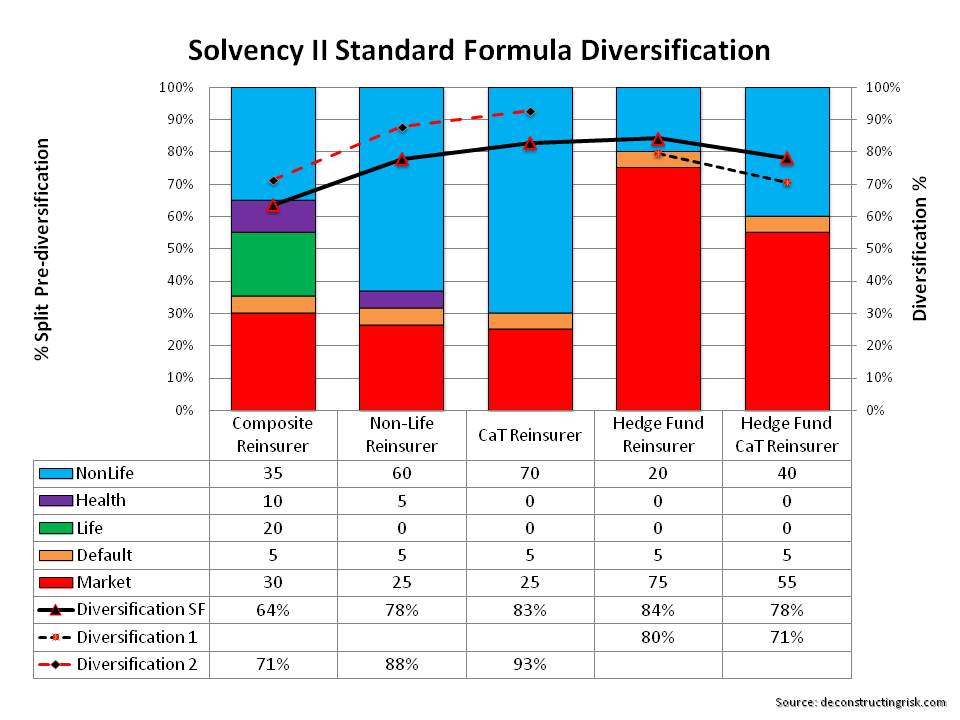
To get an idea of the theory behind the various strategies, the graph below illustrates the diversification of each using the calculation in the Solvency II standard formula, with different concentrations for market, counterparty, life, health and non-life risks (selected for illustration purposes only).

click to enlargeHedge Fund Reinsurer Diversification

The graph shows that a hedge fund reinsurer with a low volatility liability strategy shows the least amount of diversification compared to a composite, non-life or a property cat reinsurer due to the dominance of market risk. Interesting, the high risk strategy of combining a hedge fund strategy on assets with property cat on the liability side shows diversification at a similar level (i.e. 78%) to that of a non-life reinsurer where non-life risk dominates.

Hedge fund reinsurers would no doubt argue that, through their alpha creating ability, the 25% correlation between market and non-life risk is too high for them. Reducing that correlation to 0% for the hedge fund reinsurers gives the diversification above, as per “Diversification 1” above. Some may even argue that the 25% correlation in the standard formula is too low for traditional players, as this post on Munich Re’s results excluding catastrophic losses illustrates, so I have shown the diversification for an illustrative composite, non-life or a property cat reinsurer with a 75% correlation between market and non-life risks, as per “Diversification 2” above.

In my opinion, one plus one is always two and under-priced risk cannot be justified by combining risk strategies. Risk is risk and combining two risks doesn’t change the fundamentals of each. One strategy that hasn’t re-emerged as yet is what I call the hedging reinsurer whereby liabilities are specifically hedged by asset strategies. Initially, the property cat reinsurers tried to use weather derivatives to hedge their risk but an illiquid market for weather derivatives and the considerable amount of basis risk resulted in difficulties with the strategy. The strategy is commonly used on the life side of the business with investment type business, particularly business with guarantees and options. Also the appetite for longevity risk by those reinsurers with significant mortality exposure that can significantly hedge the longevity risk is a major developing market trend. I do not see why the strategy could not be used more on the non-life side for economic related exposures such as mortgage indemnity or other credit type exposures.

In the immediate term, the best strategy that I see is the arbitrage one that those who have survived a few underwriting cycles are following, as per this post. On that point, I noticed that BRIT, in their results today, stated they have “taken advantage of current market conditions in reinsurance to significantly strengthen group wide catastrophe cover. These additional protections include a property aggregate catastrophe cover and some additional variable quota share protection”. When risk is cheap, arbitrating it makes the most sense to me as a strategy, not doubling up on risks.