Tag Archives: insurance pricing

Softening but not soft

The speed dating jamboree that is the annual Monte Carlo Reinsurance Rendezvous kicks off on the 6th September where buyers and sellers (i.e. underwriters and brokers, with those clients that can afford the hotel rates) of speciality insurance and reinsurance kick off their discussions ahead of drawn-out negotiations for the January 2026 renewal season. Each side will earnestly set out their stall, with the US hurricane season as the backdrop (with the extent of any insured catastrophe losses playing a part in how actual negotiations progress towards the year-end), on the degree of rate, term, and condition changes for each client and/or client group.

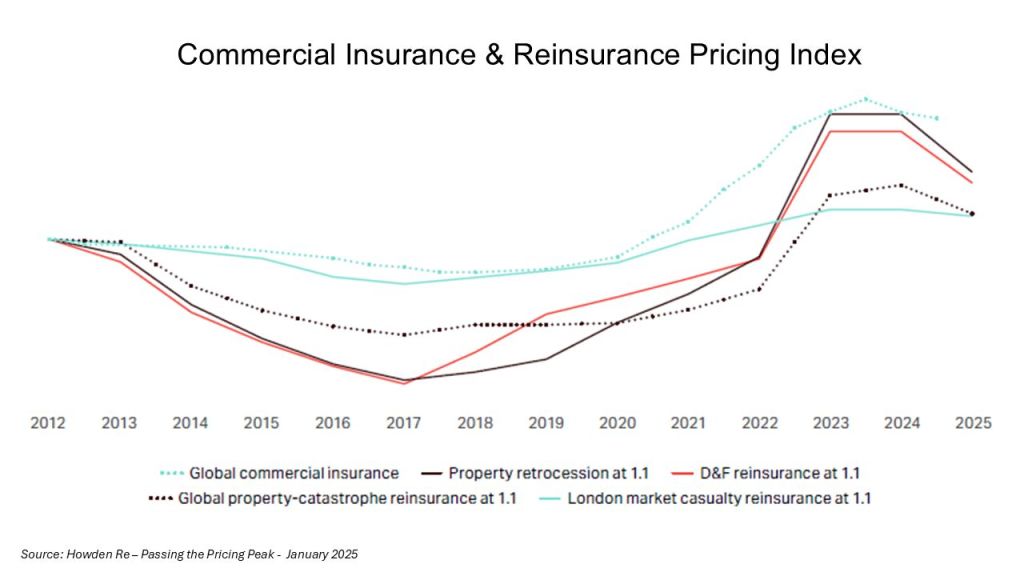
The fact that rates have peaked is now beyond doubt with even the losses from the California wildfires failing to shift the downward trend in rates. In January, David Flandro of reinsurance broker Howden Re stated “if it wasn’t obvious already, we are now firmly in the hard market softening phase of the rating cycle” with the exhibit below in a report entitled “Passing the Pricing Peak” illustrating the point.
Metrics from Lloyd’s H1 presentation by new CEO Patrick Tiernan focus on the adequacy of rates in the context of the recent decline in rates, as per the exhibit below.
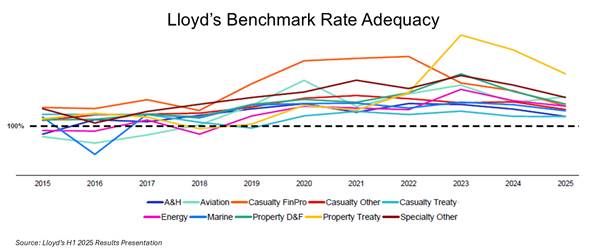
(Re)insurers and other commentators such as rating agencies are voraciously stressing the need for market discipline. A common defence from (re)insurers, as articulated by Flandro, is that “if you look at all lines, or most lines, we are still harder in terms of pricing than we were five years ago”. AM Best stated that “the lessons of past cycles suggest caution, but reinsurer sentiment has ensured tighter exposure management and market disciple in the current cycle” and asked, “the question now facing the industry is whether the improvements in terms and conditions represent a durable shift”. Fitch adjusted its outlook for the reinsurance sector to “deteriorating” stating that “softer pricing conditions and rising claims costs will pressure underwriting margins, though profitability remains strong by historical standards.” Munich Re CEO dismissed any talk of any meaningful softening in rates, stating “there is no soft market”. On the buyer side, Gallagher Re CEO highlighted that for property CAT business supply is now “materially outpacing demand”. There will be many such perspectives aired in articles and interviews over the coming week laying out the battle lines in these pre-negotiations.

A pickup in M&A is another sign that firms understand growth will not come from rates. Within the past few weeks, Sompo announced a deal to purchase Aspen at 1.3 times the tangible book and Skyward announced a deal for the Apollo Managing Agent in Lloyd’s at approx 8.5 times EBITDA, both sensible prices.

On my part, I will offer some of my thoughts on the subject in the remainder of this post through the lens of results and data over past decades, whilst updating some of the previous thinking detailed on this site (which are several years old now).

The first issue is to highlight the level of profitability the specialty insurance and reinsurance sector has enjoyed over the past few years. The exhibit below illustrates the heightened levels of ROE achieved by reinsurers over the cost of capital in recent years, according to a recent Gallagher Re mid-year report. Many would argue that such returns of 12-10% above the cost of capital are justified to compensate for the heightened risk environment of today given the climate, geopolitical, and macroeconomic issues at play.
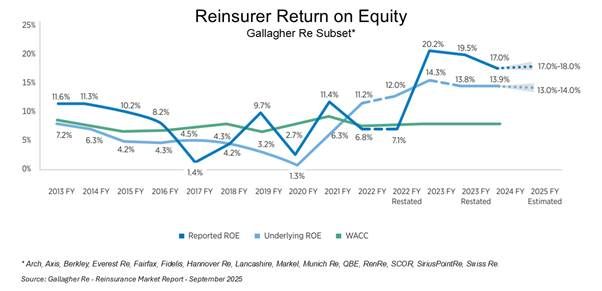
By way of further illustrating the level of recent profits in the sector, Lloyd’s of London has just announced their H1 2025 results and the pre-tax profits of Lloyd’s from 2023, 2024 and H1 2025 equal the aggregate profit and losses from the previous 15 years (from 2007 to 2022). Lloyd’s has not had the two back-to-back return on capital years of 20%+ it had in 2023 and 2024 since 2006 and 2007.

The introduction of IFRS 17 reporting for many specialty insurers and reinsurers has complicated comparative, historical and aggregate analysis in the sector so I will revert to Lloyd’s historical results as a benchmark for the sector’s history. Obviously, Lloyd’s results carry a significant degree of caution when used as a proxy for the whole sector and I would caveat their use by referring to a (now 10-year-old) post called “Lessons from Lloyds”. An updated breakdown of the Lloyd’s combined ratio from 1993 to H1 2025 is below.
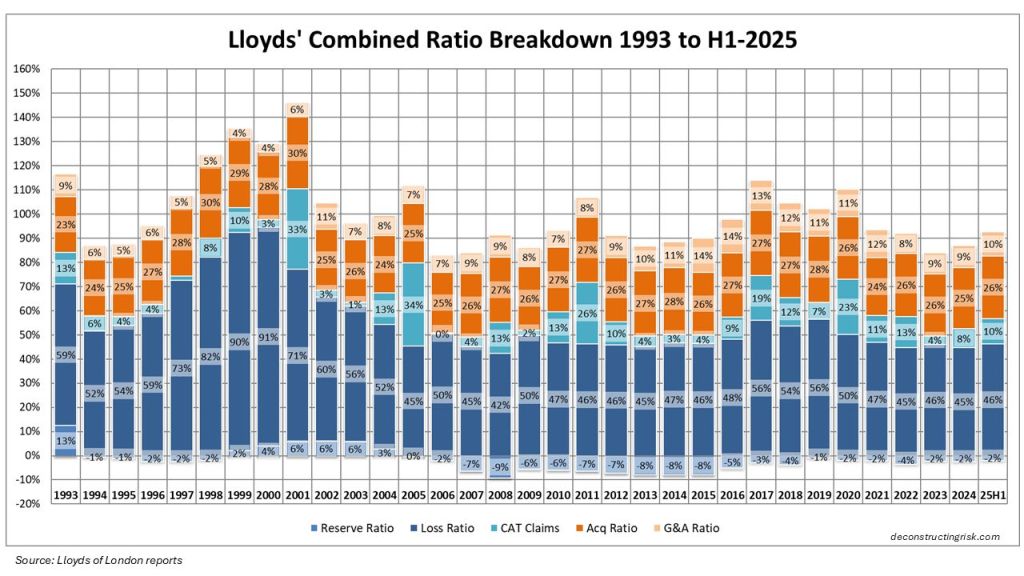
 30 year history of Lloyd's combined ratio, history of Lloyds of London

To illustrate the specialty underwriting cycle, I have discounted these combined ratios to adjust for the time value of money applicable for each year (i.e. a discount factor equal to the average annual 1 year T-Bill rate for each year over a duration of 24 months). The next metric I used to represent changes in market rates is the Guy Carpenter ROL index for property CAT reinsurance. Although this is clearly not representative of all specialty lines (see pricing and rate exhibits above) it gives a directional sense of rates for the overall sector, and it is measured on a consistent basis over an applicable long-term period. Combining these metrics with the inflated historical CAT insured losses for the post preceding this one gives the following graphic.
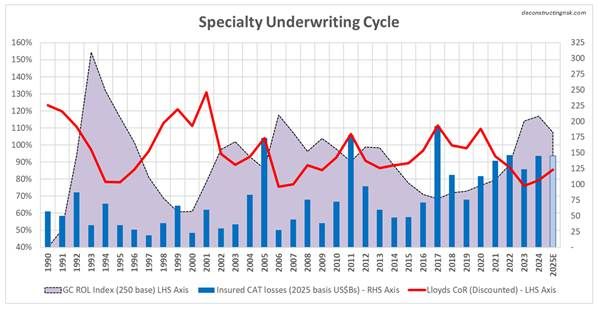
Specialty insurance cycle

In a highly unscientific way, I judgementally selected an ROL index base of 250 for the graphic as representing a level of adequacy akin to an 85% discounted combined ratio (as per 1996, 2003, 2009, and 2013). A 250 base indicates that the current 2025 index level has a further 7% to fall before becoming “inadequate”. This selection does assume that the sector has historically been able to adjust T&Cs, specifically attachment levels, to stay ahead of trend changes in insured CAT losses (at approx. 6-9% per year recently) due to factors such as loss inflation and climate change (an obviously BIG assumption!).

So, what does the above graphic illustrate? Accepting the (vast) limitations of my simplistic analysis, it indicates that the market today is at a similar stage in the rate cycle as we were in 2007 and 2014 (I would discount the 1990’s as the wild west in terms of London market underwriting behaviour). However, as highlighted by Beazley CEO Adrian Cox “in contrast to the previous softer cycle, there is a fundamental difference in today’s environment; the claims environment is active in respect to both frequency and severity, and uncertainty is elevated”. In the 2007 and 2013 years and the years that followed each, insured CAT losses were relatively low which fed the subsequent declines in rates. The CAT losses of 2011 and 2017 represented the bottom of each of the soft cycles albeit that the peak of 2012 and 2013 were short lived and it took a full 5 years over 2018 to 2022 for rates to get to an “adequate” level again.

Most (re)insurers would agree wholeheartedly in public with Cox when he says, “rate discipline is essential”. However, I suspect brokers and clients in Monte Carlo will be pushing hard to reduce rates further given the level of recent profits from the sector. Discipline but not yet will be the mantra and the level of insured losses (CAT or otherwise) over the remainder of 2025 will, I suspect, dictate how much softening of the current hard market will actually result in the January 2026 renewals and through 2026.

As a postscript, I also updated the graphic on underwriting and credit cycles to see if there were any further insights to be had, as below.
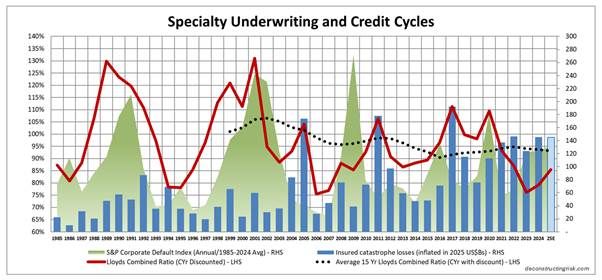
Specialty underwriting and credit cycle

The first thing to note is that credit and insurance cycles can be driven from the same event – 9/11 and COVID are obvious applicable cases. The graphic shows that the credit cycles over the past 20 years do not obviously influence the underwriting cycles with insured CAT losses being a much more relevant factor in the underwriting cycle.

The lack of a rush of new capital into the sector following major loss years have been an important factor over the past 20 years in shaping the character of underwriting cycles although economic and interest rate cycles do influence the level of capital which comes into the ILS market. It is interesting to note that with interest rates on a downward track currently, the appetite for CAT related returns from investors is again playing a part in the current availability of reinsurance, particularly retro, capacity. Memories can be short and it looks like it may take more CAT losses to reinforce to current ILS investors the risk they are taking on and the curse of “uncorrelated” tail exposure.

Finally, the impact of the policies of the mad Orange King and his sycophants, whom a wise commentator recently generously called “economic morons”, may just result in a return of a big beautiful credit crash akin to those of the past in the coming months and years which, were it to occur, would undoubtedly negatively impact everybody including (re)insurers.

It will be intriguing to see exactly how the 2026 renewal negotiations play out over the coming weeks and months.
​​​​


Low risk premia and leverage

The buzz from the annual insurance speed dating festival in Monte Carlo last week seems to have been subdued. Amid all the gossip about the M&A bubble, insurers and reinsurers tried to talk up a slowing of the rate of price decreases. Matt Weber of Swiss Re said “We’ve seen a slowing down of price decreases, although prices are not yet stable. We believe the trend will continue and we’ll see a stabilisation very soon”. However, analysts are not so sure. Moody’s stated that “despite strong signs that a more rational marketplace is emerging in terms of pricing, the expansion of alternative capital markets continues to threaten the traditional reinsurance business models”.  Fitch commented that “a number of fundamental factors that influence pricing remain negative” and that “some reinsurers view defending market share by writing business below the technical price floor as being an acceptable risk”. KBW comment that on-going pricing pressures will “eventually compressing underwriting margins below acceptable returns”.

It is no surprise then that much of the official comments from firms focused on new markets and innovation. Moody’s states that “innovation is a defence against ongoing disintermediation, which is likely to become more pronounced in areas in which reinsurers are not able to maintain proprietary expertise”. Munich Re cited developing new forms of reinsurance cover and partnering with hi-tech industries to create covers for emerging risks in high growth industries. Aon Benfield highlighted three areas of potential growth – products based upon advanced data and analytics (for example in wider indemnification for financial institutions or pharmaceuticals), emerging risks such as cyber, and covering risks currently covered by public pools (like flood or mortgage credit). Others think the whole business model will change fundamentally. Stephan Ruoff of Tokio Millennium Re said “the traditional insurance and reinsurance value chain is breaking up and transforming”. Robert DeRose of AM Best commented that reinsurers “will have a greater transformer capital markets operation”.

Back in April 2013, I posed the question of whether financial innovation always ends in reduced risk premia (here). The risk adjusted ROE today from a well spread portfolio of property catastrophe business is reportingly somewhere between 6% and 12% today (depending upon who you ask and on how they calculate risk adjusted capital). Although I’d be inclined to believe more in the lower range, the results are likely near or below the cost of capital for most reinsurers. That leads you to the magic of diversification and the over hyped “non-correlated” feature of certain insurance risks to other asset classes. There’s little point in reiterating my views on those arguments as per previous posts here, here and here.

In the last post cited above, I commented that “the use by insurers of their economic capital models for reinsurance/retrocession purchases is a trend that is only going to increase as we enter into the risk based solvency world under Solvency II”. Dennis Sugrue of S&P said “we take some comfort from the strength of European reinsurers’ capital modelling capabilities”, which can’t but enhance the reputation of regulatory approved models under Solvency II. Some ILS funds, such as Twelve Capital, have set up subordinated debt funds in anticipation of the demand for regulatory capital (and provide a good comparison of sub-debt and reinsurance here).

One interesting piece of news from Monte Carlo was the establishment of a fund by Guy Carpenter and a new firm founded by ex-PwC partners called Vario Partners. Vario states on their website they were “established to increase the options to insurers looking to optimise capital in a post-Solvency II environment” and are proposing private bonds with collateral structured as quota share type arrangements with loss trigger points at 1-in-100 or 1-in-200 probabilities. I am guessing that the objective of the capital relief focussed structures, which presumably will use Vario proprietary modelling capabilities, is to allow investors a return by offering insurers an ability to leverage capital. As their website saysthe highest RoE is one where the insurer’s shareholders’ equity is geared the most, and therefore [capital] at it’s thinnest”. The sponsors claim that the potential for these bonds could be six times that of the cat bond market. The prospects of allowing capital markets easy access to the large quota share market could add to the woes of the current reinsurance business model.

Low risk premia and leverage. Now that’s a good mix and, by all accounts, the future.

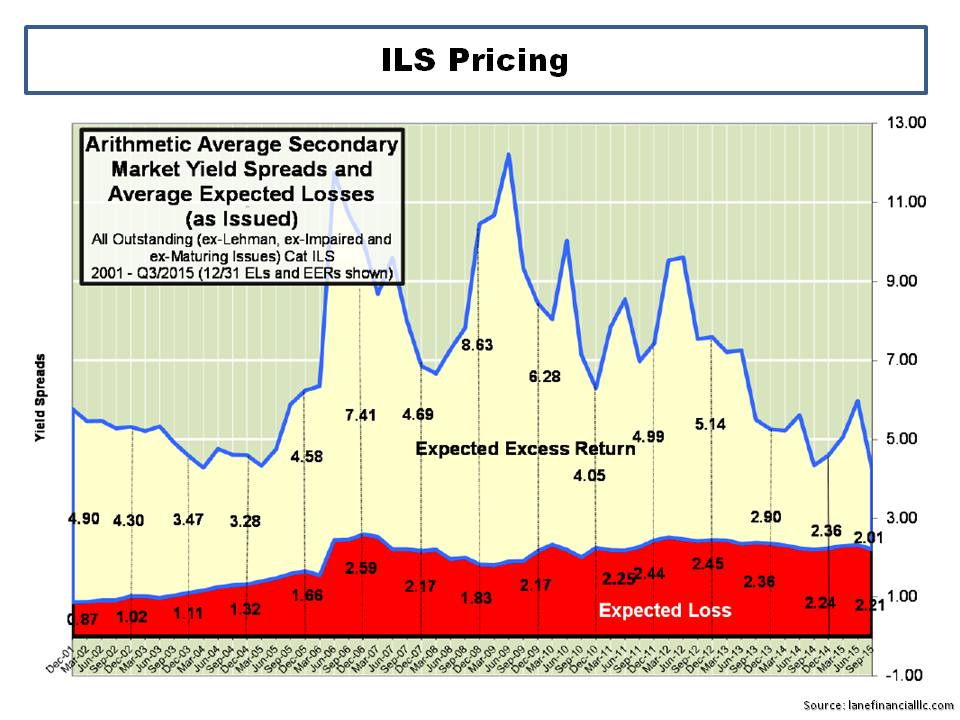
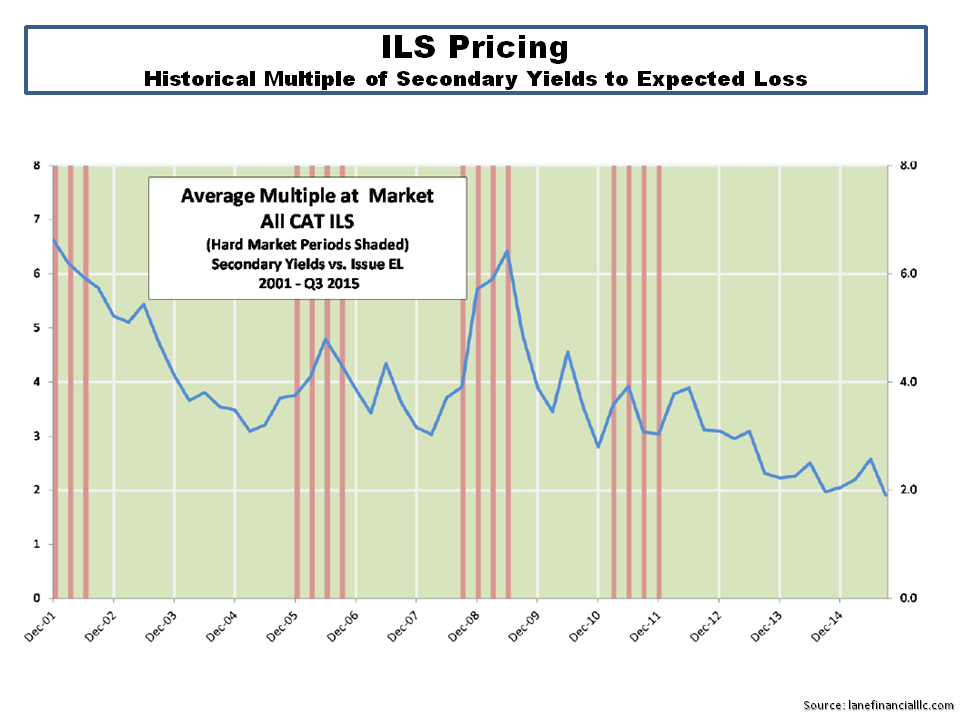
Follow-on (13th October 2015): Below are two graphs from the Q3 report from Lane Financial LLC which highlight the reduced risk premia prevalent in the ILS public cat bond market.

click to enlargeILS Pricing September 2015

click to enlargeILS Price Multiples September 2015

Same old guff

Now that the US hurricane season is over without any material events, I had a quick look over a few transcripts of conference calls in the specialty insurance and reinsurance sectors to see if there was any interesting comments on where the market is going.

Nearly everybody claims to be mitigating the challenging market conditions by ducking & diving between business classes whilst keeping their overall underwriting discipline. The softness in the reinsurance market has spread into the insurance market, albeit not to the same extent. The reality is that results continue to be flattered by reserve releases, low loss activity and improved loss trends. Market realities are slowly being reflected in ROEs which are coming down to the low double digits.

Nearly all of the reinsurers are claiming to be the winners in the structural changes in the “tiering” of the market whereby cedants are reducing their reinsurance spend and concentrating that spend amongst a select group of reinsurers. Everybody has special relationships and the gravity defying underwriters! That same old guff was the typical response in the late 1990s.

The only interesting comment that I could find was from the ever colourful Ed Noonan of Validus who, after claiming that not everybody is as disciplined as they claim (he was talking about the large generalist reinsurers), said the following:

“It’s unfortunate because the market has had such strong discipline for the last decade. There are no magical segments that are beautifully priced, and the idea that a well-diversified portfolio poorly priced risk makes sense is an economic capital model-based fantasy.”

The last sentence reminds me of one of my favourite quotes from Jim Leitner of Falcon Management that “there is no real diversification in owning a portfolio of overvalued assets“.

My view is that few economic capital models in the insurance market which are currently being used to allocate capital to business classes are taking such arguments seriously enough and most are likely over-estimating the benefit of diversification across soft or under-priced portfolios.


CaT pricing “heading for the basement”

Edward Noonan of Validus is always good copy and the Q1 conference call for Validus provided some insight into the market ahead of the important July 1 renewals. When asked by an analyst whether the catastrophe market was reaching a floor, Noonan answered that “I’m starting to think we might be heading for the basement”.

He also said “I think the truly disruptive factor in the market right now is ILS money. I made a comment that we’ve always viewed the ILS manager business behaving rationally. I can’t honestly say that (anymore with) what we’re seeing in Florida right now. I mean we have large ILS managers who are simply saying – whatever they quote we will put out a multi-hundred million dollar line at 10% less.

I have posted many times on the impact of new capital in the ILS market, more recently on the assertion that ILS funds havw a lower cost of capital. Noonan now questions whether investors in the ILS space really understand the expected loss cost as well as experienced traditional players. Getting a yield of 5% or lower now compared to 9% a few short years ago for BBB – risks is highlighted as an indication that investors lack a basic understanding of what they are buying. The growing trend of including terrorism risks in catastrophe programmes is also highlighted as a sign that the new market players are mispricing risk and lack basic understanding on issues such as a potential clash in loss definitions and wordings.

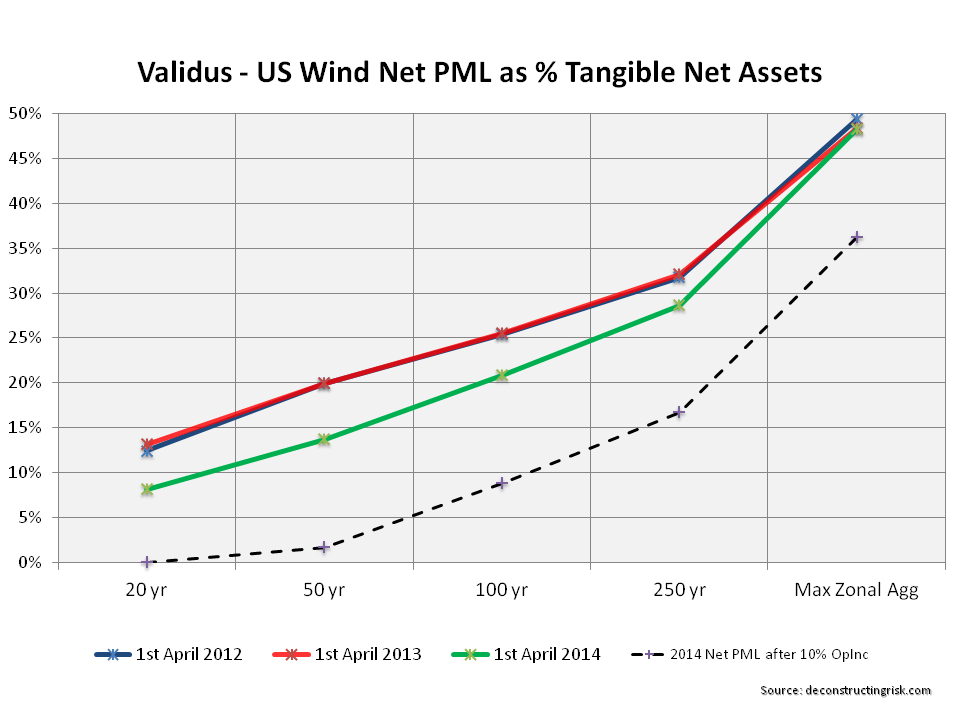
Validus highlight how they are disciplined in not renewing underpriced risk and arbitraging the market by purchasing large amounts of collaterised reinsurance and retrocession. They point to the reduction in their net risk profile by way of their declining PMLs, as the graph below of their net US wind PMLs as a percentage of net tangible assets illustrates.

This is positive provided the margins on their core portfolio don’t decrease faster than the arbitrage. For example, Validus made underwriting income in 2012 and 2013 of 6% and 17% of their respective year-end net tangible assets. The graph below also shows what the US Wind PML would be reduced by if an operating profit of 12% (my approximation of a significant loss free 2014 for Validus) could be used to offset the US Wind net losses. Continuing pricing reductions in the market could easily make a 12% operating profit look fanciful.

click to enlargeValidus Net US Wind PML as % of tangible net assets

I think that firms such as Validus are playing this market rationally and in the only way you can without withdrawing from core (albeit increasingly under-priced) markets. If risk is continually under-priced over the next 12 to 24 months, questions arise about the sustainability of many existing business models. You can outrun a train moving out of a station but eventually you run out of platform!

Pricing Pressures & Risk Profiles

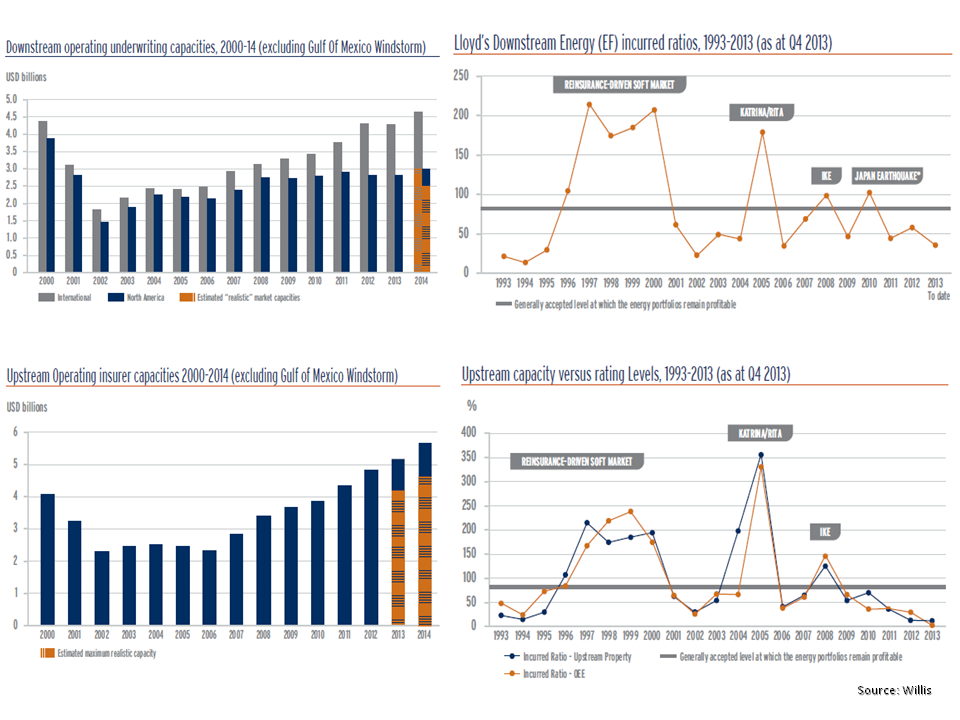
There have been some interesting developments in the insurance market this week. Today, it was announced that Richard Brindle would retire from Lancashire at the end of the month. The news is not altogether unexpected as Brindle was never a CEO with his ego caught up in the business. His take it or leave it approach to underwriting and disciplined capital management are engrained in Lancashire’s DNA and given the less important role of personalities in the market today, I don’t see the sell-off of 5% today as justified. LRE is now back at Q3 2011 levels and is 25% off its peak approximately a year ago. As per a previous post, the smaller players in the specialty business face considerable challenges in this market although LRE should be better placed than most. A recent report from Willis on the energy market illustrates how over-capacity is spreading across specialist lines. Some graphs from the report are reproduced below.

click to enlargeEnergy Insurance Market Willis 2013 Review

One market character who hasn’t previously had an ego check issue is John Charman and this week he revealed a hostile take-over of Aspen at a 116% of book value by his new firm Endurance Specialty. The bid was quickly rejected by Aspen with some disparaging comments about Endurance and Charman. Aspen’s management undoubtedly does not relish the prospect of having Charman as a boss. Consolidation is needed amongst the tier 2 (mainly Bermudian) players to counter over-capacity and compete in a market that is clustering around tier 1 global full service players. Although each of the tier 2 players has a different focus, there is considerable overlap in business lines like reinsurance so M&A will not be a case of one and one equalling two. To be fair to Charman the price looks reasonable at a 15% premium to Aspen’s high, particularly given the current market. It will be fascinating to see if any other bidders emerge.

After going ex-dividend, Swiss Re also took a dive of 9% this week and it too is at levels last seen a year ago. The dive was unusually deep due to the CHF7 dividend (CHF3.85 regular and CHF4.15 special). Swiss Re’s increasingly shareholder friendly policy makes it potentially attractive at its current 112% of book value. It is however not immune from the current market pricing pressures.

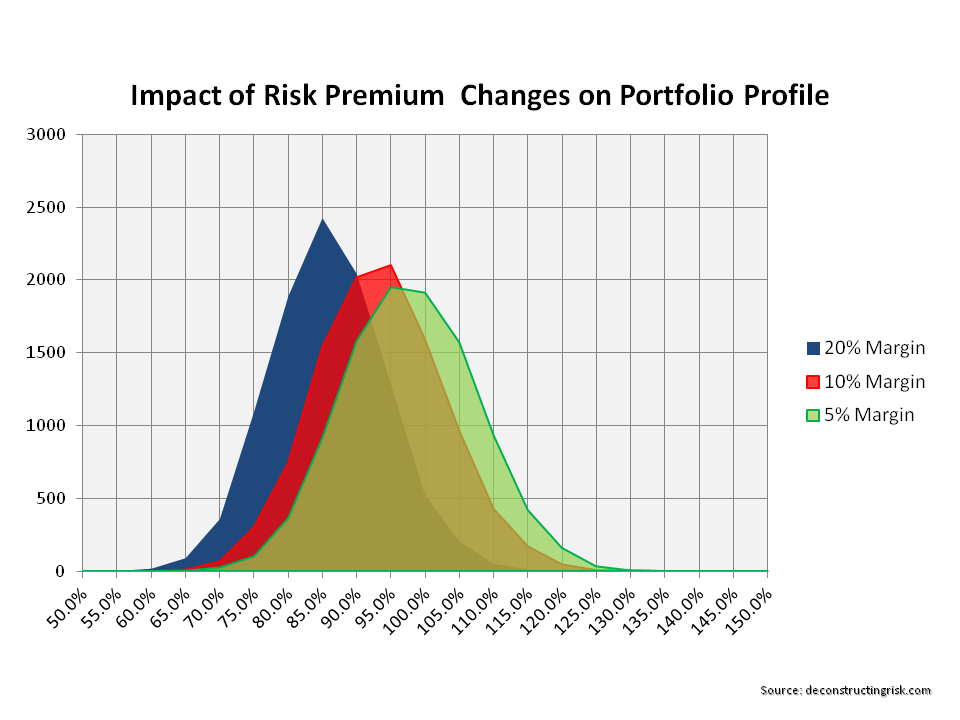
After doing some work recently on the impact of reducing premium rates, I built a very simple model of a portfolio of 10,000 homogeneous risks with a loss probability of 1%. Assuming perfect burning cost rating (i.e. base rate set at actual portfolio mean), the model varied the risk margin charged. I ran the portfolio through 10,000 simulations to get the resulting distributions. As the graph below shows, a decreasing risk margin not only shifts the distribution but also changes the shape of the distribution.

click to enlargeRisk Premium Reductions & Insurance Portfolio Risk Profile

This illustrates that as premium rates decline the volatility of the portfolio also increases as there is less of a buffer to counter variability. In essence, as the market continues to soften, even with no change in loss profile, the overall portfolio risk increases. And that is why I remain cautious on buying back into the sector even with the reduced valuations of firms like Lancashire and Swiss Re.