Monthly Archives: September 2013

Insurance & capital market convergence hype is getting boring

As the horde of middle aged (still mainly male) executives pack up their chinos and casual shirts, the overriding theme coming from this year’s Monte Carlo Renez-Vous seems to be impact of the new ILS capacity or “convergence capital” on the reinsurance and specialty insurance sector. The event, described in a Financial Times article as “the kind of public display of wealth most bankers try to eschew”, is where executives start the January 1 renewal discussions with clients in quick meetings crammed together in the luxury location.

The relentless chatter about the new capital will likely leave many bored senseless of the subject. Many may now hope that, just like previous hot discussion topics that were worn out (Solvency II anybody?), the topic fades into the background as the reality of the office huts them next week.

The more traditional industry hands warned of the perils of the new capacity on underwriting discipline. John Nelson of Lloyds highlighted that “some of the structures being used could undermine some of the qualities of the insurance model”. Tad Montross of GenRe cautioned that “bankers looking to replace lost fee income” are pushing ILS as the latest asset class but that the hype will die down when “the inability to model extreme weather events accurately is better understood”. Amer Ahmed of Allianz Re predicted the influx “bears the danger that certain risks get covered at inadequate rates”. Torsten Jeworrek of Munich Re said that “our research shows that ILS use the cheapest model in the market” (assumingly in a side swipe at AIR).

Other traditional reinsurers with an existing foothold in the ILS camp were more circumspect. Michel Lies of Swiss Re commented that “we take the inflow of alternative capital seriously but we are not alarmed by it”.

Brokers and other interested service providers were the loudest cheerleaders. Increasing the size of the pie for everybody, igniting coverage innovative in the traditional sector, and cheap retrocession capacity were some of the advantages cited. My favourite piece of new risk management speak came from Aon Benfield’s Bryon Ehrhart in the statement “reinsurers will innovate their capital structures to turn headwinds from alternative capital sources into tailwinds”. In other words, as Tokio Millennium Re’s CEO Tatsuhiko Hoshina said, the new capital offers an opportunity to leverage increasingly diverse sources of retrocessional capacity. An arbitrage market (as a previous post concluded)?

All of this talk reminds me of the last time that “convergence” was a buzz word in the sector in the 1990s. For my sins, I was an active participant in the market then. Would the paragraph below from an article on insurance and capital market convergence by Graciela Chichilnisky of Columbia University in June 1996 sound out of place today?

“The future of the industry lies with those firms which implement such innovation. The companies that adapt successfully will be the ones that survive. In 10 years, these organizations will draw the map of a completely restructured reinsurance industry”

The current market dynamics are driven by low risk premia in capital markets bringing investors into competition with the insurance sector through ILS and collaterised structures. In the 1990s, capital inflows after Hurricane Andrew into reinsurers, such as the “class of 1992”, led to overcapacity in the market which resulted in a brutal and undisciplined soft market in the late 1990s.

Some (re)insurers sought to diversify their business base by embracing innovation in transaction structures and/or by looking at expanding the risks they covered beyond traditional P&C exposures. Some entered head first into “finite” type multi-line multi-year programmes that assumed structuring could protect against poor underwriting. An over-reliance on the developing insurance models used to price such transactions, particularly in relation to assumed correlations between exposures, left some blind to basic underwriting disciplines (Sound familiar, CDOs?). Others tested (unsuccessfully) the limits of risk transfer and legality by providing limited or no risk coverage to distressed insurers (e.g. FAI & HIH in Australia) or by providing reserve protection that distorted regulatory requirements (e.g. AIG & Cologne Re) by way of back to back contracts and murky disclosures.

Others, such as the company I worked for, looked to cover financial risks on the basis that mixing insurance and financial risks would allow regulatory capital arbitrage benefits through increased diversification (and may even offer an inflation & asset price hedge). Some well known examples* of the financial risks assumed by different (re)insurers at that time include the Hollywood Funding pool guarantee, the BAe aircraft leasing income coverage, Rolls Royce residual asset guarantees, dual trigger contingent equity puts, Toyota motor residual value protection, and mezzanine corporate debt credit enhancement  coverage.

Many of these “innovations” ended badly for the industry. Innovation in itself should never be dismissed as it is a feature of the world we live in. In this sector however, innovation at the expense of good underwriting is a nasty combination that the experience in the 1990s must surely teach us.

Bringing this back to today, I recently discussed the ILS market with a well informed and active market participant. He confirmed that some of the ILS funds have experienced reinsurance professionals with the skills to question the information in the broker pack and who do their own modelling and underwriting of the underlying risks. He also confirmed however that there is many funds (some with well known sponsors and hungry mandates) that, in the words of Kevin O’Donnell of RenRe, rely “on a single point” from a single model provided by to them by an “expert” 3rd party.

This conversation got me to thinking again about the comment from Edward Noonan of Validus that “the ILS guys aren’t undisciplined; it’s just that they’ve got a lower cost of capital.” Why should an ILS fund have a lower cost of capital to a pure property catastrophe reinsurer? There is the operational risk of a reinsurer to consider. However there is also operational risk involved with an ILS fund given items such as multiple collateral arrangements and other contracted 3rd party service provided functions to consider. Expenses shouldn’t be a major differing factor between the two models. The only item that may justify a difference is liquidity, particularly as capital market investors are so focussed on a fast exit. However, should this be material given the exit option of simply selling the equity in many of the quoted property catastrophe reinsurers?

I am not convinced that the ILS funds should have a material cost of capital advantage. Maybe the quoted reinsurers should simply revise their shareholder return strategies to be more competitive with the yields offered by the ILS funds. Indeed, traditional reinsurers in this space may argue that they are able to offer more attractive yields to a fully collaterised provider, all other things being equal, given their more leveraged business model.

*As a complete aside, an article this week in the Financial Times on the anniversary of the Lehman Brothers collapse and the financial crisis highlighted the role of poor lending practices as a primary cause of significant number of the bank failures. This article reminded me of a “convergence” product I helped design back in the late 1990s. Following changes in accounting rules, many banks were not allowed to continue to hold general loan loss provisions against their portfolio. These provisions (akin to an IBNR type bulk reserve) had been held in addition to specific loan provision (akin to case reserves). I designed an insurance structure for banks to pay premiums previously set aside as general provisions for coverage on massive deterioration in their loan provisions. After an initial risk period in which the insurer could lose money (which was required to demonstrate an effective risk transfer), the policy would act as a fully funded coverage similar to a collaterised reinsurance. In effect the banks could pay some of the profits in good years (assuming the initial risk period was set over the good years!) for protection in the bad years. The attachment of the coverage was designed in a way similar to the old continuous ratcheting retention reinsurance aggregate coverage popular at the time amongst some German reinsurers. After numerous discussions, no banks were interested in a cover that offered them an opportunity to use profits in the good times to buy protection for a rainy day. They didn’t think they needed it. Funny that.
Factors impacting AIG’s valuation

AIG stock has been the subject of much investor attention in recent times and has doubled over the past 24 months. The new AIG has become a hedge fund favourite, the 3rd most popular stock according to Goldman Sachs. I did briefly look over AIG at the end of 2010 when it traded around $35 but concluded there was too much uncertainty around its restructuring and I particularly didn’t like the P&C reserve deteriorations in 2009 and 2010. The stock fell below $25 in 2011 before reversing and beginning its recent accent above $45 as further clarity on its business performance emerged. I figured now is a good time to give the new AIG another look.

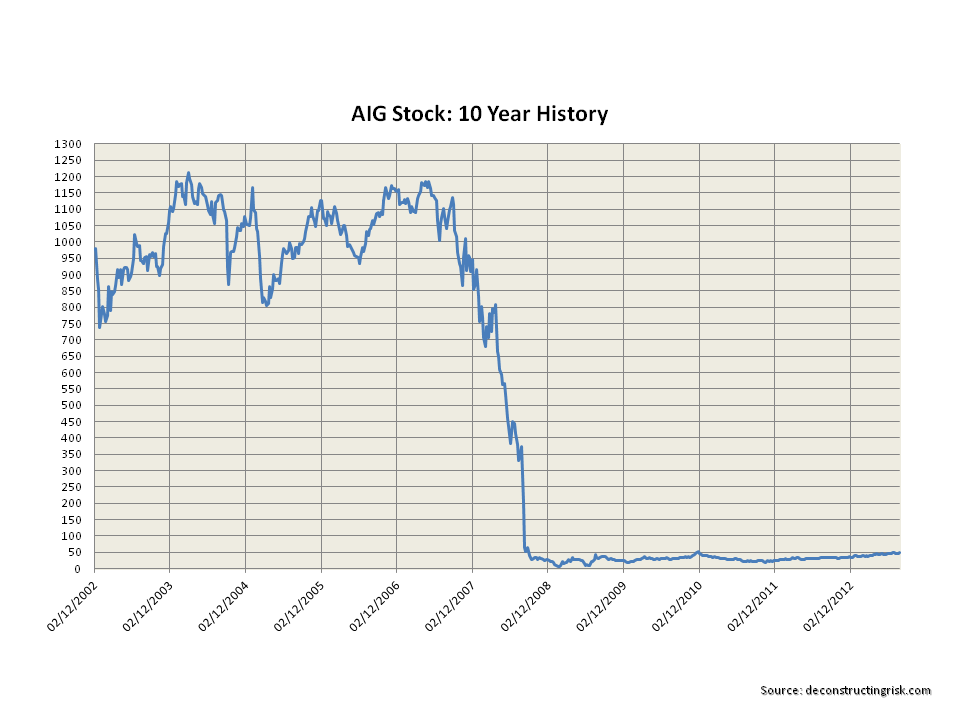
Unless you have been living on Mars, everybody is aware that AIG has had a very colourful history and, although it’s past is not the focus of this post, the graph below of the 10 year history of the stock is a reminder of the grim fate suffered by its equity holders with the current price still only about 5% of the pre-crash average. For what it is worth, the 2005 Fortune article “All I want in life is an unfair advantage” and the 2009 Vanity Fair article “The Man Who Crashed the World” by Michael Lewis are two of my favourites on the subject and worth a read.

click to enlargeAIG 10 year stock price

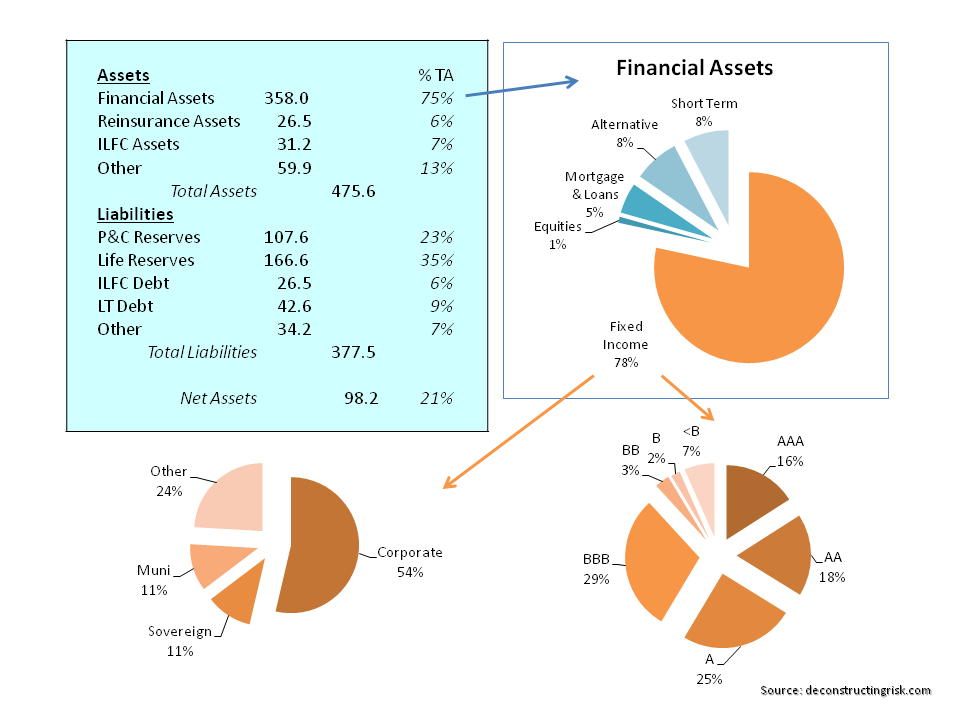
To understand the new AIG we need to review the current balance sheet and the breakdown of the sources of net income since 2010. The balance sheet (excluding segregated assets & liabilities) as at Q2 2013 is represented in the exhibit below.

click to enlargeAIG Balance Sheet & Assets

AIG’s liquid assets look reasonably diverse and creditworthy although these assets should really be looked at in their respective business units. The P&C assets are the more conservative and look in line with their peers. The life and retirement assets are riskier and reflect the underling product mix and risk profile of that business.

Another item to note is the $31.2 billion of aircraft leasing assets from ILFC against the $26.5 billion of liabilities representing $4.7 billion of net assets. AIG’s deal to sell 80% of ILFC to a Chinese consortium for book value looks like it may fall apart. If it does, the possibility of going down the IPO route is now a realistic option, absent a change in current market conditions.

The next item to note is the other assets representing 13% of total assets. These are primarily made up of $20 billion of deferred taxes, $9 billion of DAC, $14 billion of premium receivables, and $15 billion of various assets. This last item includes $2.8 billion of fair value derivative assets which correspond to $3.1 billion of fair value derivative liabilities. The notional value of these assets and liabilities is approximately $90 billion and $110 billion respectively from primarily interest rate contracts but also FX, equity, commodity and credit derivatives that are not designated for hedging purposes. The majority (about 2/3rd) of these are from the Global Capital Markets division which includes the run-off of the infamous AIG Financial Products (AIGFP) unit.

AIG’s non-life reserves, at $108 billion, have been a source of volatility in the past with significant strengthening required in 2002, 2004, 2005, 2009 and 2010. The life and retirement reserves are split $121 billion of policyholder contracts (including guaranteed variable annuity products like GMWB), $5 billion of other policyholder funds, and $40 billion of mortality and morbidity reserves.

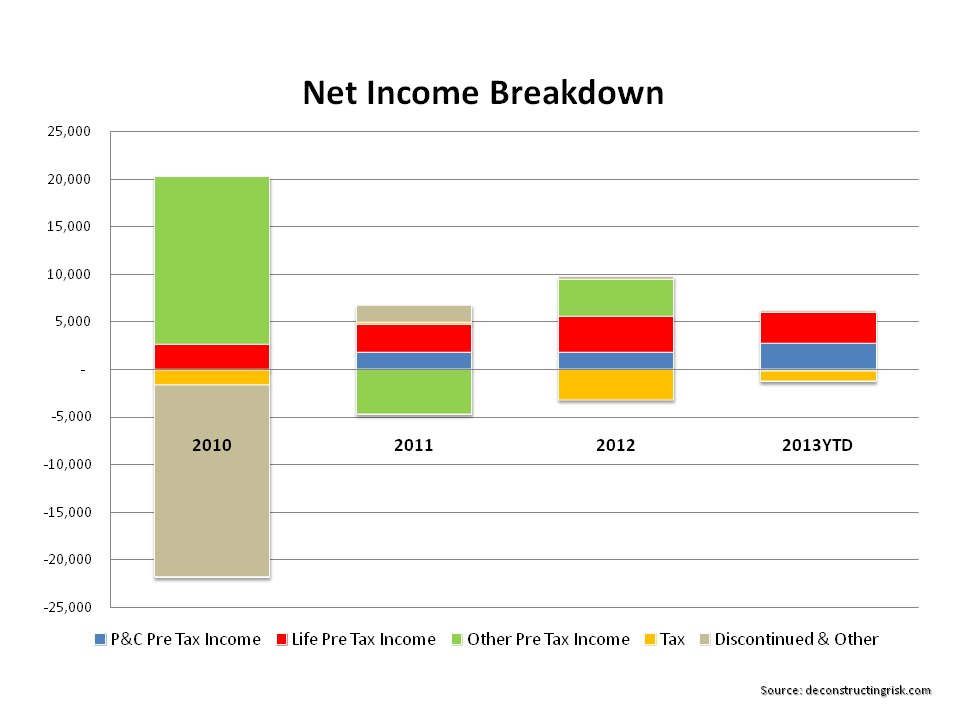
A breakdown of AIG’s net income since 2010 shows the sources of profit and losses as per the graph below.

click to enlargeAIG Net Income Breakdown 2010 to Q22013

The graph shows that the impact of discontinued operations has been playing less of a part in the net income line. It also points to the need to understand the importance of the other business category in 2011 and 2012 as well as the relative underperformance in the P&C division in contributing to net income for 2010 to 2012.

In 2011, contributors to other pre-tax income included a $1.7 billion impairment charge on ILFC’s fleet and a net $2.9 billion charge due to the termination of the New York Fed credit facility. 2012 net income included a $0.8 billion gain on the sale of AIA shares and an increase of $2.9 billion in the fair value of AIG’s interest in Maiden Lane III (the vehicle created during the AIG bailout for AIGFP’s CDO credit default swap portfolio). These 2012 gains were partially offset by an increase of $0.8 billion in litigation reserves.

AIG bulls point to the 2013 YTD performance. Improved operating margins in the core P&C and life/retirement units have combined with income from the other activities (mortgage business, Global Capital Markets & Direct Investment portfolios) covering corporate and interest expenses and any other one off charges (such as those in the paragraph above). This performance has led analysts to predict 2013 EPS around $4.20 and 2014 EPS of $4.30 to $4.50.

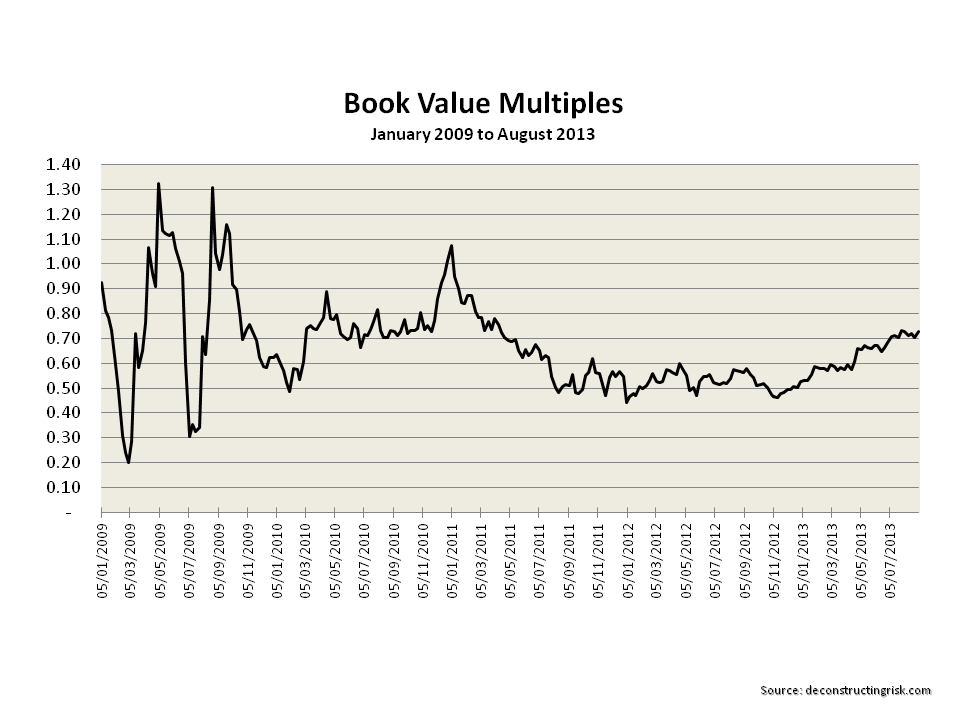
AIG has traded at a significant discount to its peers on a book value basis as a result of its troubled past and currently trades at 0.73. The graphs below uses recently published book values and book value excluding Accumulated Other Comprehensive Income (AOCI) which have been the subject to adjustment and reinstatement and may not therefore reflect the book values published at the time.

click to enlargeAIG stock price to book values 2009 to August 2013

AIG Book Value Multiples 2009 to August 2013

In summary, the factors impacting the current AIG valuation are the significant book value discount as a result of AIG’s history, the uncertainty around the ILFC sale, the future prospects of the core P&C and life/retirement units, and the historical volatility in the other operating business lines (and the potential for future volatility!). Each of these items need to be understood further before any conclusions can be reached on whether AIG is currently undervalued or overvalued. In a follow-on post on AIG I will try to dig deeper into each of these factors and also offer my thoughts on future performance and valuation of the new AIG.

Trinity Biotech valuation leaves little room for error

Trinity Biotech plc (TRIB) is a developer and manufacturer of diagnostic products for the point-of-care (POC) and clinical laboratory markets.

Trinity’s POC products primarily relate to testing for the presence of HIV antibodies and made up 23% of 2012 revenues. Within the clinical laboratory product lines, there are three product portfolios – namely infectious diseases, diabetes and life science supply.

Trinity’s largest and most diverse clinical laboratory product portfolio, at 37% of 2012 revenues, relates to tests for diagnosing a broad range of infectious diseases including kits for autoimmune diseases (e.g. lupus, celiac and rheumatoid arthritis), hormonal imbalances, sexually transmitted diseases (syphilis, chlamydia and herpes), intestinal infections, lung/bronchial infections, cardiovascular, lyme and a wide range of other diseases.

The next largest clinical laboratory product portfolio, at 28% of 2012 revenues, come from Trinity Biotech’s 2005 acquisition of Primus Corporation and primarily relate to instruments and products for in-vitro diagnostic testing, using patented HPLC (high pressure liquid chromatography) technology, for haemoglobin A1c used in the monitoring of diabetes. One of the key drivers of future growth for TRIB is its latest device, Premier Hb9210, for detecting and monitoring diabetes which was launched in 2011.

Trinity’s final clinical laboratory product portfolio, at 12% of 2012 revenues, relates to reagent products used for the diagnosis of many disease states from liver and kidney disease.

A split of TRIB’s revenues for the past 3 years by product portfolio and geographical regions is as per the graph below.

click to enlargeTRIB Revenue Split

TRIB has been on a rollercoaster ride through its past as the graph below of its share price and diluted EPS from 2000 to today shows.

click to enlargeTRIB Historical Diluted EPS and Share Price

TRIB’s shares dropped from a high of $20 in 2004 to a low just above $1 in 2009 and have since climbed steadily over the past 5 years to around $19 today. In 2007 and 2008, $19 million and $86 million of goodwill were written off in each year plus a few million in restructuring expenses and inventory over the two years after a number of missteps and lacklustre results.

In 2010, TRIB sold its lower margin coagulation business for $90 million which resulted in a net gain of $46.5 million for the 2010 financial year. Acquisitions have always been a key aspect of TRIB’s business model and following the sale of the coagulation business, TRIB acquired Phoenix Bio-tech Corp in 2011 and Fiomi Diagnostic in 2012. These companies made products for the detection of syphilis and tests for cardiac arrest and heart failure. In July 2013, TRIB announced the acquisition of Immco Diagnostics Inc for $32.75 million. Immco is a US diagnostic company specializing in the speciality autoimmune segment, where the competition is limited to a small number of key players, for conditions such as Rheumatoid Arthritis, Vasculitis, Lupus, Celiac and Crohn’s disease, Ulcerative Colitis, Neuropathy, Hashimoto’s and Graves disease.

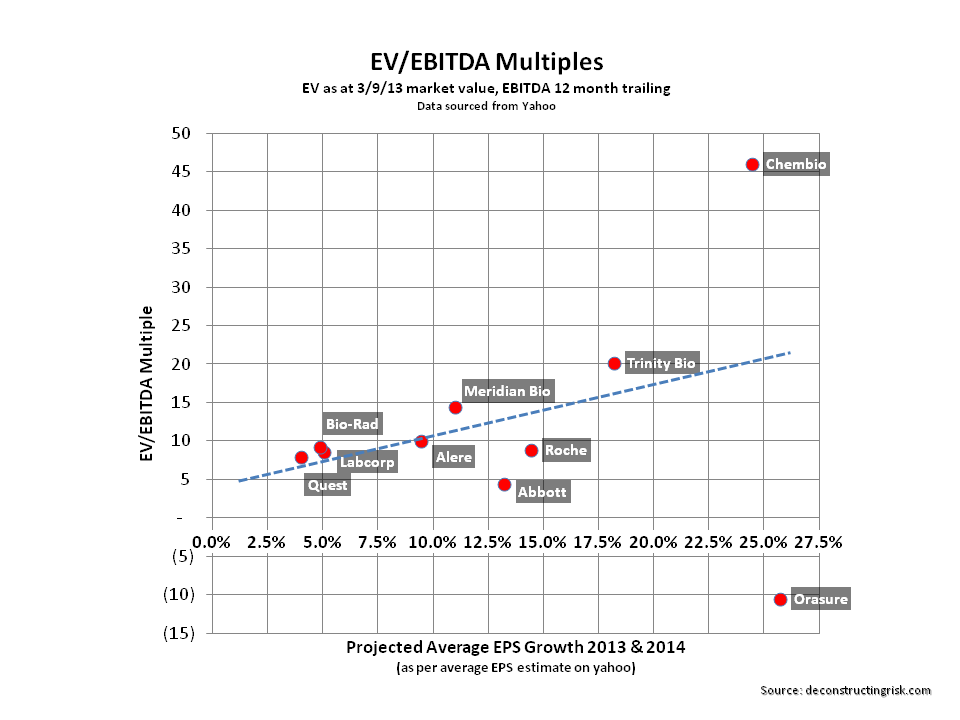
Generally, the entire Diagnostic Industry is set to gain from the ageing population and a rising demand for rapid test evaluations. TRIB has some core product catalysts over the next few years including the ramping up of sales of the Premier instruments for diabetes, its new cardiac product portfolio from Fiomi, a new range of POC products, and now the Immco acquisition. Gross margins are around a healthy 50% with net operating margins around 20%. With no debt and a healthy cash pile (albeit a reduced one to about $30 million after the Immco acquisition), TRIB’s valuation has screamed ahead. The graph below shows its current EV/EBITDA multiple (adjusted for Immco purchase) against its peers using the analyst expected EPS growth from 2012 to 2014 (sourced from yahoo).

click to enlargeTRIB EV EBITDA Peer Multiples

TRIB’s valuation is clearly at a premium to its peers (Chembio and Orasure have their own issues and are smaller and less diversified than TRIB). So is it justified?

The first thing to note is that TRIB’s intangibles have risen steadily since the 2007/8 writedowns on recent acquisitions to $75 million at year end 2012 and may touch the $100 million mark following the acquisition of Immco (this level of intangibles has not been seen since 2007). The company does provide detail in its 20F filing on its impairment methodology and the discounts used in its goodwill calculation.

Based upon the company’s own guidance and the latest conference call, I have calculated initial EBITDA and EPS projections. Analysts estimate 0.80 and 1.06 EPS for 2013 and 2014. My projections generally agree with these EPS projections and also show EPS growth of 20% a year thereafter for 2015 to 2017. Based upon TRIB reverting to a more normal sector EV/EBITDA multiple of 15 in the medium term, I can see a reasonable target for TRIB of $30/$35 by 2016/17.

However, there is a lot of assumptions and execution risks in my analysis. My current risk appetite means that I would prefer to wait on the side-lines for a better entry point than the current $19. It seems to me that $16 or below would be an attractive risk/reward for a 3 to 4 year play (subject to relative macro-economic stability). That strategy risks the possibility of the boat already having sailed on this one as flawless execution on the Q3 and Q4 EPS may push the stock into the mid 20’s.

TRIB is a quality company with hard won experiences and an exciting product pipeline. For me, it’s a pity about the frothy valuation.

Siegel versus Shiller on CAPE

Following on from last week’s post citing the Shilling PE ratio, also called the cyclically adjusted price earnings ratio or CAPE, there was an interesting article in today’s FT referring to Jeremy Siegel’s previous critique of Robert Shiller’s bearish CAPE.

Siegel points to the current S&P500 level at a 15 to 16 times 2013 estimated earnings as being close to its historical average suggesting the CAPE is overtly negative. Siegel points out that the CAPE has been bearishly above its long term average for the past 22 years, except for a brief 9 month spell.

Siegel believes that the underlying earnings in the calculation need to be adjusted for accounting changes in the 1990s that required downward only adjustment to book values when asset prices are depressed without a rebalancing upwards when asset prices are rising. According to Siegel, using more appropriate National Income and Product (NIPA) profit data in the CAPE calculation results in a much more bullish CAPE indicator.

Another issue with the underlying data is the increase in profit margins over the past 15 years due to varying (and generally lower) global corporate tax rates, the rise of technology firms with fatter margins, and generally stronger corporate balance sheets.

Finally, Siegel points to the macroeconomic environment whereby periods of low interest and inflation rates justify higher PE ratios.

The FT article points to research by the London Business School that indicate the CAPE based upon data available at the time (“out of sample date”) is a poor historical indicator for timing entries and exits in the market. The research concludes there is no consistent relationship between forecasts and outcomes.

This research and Siegel’s criticism make valid points. Historical data does need to be viewed in the context of the reporting standards of the time. However, I would be sceptical about arguments about higher long term margins and that the current macro environment justifies higher multiples (as highlighted in a previous post). The fact is that we are in unchartered territory in terms of massive Central Bank market intervention and the macro environment across the globe presents considerable challenges in getting back to a normalised situation.

The fact that Shiller’s CAPE has been bearish for so long may make the case for some adjustment. The difficulty is that once we start making adjustments to fit the current situation the validity of the underlying metric is compromised. It is too simplistic to look at a single measure to justify investment decisions. Equally ignoring one measure over another when they indicate contrary views is naïve. Overall, I am more in the Shiller camp than the Siegel camp. Notwithstanding my expectation that we are due some Autumn volatility, I would purchase quality stocks on the dip if their valuation justified it. But the macroeconomic environment scares me so I am conscious of Andres Drobny’s advise that following the financial crisis one should always “change your views as facts change“. The difficulty, of course, is knowing when the facts are changing before its too obvious (and in all likelihood too late)!