Category Archives: Investing Ideas

Uniting Gamesters

BWIN’s on-going search to “create shareholder value” seems to be moving on with the announcement that it “has entered into preliminary discussions with a number of interested parties regarding a variety of potential business”. A previous post on a number of the main players in the European gambling sector highlighted that William Hill and Paddy Power were speculated to be potential bidders for all or parts of BWIN, a European online gaming firm with a concentration of approx 25% of revenues from Germany. Now press reports speculate the potential interested parties include the Canadian firm Amaya, who purchased PokerStars/Full Tilt earlier this year, and Playtech, a software gaming firm that are “seeking transformational M&A opportunities to take the business to the next level”.

Commentators raised an eyebrow about the speculated 45% premium on offer (from before discussions were reported) given BWIN’s operating metrics and the uncertainty over the key German market. Speculation involving Playtech focussed on their recent debt raising which brings their cash-pile to around €700 million. Playtech’s shareholders may not be too pleased if their new strategy moves too far away from the very profitable software business, particularly considering the alternative of continuing with their generous special dividends. Taking on businesses such as BWIN, or even another speculated target like Ladbrokes, is a far cry from what made Playtech such a star.

In fact, the best performer in the sector (in fact the only name that’s in positive territory!) is the reinvigorated Betfair under Breon Corcoran (see previous post on Betfair) as can be seen below (they also have cash to spend on potential M&A).

click to enlargeShare price YTD selected betting stocks

This is a fascinated sector that is in the midst of considerable change. Although I have no financial interest in the sector, I am an intrigued bystander. Bring on the next development.

TRIB Follow-up: D’OH!

Well, I have to put my hands up on this one, my timing couldn’t have been worse with TRIB off about 20% since this post. Reading it back, you can see that I knew I was going against my instincts and it shows the result of indiscipline on my part.

The analysts all revised their estimates in early September to take account of delays in product take-up – revenue and EPS are estimated at a tad over $27M and 0.19 respectively for Q3. Although my estimates agree on EPS, I think revenue could miss & come in below $26.5M. Add in the uncertainty on the impact of Ebola on African revenues (approx. 12% of total revenues are from Africa in HIV segment), the push out to H2 2015 for the target commercial launch of the cardiac troponin test (assuming FDA approval), the continued selling by the shareholder(s) who has been selling down through the 20’s and beyond.

All in all, this is one to own up to as a badly timed call. My risk management allowed me to only establish a small position so it’s not a disaster and I’m not beating myself up (too much!!). Ironically, TRIB is trading now around where the level my original post targeted. However, I don’t have the conviction to follow this one down. I’ll see what is said at the earnings call next week before I decide what to do but I’m not positive short term in today’s market (which I welcome as a dose of reality is needed).

Longer term TRIB may still be interesting as the main points of my assessment still hold. But as Yra Harris said “if you’re right at the wrong time, you’re wrong“. Well, hands up, I was wrong on TRIB.

Quick check on AIG

My last post on AIG concluded that a target of $60-$70 per share over the medium term did not seem unreasonable. However, given the difficulty in predicting a number of moving items in their results and the competitive insurance market, AIG didn’t excite me enough to get involved. Based upon a quick review of the results over H1 2014, that remains my view.

Q2 results were flattered by a gain of over $2 billion on the aircraft leasing sale. Overall the operating results were steady for H1, as the graph below shows, trending towards an approximate $10 billion operating income for 2014. Core earnings from P&C and life & retirement have been steady at approximately $2.5 billion each for the year to date.

click to enlargeAIG OpIncome 2011 to 2014H1

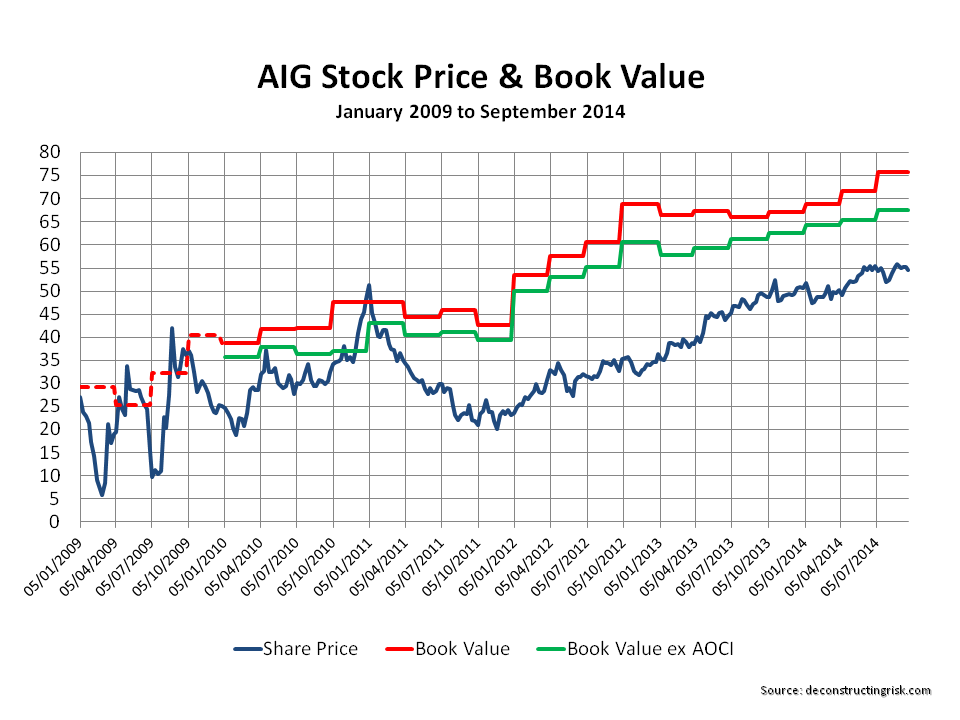
Analysts have an average EPS estimate of $4.62 for 2014, roughly the same as 2013, and $5.00 for 2015 which supports a target share price in the low to mid sixties. The AIG “discount” continues with the stock trading around 80% of book (excluding Accumulated Other Comprehensive Income), as per the graph below.

click to enlargeAIG Book Multiples 2009 to Sept2014

Some may argue that this discount is harsh given how far AIG has come. I’m not yet convinced that AIG deserves to come off the naughty step and get a more normal valuation.

Trinity Biotech looks interesting here

The bull market is raging ahead with the S&P500 and the Dow both less than 1% away from key levels and Apple breaking $100 yesterday. Given my cautious stance on the market, as articulated in multiple posts for over a year now, it is therefore uncharacteristic of me to be talking about establishing a new position. After having watched Trinity Biotech, ticker TRIB, for nearly a year now (I previously posted on the firm last year here), I have been doing some more research and modelling on the firm.

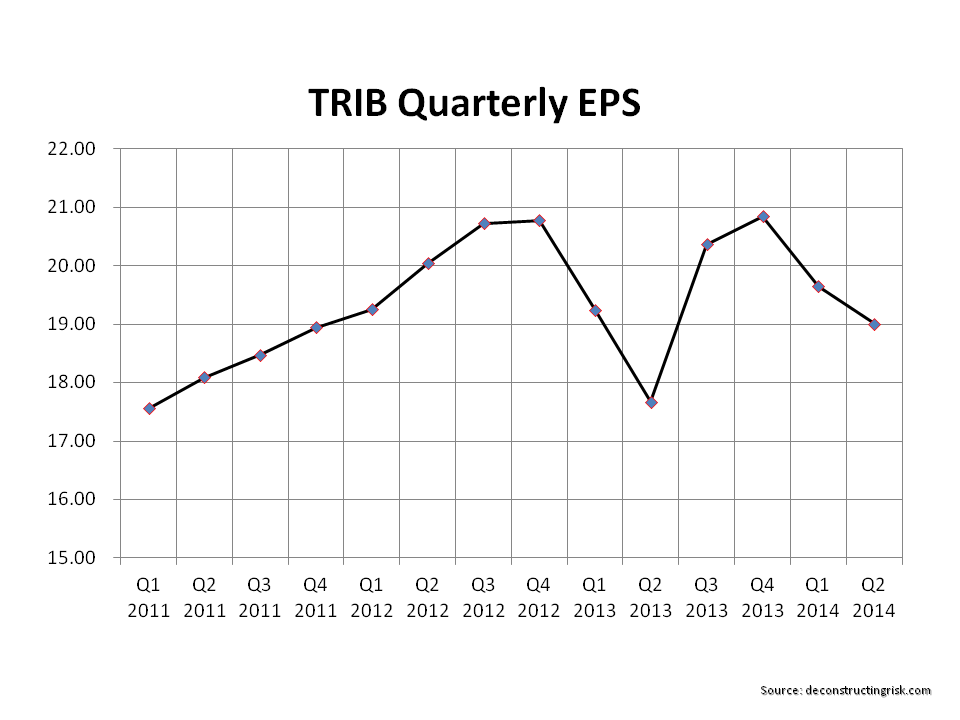
Last September, when the stock was trading around $19, I concluded that despite an attractive pipeline of new products following a number of acquisitions by TRIB, the stock was overvalued given the execution risks involved. Since that time, the stock climbed steadily to over $27 after Q3 and Q4 results last year before falling to trade around $23 since March before dropping to around $21 for the past few weeks. The graph below shows the quarterly EPS for the past 14 quarters.

click to enlargeTRIB Quarterly EPS 2011 to Q2 2014

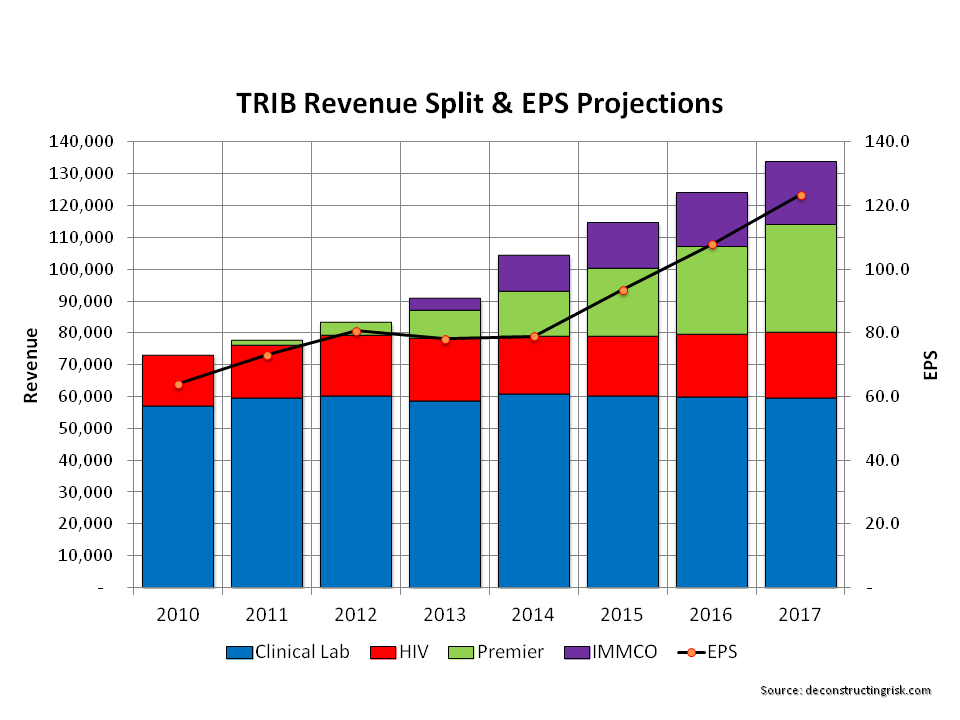
The past two quarters have been hit by subdued revenues, due to timing delays on Premier reagent income and lower lyme sales, and higher expenses from consolidating manufacturing costs and trial expenses on the Meritas Troponin cardiac test. In addition to the EPS misses, the recent drop may be as a result of cooling off on the tax inversion restructuring craze by US firms. There is always the possibility that it’s a result of some as yet unknown development (the impact of the Ebola outbreak on HIV test product sales in Africa is an example)!! Notwithstanding such a development, I spent some time going through TRIB’s releases and calls. The graph below represents my best efforts at a forecast.

click to enlargeTRIB Revenue Split & EPS Projections August 2014

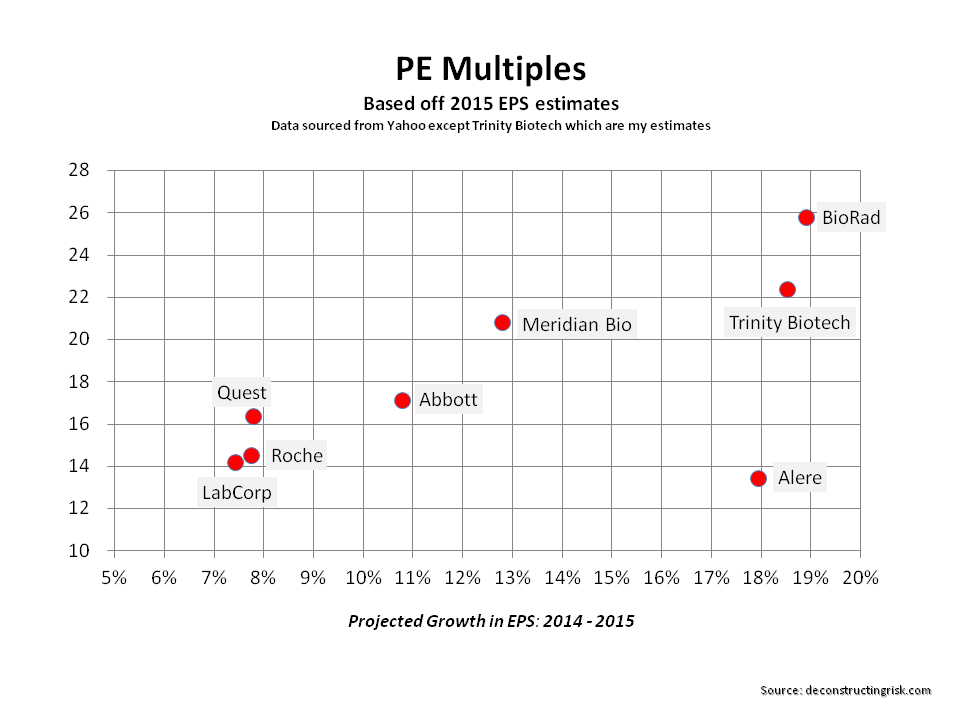
My revenue and EPS estimates for 2014 are slightly below estimates. My revenue and EPS estimates for 2015 are 10% and 15% below consensus respectively. Using my EPA estimates with the consensus estimates for TRIB’s competitors from yahoo-finance, the graph below shows the relative valuations of TRIB and selected competitors.

click to enlargeTRIB PE Multiples August 2014

This analysis shows a stock with good growth potential but one which is trading at 22 times forward earnings. Add in that TRIB have spent their cash-pile and have intangibles of $138 million making up 58% of assets (with a history of having to write-off intangibles, see previous post). Not exactly a cause to jump up and down. Indeed there are many similar growth stocks trading at lower multiples (such as SIRO as per a previous post). So, what’s the reason for my change in heart on TRIB?

Well, it’s really all about the aforementioned Meritas Troponin cardiac tests, the high sensitivity quantitative point-of-care immunoassay platform TRIB purchased in the Fiomi deal (Note – the financial projections above exclude any assumed benefit from these products). The worldwide market for point-of-care cardiac testing currently stands at about $650 million (with a larger potential for other related add-on tests) and is heavily U.S. centric. The market is dominated by three firms – Alere, Roche and Abbott – and will be a tough one to break into. However, new guidelines in the US mean that the existing products are no longer fit for purpose. A letter, dated the 25th of June 2014, from the FDA stated that “laboratories and clinicians using these troponin test results are not generally aware that the performance data listed in the device labeling is obsolete.” The letter further states the following:

“To address these concerns while improving patient care, FDA has started working with troponin assay manufacturers to modernize the performance evaluation and regulatory review of these critical tests. Our main interest is to ensure that laboratories and clinicians are informed of the true performance of troponin assays to help in result interpretation and laboratory verification of performance parameters. This is particularly important for newer, more sensitive troponin tests which may render values that can be difficult to interpret if sufficient information is not available in the device labelling. These recommendations solidified troponin’s importance in MI diagnosis and triage; at the same time, they formalized an adjustment in the clinical cutoffs and changed the way troponin results were interpreted and used.”

TRIB have obtained a European CE certificate for one of their Troponin tests and hope to gain another shortly (end of August was mentioned). However, Europe generally follows the US and the real approval required is from the FDA in the US. Studies conducted for the CE certificate show very positive results albeit with approximately 20% of the sample size required in the US, on US patients. The size of the studies required in the US has been the reason behind recent delays although TRIB hope to complete the studies and submit the results to the FDA by year end. FDA approval could then take up to 6 months so mid-year 2015 is a reasonable target date. However, these studies are dependent upon getting enough targeted patients into the study and that can be uncertain.

So, TRIB have a market opportunity for a new product line which they say has been proven in trails (albeit smaller than the FDA mandated sample sizes) to exceed the new guidelines. The opportunity is significant and will pit TRIB against some big names competitors (although Alere seems to be in a bit of a mess right now). Analysts estimate the option value of the cardiac products at between $8 to $10 per share depending upon the underlying assumptions of probability of the FDA approval and subsequent market penetration for Meritas.

I like the potential risk dynamic here as I see TRIB’s core business improve its performance over the coming quarters. News flow on the Troponin trials will likely drive share volatility but if future profits on the stock over the coming quarters from improving operating results could be used to buy options to play the embedded call in TRIB share price on the Troponin products, I can see a win:win situation arising. That does require taking a risk today however with the share price around $21. Although it is against the grain of where I believe the overall market is headed, I therefore established a small position in the stock earlier this week. Maybe I am just getting bored of the sidelines and being reckless!! Time will tell whether I am timing this really badly or not.

A visit to the dentist

Last week, Raghuram Rajan, the current governor of the Indian Central Bank and the author of the excellent book Fault Lines, warned about asset prices and macro-economic policies in the developed world. Rajan said that things may work out if “we can find a way to unwind everything steadily” but added “it is a big hope and prayer” and that the reality of history is one of sudden movements and volatility. Also this week, hedge fund manager David Einhorn said that his fund was having “difficult time finding new investments this quarter” and that “as the market continues to rise in the face of conflicting economic data, global unrest, and looming overdue Fed exit from quantitative easing we remain cautiously positioned”.

As regular readers will know, I am also wary about valuations in the current market which seem to be largely driven by the lack of return as a direct result of macro-economic policy (see Buttonwood post). I am comforted by the fact that, as a part-time investor, I am not bound by the pressures that professional money managers have in the beauty parade that is the relative annual performance competition. So that affords me and other part-time investors (our own family offices in a way!!) the luxury of watching developments from the sidelines. Trying to find the holy grail of an undervalued stock in today’s market is unrealistic and fanciful in my opinion, given the resources of a lone investor at one’s disposal. So I tend to let my attention drift to whatever comes my way with the intention of broadening my mind and maybe broadening my list of stocks to keep an eye on.

That brings me to my visit to the dentist last week. My visit was primarily to get a new crown on a neglected tooth. I had rescheduled the appointment a number of times and as a result had not really thought about the procedure beforehand. Compared to a similar procedure a number of years ago, the process was totally different. First off, my mouth was scanned by a camera and a 3D image of my teeth was produced. I was then asked to wait in the reception for 20 minutes and upon my return the ceramic crown was ready having been produced in a milling machine onsite. The crown fit perfectly and was easily fitted. My dentist conducted the procedure using a new one-day crown system produced by a German firm called Sirona Dental Systems. The system includes a computer that takes digital images of the damaged tooth, software to design the crown and a milling machine. There have been some concerns about the use of such crowns for front teeth due to colouring issues or the suitability of such crowns for people who grind their teeth heavily. Within my mouth, I have a live comparative test of a laboratory fabricated crown and a new one day procedure produced one. It will be interesting to see how the new crown gets on!

I had previously heard about new technology that could impact the dental sector. A specially designed camera, fitted to a smart phone, can scan your mouth and then send a 3D image to a central database whereupon a panel of dental experts could diagnose the issue and then submit the recommended procedure to a marketplace of dentists to provide a quote on a solution. Naturally, my dentist was skeptical on diagnosing problems with a smartphone scan! Given my first experience with a scan, I think such ideas may have potential to disrupt a protected professional sector. As a further illustration of how technology is impacting medicine, this article on a new app that can turn a smartphone into a highly portable and low cost eye scanner to diagnose eye health issues in remote areas is interesting.

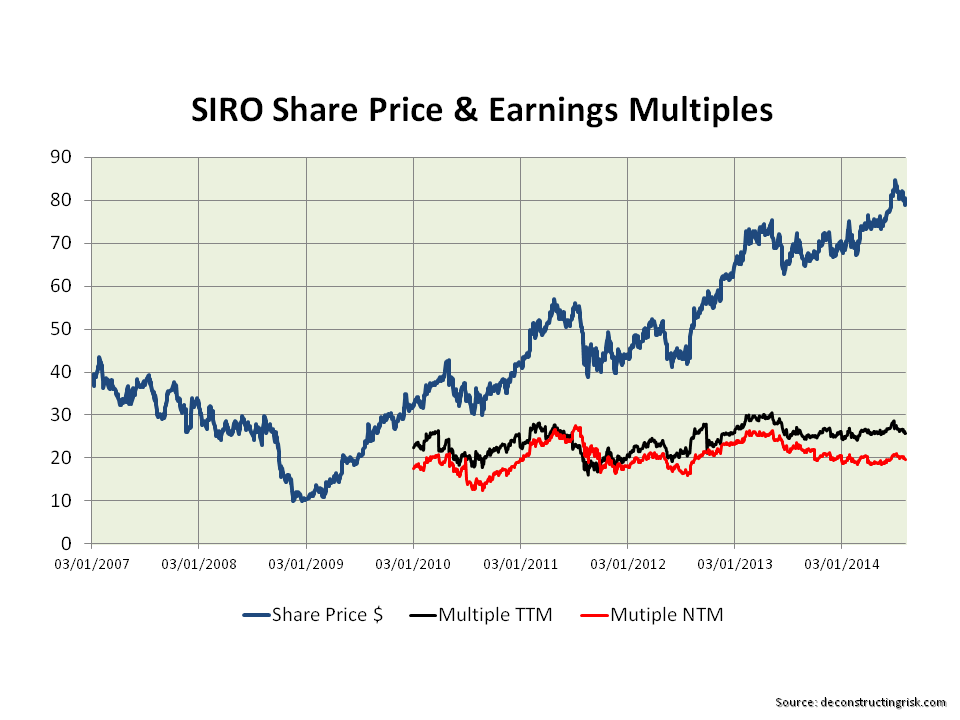
So I had a look at Sirona, ticker SIRO, who coincidentally reported quarterly results last week. SIRO’s year end is September and, based upon an estimate for Q4, revenue has grown on average by 9% for the last 3 years with operating income by 15%. The stock price has doubled over that time. The graph below shows the share price since 2007 and the 12 month trailing PE ratio and the next 12 months (current quarter and estimated next 3 quarters) PE estimate.

click to enlargeSIRO Share Price & Earnings Multiples
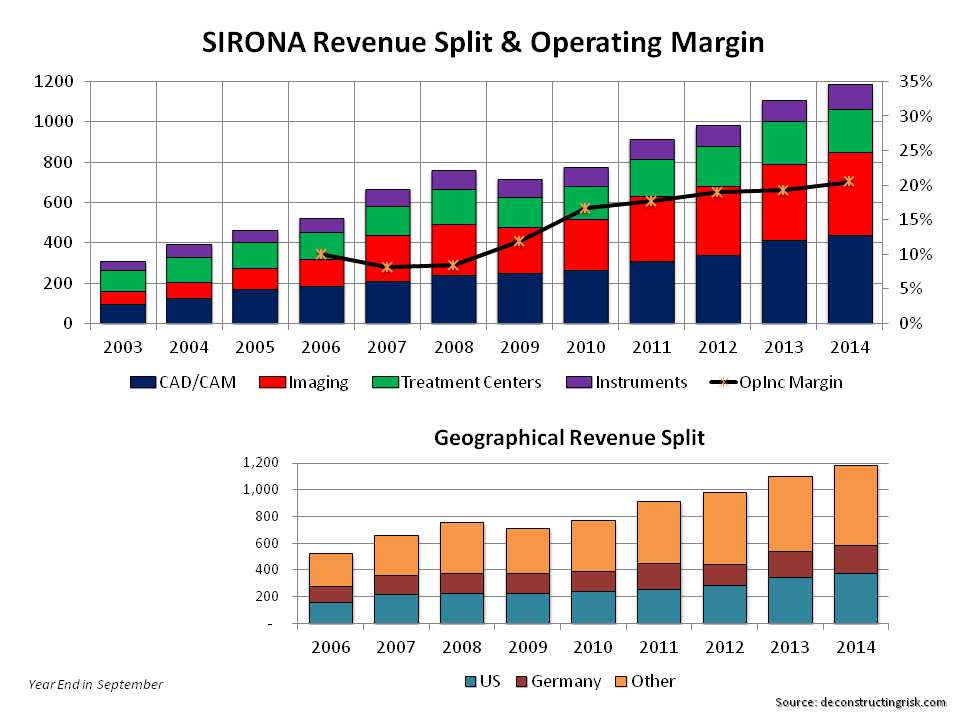
SIRO’s revenue is split into 4 main segments: dental CAD/CAM systems (such as the one I experienced), imaging systems, treatments centers, and instruments. The first two segments are the larger making up approximately 35% of revenue each and are the higher growth and margin segments. Each are described below:

  • Dental CAD/CAM systems address the market for dental restorations, which includes several types of restorations, such as inlays, onlays, veneers, crowns, bridges, copings and bridge frameworks made from ceramic, metal or composite blocks. SIRO estimates it has an approx 15% market share in US and Germany.
  • Imaging systems comprise a broad range of systems for diagnostic imaging in the dental practice. SIRO has developed a comprehensive range of imaging systems for 2D or 3D, panoramic and intra-oral applications that allow the dentist to accommodate the patient in a more efficient manner.
  • Treatment centers comprise a broad range of products from basic dentist chairs to sophisticated chair-based units with integrated diagnostic, hygiene and ergonomic functionalities, as well as specialist centers used in preventative treatment and for training purposes.
  • SIRO offers a wide range of instruments, including handheld and power-operated handpieces for cavity preparation, endodontics, periodontology and prophylaxis, which are regularly updated and improved.

The graph below shows the historical segment & geographical revenue split and the historical operating margin.

click to enlargeSIRO Revenue Split & Op Margins
The growth in operating results is impressive, as is their balance sheet and cashflow. The issue is one of valuation with SIRO trading around 26 times this year’s earnings and about 20 times next year’s projected earnings. However, despite SIRO having some major competitors, they are growing their highest margin segments impressively and, in the vein of Peter Lynch’s philosophy of investing in what you know, I shall be putting SIRO on my watch list to keep an eye on them whilst I do some more research (the most obvious of which is seeing how my crown gets on!!) and wait for a better entry point.

Speaking of valuations, my dental experience did get me thinking about the much hyped 3D printing sector. The number of applications for 3D printing continues to grow from construction, to aerospace, to medical/dental, to fashion, to biotech, to a whole host of industrial design applications. Wohlers Associates project a CAGR of 30% for the sector over the next few years (I’d love to know on what basis these guys come up with their projections). I had a brief look over two of the most hyped firms in the sector – Stratasys Ltd (SSYS) and 3D Systems (DDD). Historical comparisons are difficult as both companies have been aggressive acquirers. SSYS has had more favourable results of late compared to DDD due to SSYS acquisition of MakerBot and to DDD’s recent stumble due to heavy investments in growth. A quick snapshot of some metrics since 2011 are in the graphs below.

click to enlargeSSYS & DDD Share price revenues and earnings multiples

With SSYS and DDD trading at 36 and 40 times next year’s projected earnings respectively, these firms are not for the faint hearted. Hyper growth stories in new sectors are normally areas outside my comfort zone due to the inherent uncertainties. In this case my experience at the dentist may mean I will do some more digging in the future of this new technology, time permitting. For the sake of curiosity if nothing else.