Tag Archives: ILS pricing

Pimping the Peers (Part 1)

Fintech is a much hyped term currently that covers an array of new financial technologies. It includes technology providers of financial services, new payment technologies, mobile money and currencies like bitcoin, robo-advisers, crowd funding and peer to peer (P2P) lending. Blockchain is another technology that is being hyped with multiple potential uses. I posted briefly on the growth in P2P lending and crowd-funding before (here and here) and it’s the former that is primarily the focus of this post.

Citigroup recently released an interesting report on the digital disruption impact of fintech on banking which covers many of the topics above. The report claims that $19 billion has been invested in fintech firms in 2015, with the majority focussed in the payments area. In terms of the new entrants into the provision of credit space, the report highlights that over 70% of fintech investments to date have being in the personal and SME business segments.

In the US, Lending Club and Prosper are two of the oldest and more established firms in the marketplace lending sector with a focus on consumer lending. Although each are growing rapidly and have originated loans in the multiple of billions in 2015, the firms have been having a rough time of late with rates being increased to counter poor credit trends. Public firms have suffered from the overall negative sentiment on banks in this low/negative interest rate environment. Lending Club, which went public in late 2014, is down about 70% since then whilst Prosper went for institutional investment instead of an IPO last year. In fact, the P2P element of the model has been usurped as most of the investors are now institutional yield seekers such as hedge funds, insurers and increasingly traditional banks. JP Morgan invested heavily in another US firm called OnDeck, an online lending platform for small businesses, late in 2015. As a result, marketplace lending is now the preferred term for the P2P lenders as the “peer” element has faded.

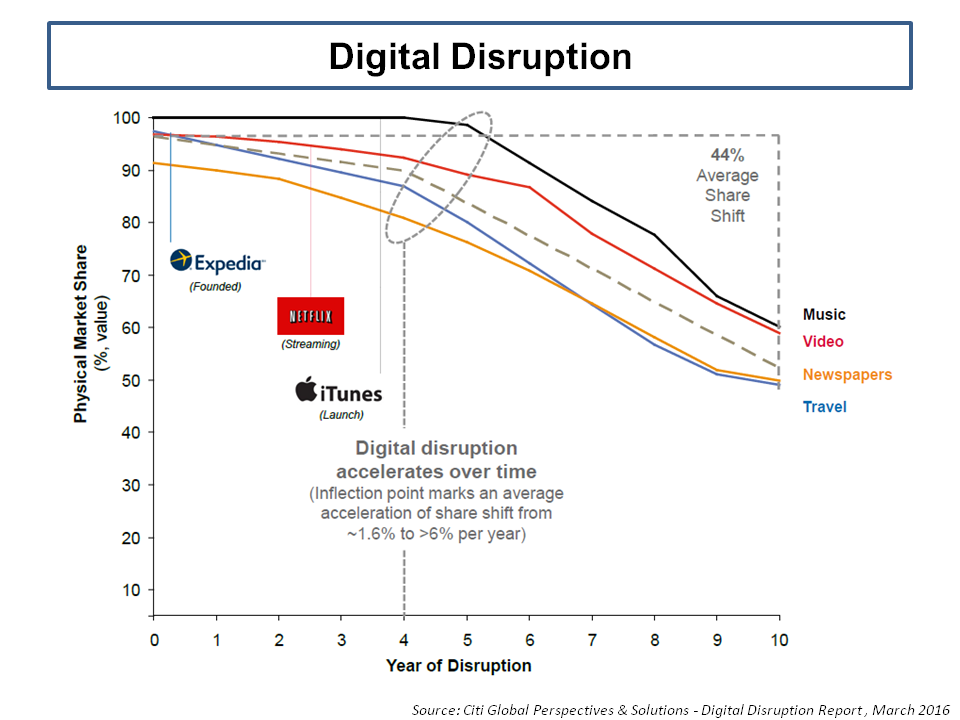
Just like other disruptive models in the technology age, eBay and Airbnb are examples, initially these models promised a future different from the past, the so called democratization of technology impact, but have now started to resemble new technology enabled distribution platforms with capital provided by already established players in their sectors. Time and time again, digital disruption has eroded distribution costs across many industries. The graphic from the Citi report below on digital disruption impact of different industries is interesting.

click to enlargeDigital Disruption
Marketplace lending is still small relative to traditional banking and only accounts for less than 1% of loans outstanding in the UK and the US (and even in China where its growth has been the most impressive at approx 3% of retail loans). Despite its tiny size, as with any new financial innovation, concerns are ever-present about the consequences of change for traditional markets.

Prosper had to radically change its underwriting process after a shaky start. One of their executives is recently quoted as saying that they “will soon be on our sixth risk model”. Marrying new technology with quality credit underwriting expertise (ignoring the differing cultures of each discipline) is a key challenge for these fledging upstarts. An executive in Kreditech, a German start-up, claimed that they are “a tech company who happens to be doing lending”. Critics point to the development of the sector in a benign default environment with low interest rates where borrowers can easily refinance and the churning of loans is prevalent. Adair Turner, the ex FSA regulator, recently stirred up the new industry with the widely reported comment that “the losses which will emerge from peer-to-peer lending over the next five to 10 years will make the bankers look like lending geniuses”. A split of the 2014 loan portfolio of Lending Club in the Citi report as below illustrates the concern.

click to enlargeLending Club Loan By Type

Another executive from the US firm SoFi, focused on student loans, claims that the industry is well aware of the limitations that credit underwriting solely driven by technology imbues with the comment that “my daughter could come up with an underwriting model based upon which band you like and it would work fine right now”.  Some of the newer technology firms make grand claims involving superior analytics which, combined with technologies like behavioural economics and machine learning, they contend will be able to sniff out superior credit risks.

The real disruptive impact that may occur is that these newer technology driven firms will, as Antony Jenkins the former CEO of Barclays commented, “compel banks to significantly automate their business”. The Citigroup report has interesting statistics on the traditional banking model, as per the graphs below. 60% to 70% of employees in retail banking, the largest profit segment for European and US banks, are supposedly doing manual processing which can be replaced by automation.

click to enlargeBanking Sector Forecasts Citi GPS

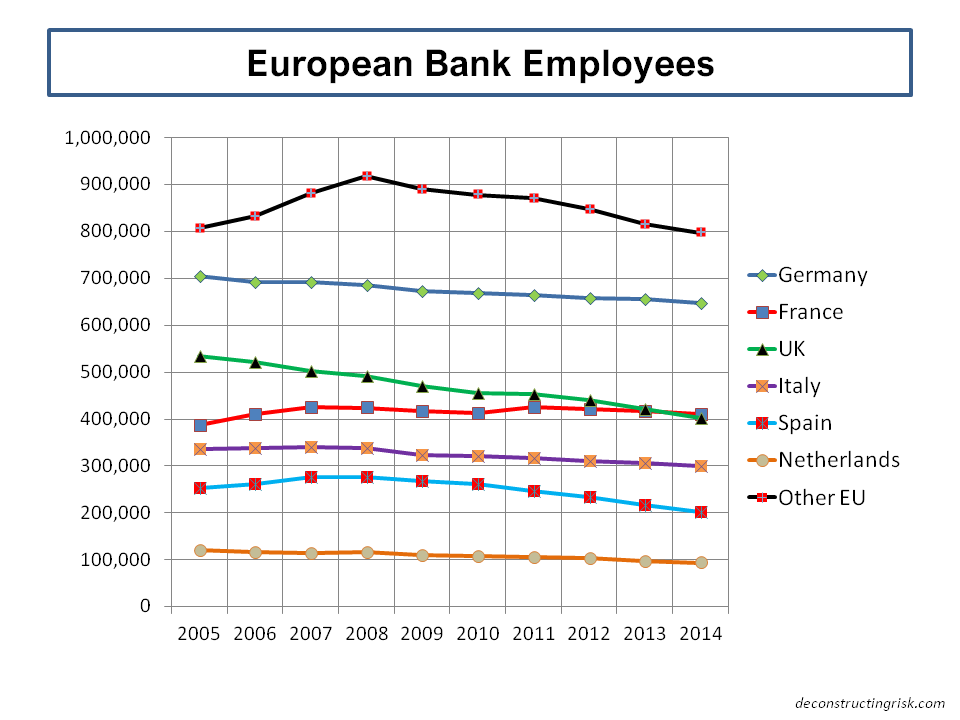
Another factor driving the need to automate the banks is the cyber security weaknesses in patching multiple legacy systems together. According to the Citigroup report, “the US banks on average appear to be about 5 years behind Europe who are in turn about a decade behind Nordic banks”. Within Europe, it is interesting to look at the trends in bank employee figures in the largest markets, as per the graph below. France in particular looks to be out of step with other countries.

click to enlargeEuropean Bank Employees
Regulators are also starting to pay attention. Just this week, after a number of scams involving online lenders, the Chinese central bank has instigated a crack down and constituted a multi-agency task force. In the US, there could be a case heard by the Supreme Court which may create significant issues for many online lenders. The Office of the Comptroller of the Currency recently issued a white paper to solicit industry views on how such new business models should be regulated. John Williams of the San Francisco Federal Reserve recently gave a speech at a recent marketplace lending conference which included the lucid point that “as a matter of principle, if it walks like a duck and quacks like a duck, it should be regulated like a duck”.

In the UK, regulators have taken a gentler approach whereby the new lending business models apply for Financial Conduct Authority authorisation under the 36H regulations, which are less stringent than the regimes which apply to more established activities, such as collective investment schemes. The FCA also launched “Project Innovate” last year where new businesses work together with the FCA on their products in a sandbox environment.

Back in 2013, I asked the question whether financial innovation always ended in lower risk premia in this post. In the reinsurance sector, the answer to that question is yes in relation to insurance linked securities (ILS) as this recent post on current pricing shows. It has occurred to me that the new collateralised ILS structures are not dissimilar in methodology to the 100% reserve banks, under the so-called Chicago plan, which economists such as Irving Fisher, Henry Simons and Milton Friedman proposed in the 1930s and 1940s. I have previously posted on my difficulty in understanding how the fully collaterised insurance model can possibly accept lower risk premia than the traditional “fractional” business models of traditional insurers (as per this post). The reduced costs of the ILS model or the uncorrelated diversification for investors cannot fully compensate for the higher capital required, in my view. I suspect that the reason is hiding behind a dilution of underwriting standards and/or leverage being used by investors to juice their returns. ILS capital is now estimated to make up 12% of overall reinsurance capital and its influence on pricing across the sector has been considerable. In Part 2 of this post, I will look into some of the newer marketplace insurance models being developed (it also needs a slick acronym – InsurTech).

Marketplace lending is based upon the same fully capitalized idea as ILS and 100% reserve banks. As can be seen by the Citigroup exhibits, there is plenty of room to compete with the existing banks on costs although nobody, not yet anyway, is claiming that such models have a lower cost of capital than the fractional reserve banks. It is important not to over exaggerate the impact of new models like marketplace lending on the banking sector given its current immaterial size. The impact of technology on distribution channels and on credit underwriting is likely to be of greater significance.

The indirect impact of financial innovation on underwriting standards prior to the crisis is a lesson that we must learn. To paraphrase an old underwriting adage, we should not let the sweet smell of shiny new technology distract us from the stink of risk, particularly where such risk involves irrational human behaviour. The now infamous IMF report in 2006 which stated that financial innovation had “increased the resilience of the financial system” cannot be forgotten.

I am currently reading a book called “Between Debt and the Devil” by the aforementioned Adair Turner where he argues that private credit creation, if left solely to the free market under our existing frameworks, will overfund secured lending on existing real estate (which my its nature is finite), creating unproductive volatility and financial instability as oversupply meets physical constraints. Turner’s book covers many of the same topics and themes as Martin Wolf’s book (see this post). Turner concludes that we need to embrace policies which actively encourage a less credit intensive economy.

It is interesting to see that the contribution of the financial sector has not reduced significantly since the crisis, as the graph on US GDP mix below illustrates. The financialization of modern society does not seem to have abated much since the crisis. Indeed, the contribution to the value of the S&P500 from the financials has not decreased materially since the crisis either (as can be seen in the graph in this post).

click to enlargeUS GDP Breakdown 1947 to 2014

Innovation which makes business more efficient is a feature of the creative destruction capitalist system which has increased productivity and wealth across generations. However, financial innovation which results in changes to the structure of markets, particularly concerning banking and credit creation, has to be carefully considered and monitored. John Kay in a recent FT piece articulated the dangers of our interconnected financial world elegantly, as follow:

Vertical chains of intermediation, which channel funds directly from savers to the uses of capital, can break without inflicting much collateral damage. When intermediation is predominantly horizontal, with intermediaries mostly trading with each other, any failure cascades through the system.

When trying to understand the potential impacts of innovations like new technology driven underwriting, I like to go back to an exhibit I created a few years ago trying to illustrate how  financial systems have been impacted at times of supposed innovation in the past.

click to enlargeQuote Money Train

Change is inevitable and advances in technology cannot, nor should they, be restrained. Human behaviour, unfortunately, doesn’t change all that much and therefore how technological advances in the financial sector could impact stability needs to be ever present in our thoughts. That is particularly important today where global economies face such transformational questions over the future of the credit creation and money.

How low is CAT pricing?

So, the February dip in the equity market is but a memory with the S&P500 now in positive territory for the year. With the forward PE at 16.4 and the Shiller CAPE at 25.75, it looks like the lack of alternatives has, once again, brought investors back to the equity market. As Buttonwood puts it – “investors are reluctant bulls; there seems no alternative.”  A December report from Bank of England staffers Rachel and Smith (as per previous post) has an excellent analysis of the secular drivers on the downward path of real interest rates. I reproduced a sample of some of the interesting graphs from the report below.

click to enlargeReal interest & growth & ROC rates

In the course of a recent conversation with a friend on the lack of attractive investment opportunities the subject of insurance linked securities (ILS) arose. My friend was unfamiliar with the topic so I tried to give him the run down on the issues. I have posted my views on ILS many times previously (here, here and here are just a recent few). During our conversation, the question was asked how low is current pricing in the catastrophe market relative to the “technically correct” level.

So this post is my attempt at answering that question. On a back of the envelop basis (I am sure professionals in this sector will be appalled at my crude methodology!). Market commentary currently asserts that non-US risks are the more under-priced of the peak catastrophe risks. Guy Carpenter’s recent rate on line (ROL) regional index, which is a commonly used industry metric for premium as a percentage of limit, shows that US, Asian, European and UK risks are off 30%, 28%, 32% and 35% respectively off their 2012 levels.

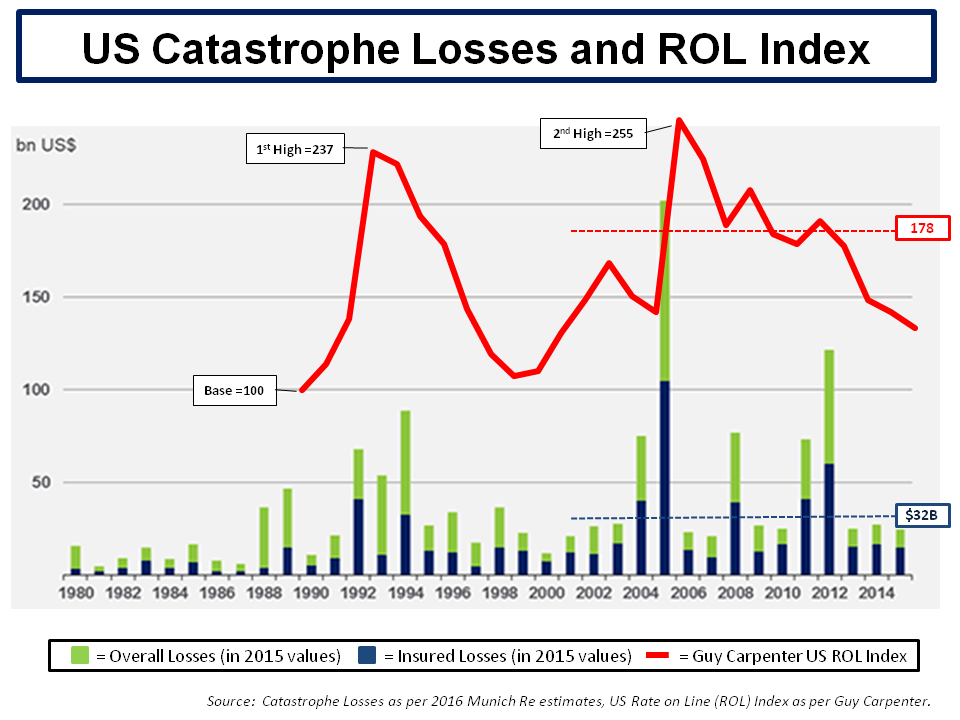
Using the US as a proxy for the overall market, I superimposed the Guy Carpenter US ROL index over historical annual US insured losses (CPI inflation adjusted to 2015) as per Munich Re estimates in the graph below. The average insured loss and ROL index since 1990 is $25 billion and 168 respectively. On the graph below I show the 15 year average for both which is $32 billion and 178 respectively. The current ROL pricing level is 18% and 23% below the average ROL since 1990 and the 15 year average respectively.

click to enlargeUS CAT Losses & ROL Index

However, inflation adjusted insured losses are not exposure adjusted. Exposure adjusted losses are losses today which take into account today’s building stock and topology. To further illustrate the point, the graph in this 2014 post from Karen Clark shows exposure adjusted historical catastrophe losses above $10 billion. One of the vendor catastrophe modelling firms, AIR Worldwide, publishes its exposure adjusted annual average insured loss each year and its 2015 estimate for the US was $47 billion (using its medium timescale forecasts). That estimate is obviously some way off the 15 year average of $32 billion (which has been influenced by the recent run of low losses).

By way of answering the question posed, I have assumed (using nothing more than an educated guess) a base of an average annual insured loss level of $40 billion, being within an approximate inflation adjusted and exposure adjusted range of $35-45 billion, would imply a “technically correct” ROL level around 185. I guesstimated this level based upon the 10 year average settling at 195 for 4 years before the 2016 decline and applying a discount to 185 due to the lower cost of capital that ILS investors require. The former assumes that the market is an efficient means of price discovery for volatile risks and the latter is another way of saying that these ILS investors accept lower returns than professional insurers due to the magic which market wisdom bestows on the uncorrelated nature of catastrophic risk. 185 would put current US catastrophe premium at a 25% discount to the supposed “technical correct” level.

Some in the market say rates have bottomed out but, without any significant losses, rates will likely continue to drop. Kevin O’Donnell of RenRe recently said the following:

“We believe that a playbook relying on the old cycle is dead. The future will not see multi-region, multi-line hardening post-event. There’s too much capital interested in this risk and it can enter our business more quickly and with less friction. There will be cycles, but they will be more targeted and shorter and we have worked hard to make sure that we can attract the best capital, underwrite better, and deploy first when the market presents an opportunity.”

I cannot but help think that the capital markets are not fully appreciating the nuances of the underlying risks and simply treating catastrophe risks like other BB asset classes as the graph below illustrates.

click to enlargeBB Corporate vrs ILS Spreads

There is an alternate explanation. The factors impacting weather systems are incredibly complex. Sea surface temperatures (SSTs) and wind shear conditions are key variables in determining hurricane formation and characteristics. Elements which may come into play on these variables include the North Atlantic Oscillation (NAO) which is a fluctuation in pressure differences between the Icelandic and Azores regions, the Atlantic Multi-Decadal Oscillation (AMO) which measures the natural variability in sea surface temperature (and salinity) of the North Atlantic, and the El Niño Southern Oscillation (ENSO) which measures cyclical temperature anomalies in the Pacific Ocean off South America. Climate change is impacting each of these variables and it may be possible that US hurricanes will become less frequent (but likely more severe).

An article from late last year in the Nature Geoscience Journal from Klotzbach, Gray and Fogarty called “Active Atlantic hurricane era at its end?” suggests the active hurricane phase in the Atlantic could be entering a new quieter cycle of storm activity. The graph below is from their analysis.

click to enlargeAtlantic hurricane frequency

Could it be that the capital markets are so efficient that they have already factored in such theories with a 25% discount on risk premia? Yep, right.

Thoughts on ILS Pricing

Valuations in the specialty insurance and reinsurance sector have been given a bump up with all of the M&A activity and the on-going speculation about who will be next. The Artemis website reported this week that Deutsche Bank believe the market is not differentiating enough between firms and that even with a lower cost of capital some are over-valued, particularly when lower market prices and the relaxation in terms and conditions are taken into account. Although subject to hyperbole, industry veteran John Charman now running Endurance, stated in a recent interview that market conditions in reinsurance are the most “brutal” he has seen in his 44 year career.

One interesting development is the re-emergence of Richard Brindle with a new hybrid hedge fund type $2 billion firm, as per this Bloomberg article. Given the money Brindle made out of Lancashire, I am surprised that he is coming back with a business plan that looks more like a jump onto the convergence hedge fund reinsurer band wagon than anything more substantive given current market conditions. Maybe he has nothing to lose and is bored! It will be interesting to see how that one develops.

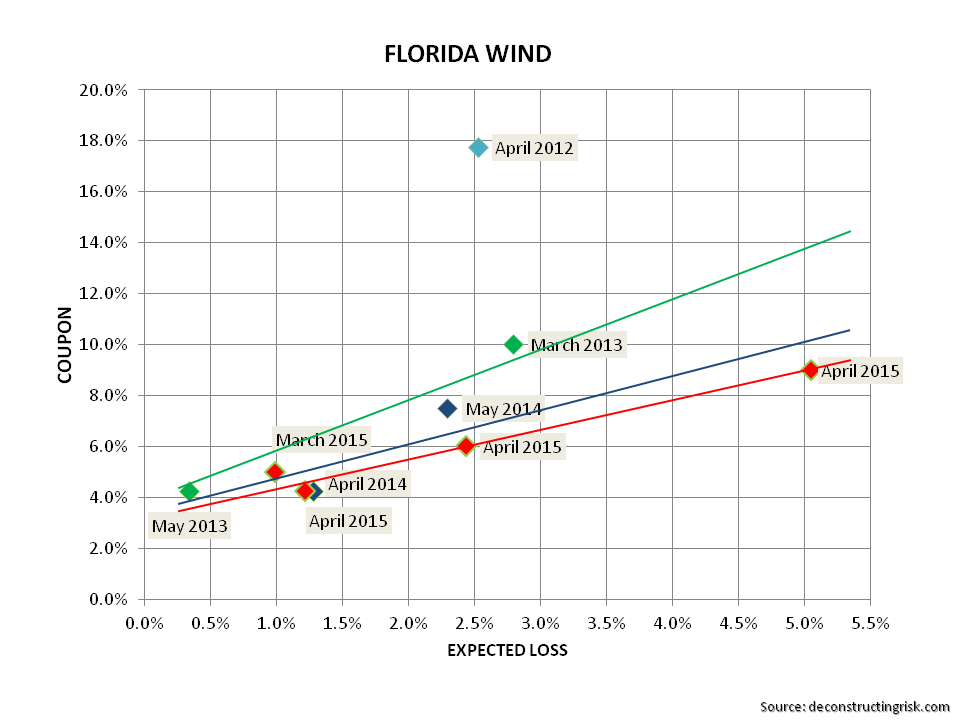
There have been noises coming out of the market that insurance linked securities (ILS) pricing has reached a floor. Given that the Florida wind exposure is ground zero for the ILS market, I had a look through some of the deals on the Artemis website, to see what pricing was like. The graph below does only have a small number of data points covering different deal structures so any conclusions have to be tempered. Nonetheless, it does suggest that rate reductions are at least slowing in 2015.

click to enlargeFlorida ILS Pricing

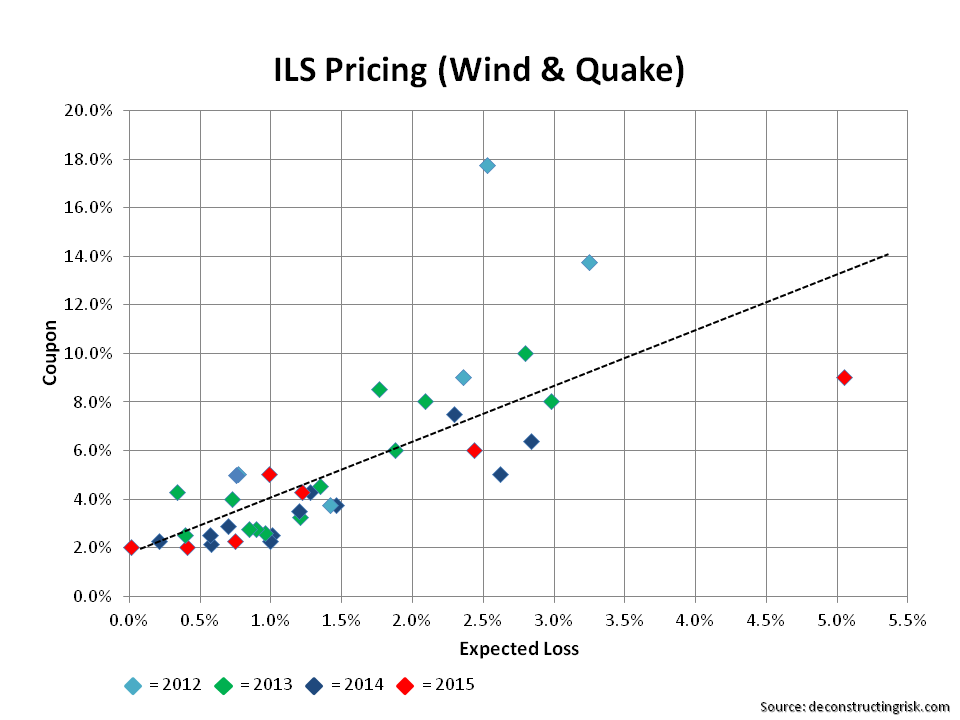
Any review of ILS pricing, particularly for US wind perils, should be seen in the context of a run of low storm recent activity in the US for category 3 or above. In their Q3-2014 call, Renaissance Re commented (as Eddie pointed out in the comments to this post) that the probability of a category 3 or above not making landfall in the past 9 years is statistically at a level below 1%. The graph below shows some wind and earthquake pricing by vintage (the quake deals tend to be the lower priced ones).

click to enlargeWind & Quake ILS Pricing by year

This graph does suggest that a floor has been reached but doesn’t exactly inspire any massive confidence that pricing in recent deals is any more adequate than that achieved in 2014.

From looking through the statistics on the Artemis website, I thought that a comparison to corporate bond spreads would be interesting. In general (and again generalities temper the validity of conclusions), ILS public catastrophe bonds are rated around BB so I compared the historical spreads of BB corporate against the average ILS spreads, as per the graph below.

click to enlargeILS Spreads vrs BB Corporate Spread

The graph shows that the spreads are moving in the same direction in the current environment. Of course, it’s important to remember that the price of risk is cheap across many asset classes as a direct result of the current monetary policy across the developed world of stimulating economic activity through encouraging risk taking.

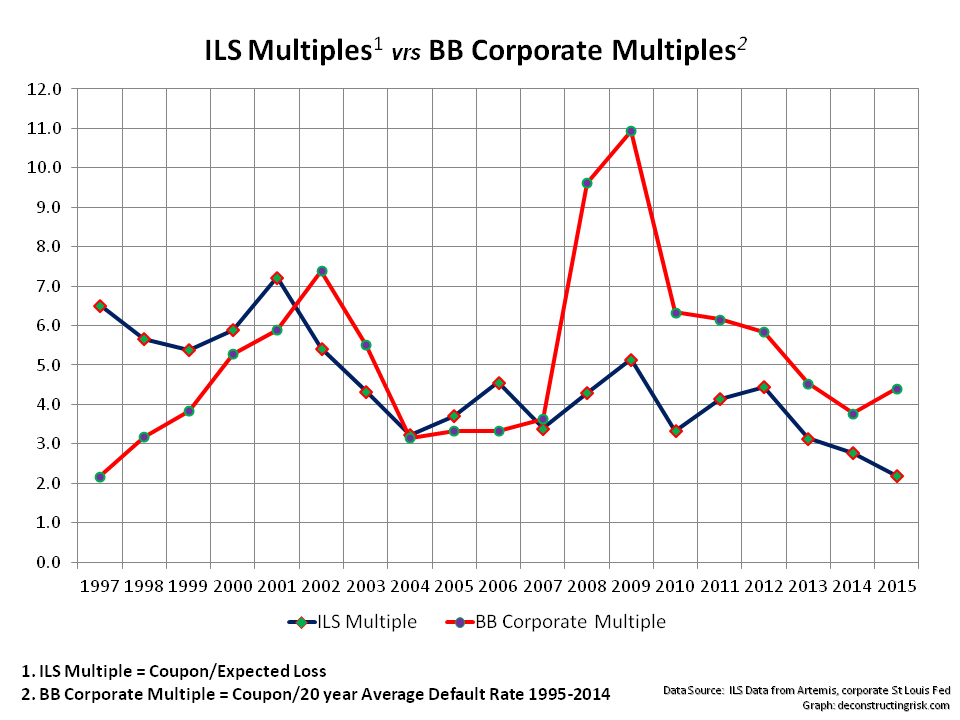
Comparing spreads in themselves has its limitation as the underlying exposure in the deals is also changing. Artemis uses a metric for ILS that divides the spread by the expected loss, referred to herein as the ILS multiple. The expected loss in ILS deals is based upon the catastrophe modeller’s catalogue of hurricane and earthquake events which are closely aligned to the historical data of known events. To get a similar statistic to the ILS multiple for corporate bonds, I divided the BB spreads by the 20 year average of historical default rates from 1995 to 2014 for BB corporate risks. The historical multiples are in the graph below.

click to enlargeILS vrs BB Corporate Multiples

Accepting that any conclusions from the graph above needs to consider the assumptions made and their limitations, the trends in multiples suggests that investors risk appetite in the ILS space is now more aggressive than that in the corporate bond space. Now that’s a frightening thought.

Cheap risk premia never ends well and no fancy new hybrid business model can get around that reality.

Follow-up: Lane Financial LLC has a sector report out with some interesting statistics. One comment that catch my eye is that they estimate a well spread portfolio by a property catastrophic reinsurer who holds capital at a 1-in-100 and a 1-in-250 level would only achieve a ROE of 8% and 6.8% respectively at todays ILS prices compared to a ROE of 18% and 13.3% in 2012. They question “the sustainability of the independent catastrophe reinsurer” in this pricing environment and offer it as an explanation “why we have begun to see mergers and acquisitions, not between two pure catastrophe reinsurers but with cat writers partnering with multi-lines writers“.

CaT pricing “heading for the basement”

Edward Noonan of Validus is always good copy and the Q1 conference call for Validus provided some insight into the market ahead of the important July 1 renewals. When asked by an analyst whether the catastrophe market was reaching a floor, Noonan answered that “I’m starting to think we might be heading for the basement”.

He also said “I think the truly disruptive factor in the market right now is ILS money. I made a comment that we’ve always viewed the ILS manager business behaving rationally. I can’t honestly say that (anymore with) what we’re seeing in Florida right now. I mean we have large ILS managers who are simply saying – whatever they quote we will put out a multi-hundred million dollar line at 10% less.

I have posted many times on the impact of new capital in the ILS market, more recently on the assertion that ILS funds havw a lower cost of capital. Noonan now questions whether investors in the ILS space really understand the expected loss cost as well as experienced traditional players. Getting a yield of 5% or lower now compared to 9% a few short years ago for BBB – risks is highlighted as an indication that investors lack a basic understanding of what they are buying. The growing trend of including terrorism risks in catastrophe programmes is also highlighted as a sign that the new market players are mispricing risk and lack basic understanding on issues such as a potential clash in loss definitions and wordings.

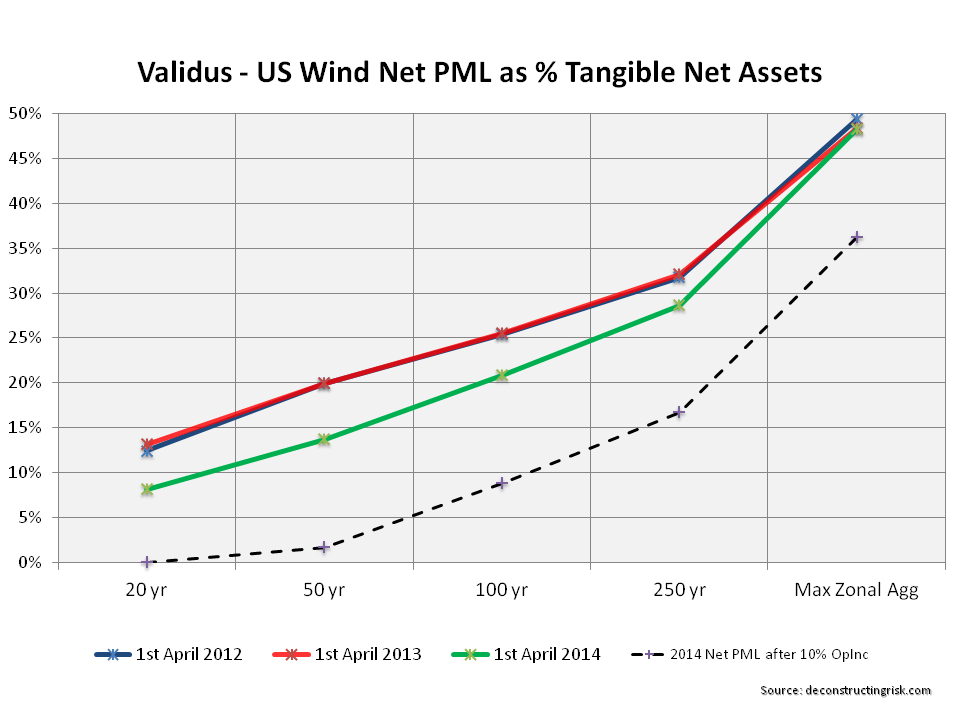
Validus highlight how they are disciplined in not renewing underpriced risk and arbitraging the market by purchasing large amounts of collaterised reinsurance and retrocession. They point to the reduction in their net risk profile by way of their declining PMLs, as the graph below of their net US wind PMLs as a percentage of net tangible assets illustrates.

This is positive provided the margins on their core portfolio don’t decrease faster than the arbitrage. For example, Validus made underwriting income in 2012 and 2013 of 6% and 17% of their respective year-end net tangible assets. The graph below also shows what the US Wind PML would be reduced by if an operating profit of 12% (my approximation of a significant loss free 2014 for Validus) could be used to offset the US Wind net losses. Continuing pricing reductions in the market could easily make a 12% operating profit look fanciful.

click to enlargeValidus Net US Wind PML as % of tangible net assets

I think that firms such as Validus are playing this market rationally and in the only way you can without withdrawing from core (albeit increasingly under-priced) markets. If risk is continually under-priced over the next 12 to 24 months, questions arise about the sustainability of many existing business models. You can outrun a train moving out of a station but eventually you run out of platform!

ILS Fund versus PropertyCat Reinsurer ROEs

Regular readers will know that I have queried how insurance-linked securities (ILS) funds, currently so popular with pensions funds, can produce a return on equity that is superior to that of a diversified property catastrophe reinsurer given that the reinsurer only has to hold a faction of its aggregate limit issued as risk based capital whereas all of the limits in ILS are collaterised. The recent FT article which contained some interesting commentary from John Seo of Fermat Capital Management got me thinking about this subject again. John Seo referred to the cost advantage of ILS funds and asserted that reinsurers staffed with overpaid executives “can grow again, but only after you lay off two out of three people”. He damned the traditional sector with “these guys have been so uncreative, they have been living off earthquake and hurricane risks that are not that hard to underwrite.

Now, far be it from me to defend the offshore chino loving reinsurance executives with a propensity for large salaries and low taxation. However, I still can’t see that the “excessive” overheads John Seo refers to could offset the capital advantage that a traditional property catastrophe reinsurer would have over ILS collateral requirements.

I understood the concept of ILS structures that provided blocks of capacity at higher layers, backed by high quality assets, which could (and did until recently) command a higher price than the traditional market. Purchasers of collaterised coverage could justify paying a premium over traditional coverage by way of large limits on offer and a lower counterparty credit risk (whilst lowering concentration risk to the market leading reinsurers). This made perfect sense to me and provided a complementary, yet different, product to that offered by traditional reinsurers. However, we are now in a situation whereby such collaterised reinsurance providers may be moving to compete directly with traditional coverage on price and attachment.

To satisfy my unease around the inconsistency in equity returns, I decided to do some simple testing. I set up a model of a reasonably diversified portfolio of 8 peak catastrophic risks (4 US and 4 international wind and quake peak perils). The portfolio broadly reflects the market and is split 60:40 US:International by exposure and 70:30 by premium. Using aggregate exceedance probability (EP) curves for each of the main 8 perils based off extrapolated industry losses as a percentage of limits offered across standard return periods, the model is set up to test differing risk premiums (i.e. ROL) for each of the 8 perils in the portfolio and their returns.  For the sake of simplicity, zero correlations were assumed between the 8 perils.

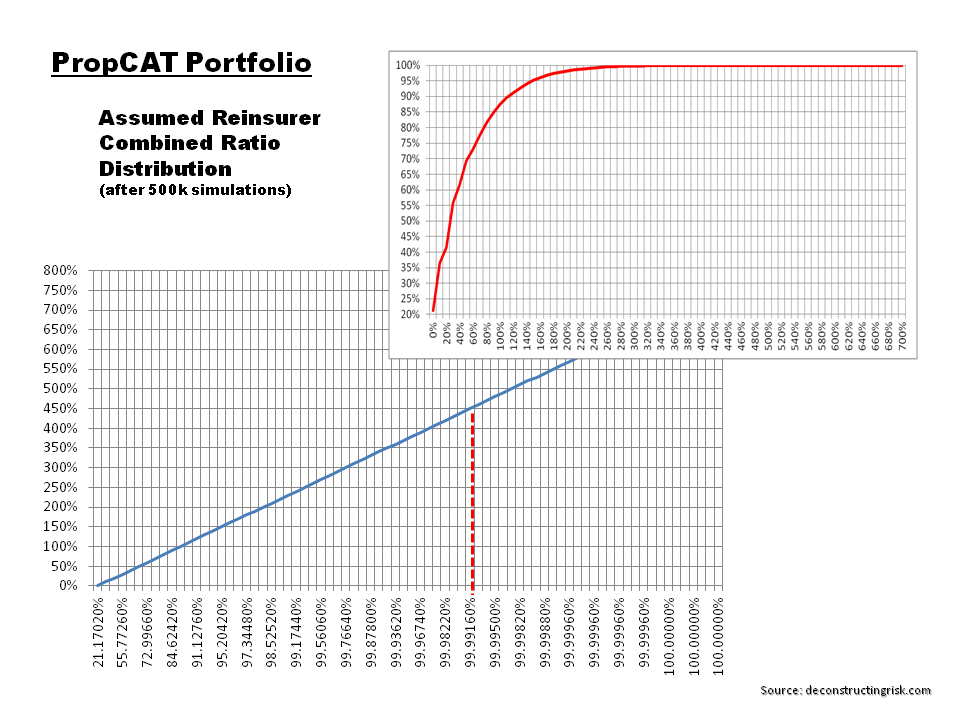
The first main assumption in the model is the level of risk based capital needed by the property catastrophe reinsurer to compete against the ILS fund. Reviewing some of the Bermudian property catastrophe players, equity (common & preferred) varies between 280% and 340% of risk premiums (net of retrocessions). Where debt is also included, ratios of up to 400% of net written premiums can be seen. However, the objective is to test different premium levels and therefore setting capital levels as a function of premiums distorts the results. As reinsurer’s capital levels are now commonly assessed on the basis of stressed economic scenarios (e.g. PMLs as % of capital), I did some modelling and concluded that a reasonable capital assumption for the reinsurer to be accepted is the level required at a 99.99th percentile or a 1 in 10,000 return period (the graph below shows the distribution assumed). As the graph below illustrates, this equates to a net combined ratio (net includes all expenses) of the reinsurer of approximately 450% for the average risk premium assumed in the base scenario (the combined ratio at the 99.99th level will change as the average portfolio risk premium changes).

click to enlargePropCAT Reinsurer Combined Ratio Distribution

So with the limit profile of the portfolio is set to broadly match the market, risk premiums per peril were also set according to market rates such that the average risk premium from the portfolio was 700 bps in a base scenario (again broadly where I understand the property catastrophe market is currently at).

Reviewing some of the actual figures from property catastrophe reinsurer’s published accounts, the next important assumption is that the reinsurer’s costs are made up of 10% acquisition costs and 20% overhead (the overhead assumption is a bit above the actual rates seen by I am going high to reinforce Mr Seo’s point about greedy reinsurance executives!) thereby reducing risk premiums by 30%. For the ILS fund, the model assumes a combined acquisition and overhead cost of just 10% (this may also be too light as many ILS funds are now sourcing some of their business through brokers and many reinsurance fund managers share the greedy habits of the traditional market!).

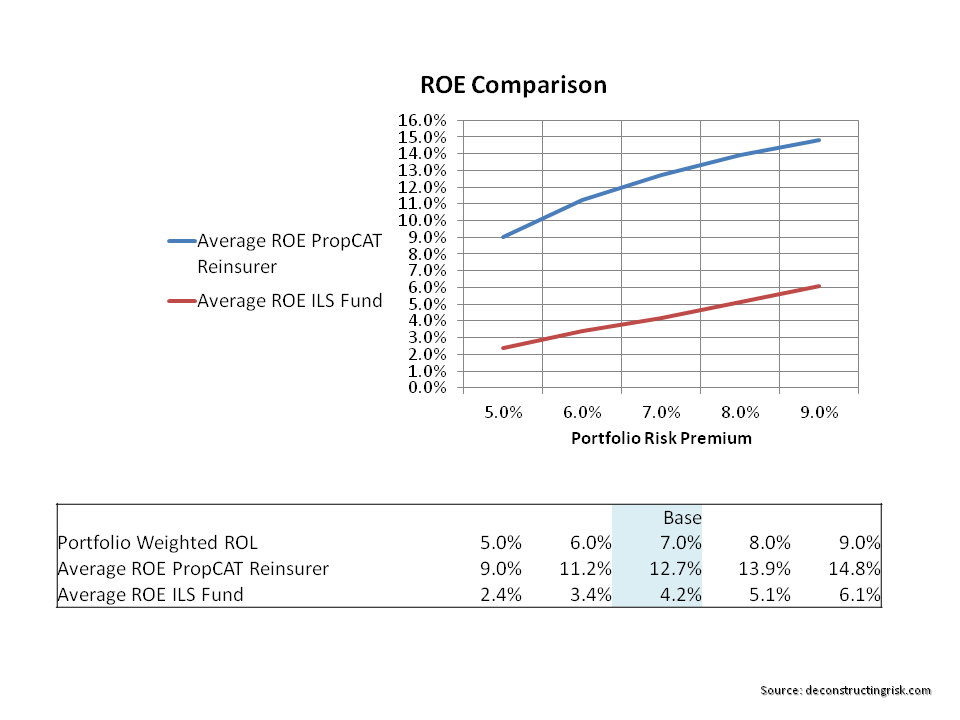
The results below show the average simulated returns for a reinsurer and an ILS fund writing the same portfolio with the expense levels as detailed above (i.e 30% versus 10%), and with different capital levels (reinsurer at 99.99th percentile and the ILS fund with capital equal to the limits issued). It’s important to stress that the figures below do not included investment income so historical operating ROEs from property catastrophe reinsurers are not directly comparable.

click to enlargePropCAT Reinsurer & ILS Fund ROE Comparison

So, the conclusion of the analysis re-enforces my initial argument that the costs savings cannot compensate for the leveraged nature of a reinsurer’s business model compared to the ILS fully funded model. However, this is a simplistic comparison. Why would a purchaser not go with a fully funded ILS provider if the product on offer was exactly the same as that of a reinsurer? As outlined above, both risk providers serve different needs and, as yet, are not full on competitors (although this may be the direction of the changes underway in the market currently).

Also, many ILS funds likely do use some form of leverage in their business model whether by way of debt or retrocession facilities. And competition from the ILS market is making the traditional market look at its overhead and how it can become more cost efficient. So it is likely that both business models will adapt and converge (indeed, many reinsurers are now also ILS managers).

Notwithstanding these issues, I can’t help conclude that (for some reason) our pension funds are the losers here by preferring the lower returns of an ILS fund sold to them by investment bankers than the higher returns on offer from simply owning the equity of a reinsurer (admittedly without the same operational risk profile). Innovative or just cheap risk premia? Go figure.