A Tale of Two Insurers

My negativity on the operating prospects for the reinsurance and specialty insurance sector has been articulated many times previously in this blog. Many of the same factors are impacting the broader commercial insurance market. Pricing conditions in the US and globally can be seen in the graph below.

click to enlargeUS and Global Commercial Insurance Pricing

Two insurers, at different ends of the size scale, which I have previously posted on, are AIG (more recently here and here) and Lancashire (more recently here and here). Given that a lot has happened to each since I last posted on them, I thought a quick update on both would give an interesting insight into the current market.

First up is AIG who have been under a lot of pressure from shareholders to unlock value, including a break-up plan for the insurance giant from the opportunistic rascal Carl Icahn. The graph below shows a breakdown of recent operating results (as ever with AIG longer term comparisons are hampered by their ever changing reporting segments). The improvement in the UGC mortgage insurance business has been dwarfed by the poor non-life results which were impacted by a significant reserve strengthening charge.

click to enlargeAIG PreTax Operating Income 2012 to 2015
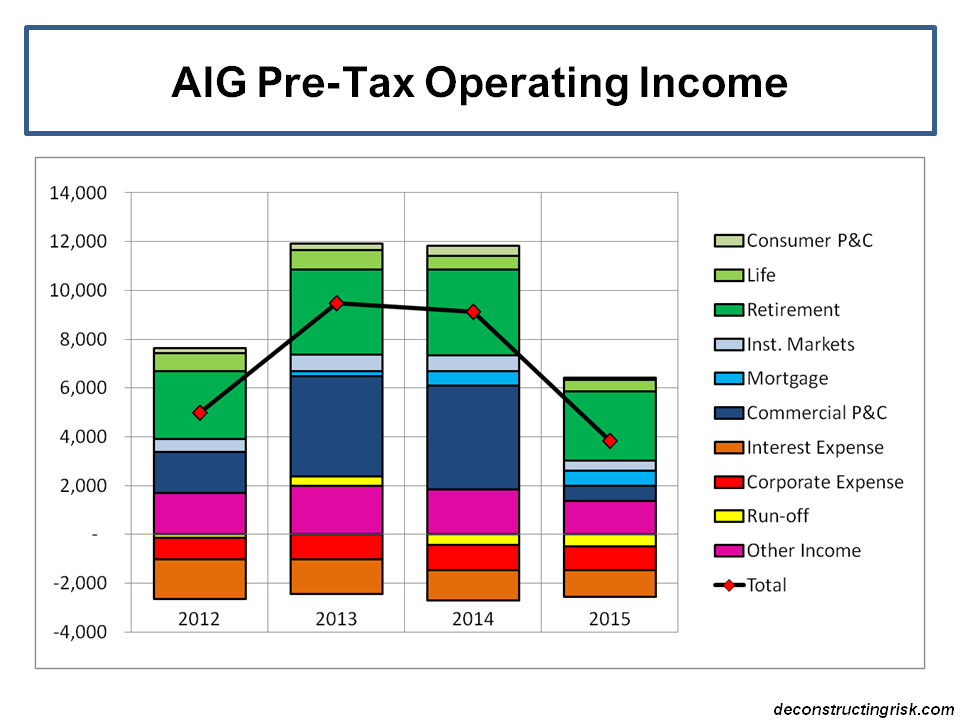
In January, Peter Hancock (the 5th CEO since Hank Greenberg left in 2005) announced a new strategic plan to the end of 2017, the main points of which are

  • Return at least $25 billion of capital to shareholders through dividends and share buy-backs from operating profits, divestitures and other actions such as monetizing future life profits by $4-5 billion through reinsurance purchases.
  • Enhance transparency by separating into an operating portfolio with a goal of over 10% return on equity and a legacy portfolio that will focus on return of capital. Reorganize into at least nine modular, more self-contained business units to enhance accountability, transparency, and strategic flexibility.
  • Reduce general operating expenses by $1.6 billion, 14 percent of the 2015 expenses.
  • Improve the commercial P&C accident year loss ratio by six points.
  • Pursue an active divestiture program, including initially the 20% IPO of UGC.

The non-life reserve charge in 2015 amounted to $3.6 billion. 60% of the charge came from the (mainly US) casualty business, 16% from financial lines (again mainly in the US) and 15% from the run-off business. After the last material reserve strengthening in 2010, the worrying aspect of the 2015 charge is that approximately two thirds comes from accident years not yet 10 years old (which is relatively immature for long tail casualty business particularly when 42% of the charge is on excess casualty business). The impact of the reserve hikes on the commercial P&C segment can be clearly seen in the graph below.

click to enlargeAIG Commercial P&C Combined Ratio Breakdown 2008 to 2015
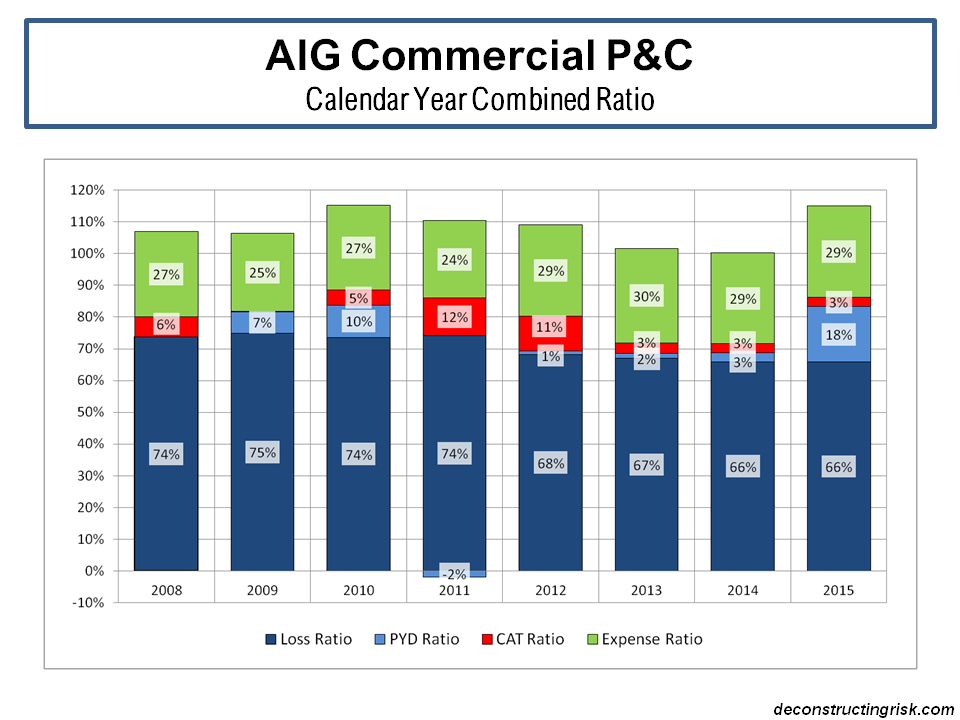
Perhaps the most aggressive target, given current market conditions, in the strategic plan is the 6% improvement in the commercial P&C accident year loss ratio by the end of 2017. The plan includes exiting approximately $1 billion of US casualty business, including poorly performing excess casualty business, primary and excess auto liability, health-care and financial lines business. Growth of $0.5 billion is been targeted in multi-national, financial lines, property upper middle market and major accounts which involve specialist engineering capabilities, international casualty and emerging risks such as cyber and M&A insurance. AIG also recently announced a two year reinsurance deal with Swiss Re on their US casualty book (it looks like a 25% quota share). The scale of the task for AIG in meeting this target can be seen in the exhibit below which takes a number of slides from the strategy presentation.

click to enlargeAIG Commercial P&C Metrics
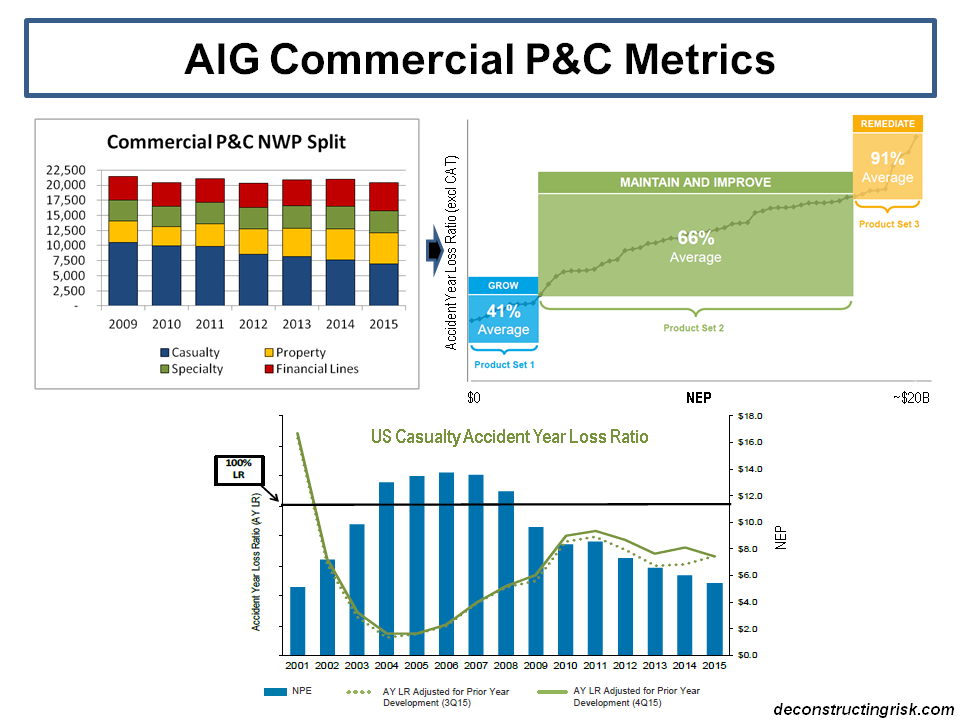
I was struck by a quote from the firm on their turnaround plan – “We will use the data and analytical tools we have invested in to significantly differentiate and determine where we should focus our resources.” I suspect that every significant insurer would claim to have, or at least aspire to have, similar analytical capabilities. Big data and analytical driven underwriting is undoubtedly the future for large insurers with access to large amounts of quality data. Fortune had an interesting recent article on the analytical firm Palantir who are working with some insurers on sharpening their underwriting criteria for the social media age. An analyst in Citi even suggested that Goggle should look at buying AIG as a fintech play. The entry of the big internet firms into the insurance sector seems inevitable in some form or other, although I doubt AIG will be part of any such strategy.

As to the benefits of staying a large composite insurer, AIG cited an analysis commissioned by consultants Oliver Wyman supporting the benefits of diversification between the life and non-life business of AIG. Using the S&P consolidated model as a proxy, Oliver Wyman estimate a $7.5 billion capital benefit to AIG compared to separate life and non-life businesses, as envisaged in Icahn’s plan.

So, can AIG achieve the aggressive operational targets they have set themselves for the P&C business? Current market conditions present a considerable challenge. Combined with their recent results, an end of 2017 target for a 6% improvement is extremely aggressive. Too aggressive for my liking. However, the P&C results should improve somewhat over the short term (particularly if there is no more big reserve charges) and actions such as expense reductions, monetizing future life profits and divestitures will give AIG the fire power to hand out sweeties to shareholders. For those willing to take the punt, the return of a chunk of the $25 billion target in dividends and share buy-backs over the next 2 years for a firm with a current market value of $61 billion, trading at a 0.72 multiple to book value (trading around 0.92 of book less AOCI and DTA), may be too tempting to resist. It does have a certain allure…..

Lancashire, a London market specialty insurer and reinsurer with a mantra of disciplined underwriting, is at the opposite end of the scale spectrum with a niche focus. Long cherished by investors for its shareholder friendly dividend policies, Lancashire has been under pressure of late due to the heavy competition in its niche markets. The energy insurance sector, for example, has been described by the broker Willis as dismal with capacity chasing a smaller premium pool due to the turmoil in the oil market. A number of recent articles (such as here and here) highlight the dangers. Alex Maloney, the firm’s CEO, described the current market as “one of the most difficult trading environments during the last twenty years”. In addition, Lancashire lost its founder, Richard Brindle, in 2014 plus the CEO, the CFO and some senior underwriters of its Lloyds’ Cathedral unit in 2015.

The graph below shows the breakdown of reported historical calendar year combined ratios plus the latest accident year net loss ratio and paid ratio.

click to enlargeLancashire Ratio Breakdown 2008 to 2015

The underwriting discipline that Lancashire professes can be seen in the recent accident year loss ratios and in the 30% drop in gross written premiums (GWP), as per the graph below. The drop is more marked in net written premiums at 35% due to the increase in reinsurance spend to 25% of GWP (from approx 10% in its early years).

click to enlargeLancashire GWP Breakdown 2008 to 2015

The timely and astute increase in reinsurance protection spend can be seen in the decrease in their peak US aggregate exposures. The latest probable maximum loss (PML) estimates for their US peak exposures are approximately $200 million compared to historical levels of $300-350 million. Given the lower net premium base, the PML figures in loss ratio terms have only dropped to 40% from 50-60% historically. Lancashire summed up their reinsurance purchasing strategy as follows:

“Our outwards reinsurance programme provides a breadth and depth of cover which has helped us to strengthen our position and manage volatility. This helps us to continue to underwrite our core portfolio through the challenges posed by the cycle.”

As with AIG, the temptation for shareholders is that Lancashire will continue with their generous dividends, as the exhibit below from their Q4 2015 presentation shows.

click to enlargeLancashire Dividend History 2015

The other attraction of Lancashire is that it may become a take-over target. It currently trades at 1.4 times tangible book level which is rich compared to its US and Bermudian competitors but low compared to its peers in Lloyds’ which trade between 1.58 and 2.0 times tangible book. Lancashire itself included the exhibit below on tangible book values in its Q4 2015 presentation.

click to enlargeInsurance Tangible Book Value Multiple 2012 to 2015

It is noteworthy that there has been little activity on the insurance M&A front since the eye boggling multiples achieved by Amlin and HCC from their diversification hungry Japanese purchasers. Many in the market thought the valuations signaled the top of the M&A frenzy.

Relatively, AIG looks more attractive than Lancashire in terms of the potential for shareholder returns. However, fundamentally I cannot get away from current market conditions. Risk premia is just too low in this sector and no amount of tempting upside through dividends, buy-backs or M&A multiples can get me comfortable with the downside potential that comes with this market. As per the sentiment expressed in previous posts, I am happy with zero investment exposure to the insurance sector right now. I will watch this one play out from the sidelines.

How low is CAT pricing?

So, the February dip in the equity market is but a memory with the S&P500 now in positive territory for the year. With the forward PE at 16.4 and the Shiller CAPE at 25.75, it looks like the lack of alternatives has, once again, brought investors back to the equity market. As Buttonwood puts it – “investors are reluctant bulls; there seems no alternative.”  A December report from Bank of England staffers Rachel and Smith (as per previous post) has an excellent analysis of the secular drivers on the downward path of real interest rates. I reproduced a sample of some of the interesting graphs from the report below.

click to enlargeReal interest & growth & ROC rates

In the course of a recent conversation with a friend on the lack of attractive investment opportunities the subject of insurance linked securities (ILS) arose. My friend was unfamiliar with the topic so I tried to give him the run down on the issues. I have posted my views on ILS many times previously (here, here and here are just a recent few). During our conversation, the question was asked how low is current pricing in the catastrophe market relative to the “technically correct” level.

So this post is my attempt at answering that question. On a back of the envelop basis (I am sure professionals in this sector will be appalled at my crude methodology!). Market commentary currently asserts that non-US risks are the more under-priced of the peak catastrophe risks. Guy Carpenter’s recent rate on line (ROL) regional index, which is a commonly used industry metric for premium as a percentage of limit, shows that US, Asian, European and UK risks are off 30%, 28%, 32% and 35% respectively off their 2012 levels.

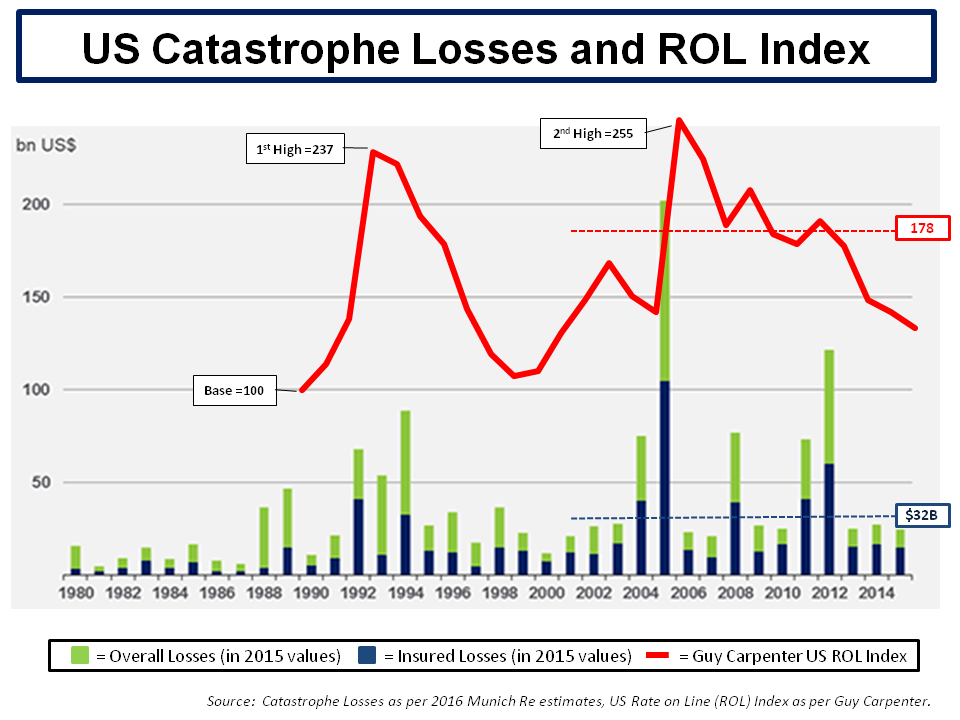
Using the US as a proxy for the overall market, I superimposed the Guy Carpenter US ROL index over historical annual US insured losses (CPI inflation adjusted to 2015) as per Munich Re estimates in the graph below. The average insured loss and ROL index since 1990 is $25 billion and 168 respectively. On the graph below I show the 15 year average for both which is $32 billion and 178 respectively. The current ROL pricing level is 18% and 23% below the average ROL since 1990 and the 15 year average respectively.

click to enlargeUS CAT Losses & ROL Index

However, inflation adjusted insured losses are not exposure adjusted. Exposure adjusted losses are losses today which take into account today’s building stock and topology. To further illustrate the point, the graph in this 2014 post from Karen Clark shows exposure adjusted historical catastrophe losses above $10 billion. One of the vendor catastrophe modelling firms, AIR Worldwide, publishes its exposure adjusted annual average insured loss each year and its 2015 estimate for the US was $47 billion (using its medium timescale forecasts). That estimate is obviously some way off the 15 year average of $32 billion (which has been influenced by the recent run of low losses).

By way of answering the question posed, I have assumed (using nothing more than an educated guess) a base of an average annual insured loss level of $40 billion, being within an approximate inflation adjusted and exposure adjusted range of $35-45 billion, would imply a “technically correct” ROL level around 185. I guesstimated this level based upon the 10 year average settling at 195 for 4 years before the 2016 decline and applying a discount to 185 due to the lower cost of capital that ILS investors require. The former assumes that the market is an efficient means of price discovery for volatile risks and the latter is another way of saying that these ILS investors accept lower returns than professional insurers due to the magic which market wisdom bestows on the uncorrelated nature of catastrophic risk. 185 would put current US catastrophe premium at a 25% discount to the supposed “technical correct” level.

Some in the market say rates have bottomed out but, without any significant losses, rates will likely continue to drop. Kevin O’Donnell of RenRe recently said the following:

“We believe that a playbook relying on the old cycle is dead. The future will not see multi-region, multi-line hardening post-event. There’s too much capital interested in this risk and it can enter our business more quickly and with less friction. There will be cycles, but they will be more targeted and shorter and we have worked hard to make sure that we can attract the best capital, underwrite better, and deploy first when the market presents an opportunity.”

I cannot but help think that the capital markets are not fully appreciating the nuances of the underlying risks and simply treating catastrophe risks like other BB asset classes as the graph below illustrates.

click to enlargeBB Corporate vrs ILS Spreads

There is an alternate explanation. The factors impacting weather systems are incredibly complex. Sea surface temperatures (SSTs) and wind shear conditions are key variables in determining hurricane formation and characteristics. Elements which may come into play on these variables include the North Atlantic Oscillation (NAO) which is a fluctuation in pressure differences between the Icelandic and Azores regions, the Atlantic Multi-Decadal Oscillation (AMO) which measures the natural variability in sea surface temperature (and salinity) of the North Atlantic, and the El Niño Southern Oscillation (ENSO) which measures cyclical temperature anomalies in the Pacific Ocean off South America. Climate change is impacting each of these variables and it may be possible that US hurricanes will become less frequent (but likely more severe).

An article from late last year in the Nature Geoscience Journal from Klotzbach, Gray and Fogarty called “Active Atlantic hurricane era at its end?” suggests the active hurricane phase in the Atlantic could be entering a new quieter cycle of storm activity. The graph below is from their analysis.

click to enlargeAtlantic hurricane frequency

Could it be that the capital markets are so efficient that they have already factored in such theories with a 25% discount on risk premia? Yep, right.

Piddling Productivity

Walk around any office today and you will likely see staff on the internet or playing with their smartphones, the extent of which will depend upon the office etiquette. The rise of the networked society would intuitively imply increased productivity. Data analytics, the cloud, the ease with which items can be researched and purchased all imply a rise in efficiency and productivity. Or does it?

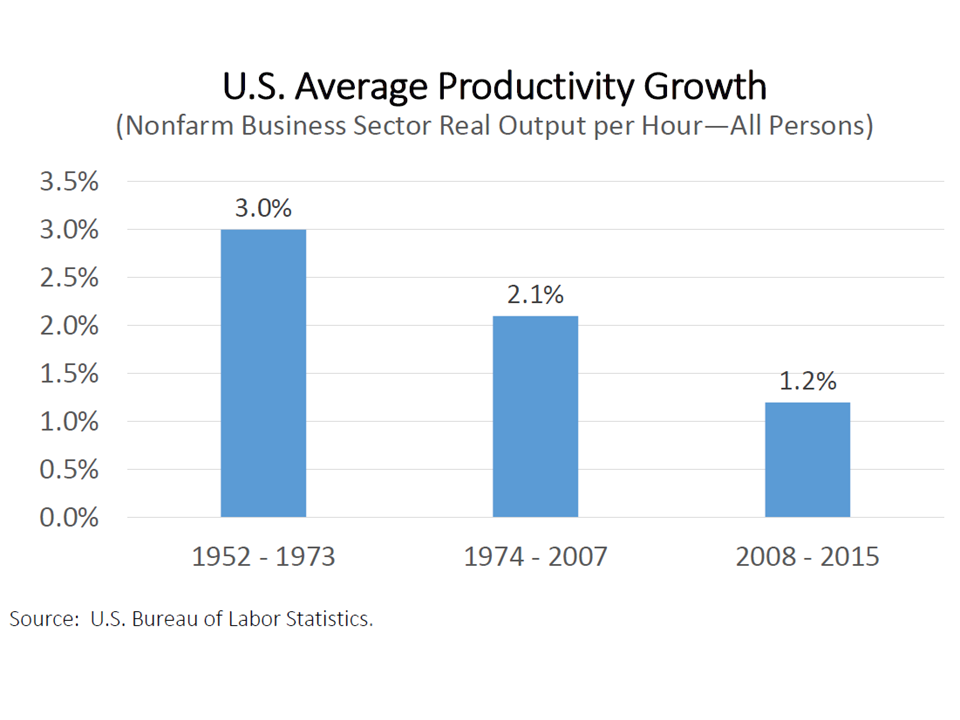
Productivity is about “working smarter” rather than “working harder” and it reflects our ability to produce more output by better combining inputs, owing to new ideas, technological innovations and business models. Productivity is critical to future growth. Has the rise of social media, knowing what your friends favourite type of guacamole is, made any difference to productivity? The statistics from recent years indicate the answer is no with the slowdown in productivity vexing economists with a multitude of recent opinion and papers on the topic. Stanley Fisher from the Fed stating in an interesting speech for earlier this month that “we simply do not know what will happen to productivity growth” and included the graph below in his presentation.

click to enlargeUS Average Productivity Growth 1952 to 2015

Martin Wolf in a piece in the FT on recent projections by the Office for Budget Responsibility (OBR) calls the prospects for productivity “the most important uncertainty affecting economic prospects of the British people”.

Some think the productivity statistics have misestimated growth and the impact of technology (e.g. the amount of free online services). A recent paper from earlier this month by Fed and IMF employees Byrne, Fernald and Reinsdorf concluded that “we find little evidence that the slowdown arises from growing mismeasurement of the gains from innovation in IT-related goods and services”.

The good news seems to be that productivity slumps are far from unprecedented according to a paper in September last year from Eichengreen, Park and Shin. The bad news is that the authors conclude the current slump is widespread and evident in advanced countries like the U.S. and UK as well as in emerging markets in Latin America, Southeast Europe and Central Asia including China.

A fascinating paper from December 2015 by staff at the Bank of England called “Secular drivers of the global real interest rate” covers a wide range of issues which are impacting growth, including productivity growth. I am still trying to digest much of the paper but it does highlight many of the economists’ arguments on productivity.

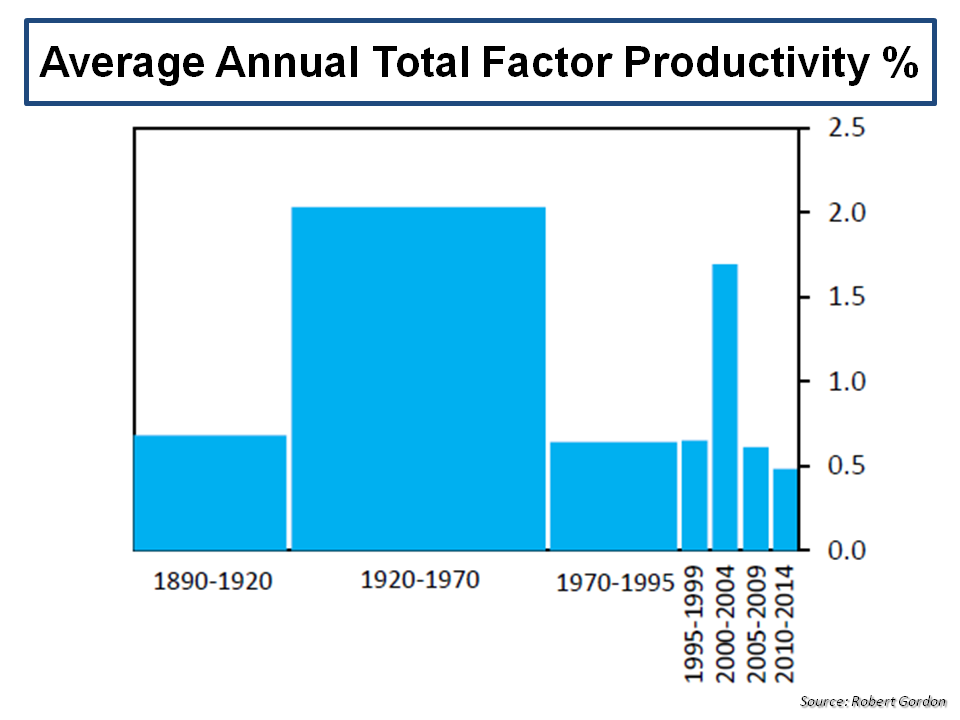
One of those is Robert Gordon, who has a new bestseller out called “The Rise and Fall of American Growth”. Gordon has long championed the view of a stagnation in technology advances due to structural headwinds such as an educational plateau, income inequality and public indebtedness.

click to enlargeAverage Annual Total Facor Productivity

Others argue that productivity comes in waves and new technology often takes time to be fully integrated into the production process (e.g. electricity took 20 years before the benefits showed in labour productivity).

Clearly this is an important issue and one which deserves the current level of debate. Time will tell whether we are in a slump and will remain there or whether we are at the dawn of a golden era of innovation led productivity growth…..

The bowels of the system and helicopters

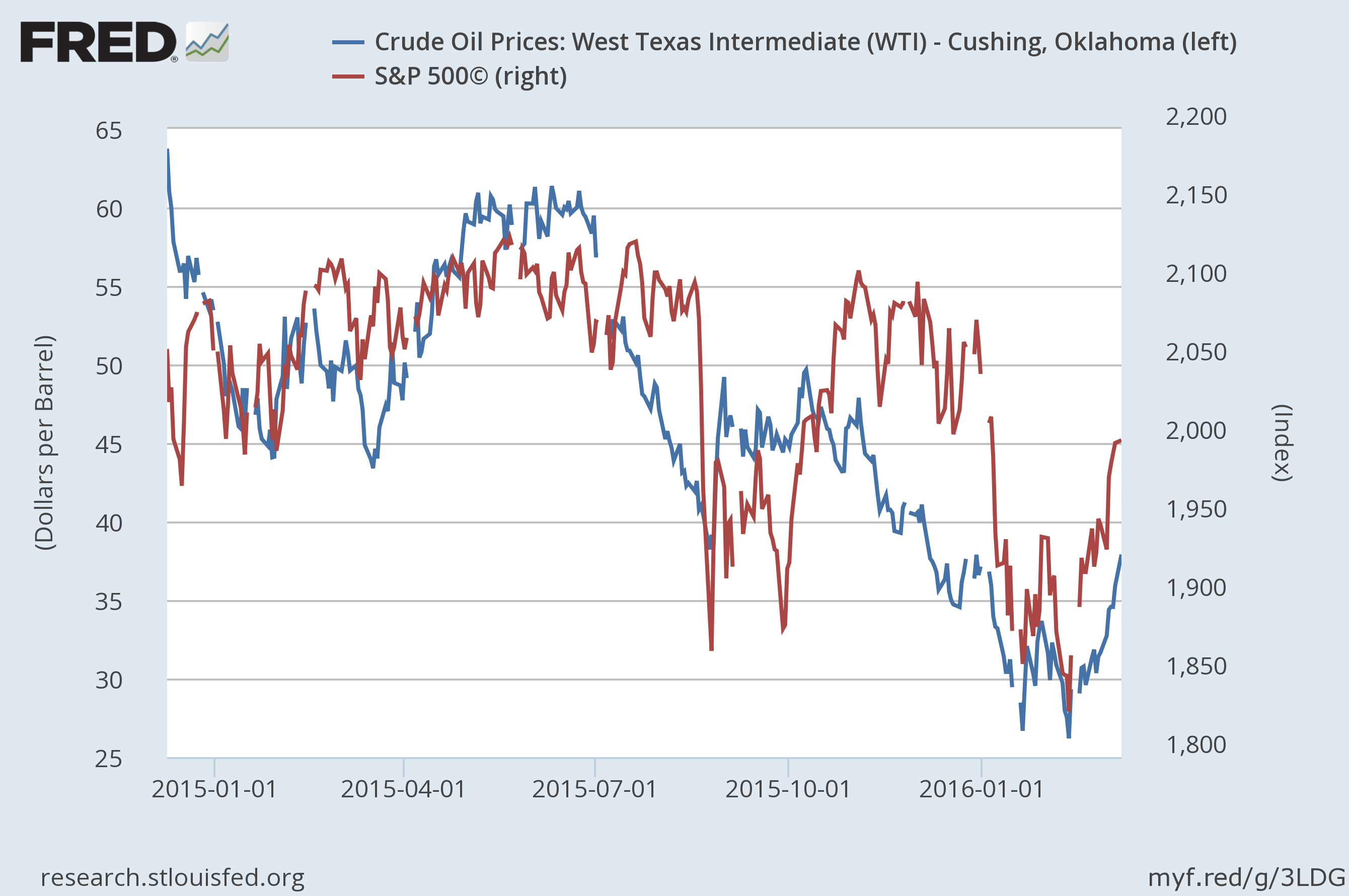
The market volatility in 2016 did seem odd in certain respects. Valuations were too high and a correction was needed. No doubt. It’s more the way the selling seemed to be indiscriminate at certain points with oil and equity prices locked in step. Some argue that China selling reserves to support their currency or oil producing countries selling assets to make up for short falls in oil revenue may be behind some of the erratic behaviour. Buttonwood had an interesting piece over the past weeks on how consequences from new bank regulations are impacting market liquidity with unusual activity in derivative pricing such as negative swap rates and relative CDS rates.

Gilian Tett, in a FT article in January, pointed to the example of capital outflows from China. Whether repaying US debt (or as Tett succinctly calls it, a quasi carry trade in reverse) in face of likely further yuan weakness or withdrawals from overzealous M&A (about a quarter of China outbound deals are said to be in trouble) or other reasons behind the veil of the Chinese economy, the outflows are having impacts. Tett said:

“Capital flows, fuelled by politics and policy change, are where the important action is taking place. Deep in the bowels of the system all manner of financial flows are switching course, creating unexpected knock-on effects for many asset prices. Capital flight from China is one example. The energy sector is another.”

The strangle lockstep between oil and the S&P500 can be seen below.

click to enlargeoil and sp500

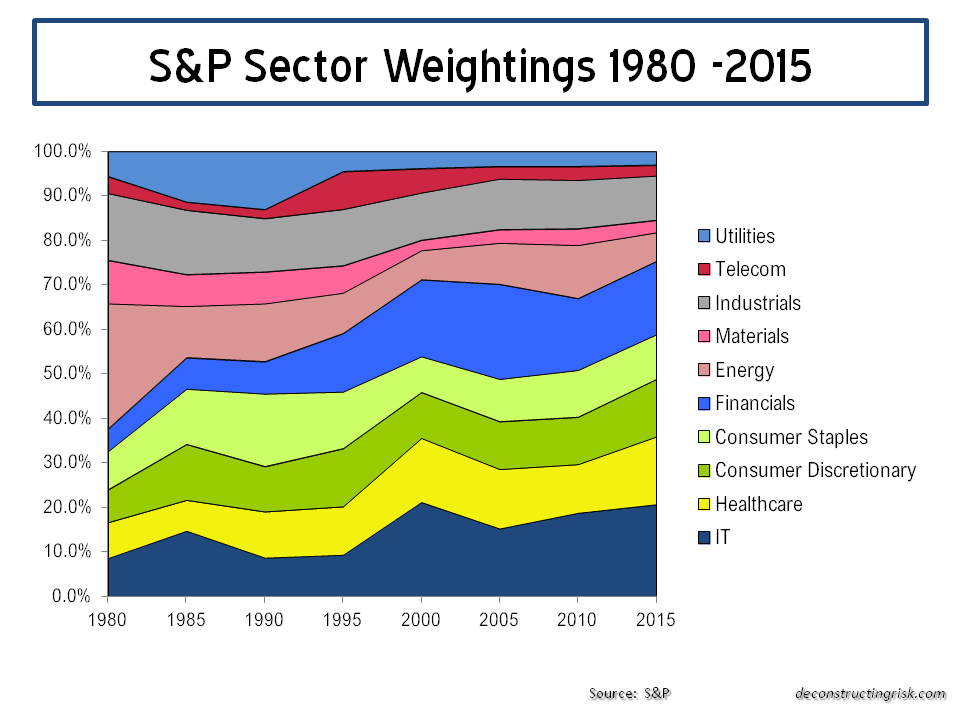
Energy has only a small impact on the S&P500 makeup, as can be seen below, and on the operating profit profile.

click to enlargeS&P Sector Weightings 1980 to 2015

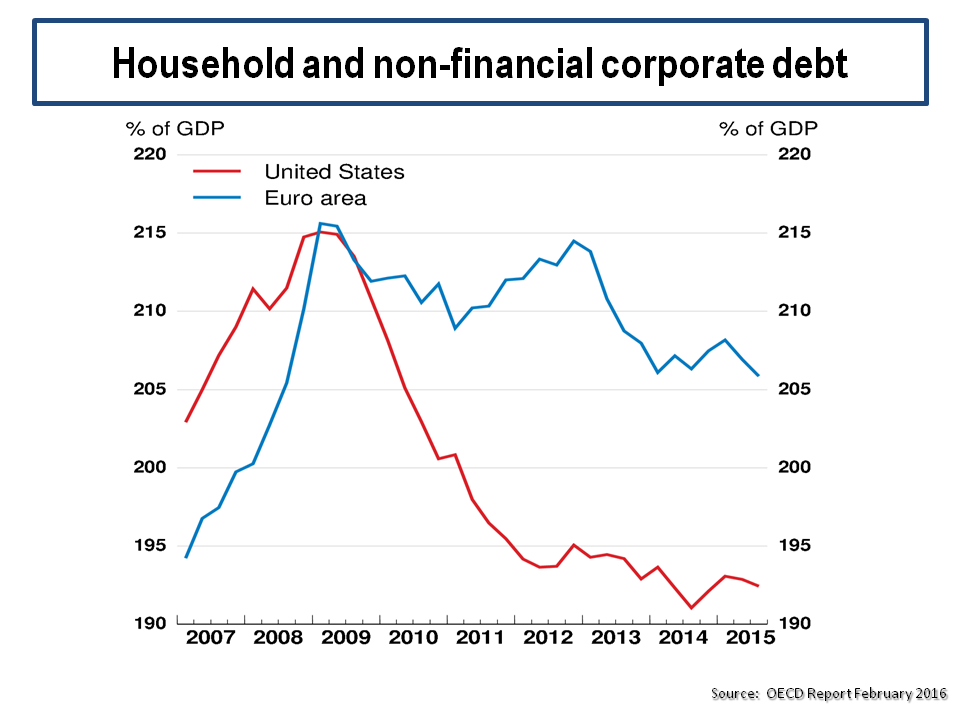
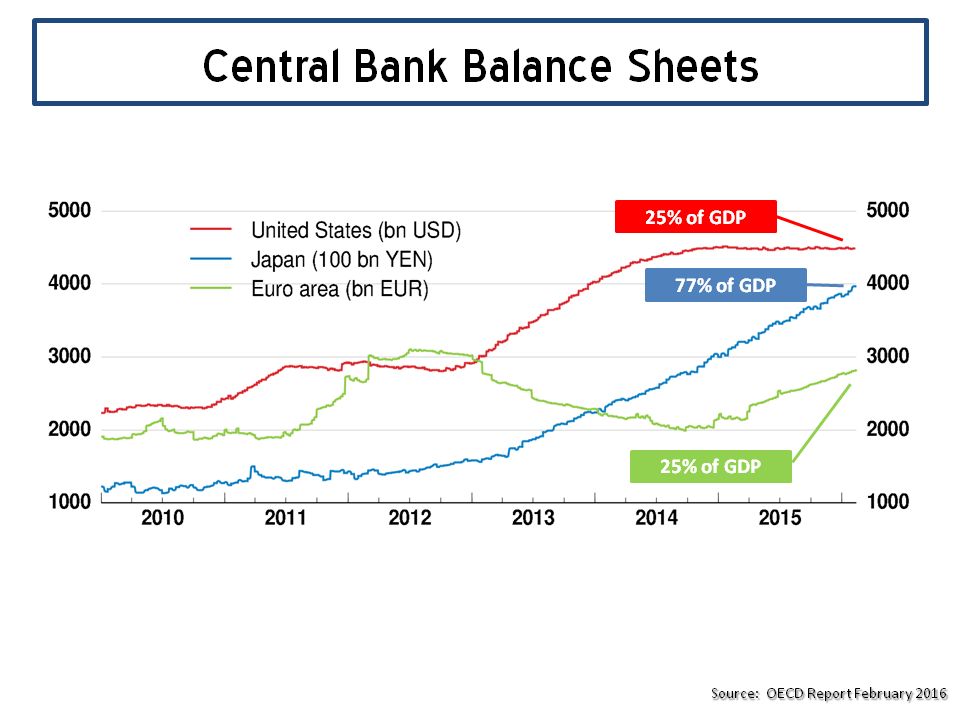
The OECD interim economic outlook by Catherine Mann on 18th February recommended “maintaining accommodative monetary policy, supportive fiscal policies on investment led spending and more ambition on structural policies which raise global growth and reduce financial risks”. Ah, yes the old structural reform answer to all of our ills. The OECD gave some graphic reminders of where we are, as below.

click to enlargeUS & Euro Household & Nonfinancial Corporate Debt 2015

click to enlargeCentral Bank Balance Sheets 2015

Central Bank policies remain stuck to QE and increasingly exotic forms of monetary policy despite the obvious failure so far for QE to kick-start either inflation or growth. The latest experiment is on negative interest rate which has had funny impacts on banks and the lending rates they need to charge. Japan in particular has shown how their brand of negative rates was countered by a currency whiplash. Mark Carney, the Governor of the Bank of England, offered the view that “for monetary easing to work at a global level if cannot rely on simply moving scarce demand from one country to another.

A recent BIS article on negative interest rates in Switzerland, Europe and Japan stated that “there is great uncertainty about the behaviour of individuals and institutions if rates were to decline further into negative territory or remain negative for a prolonged period. It is unknown whether the transmission mechanisms will continue to operate as in the past and not be subject to tipping points“.

This week Mario Draghi came up with a new twist on negative interest rates, relying on targeted long-term refinancing operations (TLTROs) to give banks effectively free money. The currency impact will be interesting, particularly to see if the Japanese whiplash will repeat. One of the results of all this QE is that central banks are a much larger player in the system and have basically taken over the government bond markets in Europe, Japan, and America. The ECB even buys low-rated bonds, not just the AA and AAA positions taken by the Fed, and makes billions of euros in low-interest-rate loans to banks.

No less that Adair Turner, Martin Wolf and Ray Dalio have all made favourable comments about another evolution in QE, so called helicopter money (named after Milton Friedman).  Wolf argues that central banks should enter the arena of public investment in the face of inaction by fiscal authorities (by which I assume he means elected politicians). He passionately says “policymakers must prepare for a new “new normal” in which policy becomes more uncomfortable, more unconventional, or both.” Turner believes that targeted stimulus of nominal demand poses “less risk to future financial stability than the unconventional monetary policies currently being deployed“.

The recent anxiety by electorates across the developed world in expressing a desire for the certainty of the past, whether it be the popularity of Donald Trump, anti-immigrant rhetoric in Europe or the arguments in the UK to leave the EC, show that ordinary people are worried about the future and no end of short term monetary stimulus is likely to change that. Helicopter money sounds like a medicated solution to the symptoms of low growth rather than any real answer to the problem of slowing growth, Chinese and Japanese unsustainable debt loads and global productivity challenges due to aging populations.

Maybe it’s just me, and I do respect the views of Wolf, Turner and Dalio, but it looks to me a measure that is open to so much moral hazard as bordering on the surreal. It gives Central Banks more power in the markets and that could be dangerous without more thought on the unintended consequences. If we are moving piecemeal towards a Chicago Plan or some other alternate economic model, then somebody should get the public on board. I think they are desperately looking for new answers to the way we run our economies.

Level-headed

After a week like the one just gone, where the S&P500 hit the 10% down threshold for the year, it’s perversely healthy to see debates rage about the likelihood of a recession, the future for oil prices, the bursting of the unicorn bubble, the impact of negative interest rates and the fallibility of central bank macro policy in the developed world, to name just a few. Considering and factoring in such risks are exactly what should be happening in a well functioning market, rather than one far too long reliant upon the supposed omnipresent wisdom of central bankers to answer any market ills that may come along. Although the market volatility during the opening months of 2016 hasn’t been pleasant and will hopefully find a floor soon, valuations didn’t reflect risks and an adjustment was needed.

I have no idea where the market is headed, although I suspect we are just one more shake-out from capitulation. Valuations have come off their unsustainable highs and a select few are beginning to look attractive. After some of this week’s indiscriminate falls, it’s always a good risk management discipline to assess current and possible new positions in light of developments. I assessed AAPL’s valuation recently in this post and offered my thoughts on the new Paddy Power Betfair in this post.

The subject of this post is Level 3 (ticker LVLT), a facilities-based provider of a range of integrated telecommunications services. Prior to their earnings on 4th of February, I had been re-examining my investment rationale on LVLT, one of my highest conviction positions that I last posted on a year ago. As I have highlighted before, LVLT is not an investment for the faint hearted and the past week has again proven that (a beta level of 1.5 according to Yahoo just doesn’t capture it!) with daily moves following the Q4 report of +6.9%,-5.7%,-9.4%,+3.7%,+3%, 0.5%, and Friday’s +1.7%. The graphic below shows the movement in the share price in LVLT, the S&P500 and the S&P High Beta index (SPHB) since the start of 2015. Also shown are the daily changes in LVLT against those of the S&P500.

click to enlargeLevel3 SP500 Share Price & Volatility

To recap on the bull case, the strength of LVLT is its deep and global IP optic network which following the recent mergers with Global Crossing and TW Telecom now has the business scale for the experienced management team to finally achieve operating margins to support its debt (current net debt to 2016 guided EBITDA is approx 3.5) and throw off meaningful cash-flow in the coming years (average FCF growth of 8% according to my estimates over the next few years). The Q4 2015 results and 2016 guidance showed the bull case is intact and the demand for new products such as the security and intelligent network services show how LVLT’s network is a competitive advantage in today’s technology driven world. The CEO Jeff Storey summarized their case at the Q4 conference call as follows:

“Most importantly, is our movement towards our vision of one, one set of products that we take to an expanding market, one network to deliver those products globally, one set of operational support systems to enable a differentiated customer experience, and one team with the singular goal of making Level 3 the premier provider of enterprise and networking services. As we look to 2016, our strategy remains the same. We are focused on operational excellence throughout our business, providing a superior experience to our customers and developing the products and capabilities to meet their complex and evolving networking needs.”

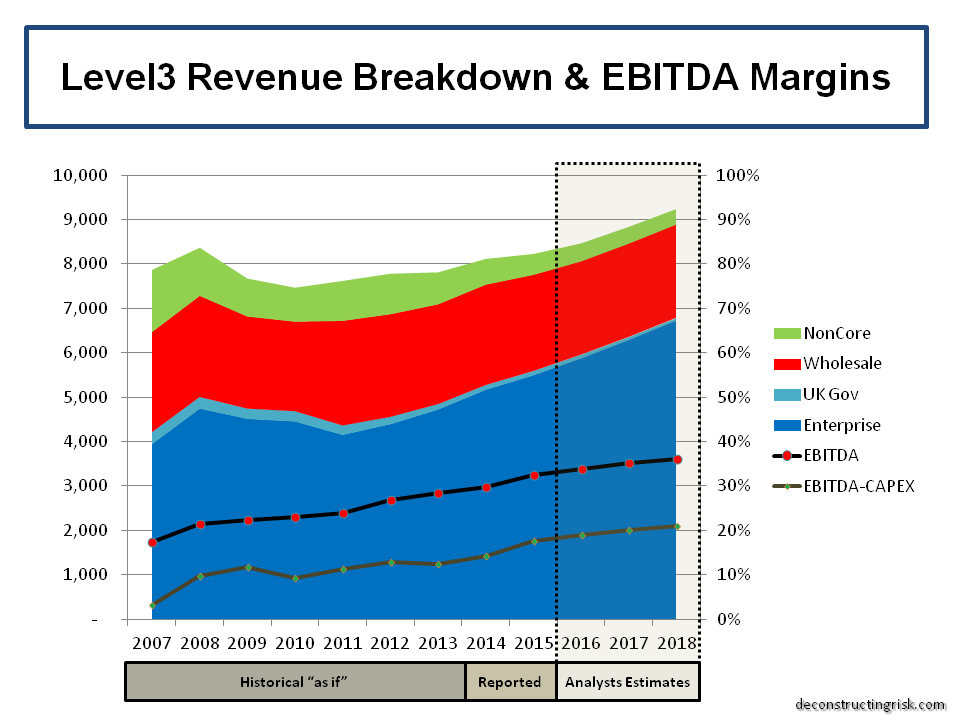
As the talk of a possible recession fuelled worries on business telecom spend, I thought it would be useful to look at the historical “as if” results of the now enlarged LVLT through the financial crisis. This involved looking through old Global Crossing and TW Telecom results and making numerous assumptions on the historical growth of acquired businesses and the business classifications (and numerous reclassifications) of each firm over time. The historical “as if” results combined with the reported figures for 2014 to 2015 and analyst estimates for 2016 to 2018 are shown below.

click to enlargeLVLT Proforma Revenue Split 2007 to 2018

Within the context of the caveat above, the drop in enterprise revenue from 2008 to 2011 was 12.5%, primarily driven the financial crisis with other factors being Global Crossing refocusing its portfolio and the operational missteps by legacy Level3 in integrating its multiple acquisition from 2006-08. TW Telecom’s consistent top-line growth since 2007, despite the financial crisis, can be seen in this post. It’s interesting that the wholesale revenues have been relatively stable historically ranging between $2.10-2.35 billion, supporting the view that price decreases are offset by unit increases in IP traffic.

Since 2012, the benefits of scale combined with the integration prowess of the current LVLT management team (Jeff Storey became CEO in 2013) are vividly shown in the impressive increase in EBITDA margin from 22% in 2009 to 32% in 2015. After cutting capex in 2008-09, the combined business has required 14%-16% since then, now targeted at 15% to support the 8% annual growth in enterprise revenues (on a constant currency basis) that management have set as their target.

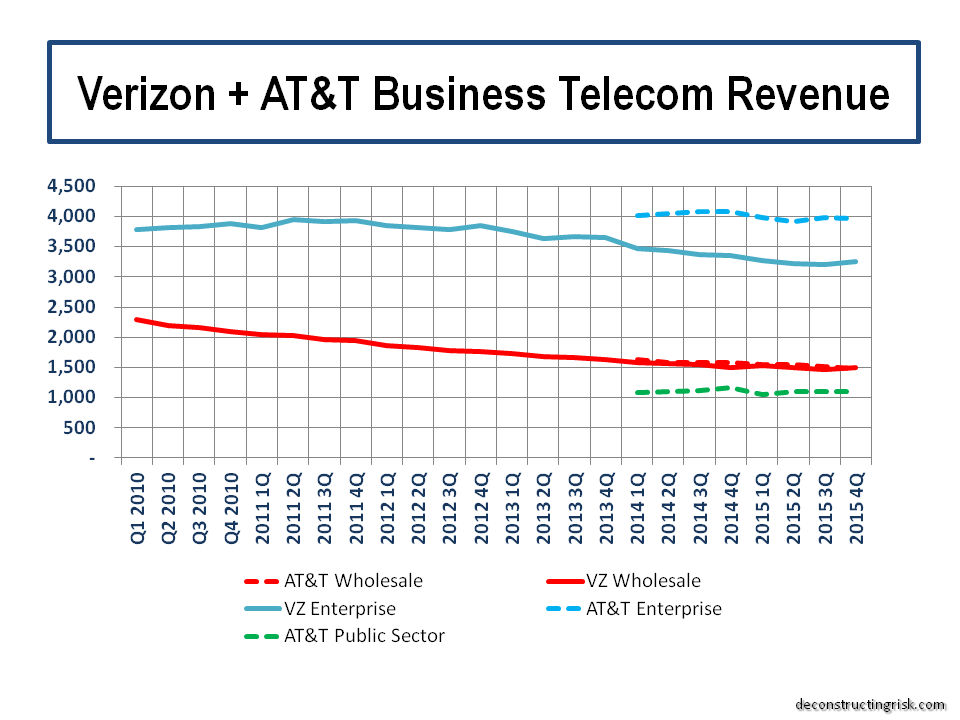
In Q4, LVLT’s revenue was derived 80% from the US and management claim that their enterprise business has only a single digit market share in the US leaving plenty of room for growth, particularly against the incumbents Verizon and AT&T. The graph below shows enterprise and wholesale revenues from each firm with AT&T showing revenue stability against a declined trend for Verizon.

click to enlargeVZ AT&T Business Telecom Revenue

Numerous analysts confirmed their estimates on LVLT following the Q4 results and the average target is above $60, approximately 30% above the current level. Regular readers will know that normally I don’t have much time for analysts’ estimates but in this case my own DCF analysis suggests a medium term target of per share in the low 60’s is reasonable. According to my estimates that translates into an EV/EBITDA multiple of approx 8.5 in 2018 which looks reasonable given LVLT’s free cash growth. I used the historical “as if” figures above to calculate a downside valuation for LVLT on the basis of a recession occurring over the next 2 years. I assumed that a 2016-2018 recession would have approx half the impact of the 2008-2011 crisis upon LVLT’s enterprise revenue (e.g. approx 7% decline) before stabilising and recovering. My valuation of LVLT in such a scenario was in the mid 30’s or an approx 25% downside potential from Friday’s close. So at a 25% downside and a 30% upside, LVLT’s risk profile is finely balanced.

LVLT itself may become a target for a firm like Comcast or CenturyLink or another large communication firm looking to bulk up its regional reach or network business. Two interesting items came out of LVLT’s Q4 call; the first being the tightening of its target leverage range to 3 to 4 times EBITDA (from 3 to 5 times) and the second being a renewed appetite by management to use free cash-flow for disciplined M&A rather than shareholder returns such as buy-backs or even initiating a dividend. With LVLT proving their ability to get in excess of $200 million in EBITDA savings from adding TW Telecom’s revenue base of $1.6 billion at the time of the merger (or an impressive 12.5% EBITDA pick-up), the case for disciplined M&A by LVLT’s management is strong. Possible targets in the US include Zayo (their share price is having a hard time of late) or Carl Icahn’s privately held XO Communications (now that the maestro has milked the firms of its tax losses), amongst others. In Europe, possible targets include the now private Fidelity owned COLT (see this post on background) or Interroute, another privately owned pan-European network.

Whatever happens, I am content to hold my position in LVLT at this level. I like the firm’s current risk profile, the developing product range in the ever important network age, and particularly the recent execution record of management. As ever, I would highlight the stock’s volatility and recommend the use of options to protect downside risks (which are not inconsiderable if the probability of recession grows). I again repeat that LVLT is not one for the faint hearted, particularly in this market where near term volatility looks all but certain, but one I trust will be an attractive investment.