So….2016

As the first week of January progressed and markets tumbled, I was thinking about this post and couldn’t get away from the thought that 2016 feels very like 2015. The issues that were prominent in 2015 are those that will be so again in 2016 plus a few new ones. The UK vote on the EU and a US presidential race are just two new issues to go with China economic and political uncertainty, Middle East turmoil, Russian trouble making, a political crisis in Brazil, the insidious spread of terrorism, a move towards political extremes in developed countries and the on-going fault lines in Europe and the Euro. All of these macro factors together with earnings and the impact of rising interest rates are going to dominate 2016.

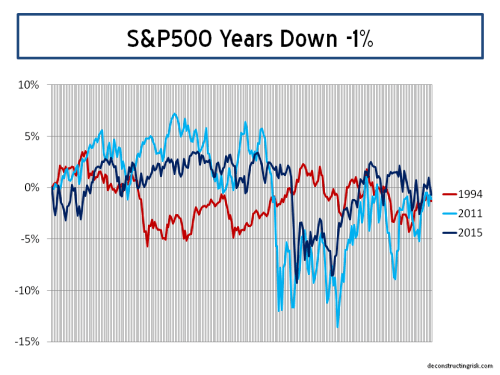
2015 joins two other years, 2011 and 1994, in being a -1% year for the S&P500 in recent times, as the graph below shows. In fact, the movements of the S&P500 in 2015 show remarkable similarity with 2011. However, there the similarities end. 2011 was the year of the Euro crisis, the Arab spring and the Japan quake. Interest rates were falling, earnings stable, and PE multiples were around 15. 1994 was even more different than 2015. In 1994, the economy was taking off and the Fed was aggressively raising rates, earnings were stable and PE multiples fell to around 15. Interesting the next 5 years after 1994 on the stock market were each 20%+ years! With 2015 around a 20 PE and earnings falling, the comparisons are not favourable and may even suggest we got off lightly with just a -1% fall.

click to enlargeS&P500 Years Down -1%
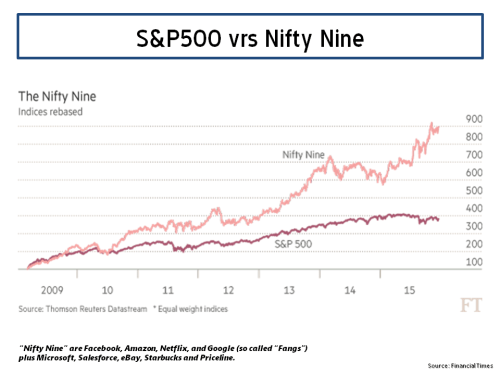
A recent article in the FT does point to the influence of a limited number of stocks on the 2015 performance with the top 10 stocks in the S&P500 up 14% in 2015 and the remaining 490 stocks down 5.8% collectively. The performance of the so-called nifty nine is shown below. The article highlights that “dominance by a few big companies – or a “narrowing” market – is a symptom of the end of a bull run, as it was in the early 1970s (dominated by the “Nifty Fifty”) or the late 1990s (dominated by the dot-coms).”

click to enlargeS&P500 vrs Nifty Nine
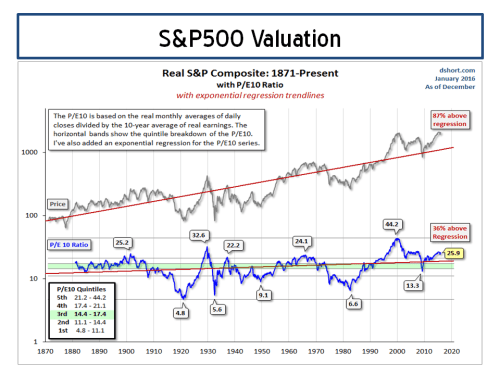
Bears have long questioned valuations. The impact of continuing falls in oil prices on energy earnings and a fall off in operating margins are signalling a renewed focus on valuations, as the events of this past week dramatically illustrate. A graph of the PE10 (aka Shiller CAPE) as at year end from the ever insightful Doug Short shows one measure of overvaluation (after this week’s fall the overvaluation on a PE10 basis is approx 30%).

click to enlargeS&P500 Valuation PE10 Doug Short
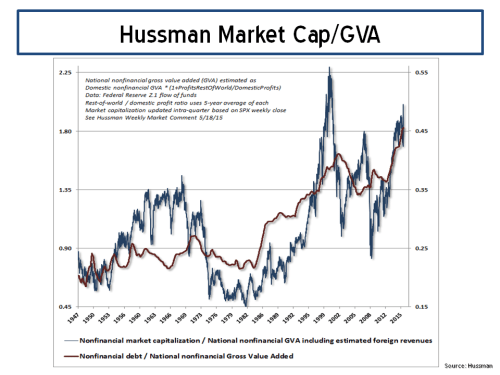
One of the longstanding bears, John Hussman, had an article out this week called “The Next Big Short”, in honour of the movie on the last big short. Hussman again cites his favourite metrics of the ratio of nonfinancial market capitalization to corporate gross value added (GVA) and the ratio of nonfinancial corporate debt to corporate GVA (right scale) as proof that “the financial markets are presently at a speculative extreme”.

click to enlargeHussman Market Cap to GVA
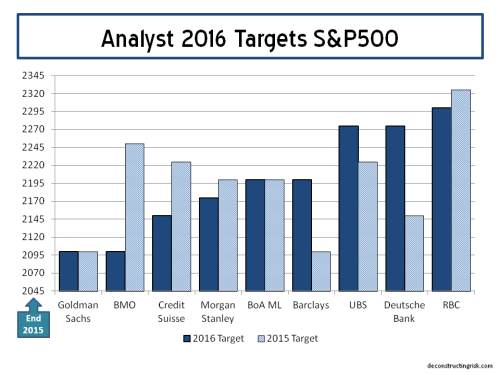
Many commentators are predicting a flat year for 2016 with some highlighting the likelihood of a meaningful correction. Whether the first week in January is the beginning of such a correction or just a blip along the path of a continually nervous market has yet to be seen. Analysts and their predictions for 2016 have been predictably un-inspiring as the graph below shows (particularly when compared to their 2015 targets).

click to enlarge2016 S&P500 Analyst Targets
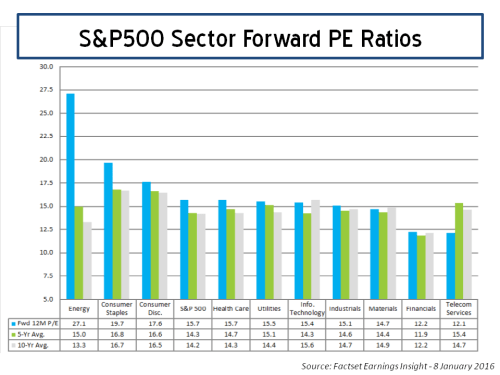
Some, such as Goldman Sachs, have already started to reduce their EPS estimates, particularly for energy stocks given the increasingly negative opinions on oil prices through 2016. The 12 month forward PEs by sector, according to Factset Earning Insight dated the 8th of January as reproduced below, show the different multiples explicit in current estimates with the overall S&P500 at 15.7.

click to enlargeS&P500 Sector Forward PE Factset 08012016
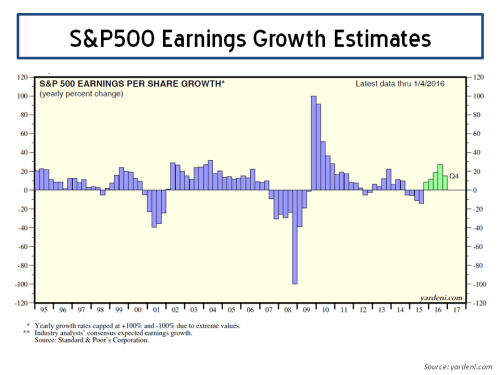
Current earnings estimates for 2016 as per the latest Yardeni report (EPS growth graph is reproduced below), look to me to be too optimistic compared to the trends in 2015 and given the overall global economic outlook. Future downward revisions will further challenge multiples, particularly for sectors where earnings margins are stagnating or even decreasing.

click to enlargeS&P500 Earnings Growth 2016 Yardeni
To further illustrate the experts’ views on EPS estimates, using S&P data this time, I looked at the evolution in actual operating EPS figures and the 2015 and 2016 estimates by sector, as per the graph below.

click to enlargeS&P500 Operating EPS by sector
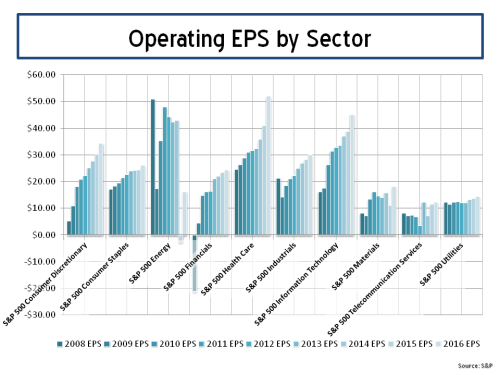
With US interest rates rising (albeit only marginally off generational lows), the dollar will likely continue its strength and higher borrowing costs will influence the environment for corporate profits. Pent up labour costs as slack in the US economy reduces may also start to impact corporate profits. In this context, the EPS estimates above look aggressive to me (whilst accepting that I do not have detailed knowledge on the reasoning behind the EPS increases in individual sectors such as health care or materials), particularly when global macro issues such as China are added into the mix.

So, as I stated at the start of this post, the outlook for 2016 is looking much like 2015. And perhaps even a tad worse.
Precarity or fecundity?

The title of this post suggests some apposite thoughts on the world but, as will become obvious later, this post is far from that. 2015 has been a good year for me professionally, if very busy at times. Investment wise, it’s been a “so what” year with valuations roughly where they were 12 months ago, although the strong dollar and pound have helped a slightly down year in local currencies for some fund positions. Markets enter 2016 in a state of uncertainty. Still, I can’t complain even though an early retirement due to my investing genius is as implausible as ever!

I did not get as much time as I had hoped this year for blogging with an average of just below 3 posts per month compared to 5 in 2014. Besides work, I did manage to spend some time this year reading a few books (I posted on Wolf’s book here and Mason’s book here). In fact, I am currently enjoying reacquainting myself with many of the words of wisdom of Charlie Munger in Tren Griffin’s book “Charlie Munger: The Complete Investor”. Munger’s views on continuous learning and being worldly wise can never be said often enough. This time around, Munger’s words on needing to test one’s thought process against multiple models to avoid torturing truth into a perceived reality have helped me in a number of cases recently. It has a Monty Pyton feel to it, but the internet is full of examples of the multiple models Munger may be referring to, although he rightly declines to give us the handbook for wisdom (now there’s a best seller!). This article from Griffin is one example.

Another pearl from the Sage is on what a waste of energy envy is. Munger says that “envy is a really stupid sin because it’s the only one you could never possibly have any fun at”. Now, that’s a motto for 2016!

Another book that I am hoping to read over the holidays is “Superforecasting” by Philip Tetlock and Dan Gardner which has been getting rave reviews. Tetlock’s previous work, such as that on foxes (know a little about a lot) and hedgehogs (know a lot about very little), has always been engaging.

One of my reading habits is to note down words which I am unsure of and then try and use them in the future. That explains the title of this post! A list of some of these words is below (and I may just spend my free time over the next few weeks trying to come up with some clever sentences to use them in for posts next year!!!).

  • Apposite: apt in the circumstances or in relation to something.
  • Sundered: split apart.
  • Vainglorious: vain, excessively boastful, swelled pride.
  • Progeny: a descendant or the descendants of a person, animal, or plant.
  • Insuperable: impossible to overcome.
  • Insouciant: showing a casual lack of concern.
  • Fecund: producing or capable of producing an abundance of offspring or new growth.
  • Hysteresis: the phenomenon in which the value of a physical property lags behind changes in the effect causing it.
  • Dissonance: lack of agreement or harmony between people or things.
  • Propitious: giving or indicating a good chance of success.
  • Strictures: a restriction on a person or activity.
  • Parsimonious: very unwilling to spend money or use resources.
  • Higgling: to bargain in a petty way.
  • Sublation: assimilate a smaller entity into a larger one.
  • Impermanence: not permanent or enduring; transitory.
  • Precarity: a condition of existence without predictability or security, affecting material and/or psychological welfare.
  • Dialectial: relating to the logical discussion of ideas and opinions; concerned with or acting through opposing forces.
  • Confected: make (something elaborate or dainty) from various elements.

I did warn at the beginning of this post on its content…..

I really just wanted to wish all readers a great holiday and to thank you for your time and support this year.

Happy Christmas.

Obstinate OpRisk

Insurers and banks are currently grappling with how best to model operational risk. Many firms struggle to come up with sensible figures that can past any proper validation criteria when faced with issues like limited applicable data, correlation with other risks, aggregation challenges, and the impact of prospective operational risks from the use of new technology.

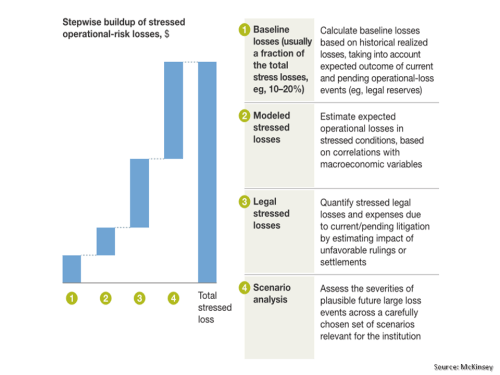
McKinsey have an interesting article out suggesting a structured approach to the issue. The graphic below illustrates their approach.

click to enlargeMcKinsey Operational Risk Exhibit

No one approach is ideal or applicable to all. Notwithstanding this, financial firms all too often focus on justifying a low operational charge to regulators in their capital modelling rather than ensuring that their approach can be embedded into their control framework as a practical risk management tool for management and employees to use in being continually vigilant of operational risks whilst offering tangible incentives to mitigate risk which are, by their nature, unanticipated.

Wobbly Tooth

The onset of a wobbly tooth from a year old crown caused me to have a look at Sirona Dental Systems (SIRO) again. I last blogged on it in August 2014 here. SIRO has had a good run since then moving from around $80 to $109 today. The recent increase is due to the announcement in September of a merger of equals with DENTSPLY which is expected to close in Q1 2016.

SIRO, with 65% of its revenues outside of the US, felt the impact of the dollar strength with flat line revenue growth in 2015 (year ending in September). In local currencies, SIRO achieved 9.8% growth which was broad based across the US and international markets with respective growth at 9.2% and 10%. Despite the FX headwind, and a volatile Q2, operating margins were impressive, as the graph below shows. Operating cash-flow after capital expenditure has also been strong closely running at approximately 65% of operating income.

Click to enlargeSIRO Revenue Split & Op Margins YE2015

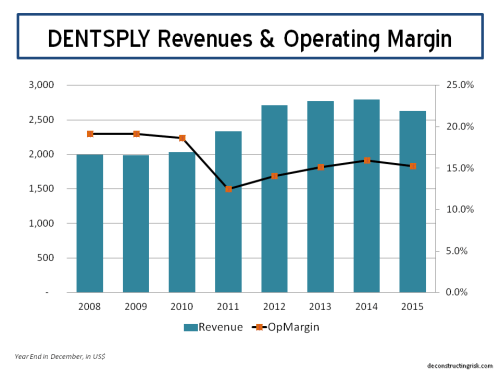
DENTSPLY (ticker XRAY) is a larger company in revenue terms with lower operating margins and a focus on dental consumable products. Dental specialty products such as endodontic (root canal) instruments and materials, implants and related products, bone grafting materials, 3D digital scanning and treatment planning software, dental and orthodontic appliances and accessories make up approximately 50% of revenues. Dental consumable products such as dental anesthetics, prophylaxis paste, dental sealants, impression materials, restorative materials, tooth whiteners and topical fluoride make up approx 30% of sales. The rest of sales are split between dental laboratory products and consumable medical device products. Geographically DENTSPLY also sells its products globally with 65% outside the US. DENTSPLY’s historical results (with assumed Q4 to December for 2015) are as below and the net cash-flow profile of DENTSPLY relative to operating income is similar to SIRO in recent years.

Click to enlargeXRAY Revenue Split & Op Margins YE2015

The investor presentation on the merger highlights further details. One interesting angle on the investment thesis is that the combined company is a good play on the aging population trend in the developed world. The $21 billion global dental market (of which the merged firm will have approximately 18%) is represented at increasing one to two times GDP. The plan also allows for a $500 million share buy-back programme post-closing with $125 million of operating costs savings (or approx 3% of operating margin based upon combined revenues) expected.

SIRO has approximately $500 million in cash with little debt. Goodwill and intangibles make up approximately 40% of SIRO’s total assets. DENTSPLY on the other hand has approximately $230 million in cash with $700 million in debt. Goodwill and intangibles make up nearly 60% of DENTSPLY’s total assets.

Based upon 5% top-line growth, my rough estimates for 2016 for the combined entity are a 21% operating margin post savings or approximately $830 million of operating income and $560 million of net income. Assuming 250 million shares (not taking the buy-back into account) I estimate an EPS of approximately $2.40. These are real back of the envelop calculations so I would caution against any rash conclusions. They do indicate a 25 times multiple of XRAY’s current share price around $60 which looks to me stretched given the integration risks. Still it’s a name for the watch list to monitor and wait for a better entry point.

In the meantime, it’s back to the dentist with this wobbly tooth.

Lessons from Lloyds

There is little doubt that the financial services industry is currently facing many challenges and undergoing a generational change. The US economist Thomas Philippon opined that the finance industry over-expansion in the US means that it’s share of GDP is about 2 percentage points higher than it needs to be although he has also estimated that the unit cost of intermediation hasn’t changed significantly in recent years, despite advances in technology and the regulatory assaults upon the industry following the financial crisis.

The insurance sector has its own share of issues. Ongoing low interest rates and inflation, broader low risk premia across the capital markets, rapid technology changes such as big data and the onset of real time underwriting are just the obvious items. The Economist had an article in March that highlighted the prospective impact of data monitoring and technology on the underwriting of motor and health risks. This is another interesting post on a number of the new peer to peer business models such as Friendsurance, Bought by Many, and Guevara who are trying to disrupt the insurance sector. There can be little doubt that the insurance industry, just like other financial sectors, will be impacted by such secular trends.

However, this post is primarily focused on the short to medium term outlook for the specialty insurance and reinsurance sector. I have been asked a few of times by readers to outline what I think the next few years may look like for this sector. My views of the current market were nicely articulated by Alex Maloney, the Group CEO of Lancashire, who commented in their recent quarterly results statement as follows:

“The year to date has seen a flurry of activity on the M&A front within the industry, much of this, in my view, is driven by the need to rationalise and refocus oversized and over stretched businesses. We also continue to see a bout of initiatives and innovations in the market, the sustainability and longer term viability of which are questionable. These are symptoms of where we are in the cycle. We have seen these types of trends before and in all likelihood, will see them again.”

Lloyds of London has had a colourful past and many of its historical issues are specific to it and reflective of its own eccentric ways. However, as a proxy for the global specialty sector, particularly over the past 20 years, it provides some interesting context on the trends we find ourselves in today. Using data from Lloyds with some added flavour from my experiences, the graphic below shows the dramatic history of the market since 1950.

click to enlargeLloyds Historical Results 1950 to 2015

The impact of Hurricane Betsy in 1965 upon Lloyds illustrated a number of the fault-lines in the structure of Lloyds with the subsequent Cromer report warning on the future danger of unequal treatment between insiders (aka working Names) and “dumb” capital providers (aka all other Names). The rapid influx of such ill informed capital in the late 1970s and the 1980s laid the seeds of the market’s near destruction largely due to the tsunami of US liability claims resulting from asbestos and pollution exposures in the 1980s. These losses were exacerbated by the way Lloyds closed underwriting years to future capital providers through vastly underpriced reinsurance to close transactions and the practice of the incestuous placement of excess of loss retrocession for catastrophe losses within the market, otherwise known as the London Market Excess of Loss (LMX) spiral. There is a clever article by Joy Schwartzman from 2008 on the similarity between the LMX spiral and the financial risk transformational illusions that featured heavily in the financial crisis. Indeed, the losses from the sloppy “occurrence” liability insurance policy wordings and the tragedy of unheeded asbestos risks continued to escalate well into the 1990s, as the exhibit below from a 2013 Towers Watson update illustrates.

click to enlargeTowers Watson Asbestos Claims US P&C Insurers

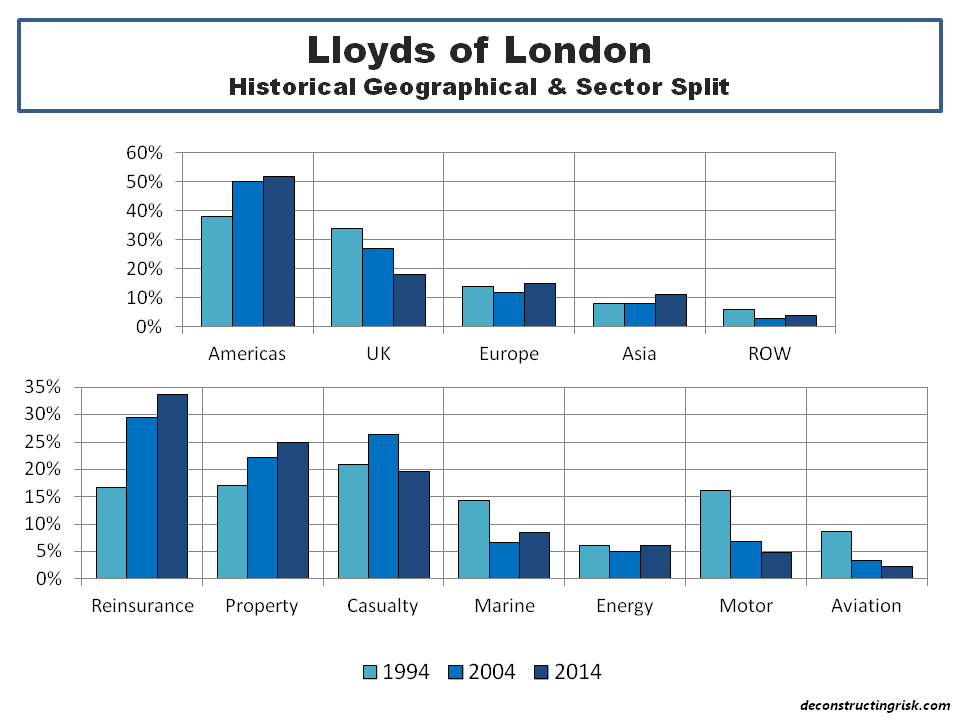
What happened in Lloyds after the market settlement with Names and the creation of the “bad bank” Equitas for the 1992 and prior losses is where the lessons of Lloyds are most applicable to the market today. The graphic below shows the geographical and business split of Lloyds over the past 20 years, showing that although the underlying risk and geographical mix has changed it remains a diversified global business.

click to enlargeLloyds of London Historical Geographical & Sector Split

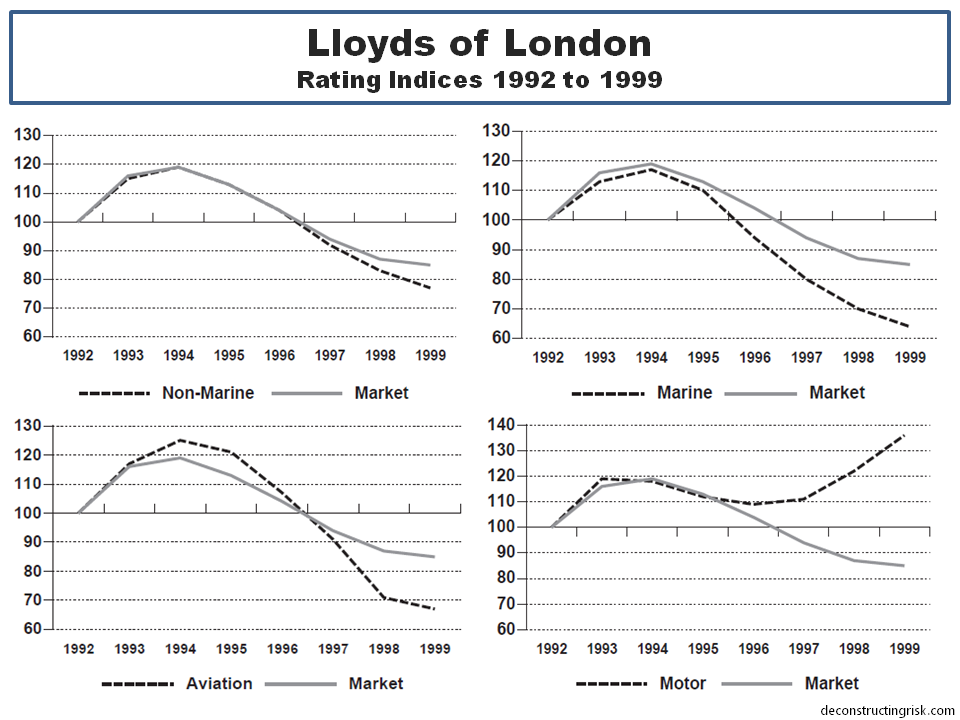
Released from the burden of the past after the creation of Equitas, the market quickly went on what can only be described as an orgy of indiscipline. The pricing competition was brutal in the last half of the 1990s with terms and conditions dramatically widened. Rating indices published by the market, as below, at the time show the extent of the rate decreases although the now abandoned underwriting indices published at the same time spectacularly failed to show the impact of the loosening of T&Cs.

click to enlargeLloyds of London Rating Indices 1992 to 1999

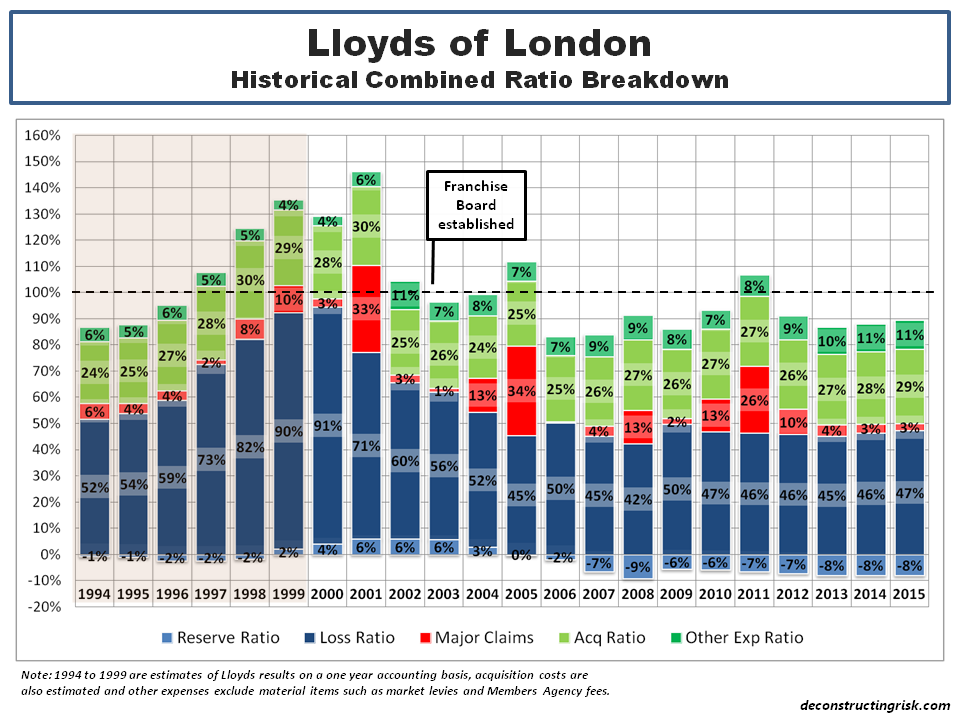
As Lloyds moved from their historical three year accounting basis in the 2000s it’s difficult to compare historical ratios from the 1990s. Notwithstanding this, I did made an attempt to reconcile combined ratios from the 1990s in the exhibit below which clearly illustrates the impact market conditions had on underwriting results.

click to enlargeLloyds of London historical combined ratio breakdown

The Franchise Board established in 2003, under the leadership of the forthright and highly effective Rolf Tolle, was created to enforce market discipline in Lloyds after the disastrous 1990s. The combined ratios from recent years illustrate the impact it has had on results although the hard market after 9/11 provided much of the impetus. The real test of the Franchise Board will be outcome of the current soft market. The rating indices published by Amlin, as below, show where rates are currently compared to the rates in 2002 (which were pushed up to a level following 2001 to recover most of the 1990s fall-off). Rating indices published by Lancashire also confirm rate decreases of 20%+ since 2012 in lines like US property catastrophe, energy and aviation.

click to enlargeLloyds of London Rating Indices 2002 to 2015

The macro-economic environment and benign claims inflation over the past several years has clearly helped loss ratios. A breakdown of the recent reserve releases, as below, show that reinsurance and property remain important sources of releases (the reinsurance releases are also heavily dependent on property lines).

click to enlargeLloyds of London Reserve Release Breakdown 2004 to 2014

Better discipline and risk management have clearly played their part in the 10 year average ROE of 15% (covering 2005 to 2014 with the 2005 and 2011 catastrophe years included). The increasing overhead expenses are an issue for Lloyds, recently causing Ed Noonan of Validus to comment:

“We think that Lloyd’s remains an outstanding market for specialty business and their thrust towards international diversification is spot on from a strategic perspective. However, the costs associated with Lloyd’s and the excessive regulation in the UK are becoming significant issues, as is the amount of management and Board time spent on compliance well beyond what’s necessary to ensure a solvent and properly functioning market. Ultimately, this smothering regulatory blanket will drive business out of Lloyd’s and further the trend of placement in local markets.”

So what does all of this tell us about the next few years? Pricing and relaxed terms and conditions will inevitably have an impact, reserve releases will dry up particularly from reinsurance and property, investment returns may improve and claim inflation may increase but neither materially so, firms will focus on expense reduction whilst dealing with more intrusive regulation, and the recent run of low catastrophic losses will not last. ROEs of low double digits or high single digits does not, in my view, compensate for these risks. Longer term the market faces structural changes, in the interim it faces a struggle to deliver a sensible risk adjusted return.