Tag Archives: specialty insurance sector

Tails of VaR

In an opinion piece in the FT in 2008, Alan Greenspan stated that any risk model is “an abstraction from the full detail of the real world”. He talked about never being able to anticipate discontinuities in financial markets, unknown unknowns if you like. It is therefore depressing to see articles talk about the “VaR shock” that resulted in the Swissie from the decision of the Swiss National Bank (SNB) to lift the cap on its FX rate on the 15th of January (examples here from the Economist and here in the FTAlphaVille). If traders and banks are parameterising their models from periods of unrepresentative low volatility or from periods when artificial central bank caps are in place, then I worry that they are not even adequately considering known unknowns, let alone unknown unknowns. Have we learned nothing?

Of course, anybody with a brain knows (that excludes traders and bankers then!) of the weaknesses in the value-at-risk measure so beloved in modern risk management (see Nassim Taleb and Barry Schachter quotes from the mid 1990s on Quotes page). I tend to agree with David Einhorn when, in 2008, he compared the metric as being like “an airbag that works all the time, except when you have a car accident“.  A piece in the New York Times by Joe Nocera from 2009 is worth a read to remind oneself of the sad topic.

This brings me to the insurance sector. European insurance regulation is moving rapidly towards risk based capital with VaR and T-VaR at its heart. Solvency II calibrates capital at 99.5% VaR whilst the Swiss Solvency Test is at 99% T-VaR (which is approximately equal to 99.5%VaR). The specialty insurance and reinsurance sector is currently going through a frenzy of deals due to pricing and over-capitalisation pressures. The recently announced Partner/AXIS deal follows hot on the heels of XL/Catlin and RenRe/Platinum merger announcements. Indeed, it’s beginning to look like the closing hours of a swinger’s party with a grab for the bowl of keys! Despite the trend being unattractive to investors, it highlights the need to take out capacity and overhead expenses for the sector.

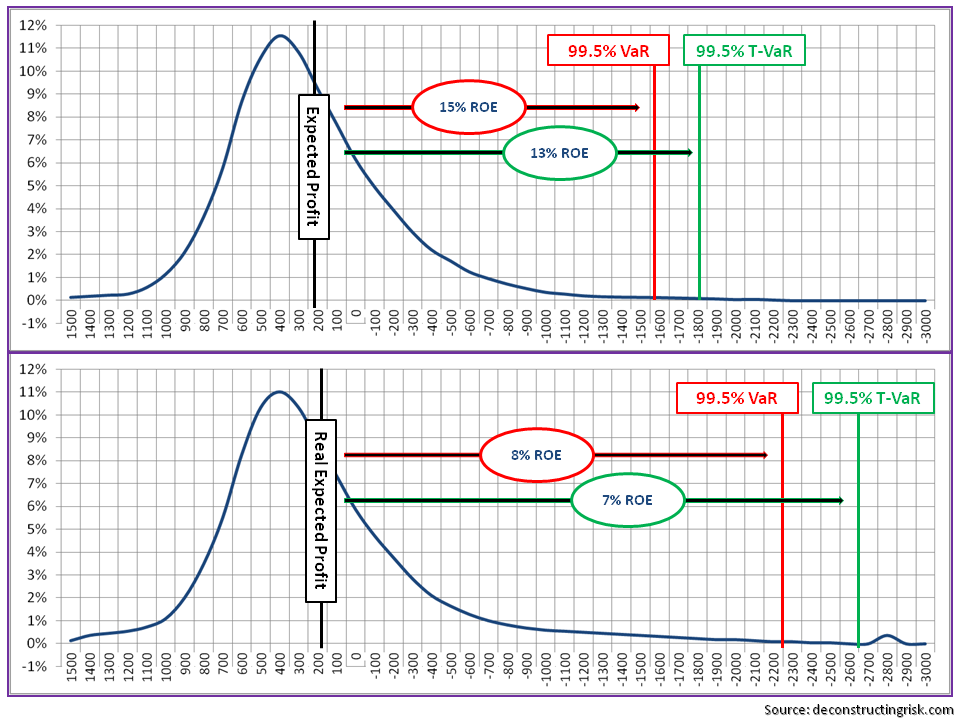
I have posted previously on the impact of reduced pricing on risk profiles, shifting and fattening distributions. The graphic below is the result of an exercise in trying to reflect where I think the market is going for some businesses in the market today. Taking previously published distributions (as per this post), I estimated a “base” profile (I prefer them with profits and losses left to right) of a phantom specialty re/insurer. To illustrate the impact of the current market conditions, I then fattened the tail to account for the dilution of terms and conditions (effectively reducing risk adjusted premia further without having a visible impact on profits in a low loss environment). I also added risks outside of the 99.5%VaR/99%T-VaR regulatory levels whilst increasing the profit profile to reflect an increase in risk appetite to reflect pressures to maintain target profits. This resulted in a decrease in expected profit of approx. 20% and an increase in the 99.5%VaR and 99.5%T-VaR of 45% and 50% respectively. The impact on ROEs (being expected profit divided by capital at 99.5%VaR or T-VaR) shows that a headline 15% can quickly deteriorate to a 7-8% due to loosening of T&Cs and the addition of some tail risk.

click to enlargeTails of VaR

For what it is worth, T-VaR (despite its shortfalls) is my preferred metric over VaR given its relative superior measurement of tail risk and the 99.5%T-VaR is where I would prefer to analyse firms to take account of accumulating downside risks.

The above exercise reflects where I suspect the market is headed through 2015 and into 2016 (more risky profiles, lower operating ROEs). As Solvency II will come in from 2016, introducing the deeply flawed VaR metric at this stage in the market may prove to be inappropriate timing, especially if too much reliance is placed upon VaR models by investors and regulators. The “full detail of the real world” today and in the future is where the focus of such stakeholders should be, with much less emphasis on what the models, calibrated on what came before, say.

Lancashire is looking unloved

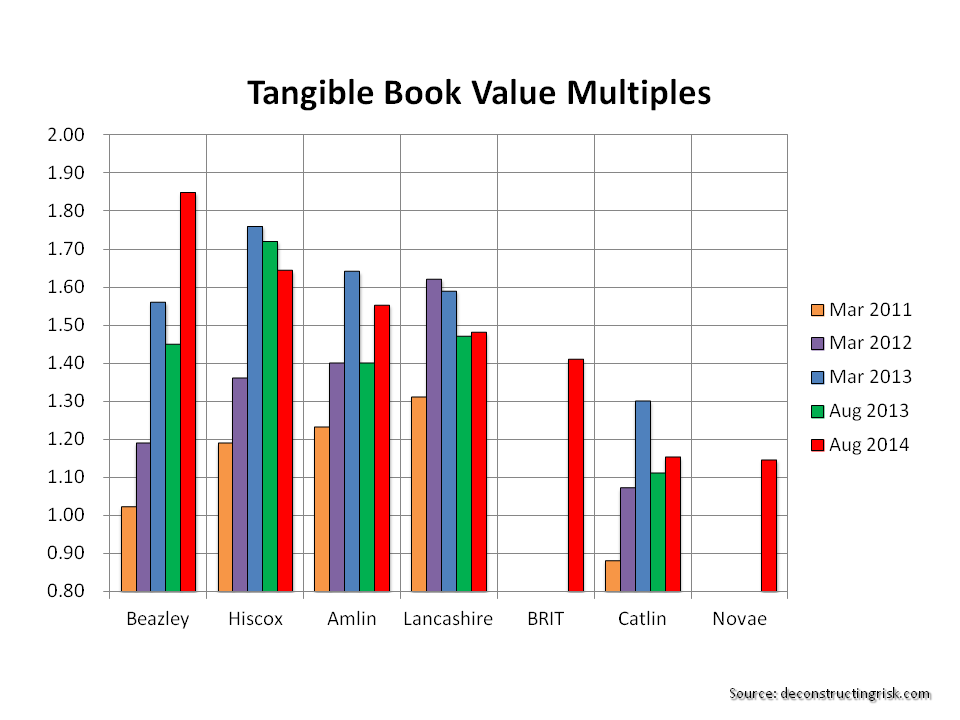
With exposure adjusted rates in the specialty insurance and reinsurance sector continually under pressure and founder/former CEO, Richard Brindle, making an unseemly quick exit with a generous pay-out, Lancashire’s stock has been decidedly unloved with the price trading well below the key £7 threshold highlighted in my last post on the subject in February. Although we remain in the middle of the US hurricane season (and indeed the Napa earthquake is a reminder that its always earthquake season), I thought it was a good time to have a quick look over Lancashire’s figures again, particularly as the share price broke below the £6 threshold earlier this month, a level not seen since early 2011. The stock has clearly now lost its premium valuation compared to others in the London market as the graph below shows.

click to enlargeLondon Market Specialty Insurers Tangible Book Value Multiples August 2014

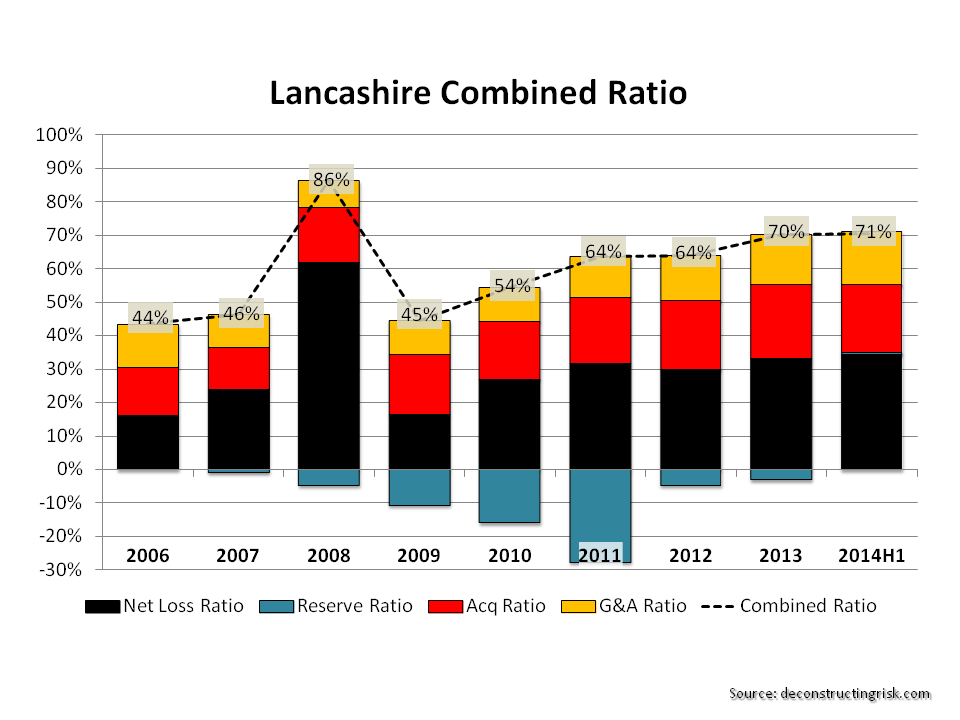
Results for H1-2014, which include full numbers from the November 2013 acquisition of Cathedral, show a continuing trend on the impact of rate reductions on loss ratios, as per the graph below.

click to enlargeLancashire Historical Combined Loss 2006 to H12014

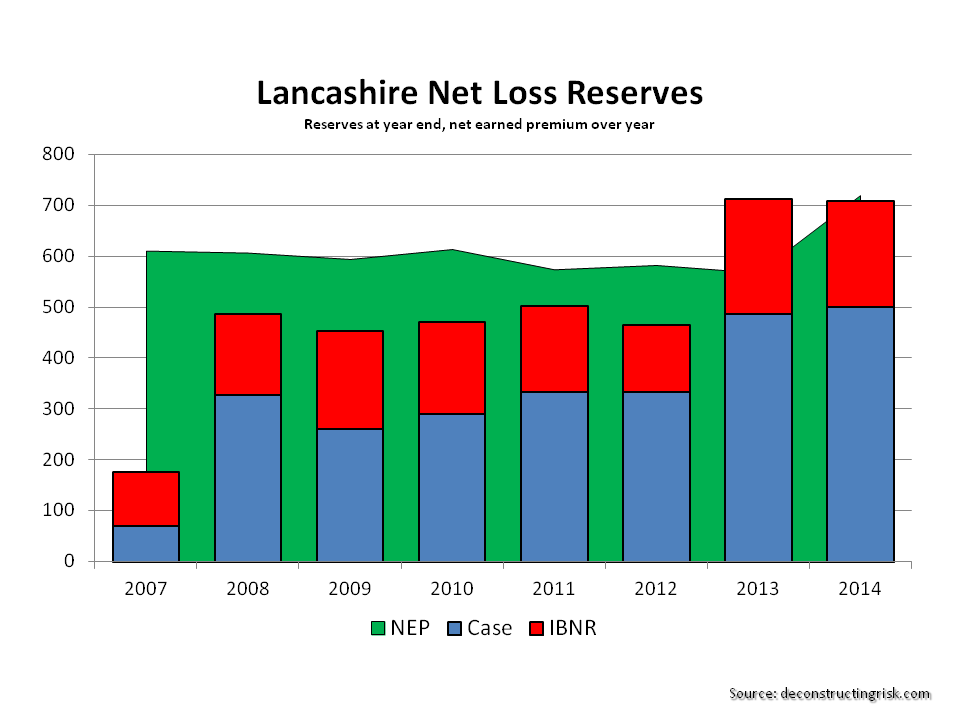
The impact of the Cathedral deal on reserve levels are highlighted below. The graph illustrates the consistent relative level of IBNR to case reserves compared to the recent past which suggests a limited potential for any cushion for loss ratios from prior year reserve releases.

click to enlargeLancashire Historical Net Loss Reserves

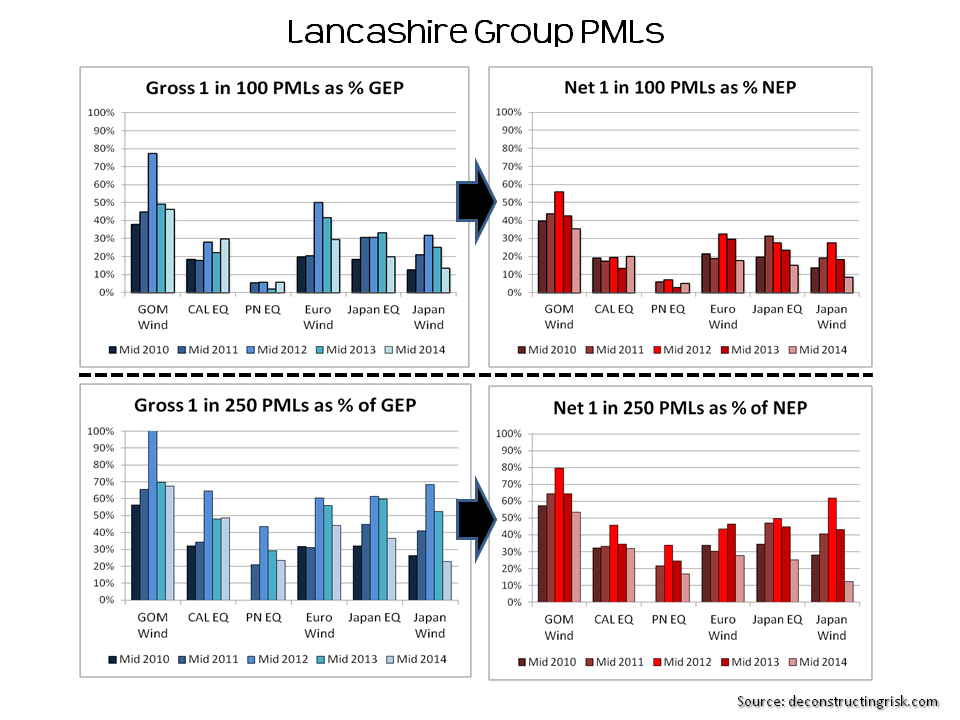
The management at Lancashire have clearly stated their strategy of maintaining their discipline whilst taking advantage of arbitrage opportunities “that allow us to maintain our core insurance and reinsurance portfolios, whilst significantly reducing net exposures and enhancing risk adjusted returns”. In my last post, I looked at post Cathedral gross and net PMLs as a percentage of earned premiums against historical PMLs. More applicable figures as per July for each year, against calendar year gross and net earned premiums (with an estimate for 2014), are presented below. They clearly show that the net exposures have reduced from the 2012 peak. It is important to note however that the Gulf of Mexico net 1 in 100 figures are high at 35%, particularly compared to many of its peers.

click to enlargeLancashire PMLs July 2010 to July 2014

There is of course always the allure of the special dividend. Lancashire has indicated that in the absence of attractive business opportunities they will look at returning most, if not all, of their 2014 earnings to shareholders. Assuming the remainder of 2014 is relatively catastrophe free; Lancashire is on track to make $1-$1.10 of EPS for the full year. If they do return, say, $1 to shareholders that represents a return of just below 10% on today’s share price of £6.18. Not bad in today’s environment! There may be a short term trade there in October after the hurricane season to take advantage of a share pick-up in advance of any special dividend.

Others in the sector are also holding out the prospect of special dividends to reward patient shareholders. The fact that other firms, some with more diverse businesses and less risky risk profiles, offer potential upside through special dividends may also explain why Lancashire has lost its premium tangible book multiple, as per the first graph in this post.

Notwithstanding that previously Lancashire was a favorite of mine due to its nimble and focused approach, I cannot get past the fact that the sector as a whole is mired in an inadequate risk adjusted premia environment (the impact of which I highlighted in a previous post). In the absence of any sector wide catalyst to change the current market dynamic, my opinion is that it is expedient to pass on Lancashire here, even at this multi-year low.

The game of chicken that is unfolding across this sector is best viewed from the side-lines in my view.

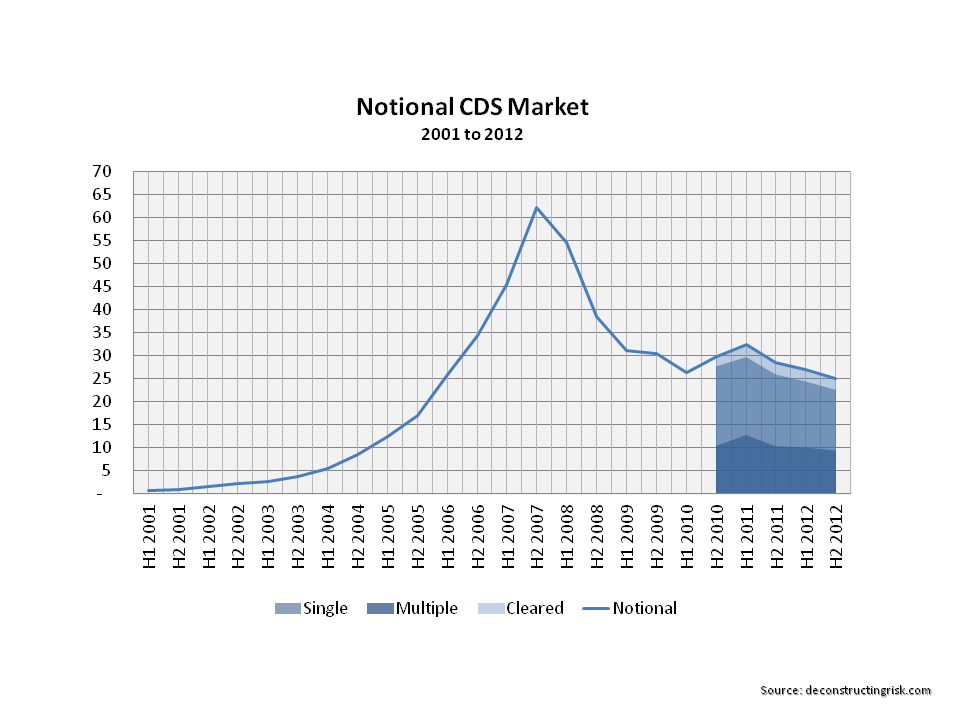
Size of notional CDS market from 2001 to 2012

Sometime during early 2007 I recall having a conversation with a friend who was fretting about the dangers behind the exponential growth in the unregulated credit default swap (CDS) market. His concerns centred on the explosion in rampant speculation in the market by way of “naked” CDS trades (as opposed to covered CDS where the purchaser has an interest in the underlying instrument). The notional CDS market size was then estimated to be considerably higher than the whole of the global bond market (sovereign, municipal, corporate, mortgage and ABS). At the time, I didn’t appreciate what the growth in the CDS market meant. Obviously, the financial crisis dramatically demonstrated the impact!

More recently the London Whale episode at JP Morgan has again highlighted the thin line between the use of CDS for hedging and for speculation. Last week I tried to find a graph that illustrated what had happened to the size of the notional CDS market since the crisis and had to dig through data from the International Swaps and Derivatives Association (ISDA) to come up with the graph below.

click to enlarge

Size of notional CDS market 2001 to 2012

Comparing the size of the notional CDS market to the size of the bond market is a flawed metric as the notional CDS market figures are made up of buyers and sellers (in roughly equal measures) and many CDS can relate to the same underlying bond. Net CDS exposures are only estimated to be a few percent of the overall market today although that comparison ignores the not inconsiderable counterparty risk. Notwithstanding the validity of the comparison, the CDS market of $25 trillion as at the end of 2012 is still considerable compared to the approximate $100 trillion global bond market today. The dramatic changes in the size of both the CDS market (downward) and the bond market (upward) directly reflect the macroeconomic shifts as a result of the financial crisis.

The financial industry lobbied hard to ensure that CDS would not be treated as insurance under the Dodd-Frank reforms although standardized CDS are being moved to clearing houses under the regulations with approximately 10% of notional CDS being cleared in 2012 according to the ISDA. The other initiative to reduce systemic risk is portfolio compression exercises across the OTC swap market whereby existing trades are terminated and restructured in exchange for replacement trades with smaller notional sizes.

Although the industry argues that naked CDS increase the liquidity of the market and aid price discovery, there is mixed research on the topic from the academic world. In Europe, naked CDS on sovereign bonds was banned as a result of the volatility suffered by Greece during the Euro wobbles. The regulatory push of OTC markets to clearing houses does possibly raise new systemic risks associated with concentration of credit risk from clearing houses! Other unintended consequences of the Dodd Franks and Basel III regulatory changes is the futurization of swaps as outlined in Robert Litan’s fascinating article.

Anyway, before I say something silly on a subject I know little about, I just wanted to share the graph above. I had thought that the specialty insurance sector, particularly the property catastrophe reinsurers, may be suited for a variation on a capital structure arbitrage type trade, particularly when many such insurers are increasingly using sub-debt and hybrid instruments in their capital structures (with Solvency II likely to increase the trend) as a recent announcement by Twelve Capital illustrates. I wasn’t primarily focussed on a negative correlation type trade (e.g. long equity/short debt) but more as a way of hedging tail risk on particular natural catastrophe peak zones (e.g. by way of purchasing CDS on debt of a overexposed insurer to a particular zone). Unfortunately, CDS are not available on these mid sized firms (they are on the larger firms like Swiss and Munich Re) and even if they were they would not be available to a small time investor like me!

Insurance & capital market convergence hype is getting boring

As the horde of middle aged (still mainly male) executives pack up their chinos and casual shirts, the overriding theme coming from this year’s Monte Carlo Renez-Vous seems to be impact of the new ILS capacity or “convergence capital” on the reinsurance and specialty insurance sector. The event, described in a Financial Times article as “the kind of public display of wealth most bankers try to eschew”, is where executives start the January 1 renewal discussions with clients in quick meetings crammed together in the luxury location.

The relentless chatter about the new capital will likely leave many bored senseless of the subject. Many may now hope that, just like previous hot discussion topics that were worn out (Solvency II anybody?), the topic fades into the background as the reality of the office huts them next week.

The more traditional industry hands warned of the perils of the new capacity on underwriting discipline. John Nelson of Lloyds highlighted that “some of the structures being used could undermine some of the qualities of the insurance model”. Tad Montross of GenRe cautioned that “bankers looking to replace lost fee income” are pushing ILS as the latest asset class but that the hype will die down when “the inability to model extreme weather events accurately is better understood”. Amer Ahmed of Allianz Re predicted the influx “bears the danger that certain risks get covered at inadequate rates”. Torsten Jeworrek of Munich Re said that “our research shows that ILS use the cheapest model in the market” (assumingly in a side swipe at AIR).

Other traditional reinsurers with an existing foothold in the ILS camp were more circumspect. Michel Lies of Swiss Re commented that “we take the inflow of alternative capital seriously but we are not alarmed by it”.

Brokers and other interested service providers were the loudest cheerleaders. Increasing the size of the pie for everybody, igniting coverage innovative in the traditional sector, and cheap retrocession capacity were some of the advantages cited. My favourite piece of new risk management speak came from Aon Benfield’s Bryon Ehrhart in the statement “reinsurers will innovate their capital structures to turn headwinds from alternative capital sources into tailwinds”. In other words, as Tokio Millennium Re’s CEO Tatsuhiko Hoshina said, the new capital offers an opportunity to leverage increasingly diverse sources of retrocessional capacity. An arbitrage market (as a previous post concluded)?

All of this talk reminds me of the last time that “convergence” was a buzz word in the sector in the 1990s. For my sins, I was an active participant in the market then. Would the paragraph below from an article on insurance and capital market convergence by Graciela Chichilnisky of Columbia University in June 1996 sound out of place today?

“The future of the industry lies with those firms which implement such innovation. The companies that adapt successfully will be the ones that survive. In 10 years, these organizations will draw the map of a completely restructured reinsurance industry”

The current market dynamics are driven by low risk premia in capital markets bringing investors into competition with the insurance sector through ILS and collaterised structures. In the 1990s, capital inflows after Hurricane Andrew into reinsurers, such as the “class of 1992”, led to overcapacity in the market which resulted in a brutal and undisciplined soft market in the late 1990s.

Some (re)insurers sought to diversify their business base by embracing innovation in transaction structures and/or by looking at expanding the risks they covered beyond traditional P&C exposures. Some entered head first into “finite” type multi-line multi-year programmes that assumed structuring could protect against poor underwriting. An over-reliance on the developing insurance models used to price such transactions, particularly in relation to assumed correlations between exposures, left some blind to basic underwriting disciplines (Sound familiar, CDOs?). Others tested (unsuccessfully) the limits of risk transfer and legality by providing limited or no risk coverage to distressed insurers (e.g. FAI & HIH in Australia) or by providing reserve protection that distorted regulatory requirements (e.g. AIG & Cologne Re) by way of back to back contracts and murky disclosures.

Others, such as the company I worked for, looked to cover financial risks on the basis that mixing insurance and financial risks would allow regulatory capital arbitrage benefits through increased diversification (and may even offer an inflation & asset price hedge). Some well known examples* of the financial risks assumed by different (re)insurers at that time include the Hollywood Funding pool guarantee, the BAe aircraft leasing income coverage, Rolls Royce residual asset guarantees, dual trigger contingent equity puts, Toyota motor residual value protection, and mezzanine corporate debt credit enhancement  coverage.

Many of these “innovations” ended badly for the industry. Innovation in itself should never be dismissed as it is a feature of the world we live in. In this sector however, innovation at the expense of good underwriting is a nasty combination that the experience in the 1990s must surely teach us.

Bringing this back to today, I recently discussed the ILS market with a well informed and active market participant. He confirmed that some of the ILS funds have experienced reinsurance professionals with the skills to question the information in the broker pack and who do their own modelling and underwriting of the underlying risks. He also confirmed however that there is many funds (some with well known sponsors and hungry mandates) that, in the words of Kevin O’Donnell of RenRe, rely “on a single point” from a single model provided by to them by an “expert” 3rd party.

This conversation got me to thinking again about the comment from Edward Noonan of Validus that “the ILS guys aren’t undisciplined; it’s just that they’ve got a lower cost of capital.” Why should an ILS fund have a lower cost of capital to a pure property catastrophe reinsurer? There is the operational risk of a reinsurer to consider. However there is also operational risk involved with an ILS fund given items such as multiple collateral arrangements and other contracted 3rd party service provided functions to consider. Expenses shouldn’t be a major differing factor between the two models. The only item that may justify a difference is liquidity, particularly as capital market investors are so focussed on a fast exit. However, should this be material given the exit option of simply selling the equity in many of the quoted property catastrophe reinsurers?

I am not convinced that the ILS funds should have a material cost of capital advantage. Maybe the quoted reinsurers should simply revise their shareholder return strategies to be more competitive with the yields offered by the ILS funds. Indeed, traditional reinsurers in this space may argue that they are able to offer more attractive yields to a fully collaterised provider, all other things being equal, given their more leveraged business model.

*As a complete aside, an article this week in the Financial Times on the anniversary of the Lehman Brothers collapse and the financial crisis highlighted the role of poor lending practices as a primary cause of significant number of the bank failures. This article reminded me of a “convergence” product I helped design back in the late 1990s. Following changes in accounting rules, many banks were not allowed to continue to hold general loan loss provisions against their portfolio. These provisions (akin to an IBNR type bulk reserve) had been held in addition to specific loan provision (akin to case reserves). I designed an insurance structure for banks to pay premiums previously set aside as general provisions for coverage on massive deterioration in their loan provisions. After an initial risk period in which the insurer could lose money (which was required to demonstrate an effective risk transfer), the policy would act as a fully funded coverage similar to a collaterised reinsurance. In effect the banks could pay some of the profits in good years (assuming the initial risk period was set over the good years!) for protection in the bad years. The attachment of the coverage was designed in a way similar to the old continuous ratcheting retention reinsurance aggregate coverage popular at the time amongst some German reinsurers. After numerous discussions, no banks were interested in a cover that offered them an opportunity to use profits in the good times to buy protection for a rainy day. They didn’t think they needed it. Funny that.